
Writing texts8 min read
Appointment reminder wording that gets replies
Two trials put numbers on reminder wording: a text cut missed NHS appointments from 11.1% to 8.4% by naming a £160 cost. What it means for your 160 characters.
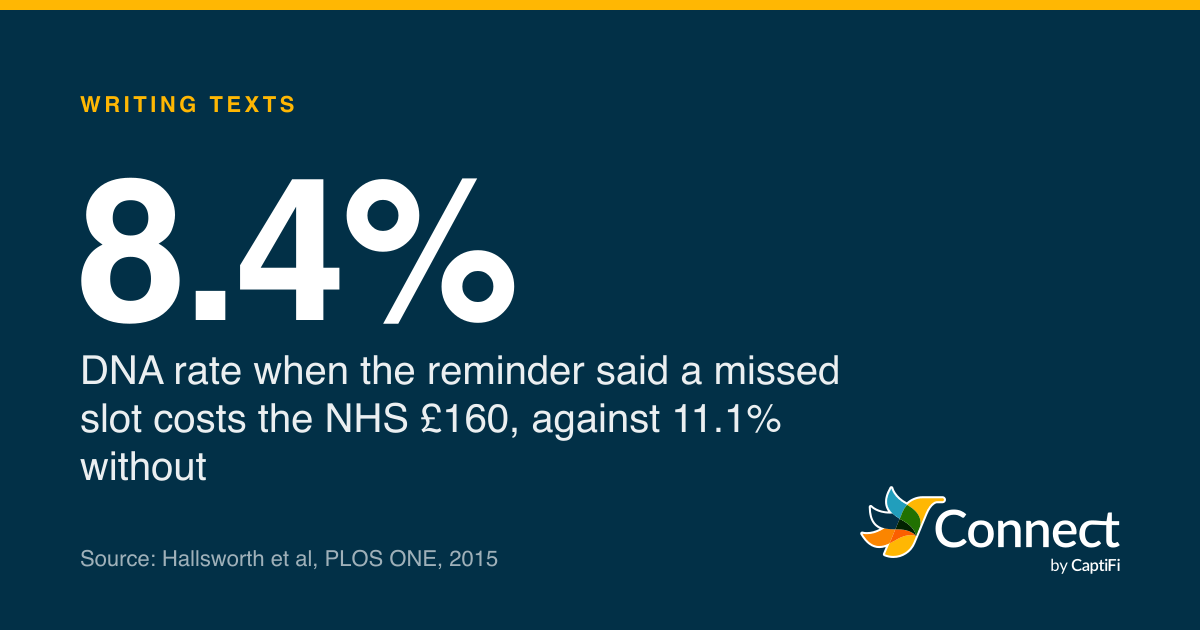
8.4%: DNA rate when the reminder said a missed slot costs the NHS £160, against 11.1% without. Source: Hallsworth et al, PLOS ONE, 2015.
In 2024-25, 8.1 million outpatient appointments in England ended as a "did not attend". That's NHS England's count, published on 25 September 2025, and it was up 1.5% on the year before even though almost every hospital now sends a text reminder. So the reminder on its own is not the answer. What the reminder says is, at least partly, and for once there's a trial that measured it word by word.
Two pieces of evidence do most of the work in this post. A Cochrane review from 2013 tells you what a text reminder does compared with nothing, and compared with a phone call. A pair of randomised trials at Barts Health NHS Trust, published in PLOS ONE in 2015, tells you what happens when you change the wording and nothing else. Between them they say more about a 160-character reminder than any amount of opinion.
What a reminder does at all
The Cochrane review (Gurol-Urganci and colleagues, published 5 December 2013) pulled together eight randomised controlled trials with 6,615 participants. Across the seven trials that compared a text reminder with no reminder, attendance went from 67.8% to 78.6%, a risk ratio of 1.14 with a 95% confidence interval of 1.03 to 1.26, on evidence the authors graded moderate. Three trials with 2,509 people compared texts with phone call reminders and found no real difference (risk ratio 0.99, confidence interval 0.95 to 1.02); the phone call group attended at 80.3%. Two of the studies costed it, and the text reminders came out 55% and 65% cheaper per attendance than the calls.
Eight randomised trials published up to August 2012, 6,615 participants. Text against no reminder is from seven trials (5,841 people); text against phone call from three (2,509).
Source: Cochrane, Mobile phone messaging reminders for attendance at healthcare appointments, 2013
See the figures as a table
| Attendance (%) | |
|---|---|
| No reminder | 67.8 |
| Text reminder | 78.6 |
| Phone call reminder | 80.3 |
Read that as the baseline. A text reminder, any text reminder, gets you roughly the attendance a phone call gets, for well under half the cost. It doesn't get everyone. About one appointment in five was still missed in the reminded group, which is why wording matters: it's the lever left once the reminder exists.
The Barts trial: four messages, one variable
Michael Hallsworth and colleagues ran their first trial at Barts Health between November 2013 and January 2014, across rheumatology, ophthalmology, gastroenterology, neurology and cardiology clinics. 10,111 appointments were randomly given one of four reminders, each sent five days before the appointment. The control was the hospital's existing text:
Appt at [clinic] on [date] at [time]. To cancel or rearrange call the number on your appointment letter.
The "easy call" version put the phone number in the message instead of pointing at a letter. The "social norms" version opened "We are expecting you at [clinic] on [date] at [time]. 9 out of 10 people attend." And the "specific costs" version said this:
We are expecting you at [clinic] on [date] at [time]. Not attending costs NHS £160 approx. Call 02077673200 if you need to cancel or rearrange.
The £160 was a real number. The authors took the 2012-13 NHS tariff for first and follow-up appointments in the five specialties and averaged it, which came to £161.
The result: 11.1% of appointments with the control message were missed (284 of 2,566), against 8.4% with the costs message (206 of 2,445). The odds ratio was 0.74 with a confidence interval of 0.61 to 0.89. The other two messages did nothing measurable to the DNA rate, although the social norms text did raise cancellations (odds ratio 1.23, interval 1.02 to 1.48), which is useful in its own way because a cancelled slot can be given to someone else.
Trial one: 10,111 appointments, November 2013 to January 2014. Trial two: 9,848 appointments, March to May 2014. Reminders sent five days before. Two trial-one arms (a phone number in the body, and "9 out of 10 people attend") had no significant effect on DNAs, and the paper gives no rate for them.
See the figures as a table
| DNA rate (%) | |
|---|---|
| Standard reminder | 11.1 |
| Costs NHS £160 (trial one) | 8.4 |
| Costs NHS £160 (trial two) | 8.2 |
| Wastes NHS money | 9.9 |
| Be fair to others waiting | 10.7 |
| We will record it as missed | 9.6 |
The second trial, 9,848 appointments between March and May 2014, made the costs message the control and tried three ways of saying something similar. "Not attending wastes NHS money" (general costs) came out at 9.9%. "Please be fair to others waiting" (empathy) came out at 10.7%. "Please attend or call ... or we will record as a missed appt" (recording) came out at 9.6%. The specific costs message held at 8.2%. Against it, the general version had an odds ratio of 1.22 (interval 1.00 to 1.48) and the empathy version 1.33 (1.10 to 1.62); the recording version's 1.18 didn't reach significance. The authors' conclusion is plain enough: missed appointments "can be reduced, for no additional cost" by changing the words, and "the wording of SMS reminders significantly affects the extent to which patients miss".
Three things fall out of that for anyone writing a reminder. A specific number beats a general appeal, and beats it clearly: "£160" worked, "wastes money" worked less, "be fair to others" didn't work at all. Telling people you're watching ("we will record") is weaker than telling them what it costs. And the opening "We are expecting you" was in every message that beat the control, so the trial can't separate it from the cost line, but it's the phrasing the winning texts share.
What that means for 160 characters
The winning message, with the placeholders filled in, sits comfortably inside one 160-character SMS part. Pull it apart and it has five pieces: who's expecting you, where, when, one reason to turn up or cancel, and one thing to do about it. There's no greeting, no "Dear patient", no second paragraph.
A business reminder can keep that skeleton and swap the pieces. Your name goes where the clinic went, and it goes first, because a text from an unknown number that opens with a date reads as spam. The reason is the part most people leave out, and the part the trial says counts. The NHS could state a tariff; a dental practice or a garage has its own version. A slot that goes unused costs you the clinician's hour, and you can say so in plain terms, or you can say what it costs the customer (a cancellation fee, a wait of three weeks for the next slot). The trial can't tell you which of those lands best outside a hospital, because nobody has run it. It does tell you that a concrete, specific consequence beat every vague one, twice.
The action line is where a business has an advantage the NHS didn't. Barts had to print a phone number, which means a call, which means a queue. A reminder sent from a number that can receive replies lets the customer answer with one letter:
Crown Dental: your check-up is on Thu 19 Nov at 10:30. Reply C to confirm or R to rebook. A missed slot costs the practice £95.
That's 127 characters. The confirmation does two jobs. It tells you who's coming, so you can chase the silence, and it gives the customer a reason to read the message to the end. NHS England's own guidance on reducing DNAs, published in February 2023, says providers "see better results when communication is 'two way'", and lists "two-way SMS reminders" as a way to make changing an appointment easier. The same guidance sets the floor: "As a minimum, all providers should use appointment reminders (e.g. via SMS)" with "an easy option to cancel and rearrange". A reminder with no way to cancel is a reminder that produces no-shows instead of cancellations.
Timing, plain words, and what NHS England adds
The Barts reminders went five days before. NHS England's guidance includes a trust whose changes "included text message appointment reminders sent seven and three days prior to appointment", and the guidance lists "appointment booked a year or more ago and patient not given a more recent reminder" as a cause of DNAs. Two reminders, then, if the booking was made weeks ahead: one far enough out that rebooking is easy, one close enough that it's remembered. For a slot booked yesterday for tomorrow, one is plenty.
On language, the guidance says reminders should be "written in simple language" and that "information should include what the appointment is for, with what service, and should include service contact details". That's the same five-piece skeleton again. The one claim in the NHS England page to be careful with is "sending reminders has been shown to reduce DNAs by up to 80%"; it gives no source for the figure, and the Cochrane numbers above are nowhere near it, so treat it as the best a single trust has reported, well above what to expect.
The scale is why any of this is worth the effort. NHS England's guidance notes that of the 103 million outpatient appointments booked in 2021-22, 7.6% ended as a DNA, "an average of 650,000 monthly appointment slots", and estimates that getting DNAs down to 2% would save £266 million. A dentist with 40 appointments a day doesn't have that problem, but the arithmetic is the same shape: at 11.1% that's four empty chairs a day, at 8.4% it's three.
Wording to copy, and wording to avoid
Three reminders in the style we use, each under 160 characters, each with the name first, a time, a reason and a one-letter reply:
Hair by Jo: your cut and colour is on Sat 22 Nov at 14:00 with Amy. Reply C to confirm, or R to release the slot to our waiting list.
Mill Lane Garage: your MOT is booked for Mon 24 Nov at 08:30. Reply C to confirm, or R to rebook. A missed slot leaves the bay empty for an hour.
Crown Dental: your hygienist appointment is on Thu 19 Nov at 10:30. Reply C to confirm or R to rebook. Missed appointments are charged at £45.
What to leave out, based on what lost in the trials: "we look forward to seeing you" (no information), "please be considerate of other patients" (the empathy arm did worst), and a warning that you keep a record (weaker than a cost, and faintly threatening). A phone number on its own, with no reply option, was the control message, and the control lost.
Two cautions. Keep the reason true: if you say a missed slot costs £45, that has to be your policy, and the customer has to have agreed to it. And keep clinical or personal detail out of the text, because a reminder gets read on a lock screen by whoever is holding the phone. "Your appointment" is enough; what it's for belongs in the booking confirmation they chose to open, or nowhere in a text at all.
Scheduled reminders with a reply keyword are what CaptiFi Connect's appointment reminders are built around: a C or an R comes back to the inbox, replies are free, and a keyword can send the rebooking link automatically. The sending is the easy part. Hallsworth's team spent two trials and 19,959 appointments finding the one sentence that got 2.7 percentage points more people through the door, and it's quoted above for anyone to copy.
Sources
Read for this post on 17 October 2026.
- Hallsworth et al: Stating appointment costs in SMS reminders reduces missed hospital appointments, PLOS ONE, 2015
- PubMed Central: Hallsworth et al 2015, full text with the message tables
- Cochrane: Mobile phone messaging reminders for attendance at healthcare appointments, 2013
- NHS England: Reducing did not attends (DNAs) in outpatient services, 2023
- NHS England: Hospital Outpatient Activity 2024-25
Written by the CaptiFi Connect team. Published 17 October 2026. More in Writing texts
Send your first text this week
Set up your account and contacts now; we check every new account before it can send.