
Sectors8 min read
Event nights by text for pubs
The UK has 9,000 fewer pubs than in 2009 and more people working in them. How a pub fills a quiz night by text without breaking the CAP Code or its licence.
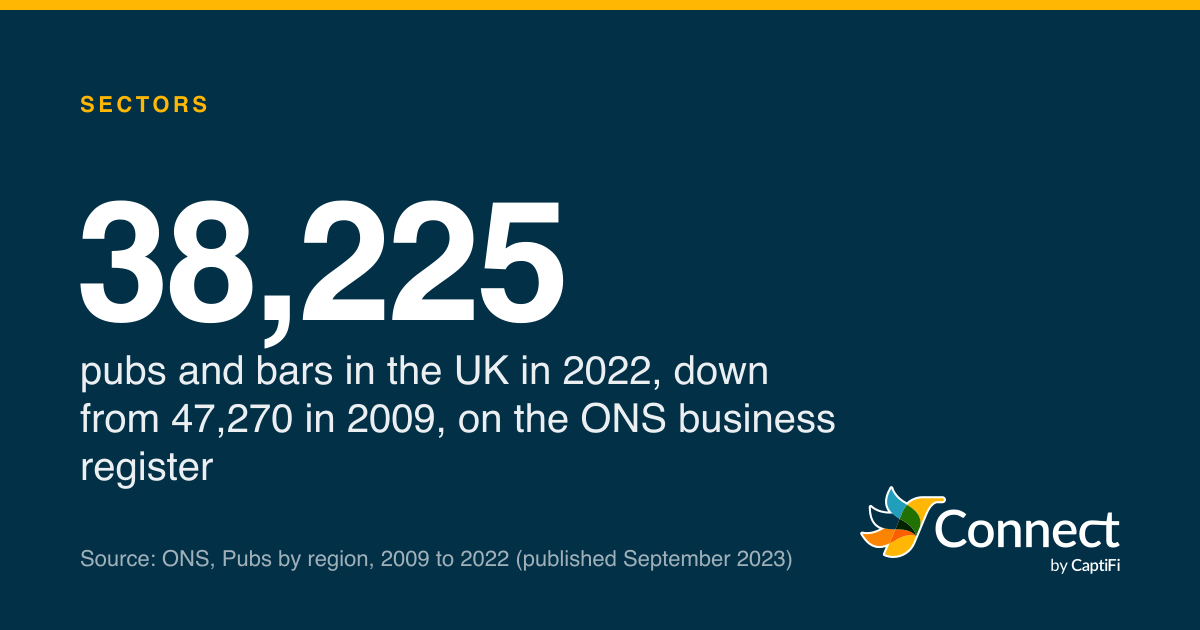
38,225: pubs and bars in the UK in 2022, down from 47,270 in 2009, on the ONS business register. Source: ONS, Pubs by region, 2009 to 2022 (published September 2023).
A quiz night on a Tuesday is worth more to a pub than it looks. Forty people in a room that would otherwise hold six, each buying two or three drinks and a plate of chips, and most of them back next week if they enjoyed it. The hard part is getting the forty to remember it's on.
Which is where the text comes in, and where a pub has to be more careful than a dentist. A reminder about a check-up is a service message. A text about a quiz night with a drinks offer attached is an alcohol advertisement under the CAP Code, a marketing message under PECR, and, depending on what it says, a promotion that the premises licence has something to say about. None of that stops you, but it decides the wording.
The pubs that are left
The Office for National Statistics counts pubs and bars as local units on its business register, and in September 2023 it published the series back to 2009 as an ad hoc release. There were 47,270 in 2009. By 2022 there were 38,225, a fall of 9,045, with the steepest drops in the first few years and a flatter line since about 2014.
Local units classified to SIC 56.30/2, public houses and bars, registered for VAT or PAYE, from a March snapshot of the Inter-Departmental Business Register each year. Counts are rounded to the nearest 5.
Source: ONS, Pubs by region, 2009 to 2022 (ad hoc analysis AH1343)
See the figures as a table
| Pubs and bars | |
|---|---|
| 2009 | 47,270 |
| 2010 | 44,680 |
| 2011 | 43,230 |
| 2012 | 42,585 |
| 2013 | 41,015 |
| 2014 | 40,540 |
| 2015 | 40,360 |
| 2016 | 39,590 |
| 2017 | 38,935 |
| 2018 | 38,825 |
| 2019 | 39,145 |
| 2020 | 38,885 |
| 2021 | 37,865 |
| 2022 | 38,225 |
The employment numbers in the same table go the other way. The register had 418,493 people working in pubs and bars in 2009 and 457,662 in 2022. Fewer sites, more staff: the pubs that survived are bigger operations, with kitchens and a calendar of events. An events programme is part of how a pub earns its keep now, and the Home Office's licensing statistics give a sense of the scale: in the year to 31 March 2026 an estimated 149,600 temporary event notices were given in England and Wales, up around 2% on two years earlier, alongside 227,300 premises licences in force.
England's regions and the three other nations. England as a whole had 32,795 in 2022.
Source: ONS, Pubs by region, 2009 to 2022 (ad hoc analysis AH1343)
See the figures as a table
| Pubs and bars | |
|---|---|
| South East | 5,150 |
| North West | 4,520 |
| South West | 4,095 |
| Yorkshire and The Humber | 3,770 |
| London | 3,585 |
| East of England | 3,485 |
| West Midlands | 3,365 |
| East Midlands | 3,140 |
| Scotland | 2,655 |
| Wales | 2,030 |
| North East | 1,685 |
| Northern Ireland | 745 |
Where the pubs are matters for the next point. The South East had 5,150 in 2022 and the North West 4,520; London had 3,585, down from 4,055 in 2009; Northern Ireland had 745. A pub in a market town with three rivals is competing for the same Tuesday as the others, and the one whose regulars got a text at four o'clock has an edge the others don't.
The three rulebooks a pub text answers to
The first is consent. A promotional text to a customer is direct marketing, and the rules on who you can text are in our guide to SMS marketing rules. The short version for a pub: people need to have agreed to hear from you, by signing up at the bar, on a card, through a QR code on the table or by texting a keyword, and every marketing text ends with "Reply STOP to opt out". The soft opt-in that lets a shop text its existing customers is awkward for a pub, because you rarely take a phone number when someone buys a pint. A sign-up list is simpler, and it's a better list anyway: the people on it asked to be there.
The second is the CAP Code, which applies to any marketing communication for alcohol, including one that only "features or refers to" a drink. Section 18 is short enough to read in full and worth the ten minutes. Its principle: marketing "should not be targeted at people under 18 and should not imply, condone or encourage immoderate, irresponsible or anti-social drinking. The spirit as well as the letter of the rules applies." A few rules do most of the work for a pub.
Rule 18.1: communications "must contain nothing that is likely to lead people to adopt styles of drinking that are unwise. For example, they should not encourage excessive drinking." Rule 18.10 says the same of promotions specifically: a marketing communication that includes a promotion "must not imply, condone or encourage excessive consumption of alcohol". Rule 18.4: "Drinking alcohol must not be portrayed as a challenge." Rule 18.3 is the one that trips up event copy, because it says you "must not imply that drinking alcohol is a key component of the success of a personal relationship or social event", while allowing that "the consumption of alcohol may be portrayed as sociable or thirst-quenching". "Quiz night, bar open" is fine. "You can't do our quiz sober" isn't.
On the audience, 18.14 says the communication "must not be likely to appeal particularly to people under 18", and 18.15 adds a hard number: "No medium should be used to advertise alcoholic drinks if more than 25% of its audience is under 18 years of age." A text list is a medium. If it's built from a student night's sign-up sheet, think about who's on it.
CAP's advice page on alcohol promotions fills in how the ASA reads these rules. Multi-buy offers are judged against the Chief Medical Officers' drinking guidelines, so "promoters need to ensure that the number of items that need to be bought does not encourage consumers to exceed" them. The page gives two upheld rulings that read like pub texts: Epic Pub Company in February 2018, for a "barrow of booze" offer for parties of 15 or more, and UKGBrunch in June 2021, for "bottomless brunch" posts. It also says promotions "encouraging people to drink at breakfast or early in the day, are likely to be problematic".
The third rulebook sits in the licence itself. The Licensing Act 2003 (Mandatory Licensing Conditions) (Amendment) Order 2014 lists the "irresponsible promotions" that a responsible person must ensure don't happen on licensed premises. They include games that require or encourage drinking "within a time limit" or "as much alcohol as possible"; unlimited or unspecified free or discounted alcohol for the public or a group, where it risks undermining a licensing objective; prizes that reward buying and drinking within 24 hours; and selling alcohol alongside posters or flyers that condone, encourage or glamorise anti-social behaviour or refer favourably to drunkenness. A text is a flyer that walks into the customer's pocket. If the wording would be a problem on the door, it's a problem on a phone.
Texts that pass, and one that doesn't
Here's a quiz night text written to those rules:
"The Crown: quiz night is back Tue 21 Oct, 8pm. Teams of up to 6, £2 a head, kitchen open till 9. Reply QUIZ with your team size to book a table. Reply STOP to opt out."
That's 167 characters, so two parts; drop "is back" and it's 159, one part. It names the pub first, gives the date and time, the price and the food, asks for a reply and carries the opt-out. There's no drink in it at all, which is the easiest way to keep the CAP Code happy. Nobody comes to a quiz for the quiz alone, but the text doesn't have to say so.
Live music, same shape:
"The Crown: live music Fri 24 Oct, The Hollow Men from 9pm. No tickets, no charge, kitchen open till 9. Reply STOP to opt out."
Add a drink and the care starts. Rule 18.9 lets you give "factual information about the alcoholic strength of a drink" and lets a low-alcohol drink be presented "as preferable because of its low alcoholic strength, provided that the alcohol content of the drink is stated clearly". So a tap takeover can say what's on and how strong it is, as a fact. It can't say the strength is the reason to come.
"The Crown: Ridgeway Brewing on the bar from Thu 30 Oct, four cask lines plus a 0.5% pale. Kitchen open till 9. Reply STOP to opt out."
A booking confirmation is a different kind of message and needs no consent beyond the booking, because the customer asked for it:
"The Crown: your table for 4 is booked for Sun 26 Oct at 1pm. Reply C to confirm or call us on 01632 960123 to change it."
And the one that fails, which you will have seen a version of:
"FRIDAY! 2-4-1 doubles all night, drink as much as you can for a tenner, first to finish wins a bottle!!!"
Count the breaches. "As much as you can" is a drinking game under the 2014 Order and encourages excessive drinking under rules 18.1 and 18.10. "First to finish" makes drinking a challenge, which 18.4 bans outright, and a bottle for winning is a prize for drinking within 24 hours, which the Order lists by name. "All night" with unspecified discounting is close to the "unlimited or unspecified" wording too. One text, and the ASA, the licensing authority and the ICO could each have a view on it. The quiz text, with no drink mentioned, has none of these problems and probably fills more tables.
When to send and what to ask for
The timing rule is the same as for any marketing text: a human hour, on a day when the person can act. For a Tuesday quiz, the Monday evening text does the reminding and a Tuesday four o'clock text does the converting, because that's when people decide what to do after work. For a Friday gig, Thursday evening. Two texts a week to the same list is already a lot for a pub, so keep each one to the thing that's on, and skip the week there's nothing to say.
Ask for a reply. "Reply QUIZ with your team size" turns a broadcast into a booking, and the reply is free for the customer. The replies also tell you who's coming, which decides how many staff to put on and how much food to prep. A quiz night that knows it has 11 tables booked at 4pm is a different night from one that hopes.
Keep the list clean. Reply STOP must work every time, on the first try, and the number comes off the list that minute. Anyone who's been in the pub that night and signed up at the bar should get one welcome text that says what they'll receive and how often, and nothing else until there's an event to tell them about. And keep a record of how each number joined: the date, where and what they agreed to. That's the thing the ICO asks for when someone complains, and the thing a well-run list can produce in a minute.
CaptiFi Connect gives a pub a keyword for sign-ups and bookings on a two-way number, scheduled sends for the Monday and Tuesday texts, and campaigns that stop at 21:00 by default; the pubs and bars page has the set-up. The ONS counted 38,225 pubs and bars in 2022 and 457,662 people working in them, more than it counted in 2009, when there were 9,045 more pubs.
Sources
Read for this post on 17 October 2026.
- ONS: Pubs by region, 2009 to 2022
- CAP: The CAP Code, section 18, Alcohol
- ASA and CAP: Advice online, Alcohol: promotional marketing
- legislation.gov.uk: The Licensing Act 2003 (Mandatory Licensing Conditions) (Amendment) Order 2014, Schedule
- Home Office: Alcohol licensing, England and Wales, April 2025 to March 2026
Written by the CaptiFi Connect team. Published 17 October 2026. More in Sectors
Send your first text this week
Set up your account and contacts now; we check every new account before it can send.