
Sectors8 min read
Fundraising texts after the 2025 Act
CAF's giving figures, the charity soft opt-in since 5 February 2026, the Code of Fundraising Practice, and sample texts for appeals, events and thank-yous.
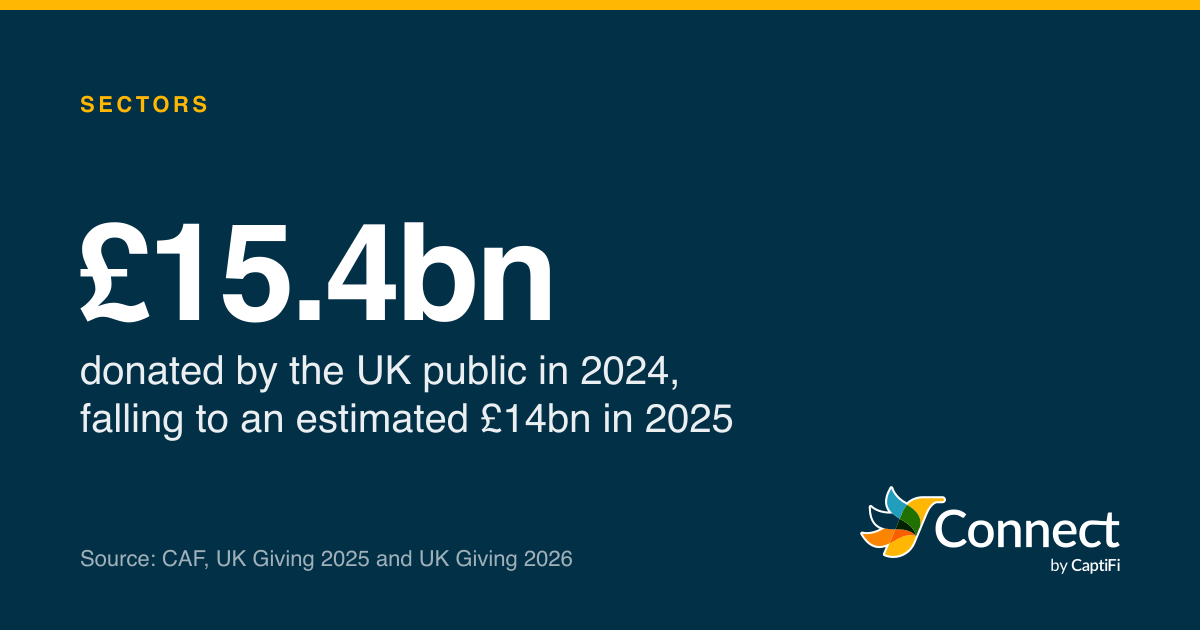
£15.4bn: donated by the UK public in 2024, falling to an estimated £14bn in 2025. Source: CAF, UK Giving 2025 and UK Giving 2026.
Half of UK adults gave money to charity in 2024. That's the lowest share CAF has recorded since it started asking in 2016, when the answer was 61%, and the figure comes from a YouGov survey of 13,459 people for the UK Giving 2025 report. The money went the other way: an estimated £15.4 billion donated in the year, with a mean gift of £72 and a median of £28 over four weeks, which CAF reads as "a decreasing cohort of donors giving more". Its 2026 report, out this year, puts 2025 at £14 billion.
Two more numbers from the same survey set the tone for anything a charity sends by text. In any given month about 8.2 million people give by direct debit or standing order, worth £2.7 billion a year. And in 2024 around 3.9 million people cancelled a regular payment to charity, against 3.3 million who increased one. The fundraising job, on those figures, is mostly keeping the donors you have. A text is good at that, and since 5 February 2026 the law has made it easier to send one.
What changed on 5 February 2026
The Data (Use and Access) Act 2025 inserted a new paragraph (3A) into regulation 22 of PECR, and it's short enough to read in full on legislation.gov.uk. A charity may send electronic mail (which the ICO's guide to PECR says includes texts) for direct marketing where "the sole purpose of the direct marketing is to further one or more of the charity's charitable purposes", the charity got the number "in the course of the recipient" either "expressing an interest in one or more of the purposes that were the charity's charitable purposes at that time" or "offering or providing support to further one or more of those purposes", and the person was given "a simple means of refusing" at the time the number was collected and in every message since. "Charity" means a charity under section 1(1) of the Charities Act 2011, its Northern Ireland equivalent, or a body on the Scottish Charity Register (new paragraph (5)).
So a supporter who gave you their mobile number when they signed up for your walk, bought a raffle ticket or put a pound in the tin and ticked a box can now be texted about the appeal without a separate marketing consent, provided the opt-out was offered at the time and sits in every text. Before February, the soft opt-in in paragraph (3) applied only to someone who'd bought or negotiated to buy something, which left most charity contact outside it. Our post on charity texting and the new soft opt-in goes through the conditions one by one; this one is about what to send.
The other change landed three months earlier. The Fundraising Regulator's new Code of Fundraising Practice took effect on 1 November 2025, and section 8.4 is the part that governs a text. 8.4.1 says you "must have appropriate systems and procedures in place" so that you don't send fundraising communications to people who've said they don't want them, you stop sending to people you know have died, and your databases are accurate. 8.4.2 says that if you hold consent for electronic direct marketing you must offer "an easy way for them to withdraw their consent" and remind people of their contact preferences. 8.4.3 is the one written for phones: "You must use a simple opt-out message for people to tell you if they don't want to receive messages from you. This includes offering an option for people to reply to mobile messages to opt out of receiving them."
One more line from the code matters for the money itself. 7.5.4: "You must use charity short codes when asking for donations by text message." Premium-rate giving (text HOPE to a five-digit number) is a separate, Ofcom-regulated service, and a plain SMS sender like CaptiFi Connect doesn't do it. A fundraising text from a normal UK mobile number asks for a gift by linking to your own donation page, which is where a good slice of the money in CAF's figures goes anyway: £1.84 billion through a charity's own website or app in 2024, and £1.57 billion through fundraising websites and apps.
Who gives, and what makes them give
YouGov survey for CAF; 13,459 respondents in 2024. Sponsoring someone for charity fell from 37% to 21% over the same years.
Source: CAF, UK Giving 2025 (figure 2)
See the figures as a table
| Donated (%) | |
|---|---|
| 2016 | 61 |
| 2017 | 60 |
| 2018 | 57 |
| 2019 | 58 |
| 2020 | 57 |
| 2021 | 53 |
| 2022 | 54 |
| 2023 | 53 |
| 2024 | 50 |
The decline is steady and it's steepest among the young. In 2024 only 36% of 16 to 24 year olds said they'd donated or sponsored in the past 12 months, down from 55% in 2017. London is the first region where fewer than half of people give (49%, from 64% in 2017). Health charities drew the broadest support, with 43% of donors and about £2.22 billion, then children and young people on £1.99 billion and religion on £1.23 billion.
What prompted the last gift is the more useful chart for anyone writing a text.
All respondents who donated or sponsored in the past 12 months, 7,514 people. Don't know (4%), other (4%) and none of these (16%) are left off.
Source: CAF, UK Giving 2025 (figure 8)
See the figures as a table
| Donors (%) | |
|---|---|
| Friend, family or colleague | 17 |
| Automatic (eg direct debit) | 15 |
| A personal experience | 11 |
| In memory of a loved one | 11 |
| Something seen on social media | 6 |
| Something in the news | 5 |
| Street or doorstep fundraiser | 4 |
| An advert | 3 |
| An email from a charity | 2 |
| Post from a charity | 2 |
| A celebrity talking about it | 1 |
Nothing a charity sends is near the top. A friend, family member or colleague prompted 17% of last donations, an automatic payment 15%, a personal experience or a loved one's memory 11% each. Email from a charity prompted 2% and post from a charity 2%; a text message isn't offered as an answer at all. A text is unlikely to be the reason someone gives for the first time. It's very good at being the reason someone turns up, remembers, finishes, renews, or feels thanked, which is where the £2.7 billion of regular giving and the 3.9 million cancellations live.
The complaint figures point the same way. The Fundraising Regulator took on 1,284 cases between 1 September 2024 and 31 August 2025, 9% more than the year before. The most complained-about methods were charity bags and clothing banks, then collections, face-to-face, addressed mail and digital fundraising. Repeated contact and misleading information are the two themes the regulator names, and both are easy to avoid in 160 characters.
The texts
Each sample below is marked as either a service message or marketing, because the ICO's test decides which rules apply. A message "for administrative or customer services purposes" is a service message, and the ICO is explicit that a service message becomes direct marketing the moment it carries promotion, even when that promotion isn't the main point. A thank-you with an ask in it is an appeal.
An appeal, sent under the soft opt-in or with consent, so it ends with the way out:
Hope Hospice: our winter appeal is open. £20 pays for an hour of nursing at home for a family in Kent. Give at hope.uk/w. Reply STOP to opt out.
An event reminder to someone who's registered, which is logistics and so a service message:
Hope Hospice: Sunrise Walk is Sun 7 Jun, 06:30 start at Castle Park. Collect your bib from 05:45. Reply if you can no longer make it.
A sponsorship nudge to the same walker, which promotes fundraising and so is marketing:
Hope Hospice: your Sunrise Walk page is at £140 with a week to go. A share now helps: hope.uk/p/ab12. Reply STOP to opt out.
A thank-you with no ask in it, which stays a service message:
Hope Hospice: thank you. Your £20 arrived today and pays for an hour of nursing at home. No reply needed, but we read every one.
A failed regular payment, which is administration about an existing arrangement:
Hope Hospice: your monthly gift due on 1 Mar didn't go through. Nothing to do if you meant to cancel. If not, reply and we'll sort it in a minute.
A Gift Aid prompt on a gift already made. CAF found more than three quarters of donors add Gift Aid always or sometimes, and that forgetting is one of the reasons for "sometimes", so a reminder about the gift the person has just made earns its place:
Hope Hospice: thanks for your gift on 3 Mar. If you pay UK tax, Gift Aid adds 25p per £1 at no cost to you: hope.uk/ga. Reply if you'd rather we didn't ask.
Three things hold across all six. The charity's name comes first, every time, because a supporter who can't tell who's texting will report it rather than read it. Every claim about what money does is one you can stand behind, since 8.1.3 of the code says the information in a fundraising communication "is accurate" and that is what the Fundraising Regulator's misleading-information complaints are about. And every marketing text, under both the soft opt-in and the code, carries the reply-to-opt-out line; the service messages don't need it, but a supporter who replies STOP to any of them should still be taken off the appeals list.
Timing and the list
Send appeals when people can act on them. The CAF figures don't say when people give, but the code's standard on responsible and suitable methods (8.1.1) points one way: nothing late at night, nothing more than the person signed up for. A monthly appeal to a soft opt-in list is plenty, and an event list should hear from you about the event, then once or twice about sponsorship, then a thank-you. If you're sending to a list collected before 5 February 2026, check the number came from an expression of interest or an offer of support and that an opt-out was offered when you took it; if it wasn't, (3A) doesn't cover it and you need consent. Our post on writing a consent request that stands up has the wording.
The list hygiene in 8.4.1 is the unglamorous half. Opt-outs, deceased supporters, the Fundraising Preference Service where you don't hold specific permission, and a database that's kept up to date. CaptiFi Connect treats STOP, UNSUBSCRIBE, CANCEL and the rest as an opt-out the moment the reply arrives and puts "Reply STOP to opt out" on every campaign by default, which covers 8.4.3 without a person watching the inbox; its tracked links show which appeal texts were opened, so you can see whether the walkers or the winter list responded. The 3.3 million people who increased a regular gift last year had their reasons, and a thank-you on the day the gift lands is the one of them a charity controls.
Sources
Read for this post on 17 October 2026.
- CAF: UK Giving 2025
- CAF: UK Giving report page (UK Giving 2026 key findings)
- Fundraising Regulator: Code of Fundraising Practice, effective 1 November 2025
- Fundraising Regulator: Casework insights and trends 2024-25
- legislation.gov.uk: PECR 2003, regulation 22
- ICO: Direct marketing guidance, identify direct marketing
Written by the CaptiFi Connect team. Published 17 October 2026. More in Sectors
Send your first text this week
Set up your account and contacts now; we check every new account before it can send.