
Sectors8 min read
Gym member texts and retention
ukactive counts 12.2m UK gym members and 679m visits in 2025. The texts that keep people turning up, the figures behind them, and the consent rules.
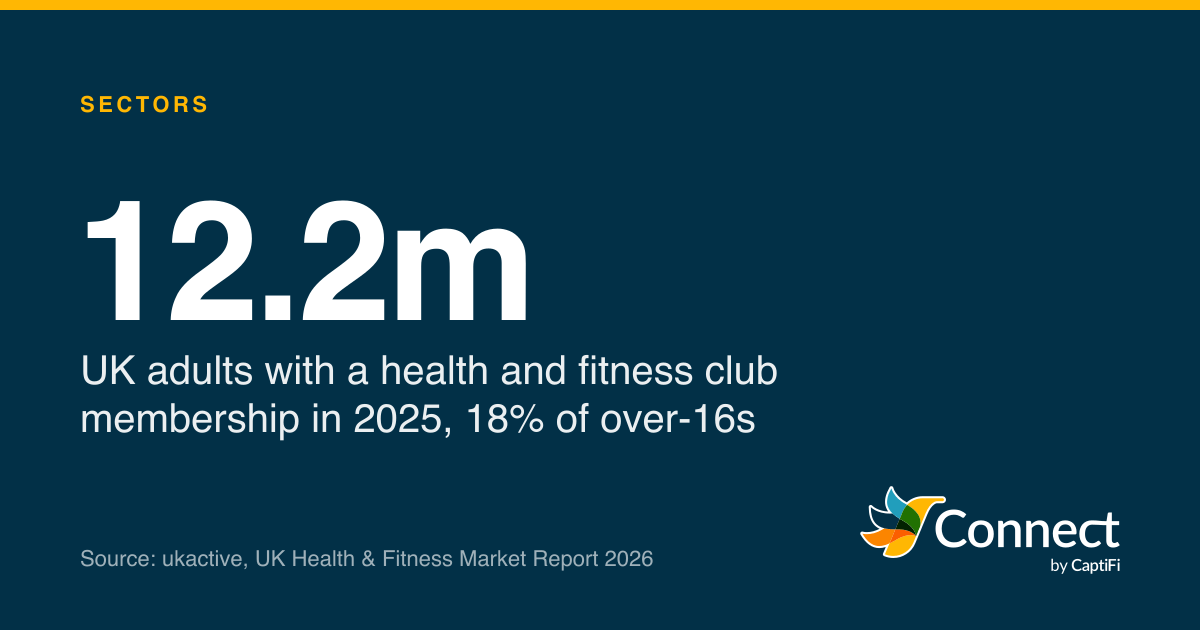
12.2m: UK adults with a health and fitness club membership in 2025, 18% of over-16s. Source: ukactive, UK Health & Fitness Market Report 2026.
12.2 million people in the UK had a gym or leisure centre membership in 2025, and between them they made 679 million visits. Both figures are from the UK Health & Fitness Market Report 2026, which ukactive published on 9 April 2026 with Sport England and 4GLOBAL. Divide one by the other and the average member turned up about 56 times in the year, a little over once a week. That's my arithmetic, not ukactive's, and averages hide a lot, but it frames the problem every gym owner knows. The member who comes twice a week has a habit. The one who hasn't been in since the third week of January is still paying, for now, and the direct debit will stop the month they notice. A text is the cheapest thing a gym can send that the second member is likely to read.
The market in ukactive's numbers
The 2026 report is the second in the series. The first, out on 3 April 2025, counted 11.5 million members over the age of 16 and 5,607 clubs, with more than 600 million visits in 2024 and membership numbers up from 9.9 million in 2022. A year on, the count is 12.2 million members and 5,842 clubs, a rise of 4.2% in sites, and 679 million visits, up 10% on 2024. Total income across the sector reached £6.5 billion, from £5.7 billion the year before.
A club is a site with a gym holding resistance or cardiovascular equipment, open to the public by membership or pay as you go. Studio-only sites and pool-only sites are excluded.
Source: ukactive, UK Health & Fitness Market Report 2026, press release of 9 April 2026
See the figures as a table
| Members (%) | |
|---|---|
| 2022 | 14.6 |
| 2023 | 16 |
| 2024 | 16.9 |
| 2025 | 18 |
The number ukactive leads with is penetration: the share of over-16s who hold a membership. It has gone up by roughly a point a year since the data began, 14.6% in 2022, 16.0% in 2023, 16.9% in 2024 and 18.0% in 2025, and ukactive's stated ambition from 2021 is 20% of the population by 2030. The report's data covers 74% of private operators, 85% of public operators and 88% of independents, so the figures are built from recorded visits across most of the sector, which is a stronger base than a consumer poll.
Two lines in the release bear on texting. The consumer survey inside the report found that "trying new activities" motivates 62% of people to take out a membership, and "making friends" matters to 49%. And 4GLOBAL's Utku Toprakseven described "a maturing sector, where operators are generating more value per member through more frequent usage". More frequent use is what the report credits for the extra value, and both of those motivations are things a gym can prompt with a message.
Who is doing what
Sport England's Active Lives Adult Survey for November 2024 to November 2025, published in April 2026 from a sample of 176,326 adults in England, puts the exercise habit in context. 64.6% of adults, 30.9 million people, did 150 minutes or more of activity a week, up 859,000 on the year before. 10.7% (5.1 million) were fairly active and 24.7% (11.8 million) did less than 30 minutes a week, which is the "one in four" that Huw Edwards of ukactive quoted in the 2026 release. Activity isn't evenly spread: 53.8% of the least affluent adults were active against 73.2% of the most affluent, 62.2% of women against 67.3% of men, and 44.3% of over-75s.
Fitness activities, the survey's label for gym sessions, classes, machines and weights, were done at least twice in the last 28 days by 15.3 million adults, up 921,000 on the year and just over 2 million up on November 2016-17.
- Nov 2021-22
- Nov 2024-25
Adults aged 16 and over in England, read from the chart on page 23 of the report. One person can appear under more than one activity.
Source: Sport England, Active Lives Adult Survey November 2024-25 report (page 23)
See the figures as a table
| Nov 2021-22 (m) | Nov 2024-25 (m) | |
|---|---|---|
| Fitness class | 6 | 7.2 |
| Gym session | 4.8 | 6.4 |
| Exercise machines | 3.8 | 4.9 |
| Weights session | 2.6 | 3.5 |
| Interval session | 2.2 | 2.3 |
| Generic fitness training | 1.9 | 2.2 |
Classes are the biggest single fitness activity, 7.2 million people in 2024-25, and gym sessions the fastest-growing, from 4.8 million in 2021-22 to 6.4 million. Weights sessions went from 2.6 million to 3.5 million over the same three years. The report's own summary is that "fitness classes remain the most common form of fitness activity done" and that the largest increases since 2021-22 are in gym sessions and exercise machines.
For a gym the practical reading is that the class timetable is the thing most members organise their week around, and the one with a fixed time attached, which is what a reminder needs.
The texts that bring people back
The texts that get people through the door are mostly service messages: short, and tied to a thing the member has already chosen to do. Five of them do most of the work.
The class booking confirmation and reminder. A member who books a 6:30am spin class and gets a text the evening before has a reason to set the alarm, and a member who can reply to cancel frees the bike for the waiting list. Send the reminder before 9pm the night before, and put the cancellation in the text.
Riverside Gym: you're booked for Spin with Dan, Tue 18 Nov at 06:30. Reply X to cancel and free the bike.
The induction follow-up. New members are the ones who lapse, and the first fortnight is when the habit forms or doesn't. A text a week after joining that offers the programme review or the next beginners' class is a nudge at the moment it counts.
Riverside Gym: how's the first week gone? Your free programme review with a trainer is waiting. Reply BOOK and we'll find a slot.
The "we've missed you". Pick an interval, say 14 days without a swipe at the turnstile, and send one plain text. Leave out the guilt and the discount and give them one easy thing to do. The ukactive survey's 62% who joined to try new activities is the reason to make that one thing a class they haven't done.
Riverside Gym: it's been a couple of weeks. Reflex, our new 30-minute HIIT class, starts Thu 7pm. Reply YES to save a spot.
The payment text. A failed direct debit, handled by a text with a link to update the card, keeps a member who would otherwise drift into arrears and then out of the door. That's a service message too.
The practical notice: a pool closure, a changed class time, a bank holiday timetable. Nobody enjoys driving to a shut gym, and a text at 7am about a burst pipe is the kind of message members thank you for.
Then there's the real marketing: the referral offer, the new-year deal, the personal training promotion. Those are legitimate too, with consent, and the ukactive finding that 49% of members value making friends suggests the "bring a friend" text is worth more than most. Just don't let the marketing crowd out the service texts, which are the ones people read.
The consent rules for a gym
The rules come from regulation 22 of the Privacy and Electronic Communications Regulations 2003, and a text counts as electronic mail under them. Regulation 22(2) bans unsolicited marketing by text to an individual subscriber "unless the recipient of the electronic mail has previously notified the sender that he consents", with an exception in 22(3) usually called the soft opt-in. The ICO's electronic mail marketing page puts the soft opt-in in plain terms: it applies to existing customers who bought, or discussed buying, a similar product or service from you, provided you gave them "a clear chance to opt out" when you collected their details and in every message since. The ICO says it does not cover prospective customers or new contacts such as bought-in lists; a name taken at a stand with no mention of texts is on the wrong side of that line too.
A gym membership is a sale, so the soft opt-in covers marketing texts to current members about the gym's own services, as long as the opt-out was offered on the joining form and appears on every text. The cleaner route is still an explicit tick box for marketing texts at sign-up, kept separate from the terms and conditions, which is what the ICO gives as its example of consent. Our post on writing a consent request that stands up has the wording.
The service texts above are a different matter. A booking reminder, a payment failure, a closure notice: none of those is advertising, so regulation 22 doesn't apply to them and you can send them to any member who has given you a mobile number for the purpose. What decides it is the content of the message. "Your class is at 06:30" is service. "Your class is at 06:30, and PT sessions are 20% off this week" is marketing, and needs the consent.
Former members are where gyms go wrong. Once someone cancels, every text that promotes a rejoin offer is marketing to a person who has, in effect, told you they've stopped buying. The soft opt-in needs the details to have come from a sale and the opt-out to have been offered at the time, and the further you get from the cancellation the harder that is to stand behind. Keep a dated record of the consent, respect every STOP, and if a lapsed member asked you to stop texting while they were a member, that request survives the cancellation.
Two housekeeping points. Every marketing text carries an opt-out ("Reply STOP to opt out"), and a STOP has to work on the first try, across every list you hold. And the sender has to be identifiable: the gym's name at the front of every text, as in the samples above, is what regulation 23 of the same regulations asks for, and what makes a reminder look like a reminder.
What a gym should do about it
Start with the class reminder, because it's the message with a fixed time and a measurable result: a cancelled spot you can refill against a no-show you can't. Add the induction text in the second week. Then the 14-day "we've missed you", sent once, with a class attached. Those three cover the moments ukactive's frequency finding points at, and they're all service messages or close to it.
Put the sign-up consent right. One tick box, marketing texts only, dated, and stored with the member record, and treat the soft opt-in as the fallback.
Write the texts to be answered. "Reply X to cancel", "Reply BOOK", "Reply YES": a reply is the thing that turns a message into a visit, and the replies are free for the member. CaptiFi Connect handles the keywords with an automatic reply and puts the rest in a shared inbox the front desk can work from, with scheduled sends for the evening-before reminders.
Measure the swipe. ukactive's 679 million visits is the whole sector's scoreboard, and every gym has its own in the access control log. A text programme that doesn't move the visits per member isn't working, whatever the open rate is. One that does will show up in the numbers ukactive publishes next April, and in the direct debits that don't stop.
Sources
Read for this post on 17 October 2026.
- ukactive: UK Health and Fitness Market Report 2026, press release, 9 April 2026
- ukactive: UK Health and Fitness Market Report 2025, press release, 3 April 2025
- Sport England: Active Lives Adult Survey November 2024-25, headline page
- Sport England: Active Lives Adult Survey November 2024-25, report
- legislation.gov.uk: PECR 2003, regulation 22
- legislation.gov.uk: PECR 2003, regulation 23
- ICO: Guide to PECR, electronic mail marketing
Written by the CaptiFi Connect team. Published 17 October 2026. More in Sectors
Send your first text this week
Set up your account and contacts now; we check every new account before it can send.