
Sectors9 min read
Hotel guest texts from arrival to checkout
England's hotels ran at 79% occupancy in 2025 and took 89.6m domestic overnight trips the year before. The texts that help a stay, with the rule on each.
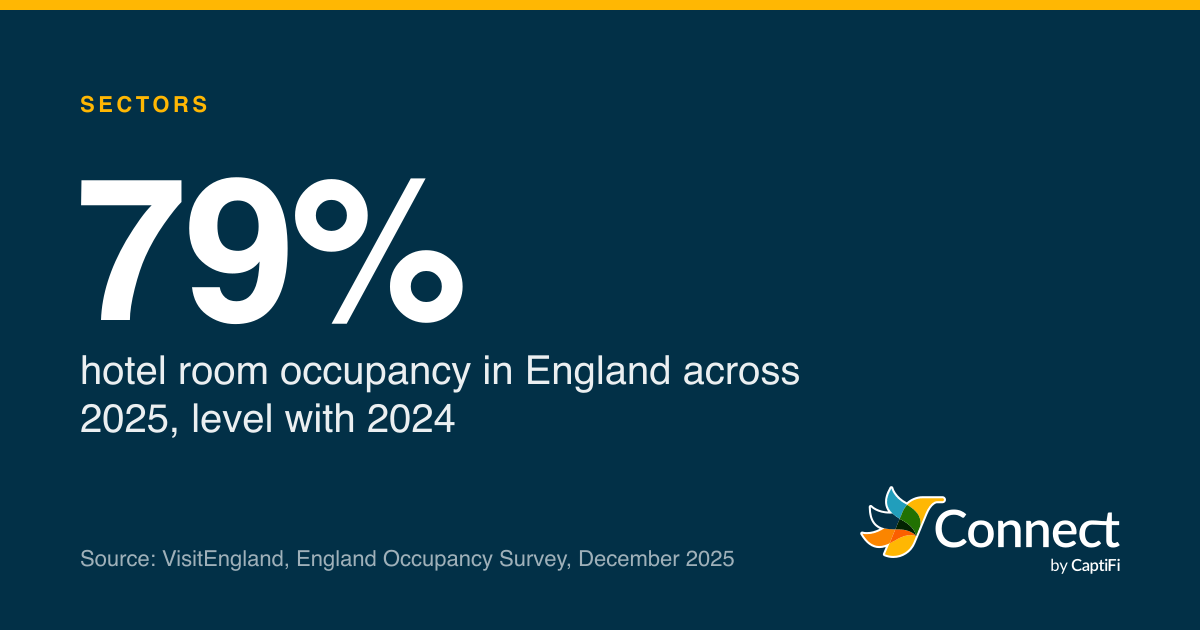
79%: hotel room occupancy in England across 2025, level with 2024. Source: VisitEngland, England Occupancy Survey, December 2025.
Hotels in England filled 79% of their rooms in 2025, the same as in 2024, and July was the top month at 86%. Those figures are from VisitEngland's occupancy survey, and they describe a trade that is full most of the time and still has one in five rooms empty on an average night. The guest in the room that is sold has, between booking and leaving, perhaps six moments where a short message from the hotel would have made the stay easier. Most hotels send none of them, or send one email that gets read on the drive up, if at all.
The figures first, because the shape of the trade decides what the texts are for.
The numbers behind a stay
VisitBritain's GB Tourist Annual Report 2024, published on 29 May 2025, counts 106 million domestic overnight trips in Great Britain in 2024, a 10% fall on 2023 and 14% down on 2022. People stayed 308 million nights on those trips and spent £32.9 billion, 5% more than the year before despite the fewer trips, with spend per night per person up from £85 in 2022 to £107 in 2024. England alone had 89.6 million overnight trips and £27.3 billion of spend. The average trip was 2.9 nights, the same as in 2023.
In England the biggest group by some distance is people visiting friends and relatives, 33.8 million trips or 38% of the total. Holidays are 26.8 million (30%), business trips just 4.9 million (6%), and the rest the survey files as miscellaneous. The report says "serviced accommodation (e.g. hotel, B&B, serviced apartment)" was still the most common place to stay in England, ahead of someone's private home, and that booking has drifted later: 26% of trips were booked two or more months ahead in 2024, down from 30% in 2022.
Trips by residents of Great Britain with a main destination in England, 89.6m in total. The report labels the fourth group "miscellaneous trips".
Source: VisitBritain, GB Tourist Annual Report 2024 (Great Britain Tourism Survey)
See the figures as a table
| Trips (m) | |
|---|---|
| Visiting friends and relatives | 33.8 |
| Holiday | 26.8 |
| Other purposes | 24.1 |
| Business | 4.9 |
VisitBritain's latest quarterly release, on 11 June 2026, has England's overnight trips for the last quarter of 2025 at 23 million, up 5% on the same quarter of 2024, with accommodation taking 22% of the trip budget. Add the overseas visitors. The ONS's Travel trends for 2025, released on 16 October 2026, puts overseas residents' visits to the UK at 40.8 million for the year, with £29.8 billion spent, the Americans first at 5.5 million visits, then France at 3.1 million and Germany at 2.8 million. A fair share of those guests have a foreign SIM, which matters for texting and comes up below.
Then the rooms. The occupancy survey's December 2025 report gives a month-by-month series, and the shape of a hotel year is in it: 66% in January, up through the spring to 86% in July, a dip to 81% in August, 84% in September, then the slide to 73% in December. The report puts December's average daily rate at £172 and revenue per available room at £126.
- 2024
- 2025
Room occupancy for England as published in the December 2025 report. VisitEngland notes that historical figures change as more hotels submit data.
Source: VisitEngland, England Occupancy Survey, December 2025 results
See the figures as a table
| 2024 (%) | 2025 (%) | |
|---|---|---|
| Jan | 65 | 66 |
| Feb | 73 | 74 |
| Mar | 75 | 75 |
| Apr | 77 | 77 |
| May | 79 | 80 |
| Jun | 83 | 83 |
| Jul | 85 | 86 |
| Aug | 82 | 81 |
| Sep | 84 | 84 |
| Oct | 82 | 82 |
| Nov | 81 | 80 |
| Dec | 75 | 73 |
Two things in those numbers set up the texts. Hotel stays are short, so there's no time to recover from a bad start. And the guest is usually on the move when the hotel most needs to reach them, which is the one situation where a text beats everything else.
Before arrival
The booking confirmation is an email, and should be, because it carries the terms. The text that earns its place is the one the day before.
Harbour Hotel: we're looking forward to seeing you tomorrow. Check-in is from 3pm and parking is behind the hotel. Reply if you'll arrive after 10pm.
It does three jobs. It reminds the guest of the booking, it answers the two questions reception gets asked most, and it opens a channel: the guest can reply, and the reply costs them nothing. On a two-way number the reply lands in an inbox reception can see, which is the reason to send it the day before: a reply a week out tells reception nothing it can act on. The booking confirmations page has more samples, and the two-way SMS page explains how replies work.
Send it mid-morning, and schedule it. Nothing good happens when a hotel's "see you tomorrow" lands at 11pm. CaptiFi Connect's campaigns keep quiet hours of 21:00 to 09:00 London time by default, which is a sensible rule for one-off service texts as well.
The rule on this text is simple. It's a service message about a booking the guest has made, so it isn't direct marketing and PECR's consent rules don't apply to it. The ICO's summary of the current definition is "the communication (by whatever means) of advertising or marketing material which is directed to particular individuals", and a check-in time is neither. Keep it that way: the moment the text ends "and don't forget our spa is 20% off this week", it's a marketing text, and the rules in the last section apply to the whole of it.
Arrival and the room
Two texts help here, one before the guest reaches the desk and one after.
Harbour Hotel: your room is ready. Collect your key at reception, or reply HERE if you'd like us to meet you at the door.
Harbour Hotel: you're in room 212. Breakfast is 7 to 10 in the restaurant, lift to your left. Reply to this number any time and reception will see it.
The second one replaces the laminated card nobody reads, and the last sentence is the part that pays. A guest who knows a reply reaches a person will tell you about the noisy extractor fan at 9pm, when you can still move them. The alternative is reading about it in a review three days later.
There's an old piece of law that already governs the first minute of a stay. The Immigration (Hotel Records) Order 1972 requires every guest aged 16 or over, "on arriving at the premises", to tell the keeper their "full name and nationality", requires guests the Order calls aliens to give the number and place of issue of their passport as well, and requires the keeper to keep a written record for at least 12 months. The legislation.gov.uk record shows one amendment, in 1982, and no revocation. A mobile number isn't on that list, so collecting one needs a reason the guest is told: "so we can text you when your room is ready, and so you can reach reception". Say that on the booking form or at the desk, and the number is yours to use for the stay.
Overseas guests complicate it. CaptiFi Connect sends to UK mobiles only (the UK, Guernsey, Jersey and the Isle of Man), so a visitor on a French or American SIM won't get the text. For the 40.8 million overseas visits a year that means asking at check-in whether the guest has a UK number, and falling back to email or the desk when they don't.
During the stay
The mid-stay text is the one most hotels skip, and it's the cheapest.
Harbour Hotel: is everything as it should be? Reply to this text if anything needs sorting and we'll be straight on it.
One text, sent the morning after the first night, scheduled when the guest checks in. The replies are the product. A hotel that gets "the shower's cold" at 8am fixes a problem that would otherwise have been a one-star review, and the guest remembers being asked.
Late checkout is where the stay tips into selling.
Harbour Hotel: checkout tomorrow is 11am. Reply LATE for a 1pm checkout (£20, subject to availability). Reply STOP to opt out
Is that marketing? It's an offer of a paid extra, which is advertising material by the definition above, so treat it as marketing and keep it inside the rules. For a guest who's already bought a room, PECR's soft opt-in in regulation 22(3) covers it: the details were obtained "in the course of the sale or negotiations for the sale of a product or service", the offer concerns "similar products and services", and the guest was given "a simple means of refusing" when the details were collected and in every message. The ICO's guide confirms that texts count as electronic mail for this purpose and that the soft opt-in "does not apply to prospective customers or new contacts". So the opt-out line at the point of booking is what makes the late checkout text legal six weeks later. Put it on the form.
After checkout
The feedback request is the text with the best return and the most ways to go wrong.
Harbour Hotel: thank you for staying with us. How was it? Reply with a number from 1 to 5 and a line if you'd like, and we'll read every one.
A plain request for feedback with nothing to sell in it isn't advertising material, so it sits with the service texts. Send it the afternoon of checkout, while the stay is fresh and before the drive home has blurred it. Replies go to the same inbox, and a 2 with a reason attached is worth more than a 5 with none. The feedback and review requests page has the samples; the rules on asking for public reviews, and on never paying for them, are in our post on review request texts and the DMCC Act 2024.
Then the marketing proper, to past guests, in the quiet months the occupancy chart shows. A January at 66% is thirteen points of empty rooms below the year's average, and the people most likely to fill them have stayed before.
Harbour Hotel: 20% off midweek stays in January for past guests, with breakfast included. Book on 01234 567890 and quote JAN20. Reply STOP to opt out
This is the one that needs the paperwork. Soft opt-in, as above, for anyone who booked direct and was offered an opt-out at the time; explicit consent for everyone else, including guests who came through an agent or a booking site, because the hotel didn't make the sale to them. One offer, one booking route, a name at the front and STOP at the end, and never more than a handful a year. The guide to SMS marketing rules in the UK sets out the consent records to keep.
The rules in one place
Every text above falls on one side of a line, and the line is whether it contains advertising or marketing material.
Service texts (the day-before reminder, room ready, room details, the mid-stay check, the feedback request) need no marketing consent. They do need the guest to know why their number was collected, and they should stop at checkout unless the guest has agreed to more.
Marketing texts (late checkout upsells, offers to past guests, anything with a price or a promotion in it) need either the soft opt-in, which means a direct sale, similar services and an opt-out offered at collection and in every message, or explicit consent. Regulation 23 requires the sender's identity in the clear and a valid way to opt out, every time. Since February 2026 the ICO's enforcement powers under PECR have been brought into line with UK GDPR (our post on the Data (Use and Access) Act 2025 has the detail), which is reason enough to get the form right; the ICO's own page says its guidance is under review because of that Act, so check it again before the season.
And the 1972 Order sits underneath all of it: name and nationality on arrival, kept for a year, whether or not you ever send a text.
CaptiFi Connect gives a hotel a UK mobile number with a shared inbox, free replies, scheduled sends and automatic STOP handling, which covers every text in this post; the hotels page shows how the inbox looks on reception's screen. The six service texts above are one part each, so a two-night stay costs six credits to text from end to end, which against a £172 room is the cheapest thing the hotel will do for that guest all week.
Sources
Read for this post on 17 October 2026.
- VisitBritain: GB Tourist Annual Report 2024, domestic overnight trips in Britain and in England
- VisitBritain: Domestic tourism latest results, Q4 2025 (released 11 June 2026)
- VisitEngland: England Occupancy Survey, December 2025 results
- ONS: Travel trends 2025 (released 16 October 2026)
- ICO: Guide to PECR, electronic mail marketing
- ICO: DUAA summary of the changes, privacy and electronic communications
- legislation.gov.uk: PECR 2003, regulation 22
- legislation.gov.uk: Immigration (Hotel Records) Order 1972
- legislation.gov.uk: changes affecting the Immigration (Hotel Records) Order 1972
Written by the CaptiFi Connect team. Published 17 October 2026. More in Sectors
Send your first text this week
Set up your account and contacts now; we check every new account before it can send.