
Sectors8 min read
Texting tenants under the Renters' Rights Act
The Act's dates and duties from 1 May 2026, the 4.7 million private renting households, and the service texts an agent can send with no marketing consent.
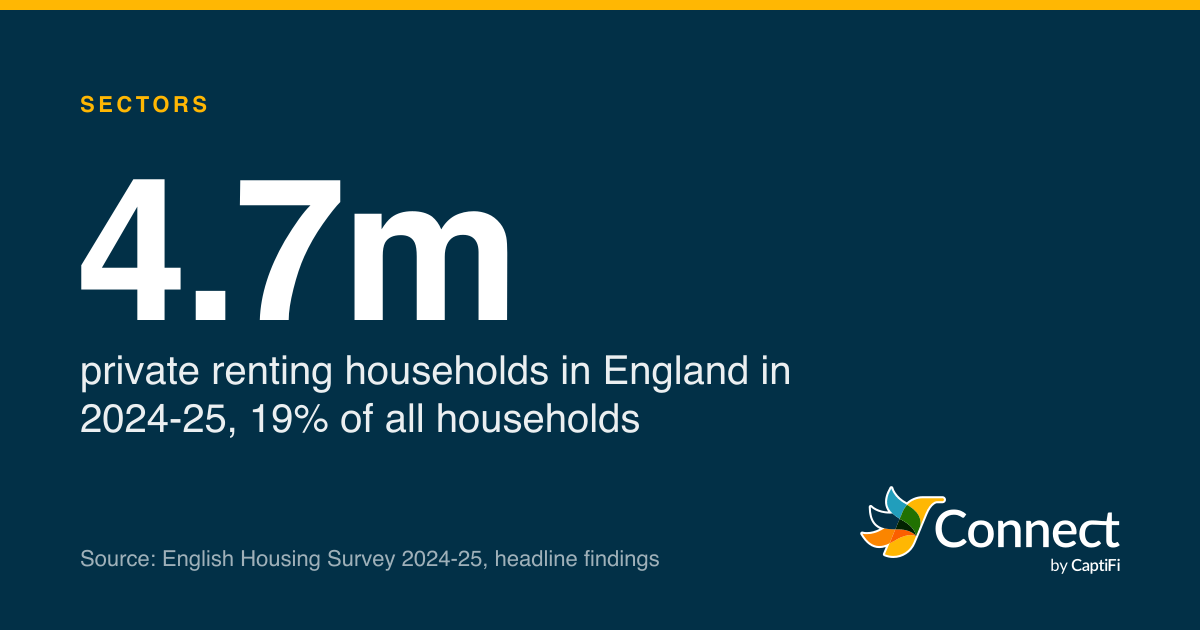
4.7m: private renting households in England in 2024-25, 19% of all households. Source: English Housing Survey 2024-25, headline findings.
On 1 May 2026 every assured tenancy in England's private rented sector became periodic, fixed terms ended, and section 21 went with them. By 31 May every landlord and agent had to have handed each tenant the government's information sheet or risk a fine of up to £7,000, and the GOV.UK page that hosts the sheet carries one line that matters to anyone running a lettings branch on texts: "You must not email or text a link to the PDF to the tenant, as this will not be valid."
So the one document every tenant had to be given this year couldn't go by text link. It could go as an attachment, by email, or by hand, and the text could tell the tenant it was coming. That is roughly the shape of texting under the Renters' Rights Act: the formal notices live elsewhere, in prescribed forms and written statements, and the text is the thing that gets the tenant to the door, the inbox or the phone on the right day.
Who's renting, and who's managing
The English Housing Survey's headline findings for 2024-25 put the private rented sector at 4.7 million households, 19% of all households in England. Owner occupiers are 16.2 million (65%) and social renters 4.1 million (16%). The private share has sat at 19% or 20% since 2013-14, after sitting between 9% and 11% through the 1980s and 1990s, and the survey says the sector "has doubled in size since the early 2000s". The English Private Landlord Survey 2024 gives the same growth as a count: from 3.1 million households in 2008-09 to 4.7 million in 2023-24, a rise of 52%.
Households in millions. Owner occupiers are 65% of households, private renters 19% and social renters 16%.
Source: English Housing Survey 2024-25, headline findings, chapter 1
See the figures as a table
| Households (m) | |
|---|---|
| Owner occupiers | 16.2 |
| Private renters | 4.7 |
| Social renters | 4.1 |
Who the renters are matters for how you reach them. The housing survey found that 69% of households headed by someone aged 16 to 24 rent privately, against 6% of those headed by someone 65 or over, and that private renters mostly have a household reference person between 25 and 54. London's private share fell from 32% to 28% between 2023-24 and 2024-25 (the survey calls the drop not statistically significant), against 17% in the rest of England. A mobile number is the one piece of contact detail every one of those households has.
The landlord survey is the one that describes the agent's side. Of the direct landlords it reports on (fieldwork 3 April to 19 May 2024), 43% used an agent's letting services, 18% used an agent's management services and 52% used no agent at all. Agents had registered 2.9 million, or 70%, of the roughly 4.2 million live tenancy deposits. Nearly half of landlords (45%) own a single rental property, and between them those landlords hold 21% of tenancies. Four in five (80%) had no tenant in arrears in the previous two years, 26% had found damp or mould in the last year, and 86% had inspected the property for fitness before their most recent let.
Direct landlords, fieldwork 3 April to 19 May 2024. The first two categories overlap, so the three do not sum to 100%.
Source: English Private Landlord Survey 2024, main report
See the figures as a table
| Landlords (%) | |
|---|---|
| Agent letting services | 43 |
| Agent management services | 18 |
| No agent | 52 |
What changed on 1 May 2026, and what's still coming
The commencement order (S.I. 2026/421, made on 16 April 2026) switched on Chapter 1 of Part 1 of the Act for private assured tenancies from 1 May 2026. In plain terms, from the roadmap GOV.UK published on 13 November 2025: all tenancies are now periodic, tenants can leave on two months' notice, section 21 is gone and the possession grounds are reformed. Rent can rise once a year, through the section 13 procedure, with notice "at least 2 months before it is due to take effect" (section 6 of the Act rewrites the old minimum period as "two months"). Landlords and agents can't ask for more than a month's rent in advance (sections 8 and 9), can't invite or accept bids above the advertised rent (section 56, with civil penalties of up to £7,000), can't discriminate against people with children or on benefits, and have to consider a pet request within 28 days (section 11).
Two duties fall squarely on the agent. Section 12 inserts a new section 16D into the Housing Act 1988: the landlord "must give the tenant a written statement" of the terms set out in regulations, before the tenancy is entered into, and subsection (8) extends that duty to anyone the landlord has contracted to handle it. And the information sheet page says "the agent must have given the Information Sheet to the tenant, even if you have also given it", so the branch's own record of giving it is the one that counts for the branch.
The later phases are dated loosely. The roadmap says "We will commence roll out of the Database from late 2026", with registration and an annual fee mandatory for every landlord of an assured tenancy (section 75 onwards), and puts mandatory membership of the landlord ombudsman at 2028. The Decent Homes Standard for private renting was consulted on with a proposed start of 2035 or 2037, and the roadmap marks Awaab's law for the private sector as "TBC", subject to consultation. None of those changes what you can text a tenant today, but each will add a reason to.
The texts, and why none of them needs marketing consent
The ICO's direct marketing guidance draws the line in one place: a message "for administrative or customer services purposes" is a service message, and a service message stops being one the moment it carries promotion, even as an afterthought. Everything below is on the service side of that line, which means PECR's consent rule for marketing texts doesn't apply to it. The tenant gave you the number for the tenancy, and the texts are about the tenancy.
Inspections and visits. The right of entry to check the condition of the property comes from section 11(6) of the Landlord and Tenant Act 1985, which implies a covenant that the landlord "may at reasonable times of the day and on giving 24 hours' notice in writing to the occupier" enter to view the condition and state of repair. Whatever channel your tenancy agreement names for formal notices, the reminder that gets the tenant home at the right hour is the text:
Hadley Lets: routine inspection of 14 Mill St on Tue 3 Nov between 10:00 and 12:00, as per the notice sent on 27 Oct. Reply C to confirm or R to rearrange.
Repairs. The thing a tenant wants to know is who is coming and when. The ICO's example of a service message is a reminder of how to contact you if there's a problem, and this is that reminder with a date on it:
Hadley Lets: AquaFix are booked for the boiler at 14 Mill St on Thu 5 Nov, 08:00 to 10:00. Reply if that slot doesn't work and we'll move it.
Hadley Lets: your damp report for the back bedroom is logged, ref 2214. A surveyor will be in touch in 2 working days. Reply with anything to add.
Rent. The landlord survey's 80% with no arrears are the quiet majority; a reminder text is for the rest, and it works better before the due date than after:
Hadley Lets: a reminder that rent of £950 for 14 Mill St is due on Mon 1 Dec. If it's already on standing order, ignore this text.
Hadley Lets: we haven't received rent for 14 Mill St this month. If something's changed, reply to this text and we'll work out a plan with you.
Rent increases. The section 13 notice is a prescribed form with a two-month lead; the text is the heads-up that it's on its way, so the tenant isn't surprised by an envelope:
Hadley Lets: a rent notice for 14 Mill St was posted to you today. The new rent starts on 1 Feb, two months from now, and the letter explains how to query it.
References and viewings. The two ends of a tenancy are where an agent sends the most texts, and both are plain confirmations:
Hadley Lets: viewing of 14 Mill St confirmed for Sat 7 Nov at 11:00. Reply C to confirm.
Hadley Lets: thanks for applying for 14 Mill St. Your referencing form has been emailed to you. Reply if it hasn't arrived by tomorrow.
The information sheet, finally, is the one case where the text can't carry the document. An SMS has no attachment, and GOV.UK says a link isn't valid, so the sheet goes by email as the exact PDF from the GOV.UK page, or by hand, and the text does what it does best:
Hadley Lets: the Renters' Rights Act information sheet was emailed to you today as a PDF. Check your inbox and spam folder, and reply if it hasn't arrived.
What does need consent is anything that sells. "New properties matching your search", "refer a friend and get £50", "our mortgage partner can help" are marketing, and a tenant's number given for the tenancy is not consent to them. Our post on writing a consent request that stands up has the wording, and the SMS marketing rules guide has the rest.
Three habits for a branch
Name the property in every text, not just the tenant, because the same person may have moved through two or three of your properties and the branch has many. Keep the tone the ICO calls neutral and informative, which in practice means a date, a time, a reference and a way to reply, with the warmth saved for the reply itself. And keep the formal thing formal: the section 13 notice, the section 16D statement and the information sheet all have required forms and a record of their own, so the text points at them and never stands in for them.
Replies are the point. A tenant who can answer "R" to an inspection text, or "it's still leaking" to a repair text, and reach a person is a tenant who doesn't ring the branch at 17:25 on a Friday. CaptiFi Connect runs that thread from a UK mobile number with a two-way inbox, team logins so a branch shares it, and a delivery report with a timeline per text, which is a useful thing to have when someone asks when the reminder about the inspection went.
Sources
Read for this post on 17 October 2026.
- legislation.gov.uk: Renters' Rights Act 2025, contents
- legislation.gov.uk: Renters' Rights Act 2025, section 6 (rent increases)
- legislation.gov.uk: Renters' Rights Act 2025, section 12 (statement of terms)
- legislation.gov.uk: Renters' Rights Act 2025 (Commencement No. 2) Regulations 2026
- legislation.gov.uk: Landlord and Tenant Act 1985, section 11
- GOV.UK: Guide to the Renters' Rights Act
- GOV.UK: Implementing the Renters' Rights Act 2025, roadmap
- GOV.UK: The Renters' Rights Act Information Sheet 2026
- GOV.UK: English Housing Survey 2024-25, headline findings, chapter 1
- GOV.UK: English Private Landlord Survey 2024, main report
- ICO: Direct marketing guidance, identify direct marketing
Written by the CaptiFi Connect team. Published 17 October 2026. More in Sectors
Send your first text this week
Set up your account and contacts now; we check every new account before it can send.