
By the numbers8 min read
Missed appointments: what the NHS data shows
Patients missed 8.1m outpatient appointments in England in 2024-25 and 16m GP slots in 2025. The rates, the cost quoted and what the reminder trials found.
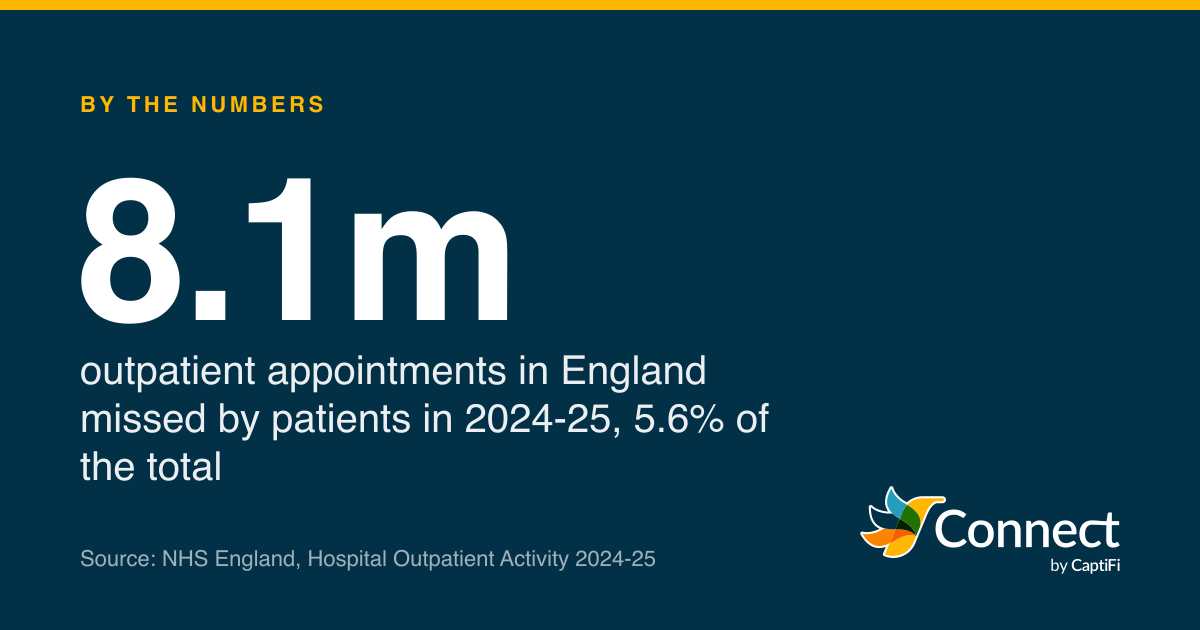
8.1m: outpatient appointments in England missed by patients in 2024-25, 5.6% of the total. Source: NHS England, Hospital Outpatient Activity 2024-25.
Patients in England missed 8.1 million hospital outpatient appointments in 2024-25. That's NHS England's count, published on 25 September 2025, and it was up by just over 123,800 on the year before. Add general practice and the number gets bigger: on 2 March 2026 NHS England said patients had failed to turn up for 16 million GP appointments in 2025, one in every 23 booked. Those two figures are the backdrop to every reminder text a clinic, a dentist or a physio sends, and they're worth reading properly, because the detail is less gloomy than the headline and more useful.
What the outpatient figures say
The series is Hospital Outpatient Activity, published once a year by NHS England. For 2024-25 it counted 146.1 million outpatient appointments and 113.2 million attendances, 7.8% and 8.2% more than the year before and 16.9% and 17.4% more than in 2019-20. The 8.1 million appointments that patients missed, "did not attends" or DNAs in the jargon, are the ones where the patient neither came nor cancelled. Patient cancellations are a separate line, and so are hospital cancellations.
The rate is the figure to watch, because the volume keeps climbing and the rate doesn't.
Each year is taken from its own summary report. The pandemic years are left off: the 2022-23 report gives no rate for 2021-22. Patient cancellations are counted separately and are not in these figures.
Source: NHS England, Hospital Outpatient Activity 2024-25, summary report
See the figures as a table
| Did not attend (%) | |
|---|---|
| 2019-20 | 6.2 |
| 2022-23 | 6.4 |
| 2023-24 | 5.9 |
| 2024-25 | 5.6 |
In 2019-20, before the pandemic, 6.2% of outpatient appointments were missed. In 2022-23 the summary report noted that DNAs, at 6.4%, "now exceed the proportions seen before the COVID19 pandemic". Then 5.9% in 2023-24 and 5.6% in 2024-25, the lowest of the four. So the 1.5% rise in missed appointments last year is a rise in the count only; the share of patients who don't show up has fallen two years running and sits below where it was in 2019.
Two things sit alongside that. Patient cancellations rose by just over 1.59 million (18.0%) in 2024-25, to 7.1% of appointments, which NHS England reads as a return towards the pre-pandemic level of 7.5%. And hospital cancellations ran at 9.2% of appointments, down from 9.9%, which means the hospitals cancelled more appointments than the patients missed. The honest summary of the outpatient numbers is that about one appointment in eighteen is missed, one in fourteen is cancelled by the patient, and one in eleven is cancelled by the hospital.
The summary report also breaks DNAs down by ethnicity, per 100,000 population: 10,300 for White patients, 14,900 for Asian patients, 23,200 for Black patients and 25,000 for the "Other" group. NHS England's own page on DNAs in its outpatient transformation programme says missed appointments happen "often for reasons outside of their control, and often linked to health inequalities", and that understanding those reasons "provides an opportunity to take action to address them". Keep that in mind before you decide a no-show is someone being careless.
General practice
GP appointments are counted in a different series, Appointments in General Practice, published monthly. The August 2026 release, out on 24 September 2026, recorded 29.8 million appointments, 89.6% of them attended, 59.9% face to face, and 45.0% booked and held on the same day. It's a series NHS England labels official statistics in development, and it only sees what practices put in their appointment books.
The annual picture comes from NHS England's press office. On 2 March 2026 it said practices had arranged 376 million appointments in 2025, 8.4 million (2.3%) more than in 2024, and that patients had missed 16 million of them, "1 in 23" or 4.3%, which it described as the equivalent of a whole day of missed appointments at every practice in England each month. Seven years earlier, on 2 January 2019, the same office had put the figure at more than 15 million missed slots out of roughly 307 million, 5%, and costed them at "more than £216million pounds" a year at an average of £30 an appointment. So, as with hospitals: more appointments, more missed in absolute terms, and a lower rate. The £216 million is the only national cost figure NHS England has attached to missed GP appointments, and it's from 2019 at 2019 prices.
The 2026 release also had a survey, 2,000 adults in England polled by Censuswide. 12% said they'd forgotten an NHS appointment at some point, and 11% said they'd arrived too late for one, which together is where the "nearly 1 in 4" in the headline comes from. The NHS's answer was to get people to switch on reminders in the NHS App. Dr Amanda Doyle, its national director for primary care and community services, put the ask simply: "It's really important that they let us know if possible so we can offer the appointment to someone else."
What the reminder trials found
The evidence that reminders work is older than the app, and it's about texts. The Cochrane review Mobile phone messaging reminders for attendance at healthcare appointments, published on 5 December 2013, pooled eight randomised controlled trials with 6,615 participants. Against no reminder at all, a text reminder raised attendance with a risk ratio of 1.14 (95% confidence interval 1.03 to 1.26), from seven trials and 5,841 people, on evidence the authors judged moderate. Across the trials, attendance was 67.8% with no reminder, 78.6% with a text and 80.3% with a phone call, and the text and the call were statistically the same thing (risk ratio 0.99). Two of the trials costed it: the cost per text per attendance was 55% and 65% lower than the cost of a phone call reminder.
That settles whether to send one. The more interesting question, what the text should say, got its best answer from a pair of trials at Barts Health NHS Trust, published in PLOS ONE in 2015 by Michael Hallsworth and colleagues.
Barts Health NHS Trust outpatients, texts sent five days before the appointment. Trial one ran November 2013 to January 2014 on 10,111 appointments; trial two ran March to May 2014 on 9,848.
Source: Hallsworth et al, PLOS ONE, 2015
See the figures as a table
| Did not attend (%) | |
|---|---|
| Existing message (trial 1) | 11.1 |
| Specific cost (trial 1) | 8.4 |
| Specific cost (trial 2) | 8.2 |
| Recording (trial 2) | 9.6 |
| General cost (trial 2) | 9.9 |
| Empathy (trial 2) | 10.7 |
In the first trial, between November 2013 and January 2014, 10,111 outpatient appointments were randomised to one of four reminder texts sent five days ahead. The trust's existing message produced a DNA rate of 11.1%. Adding the cancellation phone number to the text made no measurable difference, and neither did a "we are expecting you" social norms message, although that one did raise cancellations from 8.8% to 10.5%. The message that worked stated the cost of a missed appointment to the NHS in pounds, using the mean 2012-13 tariff of £161 across the five specialties. Its DNA rate was 8.4%, an odds ratio of 0.74 against the existing message.
The second trial, March to May 2014 on 9,848 appointments, took the specific cost message as the new control and tried to beat it. Nothing did. Saying that missed appointments cost the NHS money without giving the figure came out at 9.9%; telling patients the hospital records missed appointments came out at 9.6%; asking them to think of other patients ("put yourself in others' shoes") was worst at 10.7%. The specific figure in pounds, 8.2%, held its ground. The authors estimated that switching the trust's reminder to the cost message would mean about 5,800 fewer missed appointments a year, and noted that only around 20% of eligible appointments had a usable mobile number on file, so the full effect could be larger.
Two cautions. It was one trust in London, and the authors say so. And the 2.7 points between the two messages is a lot smaller than the nearly 11 points between a reminder and none in the Cochrane figures. Send the reminder first; argue about the wording second.
What a business can take from it
Most of the readers of this post don't run a hospital. They run a dental practice, a salon, a physio clinic, a garage, a vet, and the same arithmetic applies on a smaller scale: an empty slot is a slot you can't sell twice. The NHS numbers suggest four habits.
Send a reminder by text, a few days ahead, every time. The Cochrane figures put the gain at around ten percentage points of attendance over no reminder, at a fraction of the cost of ringing round. Five days is what Barts used; for a shorter booking cycle, two or three days ahead with a second text the morning before is a reasonable pattern.
Make it easy to cancel, and treat a cancellation as a win. The outpatient figures show patient cancellations running higher than DNAs, and a cancelled slot can be refilled. A reminder the customer can answer ("Reply C to confirm or X to cancel") turns a silent no-show into a slot you know about. Our two-way SMS page shows how the replies come back.
Say what a missed appointment means, specifically. The Barts result is that a concrete fact beat a general appeal and beat a guilt trip. For a private business that might be your cancellation policy or the fee, stated plainly and in advance, never as a threat.
Keep the mobile numbers clean. The trial could only text 20% of its patients because the rest had no usable mobile number on record. Ask for the mobile at booking, confirm it with the first text, and check the delivery report when one fails.
A reminder in that shape:
Crown Dental: your check-up is on Thu 19 Nov at 10:30 with Dr Shah. Reply C to confirm or X to cancel. Missed visits cost £25 unless cancelled a day ahead.
That's 155 characters, so it fits in one part. CaptiFi Connect schedules a text like that against each booking and puts the replies in an inbox your front desk can act on, which is the whole job of the reminder: a reason to turn up and a way to answer.
Reading the data yourself
The outpatient series is on NHS England's digital statistics site under Hospital Outpatient Activity; each year has a summary report page with the attendance, cancellation and DNA percentages, and the data tables underneath give the counts. Appointments in General Practice is published monthly on the same site, about four weeks after the month ends. The 16 million and £216 million figures are in NHS England press releases of 2 March 2026 and 2 January 2019 respectively, and they use different denominators, so compare the rates (4.3% and 5%) rather than the counts. The Cochrane review and the PLOS ONE paper are both free to read, and the PLOS paper has the exact wording of every message in its tables.
One thing none of these sources gives you is the national DNA rate for private practice, and there's no public series for it that I know of. The NHS's 5.6% for hospitals and 4.3% for GPs are the nearest public benchmarks, and a reminder text is the cheapest thing in the evidence for getting under them.
Sources
Read for this post on 17 October 2026.
- NHS England: Hospital Outpatient Activity 2024-25
- NHS England: Hospital Outpatient Activity 2024-25, summary report
- NHS England: Hospital Outpatient Activity 2023-24, summary report
- NHS England: Hospital Outpatient Activity 2022-23, summary report
- NHS England: NHS urges "tap the app" as 1 in 4 miss appointments, 2 March 2026
- NHS England: Missed GP appointments costing NHS millions, 2 January 2019
- NHS England: Did Not Attends (DNAs), outpatient transformation programme
- NHS England: Appointments in General Practice, August 2026
- Hallsworth et al: Stating appointment costs in SMS reminders reduces missed hospital appointments, PLOS ONE 2015
- Cochrane: Mobile phone messaging reminders for attendance at healthcare appointments, 2013
Written by the CaptiFi Connect team. Published 17 October 2026. More in By the numbers
Send your first text this week
Set up your account and contacts now; we check every new account before it can send.