
By the numbers8 min read
Nuisance texts: what the ICO's complaint data shows
ICO spam text complaints fell from 21,257 in 2021/22 to 6,649 in 2025/26 while 7726 reports passed 100 million a year. What the series counts, and why it fell.
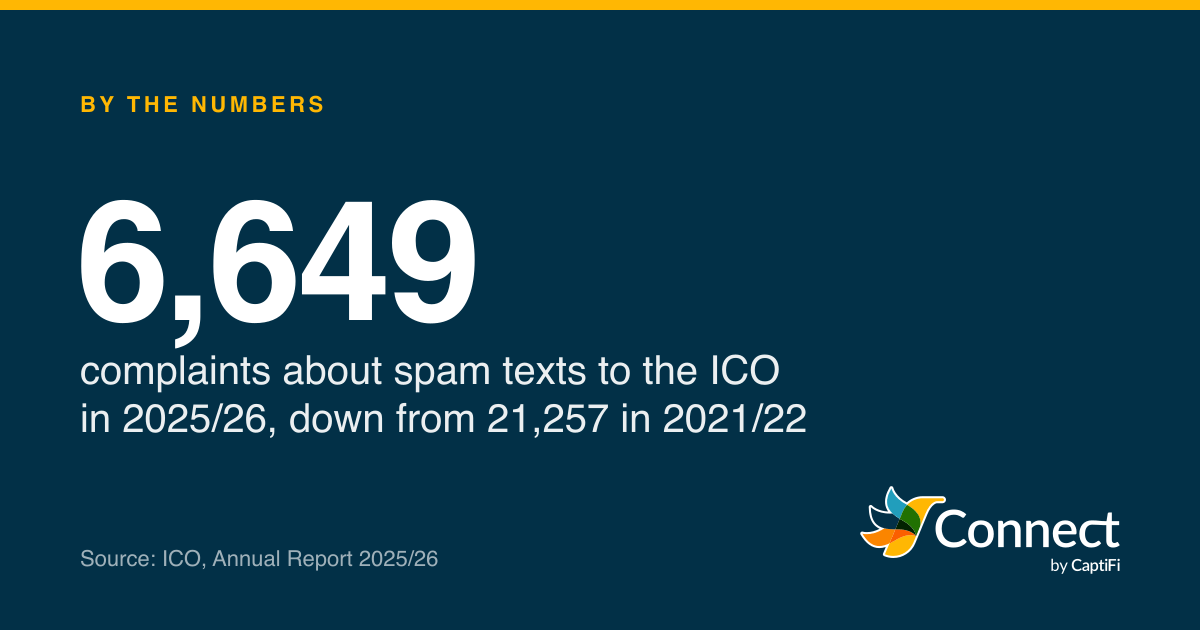
6,649: complaints about spam texts to the ICO in 2025/26, down from 21,257 in 2021/22. Source: ICO, Annual Report 2025/26.
The ICO received 6,649 complaints about spam texts in the year to March 2026. That's from its annual report for 2025/26, laid before Parliament on 14 July 2026, and it's the lowest figure in the seven years the regulator has published the breakdown. In the same report the ICO describes one person who sent nearly a million texts without consent, which on its own produced "over 19,000 complaints through the 7726 spam reporting service". One sender, 19,000 reports to the networks, and the whole year's tally at the ICO's door is 6,649. The two numbers aren't measuring the same thing, and knowing why is most of what this post is about.
What the ICO counts
Under the Privacy and Electronic Communications Regulations (PECR, the rules on marketing calls, texts and emails), the ICO is the regulator, and it asks the public to tell it about unwanted marketing through an online reporting tool. Its page for the public says the information "helps us investigate and take action against those responsible", which is a careful way of saying the ICO does not look into each complaint on its own; the reports are intelligence, and the regulator picks targets from the pile.
The annual report sorts what comes in under "PECR concerns reported". For 2025/26 that was 48,395 about telesales calls and texts, 24,710 about emails and 3,906 about cookies. The calls-and-texts figure is then split by what the complainant said happened: in 2025/26, 25,235 spoke to a person, 16,511 heard a recorded voice, and 6,649 received a spam text. The three add up to the 48,395, which is also the number the report quotes for reports "via our online reporting tool" (49,494 the year before).
So texts were 14% of the nuisance contact the ICO was told about last year. Calls were the rest. That is the first thing the series tells you, and it has been true for as long as the ICO has broken the figure out: in a February 2023 enforcement update for its Operation Linden partners, it noted that live and automated calls had "historically" each accounted for between 35% and 45% of complaints, "with SMS making up a smaller proportion".
The text series, and the drop in 2022
Put the spam text rows from each annual report side by side and you get seven years.
Concerns about spam texts made through the ICO's online reporting tool, April to March each year. From 2022/23 the ICO notes that most people now report spam texts through the mobile networks' 7726 service instead.
See the figures as a table
| Spam text complaints | |
|---|---|
| 2019/20 | 14,343 |
| 2020/21 | 17,222 |
| 2021/22 | 21,257 |
| 2022/23 | 8,935 |
| 2023/24 | 7,405 |
| 2024/25 | 6,891 |
| 2025/26 | 6,649 |
The 2019/20 figure was 14,343. It rose to 17,222 in 2020/21 and peaked at 21,257 in 2021/22, the two pandemic years, when the ICO and Ofcom's joint action plan noted "a sharp rise in suspected scam text messages", many of them "attempting to exploit the pandemic and the national response". Then it fell by more than half in a single year, to 8,935 in 2022/23, and has drifted down since: 7,405, 6,891, 6,649.
The ICO explains the 2022 drop itself, in a footnote to the table in its 2023/24 report: "the number of spam text reports has reduced as the main route for consumer complaints is now via the mobile phone networks' own spam reporting system." That system is 7726, the number you forward a text to. Ofcom's figures put the scale of it: the four network operators logged 89.8 million 7726 reports between May 2024 and March 2025, and more than 100 million in the full year to March 2025, with the monthly rate passing 10 million once iPhones got a one-tap report button.
Which settles what the ICO's text series is: a count of people who went to a regulator's website and filled in a form, and it fell when a quicker route appeared. The networks see four orders of magnitude more. The Operation Linden update from February 2023 shows the moment it happened: 38,709 call and text complaints in the financial year to that point, down 56% on the same point a year before, with SMS complaints down 61%, automated calls down 71% and live calls down 39%. Texts had been 18% of the pile that year.
Calls went down too, then recorded calls came back
The text line is not the only one that fell. In 2020/21 the ICO logged 60,004 complaints about calls with a recorded voice; by 2022/23 it was 12,888. Live telesales calls went from 46,528 in 2021/22 to 29,131 the year after. The 2023 update attributed most of the fall to the automated category, "a category that historically contained a lot of suspected fraudulent messaging", and allowed that enforcement and regulatory changes might have played a part too.
- 2021/22
- 2025/26
The three categories a person can pick in the ICO's reporting tool. They sum to the "telesales calls and texts" total in each annual report: 105,438 in 2021/22 and 48,395 in 2025/26.
Source: ICO, Annual Reports 2023/24 and 2025/26 (nature of telesales and spam texts reported)
See the figures as a table
| 2021/22 | 2025/26 | |
|---|---|---|
| Live telesales calls | 46,528 | 25,235 |
| Recorded voice calls | 37,653 | 16,511 |
| Spam texts | 21,257 | 6,649 |
The one line going the wrong way lately is recorded calls, up from 13,015 in 2023/24 to 16,511 in 2025/26. The annual report says why: "numerous complaints about the marketing of green energy products such as solar panels and foam insulation", many of them "automated 'robocalls' made using so-called 'avatar' software that mimics human interactions". On 28 August 2025 the ICO fined Green Spark Energy Ltd £250,000 for instigating 9,587,050 of those calls and Home Improvement Marketing Ltd £300,000 for 2,449,380, each with an enforcement notice attached.
The longer view comes from the joint action plans the ICO and Ofcom used to publish each year, which counted complaints by calendar year rather than financial year and lumped calls and texts together. On that series the ICO received 166,663 complaints in 2015, 153,525 in 2016, 127,623 in 2017, 124,363 in 2018, 129,354 in 2019 and 103,733 in 2020. The 2019 bump the plan put down to publicity around GDPR and the ban on cold calls from claims management companies, which sent more people to the reporting tool; the 2020 fall to the first lockdown, when complaints dropped and then recovered as the year went on. From 166,663 in 2015 to 48,395 in 2025/26 is a fall of about 70% in a decade, and nobody at either regulator claims that nuisance contact itself fell by that much.
What the complaints turn into
The point of the series, from the ICO's side, is enforcement. In 2025/26 it issued 10 monetary penalty notices totalling £1,445,000 and 10 enforcement notices for breaches of PECR, and says it "targeted the cases that have resulted in the greatest harm to the public". For texts, the case it names is Allay Claims Ltd, fined £120,000 on 15 January 2026 with an enforcement notice: between 1 February 2023 and 13 February 2024 the company had sent 4,046,947 direct marketing SMS messages promoting PPI tax refunds, "in breach of regulation 22 of PECR", without the consent the regulation requires. The report also notes that fines under PECR are capped at £500,000.
Two things about that case are worth noticing. Four million texts over a year produced a fine of about 3p a message. And the evidence trail in the other text case the report describes ran through 7726, the networks' route, with its 19,000 reports, which the ICO counts even though those reports never touched its own form.
For comparison, the ICO's year-in-review for calendar 2024 gave 44,400 reports about nuisance calls and 28,969 about spam emails, and £1,270,000 in fines for nuisance calls that year. Its public page on nuisance calls still cites "over £2.8 million in fines" to companies behind nuisance calls, texts and emails in 2021/22, the peak year for text complaints.
Reading the series without fooling yourself
A few rules, if you want to quote any of this.
The ICO's spam text figure measures complaints to the ICO, by financial year, through one web form. It cannot tell you whether spam texting rose or fell in any year after 2022, because the fall that year was a change of route. The 7726 counts Ofcom publishes are the measure of volume, and they run to nine figures.
The breakdown is by what the complainant chose, from three options. The ICO's nuisance calls page promises statistics on trends, but when we looked in October 2026 the annual report tables were the only published breakdown we could find, so there is no monthly text series to quote.
The share is stable even when the level isn't. Texts have been the smallest of the three categories every year the ICO has split them, between 12% and 20% of nuisance contact complaints, with live calls the largest in every year but two.
And the trend in recorded calls is the one to watch, because it is the one that is rising, and it's rising for a reason the ICO names.
What it means if you send texts
Nobody's marketing list should be producing ICO complaints, but the series shows where the real risk sits. A complaint to the ICO is one person's effort. A 7726 report is one tap, there are a hundred million of them a year, and the ICO treats them as evidence. The texts that end up in either pile share a shape: sent to people who never agreed to them, about something they didn't ask for. Allay Claims' four million PPI texts are the type.
The defences are the dull ones: consent you can show for every number on a marketing list, with a record of when and how it was given; "Reply STOP to opt out" on every marketing text, with an opt-out that takes effect at once; a sender name people recognise; and no marketing late at night. Our guide to the UK's SMS marketing rules covers what regulation 22 requires, and our post on the ICO's text marketing fines goes through the penalty notices one by one. CaptiFi Connect handles the mechanical part: STOP and six other keywords opt a number out automatically, campaigns carry the opt-out line by default, and quiet hours keep marketing sends out of the 21:00 to 09:00 window unless you change them.
The ICO's next annual report will add a 2026/27 row to the table. If the pattern of the last four years holds it will be a little under 6,649, and it will still say almost nothing about how many spam texts people got.
Sources
Read for this post on 17 October 2026.
- ICO: Annual Report and Financial Statements 2025/26
- ICO: Annual Report and Financial Statements 2024/25
- ICO: Annual Report and Financial Statements 2023/24
- ICO: Annual Report and Financial Statements 2022/23
- ICO: Annual Report and Financial Statements 2021/22
- ICO: Operation Linden meeting, 6 February 2023
- ICO: 2024, a year in review
- ICO: Nuisance calls (information for the public)
- ICO and Ofcom: Joint action plan on nuisance calls and messages, 2021 update
- ICO and Ofcom: Joint action plan on nuisance calls and messages, 2020 update
- Ofcom: New rules to thwart text message scammers, 29 October 2025
Written by the CaptiFi Connect team. Published 17 October 2026. More in By the numbers
Send your first text this week
Set up your account and contacts now; we check every new account before it can send.