
Sectors8 min read
On-my-way texts for trades
ONS counts 160,064 one-person construction firms in Great Britain. The quote, arrival window, on-my-way and invoice texts a trade sends, and the rules on each.
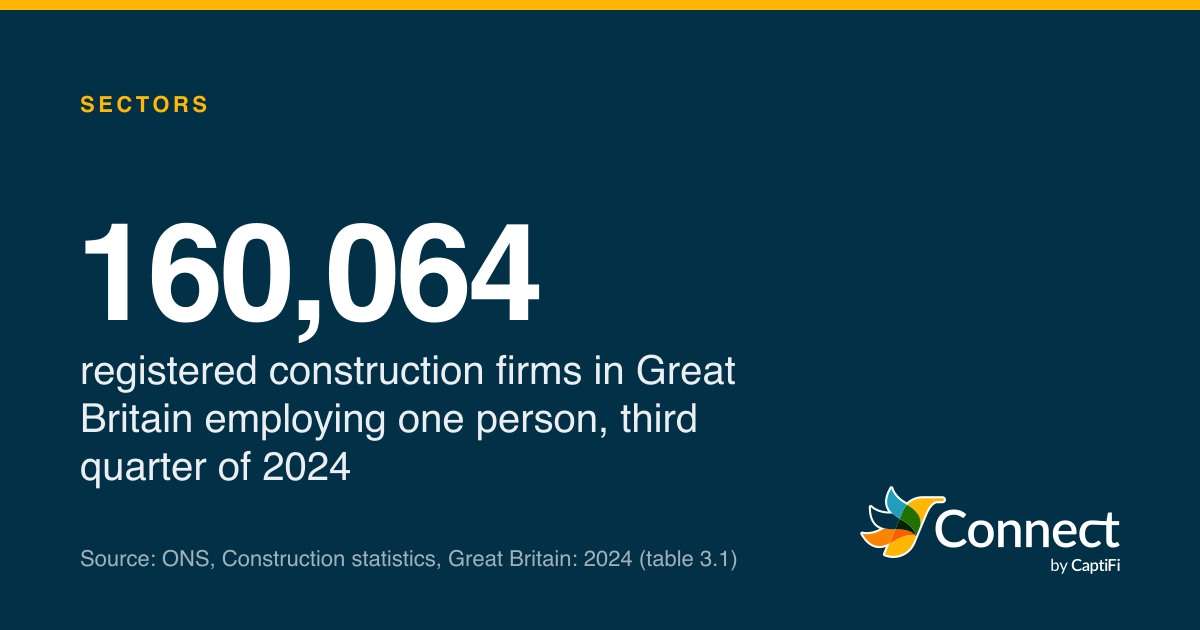
160,064: registered construction firms in Great Britain employing one person, third quarter of 2024. Source: ONS, Construction statistics, Great Britain: 2024 (table 3.1).
The ONS counted 370,770 VAT or PAYE registered construction firms in Great Britain in the third quarter of 2024, and 160,064 of them employed exactly one person. Another 104,739 employed two or three. So four out of five registered building firms are a van, a phone and at most a couple of mates, and that's before you count the ones too small to register at all. The person who quotes the job, does the job and chases the invoice is the same person, and the phone they do it all from is the one in their pocket on a roof.
Most of the texting advice online assumes a marketing department. A plumber wants the customer to be in when they arrive and to pay when they're done. Texts do both jobs well, and the rules on them are lighter than people think, provided the texts stay about the work.
How small the trades are
The Department for Business and Trade's Business Population Estimates for the start of 2025 put the number of UK construction businesses at 885,485, more than any other sector, and 78.1% of them have nobody on the payroll apart from the owner. Only 193,675 employ anyone. Inside that, the division the ONS calls specialised construction activities (electricians, plumbers, plasterers, roofers, joiners, decorators and the rest) has 519,670 businesses, of which 392,415 have no employees. The same tables reckon 500,325 construction businesses across the sector are unregistered with no employees, which is the part the ONS register below can't see. A business that small has no office and no one answering a phone while the owner is under a floor, which is the first thing to know about how it should text: whatever it sends has to be sendable in the time it takes to walk back to the van.
The ONS's own register counts only firms that are VAT or PAYE registered, which is why its total is smaller, and it breaks them down by how many people they employ.
VAT and PAYE registered firms only, 370,770 in all. The ONS bands above 24 are summed here: 25 to 59 combines two bands, 60 to 299 three, and 300 and over three.
Source: ONS, Construction statistics annual tables 2024 (table 3.1)
See the figures as a table
| Firms | |
|---|---|
| 0 (sole proprietors) | 39,156 |
| 1 | 160,064 |
| 2 to 3 | 104,739 |
| 4 to 7 | 39,827 |
| 8 to 13 | 14,170 |
| 14 to 24 | 7,080 |
| 25 to 59 | 3,931 |
| 60 to 299 | 1,568 |
| 300 and over | 235 |
The spread by trade, from the same tables, tells you who's sending the texts. Electrical installation is the biggest allied trade at 47,532 registered firms, plumbing and heating next at 44,668, then joinery at 26,881.
The eleven largest allied trades by firm count. Site preparation (2,863), demolition (771) and test drilling (288) are left off.
Source: ONS, Construction statistics annual tables 2024 (table 3.8)
See the figures as a table
| Firms | |
|---|---|
| Electrical installation | 47,532 |
| Plumbing, heating and air con | 44,668 |
| Other installation and finishing | 35,799 |
| Joinery installation | 26,881 |
| Other specialised construction | 22,290 |
| Painting | 12,020 |
| Roofing | 11,842 |
| Floor and wall covering | 9,102 |
| Plastering | 6,427 |
| Scaffolding | 6,220 |
| Glazing | 3,926 |
Two numbers from the output tables matter here as well. Of the £109,786 million of work done by specialised construction firms in 2024, £54,882 million was repair and maintenance, and £23,686 million of that was repair and maintenance of private housing. For plumbing and heating firms, private housing repair and maintenance was £6,717 million out of £19,465 million. That's the boiler service and the leaking tap, the kind of job where someone has to be in to open the door.
Why the arrival text matters
Citizens Advice published a report on the home repairs market on 7 July 2026, and its headline finding was that "nearly three in ten (28%) people who hired a trader for work on their home experienced an issue", ranging "from living with unfinished or unsafe work, to dealing with stressful disputes with traders". The report is about the bad end of the trade, and most firms never get near it. But a dispute usually starts smaller than unsafe work. It starts with a morning taken off and nobody turning up, or a text that said "Tuesday" and nothing after it, and from there the customer's trust goes and every later problem gets read in the worst light.
An arrival text is a cheap fix. It costs one credit and ten seconds from the previous job, and it turns a vague promise into one the customer can plan round. It also answers the question they would otherwise ring to ask, which is the call you'd be taking with your hands full.
A trade's texts are service messages, which matters for the rules. The ICO's direct marketing guidance says a service message "covers messages that aren't promotional but are for administrative or customer services purposes", and it gives confirming or reminding people about appointments as an example. Those need no marketing consent under PECR. The condition is that they stay that way: "If your service message has elements that are direct marketing, even if that is not the main purpose of your message, then it will count as direct marketing." So "Dan's on his way" is fine. "Dan's on his way, and ask him about our boiler cover, 10% off this month" is a marketing text, and you'd need consent for it.
The guidance gives a test for the borderline. It tells you to "think about why you want to communicate with people" and to "look at whether the content is promotional", and it says that "if a message has a neutral tone and simply gives information that they need to know as part of their relationship with you this is more likely to be a service message". It then closes the obvious loophole: "simply using a neutral tone doesn't necessarily avoid messages being direct marketing." A flatly worded text that mentions the autumn boiler offer is still an offer.
The texts a trade sends
There are six, and they follow the job in order. Each sample below fits in one 160-character part (the character counter will tell you if yours doesn't), and each starts with the firm's name because an anonymous message from an unknown number looks like a scam.
The quote. The customer has your number in their phone from the moment you send this, and the figure is in writing.
Harris Plumbing: your quote for the bathroom is £1,840 inc VAT, valid 30 days. Full breakdown: [link]. Reply YES to book or call with any questions.
The booking, the day you agree it. Window, not a time, because you don't control the job before it.
Harris Plumbing: booked for Tue 21 Oct, arriving between 8 and 10am. Please leave the stopcock clear. Reply if the date no longer works.
The reminder, the evening before. This is the one that stops the wasted morning.
Harris Plumbing: reminder that Dan is with you tomorrow (Tue) between 8 and 10am. Reply C to confirm someone will be in.
The reply is the point of that one. A "C" back means the morning is safe. No reply by the evening means a thirty-second call before you load the van, and "can we do Thursday instead" means you've found out the night before instead of on the doorstep. Treat the reminder as a question with a deadline and the answers sort themselves out.
The on-my-way text, from the van.
Harris Plumbing: Dan is on his way to you now, about 25 minutes. See you shortly.
And the one people forget, the running-late text, which is the one that heads off a complaint.
Harris Plumbing: sorry, the job before yours has overrun. Dan now expects to be with you around 11:15. Reply if that's a problem and we'll rebook.
Then the invoice, after the job, with the amount and a link rather than an attachment.
Harris Plumbing: invoice 1042 for £320.00 is at [link], payable within 14 days. Thanks for having us.
A seventh, a week later, is a review request, which is allowed as a service follow-up if it asks and doesn't sell. The feedback and review requests page covers the wording and the rules on incentives.
The reminder is the one to send from a schedule rather than from memory, because the evening before a job is when a trade is least likely to be thinking about the next day's first customer. The on-my-way and running-late texts are the ones to send by hand, from the phone, because only the person in the van knows the time.
The kitchen-table quote and the 14 days
One rule touches the quote text specifically, and most small trades have never heard of it. The Consumer Contracts Regulations 2013 define an "off-premises contract" as, among other things, one "concluded in the simultaneous physical presence of the trader and the consumer, in a place which is not the business premises of the trader". A customer agreeing a job with you in their kitchen is exactly that. Regulation 27(3) takes out small jobs: the cancellation rules "do not apply to off-premises contracts under which the payment to be made by the consumer is not more than £42". Above that, regulation 30 gives the customer a cancellation period that, for a service contract, "ends at the end of 14 days after the day on which the contract is entered into".
The practical point for texting is narrower. If you agree the job on the doorstep, the text that follows is your record of what was agreed and when, so include the price, the date and what the job covers, and keep it. A quote text that says "valid 30 days" and a booking text that says what was agreed are your record of the contract and its date, which is the day the 14 days run from.
Keeping it simple
A few habits, none of them hard:
- Put the firm's name first in every text, and the person's first name when it's someone other than you arriving.
- Give windows for arrivals and times only once you're in the van.
- Send the day-before reminder from a schedule, so it goes even when you're on a roof.
- Reply to replies. If a customer answers "that's fine" or "can we do Thursday instead", the text is only useful if someone reads it. If the number can't take replies, the customer's answer goes nowhere.
- Never put an offer in a service text. If you want to tell past customers about a boiler service deal in September, that's a marketing text, and it needs consent and a STOP line.
- Keep each text to one part. The limit is 160 characters in the standard character set, and a single emoji drops it to 70, so a chatty invoice text can quietly cost two credits. Our guide to the SMS character limit explains the sets.
None of that needs software beyond a sending service and a phone. What it needs is the habit, which is harder, because the day the reminder gets forgotten tends to be the day the customer booked the morning off.
CaptiFi Connect gives a trade a UK mobile number with a two-way inbox, where replies are free, and scheduled sends for the evening-before reminder. The sending is 3.5p to 5p a text depending on the pack, and credits don't expire, so a firm doing a job a day can buy once and forget about it. A customer who gets those texts across a job has the quote, the date, the window, the arrival time and the invoice in their phone, and the firm has the same thread as its record of what was agreed.
Sources
Read for this post on 17 October 2026.
- ONS: Construction statistics, Great Britain: 2024
- ONS: Construction statistics annual tables, 2024 edition (tables 1.4, 3.1 and 3.8)
- Department for Business and Trade: Business Population Estimates for the UK and regions 2025, statistical release
- Department for Business and Trade: Business Population Estimates 2025, detailed tables (tables 4, 5 and 6)
- Citizens Advice: Built to fail, how the home repairs market is failing consumers
- ICO: Direct marketing guidance, Identify direct marketing
- legislation.gov.uk: Consumer Contracts (Information, Cancellation and Additional Charges) Regulations 2013, regulation 5
- legislation.gov.uk: Consumer Contracts Regulations 2013, regulation 27
- legislation.gov.uk: Consumer Contracts Regulations 2013, regulation 30
Written by the CaptiFi Connect team. Published 17 October 2026. More in Sectors
Send your first text this week
Set up your account and contacts now; we check every new account before it can send.