
Sectors8 min read
Payment reminder texts and late payment
DBT research puts late payments owed to UK businesses at £26bn at any one time. The reminder texts that get invoices paid, and the interest the law adds.
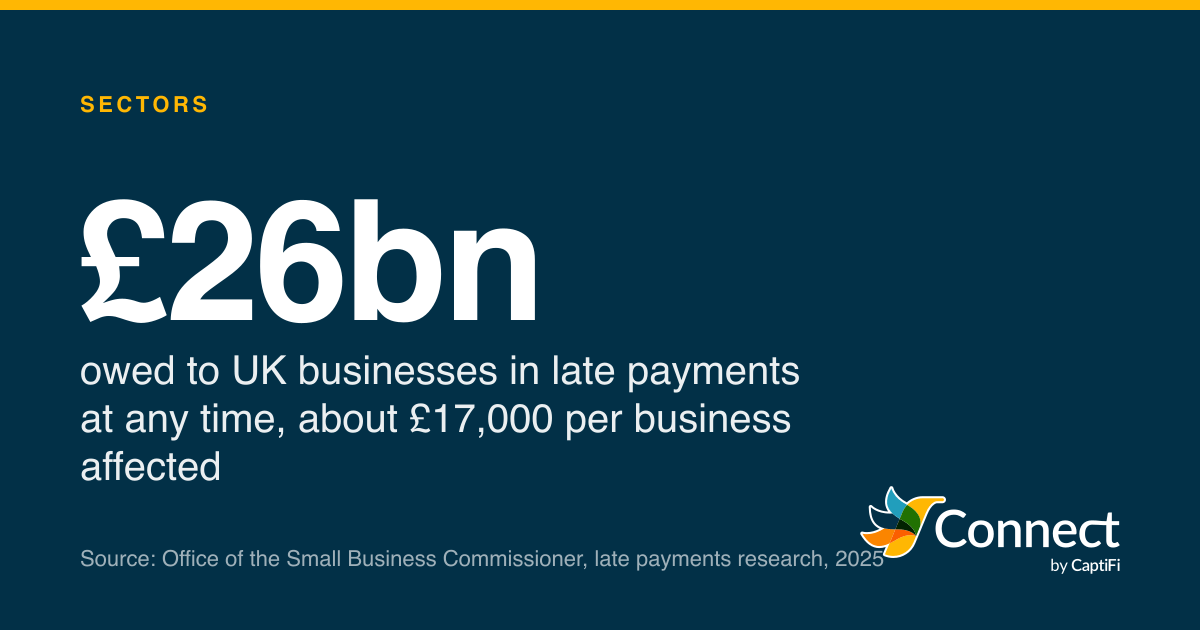
£26bn: owed to UK businesses in late payments at any time, about £17,000 per business affected. Source: Office of the Small Business Commissioner, late payments research, 2025.
UK businesses are owed about £26 billion in late payments at any given moment. That figure comes from research for the Department for Business and Trade and the Office of the Small Business Commissioner, published on 30 July 2025, and the same research put the average at £17,000 for each business affected. More than 1.5 million businesses, 28% of the total, are paid late in a year. 22% of the businesses surveyed said they spend staff time chasing late payments, and among those affected the average was 86 hours a year, which the researchers scaled up to 133 million hours across the economy. And the number that gets quoted most, because it's the bleakest: 14,000 businesses close each year because of late payment, 38 a day.
Eighty-six hours is more than two working weeks spent writing "just following up on invoice 2231". A lot of that chasing is done by email, which the customer's accounts inbox treats the way everyone treats email. Some of it is done by phone, which takes both people's time and tends to happen when the person who can pay is out. A text sits in between: it arrives on the phone of the person who can pay, it takes twenty seconds to send, and the reply comes back to the same thread.
What the law lets you add
For a business selling to another business, the Late Payment of Commercial Debts (Interest) Act 1998 gives the supplier the right to charge interest on a late payment even when the contract says nothing about it. GOV.UK's guide sets out when a payment is late. If you agreed a date, "it must usually be within 30 days for public authorities or 60 days for business transactions". If you didn't agree one, "the law says the payment is late 30 days after" the customer gets the invoice or you deliver the goods or service, whichever is later.
Once it's late, the rate is "8% plus the Bank of England base rate for business to business transactions". The Bank's Bank Rate has been 3.75% since 18 December 2025, so a late commercial debt today carries statutory interest at 11.75% a year. GOV.UK's worked example uses an older base rate of 0.5%: on £1,000 "the annual statutory interest on this would be £85", about 23p a day, and £11.50 after 50 days. At today's rate the same £1,000 earns £117.50 a year, or about 32p a day. You can't claim the statutory rate if the contract sets a different one.
- Bank Rate
- Statutory interest
Thirteen of the 22 Bank Rate changes since March 2020, chosen to show the shape. The statutory rate is Bank Rate plus 8 percentage points, as GOV.UK describes it for business to business debts.
Source: Bank of England, Bank Rate history
See the figures as a table
| Bank Rate (%) | Statutory interest (%) | |
|---|---|---|
| 19 Mar 2020 | 0.1 | 8.1 |
| 16 Dec 2021 | 0.25 | 8.25 |
| 5 May 2022 | 1 | 9 |
| 22 Sep 2022 | 2.25 | 10.25 |
| 15 Dec 2022 | 3.5 | 11.5 |
| 23 Mar 2023 | 4.25 | 12.25 |
| 3 Aug 2023 | 5.25 | 13.25 |
| 1 Aug 2024 | 5 | 13 |
| 7 Nov 2024 | 4.75 | 12.75 |
| 6 Feb 2025 | 4.5 | 12.5 |
| 8 May 2025 | 4.25 | 12.25 |
| 7 Aug 2025 | 4 | 12 |
| 18 Dec 2025 | 3.75 | 11.75 |
Then there's the fixed sum, which is the part most small firms don't know they're entitled to. Section 5A of the Act says that once statutory interest starts to run, the supplier can add, on top of the interest, "for a debt less than £1000, the sum of £40", "for a debt of £1000 or more, but less than £10,000, the sum of £70" and "for a debt of £10,000 or more, the sum of £100". Subsection (2A), added in 2013, goes further: "if the reasonable costs of the supplier in recovering the debt are not met by the fixed sum", the supplier is also entitled to the difference. So a £1,460 invoice that goes 14 days over carries £70 plus 47p a day, and the customer owes it without being asked. Whether you ask is a commercial decision. A text that says so is stating the law.
What is changing
The government has spent a year making late payment harder to get away with. Its news release of 30 July 2025 opened with the claim that late payment "costs the UK economy £11bn a year and shuts down 38 businesses every day" and announced maximum payment terms of "60 days, reducing to 45 days", "mandatory interest charges for those who pay late", and new powers for the Small Business Commissioner to carry out spot checks, enforce "a 30-day invoice verification period" and fine the biggest persistent late payers.
On 19 May 2026 the Small Business Protections Bill went into Parliament. The release that day listed a 60-day cap on payment terms for large firms paying smaller suppliers, mandatory interest on late payments at 8% above Bank Rate, a ban on withholding retention payments under construction contracts, powers for the Commissioner to investigate, adjudicate and fine, and a requirement that boards of persistently late-paying large companies publish an explanation. In Parliament the Bill carries the plainer name of the Commercial Payments Bill. Lord Leong introduced it in the House of Lords on 19 May 2026, it drew 103 amendments after its second reading, and the Commissioner's office says it hopes to see it through both Houses "by end of this year/early 2027", with the secondary legislation that switches it on taking "3-4 months" after that. So none of it is law as I write, and the detail may move, but the direction is set: the interest that is currently a right you can choose to claim is on its way to being automatic, and a 60-day term is on its way to being the longest a large customer can impose.
Alongside the legislation sits the Fair Payment Code, which the Office of the Small Business Commissioner has run since December 2024 in place of the old Prompt Payment Code. It has three levels. Gold is "to pay at least 95% of all invoices within 30 days"; Silver is 95% within 60 days, "including at least 95% of invoices to small businesses" with fewer than 50 employees within 30 days; Bronze is 95% within 60 days. Every awardee signs up to a "Be Fair" principle under which "signatories will accept consequences such as automatically applied late payment interest and compensation" under the 1998 Act.
Counts shown on the Fair Payment Code homepage when read on 17 October 2026, 817 in all. Awards last two years.
Source: Office of the Small Business Commissioner, Fair Payment Code
See the figures as a table
| Awardees | |
|---|---|
| Gold (95% paid in 30 days) | 358 |
| Silver (60 days, small firms 30) | 149 |
| Bronze (95% paid in 60 days) | 308 |
If a customer of yours holds an award, their own public commitment is to pay you in 30 or 60 days and to accept the interest if they don't. That's worth knowing before you soften a reminder. The list of awardees is public on the Code's site, and it takes a minute to check whether the firm that is 20 days late on your invoice has a gold badge on its website.
Reminder texts that get paid
A payment reminder is a service message in the ICO's terms. Its direct marketing guidance describes a service message as one that is "for administrative or customer services purposes" and not promotional, so PECR's consent rule for marketing texts doesn't apply to a text about an invoice the customer agreed to. The condition, as always, is that it stays about the invoice. Six messages cover the cycle, each under 160 characters.
When the invoice goes out, so the number is in their phone before anything is late:
Kestrel Signs: invoice 2231 for £1,460.00 is at [link], due Fri 14 Nov. Reply with any queries.
Three days before it's due, which is the reminder that does most of the work:
Kestrel Signs: invoice 2231 (£1,460.00) is due on Fri 14 Nov. If it's already on its way, thank you. If there's a problem, reply and we'll sort it.
The day after, plainly:
Kestrel Signs: invoice 2231 (£1,460.00) was due 14 Nov and hasn't arrived. Please pay today or reply with the date we can expect it.
Two weeks after, with the law in it:
Kestrel Signs: invoice 2231 is now 14 days overdue. Statutory interest at 11.75% a year and the £70 fixed sum now apply. Reply to arrange payment.
When they ask for time, which they will:
Kestrel Signs: thanks, noted that invoice 2231 will be paid on Fri 28 Nov. We'll hold further reminders until then.
And when the money lands:
Kestrel Signs: payment received for invoice 2231, thank you.
A few things about the wording. Put the invoice number and the amount in every message, because the person reading it is matching it against a list. Give a specific date rather than "as soon as possible". Keep the tone level all the way through; the 14-day message states a fact about interest, it doesn't shout. Send the three-day reminder from a schedule, set when the invoice goes out, so it never depends on anyone remembering, and send it in working hours, because a reminder about money that lands at 22:00 reads as a demand however politely it's worded. And read the replies, because a reply to a reminder is usually one of three things, a payment date, a query, or a dispute, and each of them stops the clock in a different way. A query answered the same day gets paid; a query that sits in an unread inbox becomes a reason not to pay.
When a text is the wrong tool
Three cases. First, a consumer customer. The 1998 Act's interest and fixed sums are for business to business debts, so a reminder to an individual who owes you for a kitchen or a wedding can't quote them; what you can charge a consumer depends on your contract, and the tone should be gentler still.
Second, regulated credit. If the money is owed under a consumer credit agreement you provide, say instalments on a finance plan, the Financial Conduct Authority's rules in CONC 7, "arrears, default and recovery", govern how you chase it, and they are strict about contact. CONC 7.9.4R says "a firm must not contact customers at unreasonable times and must pay due regard to the reasonable requests of customers", giving customers who work shifts as the example, "in respect of when, where and how they may be contacted". That regime is outside this post, and if it applies to you, read it before you send anything.
Third, a dispute. If the customer has replied to say the signs were the wrong size, the reminder sequence stops and the conversation starts. Sending the 14-day interest text into an open dispute is how a £1,460 invoice turns into a stand-off over £1,530. The research for the Department for Business and Trade found that 22% of businesses spend staff time chasing; the ones that spend least are the ones whose reminders arrive before the money is late and stop the moment there's a reply.
CaptiFi Connect runs the sequence above from one UK mobile number: scheduled sends for the reminders, a two-way inbox where replies are free and sit in the same thread as the invoice, and email to SMS so an invoicing system that can send an email can send the first text without anyone retyping it. The research for the Department for Business and Trade found that 15% of the businesses surveyed had avoided doing business with specific customers because of their payment behaviour. A reminder that arrives three days early, with the number and the amount in it, is cheaper than losing the customer or chasing them for 86 hours.
Sources
Read for this post on 17 October 2026.
- Office of the Small Business Commissioner: Late payments research, 31 July 2025
- GOV.UK: Late payments research, estimating the economic cost of late payments and their impact on the UK economy
- GOV.UK: Late commercial payments, charging interest and debt recovery (when a payment becomes late)
- GOV.UK: Late commercial payments, charging interest on a commercial debt
- legislation.gov.uk: Late Payment of Commercial Debts (Interest) Act 1998, section 5A
- Bank of England: Bank Rate history
- GOV.UK: news release, Time to pay up, 30 July 2025
- GOV.UK: news release, largest crackdown on late payments in over 25 years as Bill enters Parliament, 19 May 2026
- Office of the Small Business Commissioner: A Bill progresses at pace through Parliament
- Office of the Small Business Commissioner: About the Fair Payment Code
- Office of the Small Business Commissioner: Fair Payment Code criteria
- Office of the Small Business Commissioner: Fair Payment Code homepage
- FCA Handbook: CONC 7, arrears, default and recovery
- ICO: Direct marketing guidance, Identify direct marketing
Written by the CaptiFi Connect team. Published 17 October 2026. More in Sectors
Send your first text this week
Set up your account and contacts now; we check every new account before it can send.