
Sectors8 min read
Restaurant no-shows and booking texts
Zonal and CGA's survey puts no-shows at 14% of consumers, and 17% of those say they forgot. What a confirmation text and a reminder text do about it.
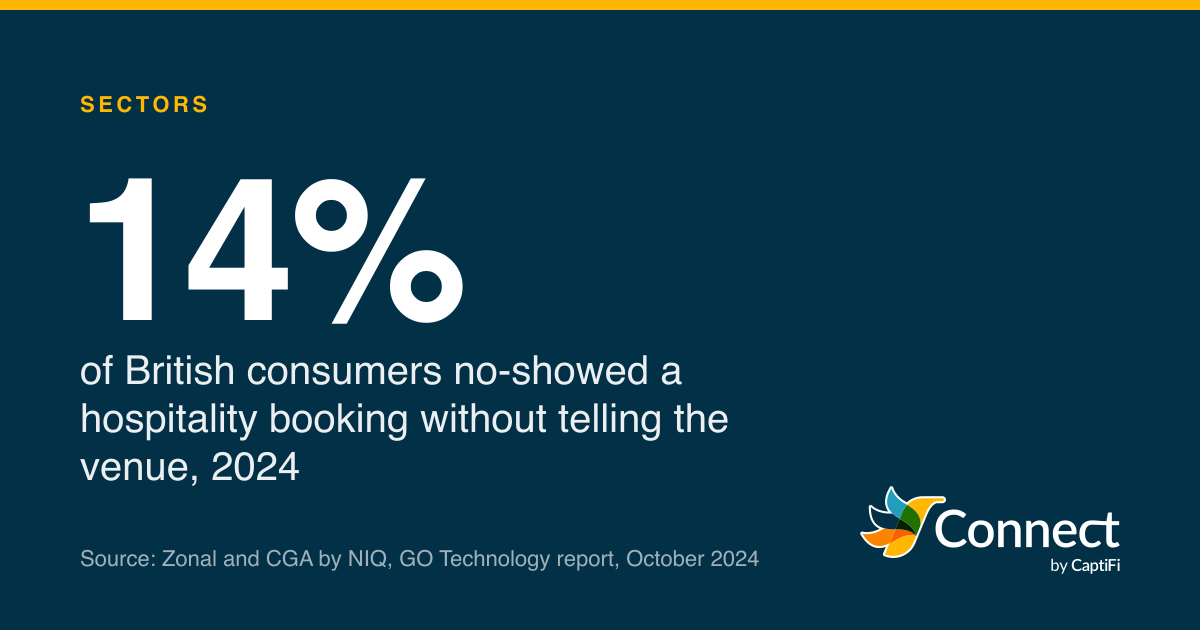
14%: of British consumers no-showed a hospitality booking without telling the venue, 2024. Source: Zonal and CGA by NIQ, GO Technology report, October 2024.
A table for four, booked three weeks ago for Friday at half seven, and at ten to eight it's still empty. Every restaurant knows the feeling, and since late 2024 there's been a decent figure for how often it happens. Zonal and CGA by NIQ surveyed 5,000 British consumers in October 2024 for their GO Technology report and found that 14% had failed to turn up for a booking at a restaurant, pub or bar without telling the venue. Zonal's chief commercial officer put the cost to the sector at £17.59 billion a year in lost sales.
The useful part of that report is the pair of tables under the headline: why people say they didn't come, and what they say would have made them. Both point at the same two texts, and the rest of this is about how to write them.
The size of it
Start with who books at all. The survey found 57% of consumers had made an advance booking at a pub, bar or restaurant in the previous six months, three points down on mid-2021, when Covid rules had pushed bookings up. Of the people who book, 68% say they turn up for every one, and 18% cancel in advance, which, with enough notice, lets the venue resell the table. The remaining 14% is the no-show figure, and the report describes it as a return to the level seen in mid-2021, "proof that this is a significant and very persistent problem".
Hospitality isn't the worst at this, which the report is at pains to say. Asked where they'd no-showed in the past year, 35% of consumers admitted to a gym or exercise class, 25% to a hairdresser, 25% to a driving lesson and 25% to a taxi, 22% to an adult education class and 20% to a car service or MOT. Hospitality's 14% is the lowest on the list. The difference is what a no-show costs. A gym class runs anyway. A table for four is perishable stock, bought and prepped, with staff rostered to serve it, in a room with a fixed number of seats.
For scale, UKHospitality's own figures put the sector at around 140,000 venues, 3.5 million jobs and £93 billion a year of direct economic contribution. The ONS counted 2.73 million VAT or PAYE registered businesses in the UK in March 2025, and its table for the accommodation and food services industry comes to about 177,000 of them, 6.5% of the total. Spread £17.59 billion across that and you get a sense of why a single empty table on a Friday matters to a small operator with margins the report itself calls "finely balanced".
Why people don't turn up
The report asked the no-show guests why, and let them give more than one reason.
Survey of 5,000 nationally representative British consumers in October 2024. Respondents could give more than one reason.
Source: Zonal and CGA by NIQ, GO Technology report, October 2024
See the figures as a table
| Share of no-show guests (%) | |
|---|---|
| Decided it was too expensive | 29 |
| Had a change of plans | 27 |
| One of the group fell ill | 21 |
| Forgot about it | 17 |
| Someone in the group cancelled | 14 |
| Booked a few venues | 10 |
The top answer is money: 29% decided it would be too expensive, and the report links this to the cost of living, with 56% of no-show guests saying they're severely or moderately affected by it, against 46% of those who've kept every booking. The second is a change of plans (27%), and the third is someone in the group falling ill (21%). None of those three is something a text fixes, though a text makes each of them easier to tell you about.
The next three are different. 17% simply forgot. 10% booked a few venues and let all but one of them down. 14% say someone else in the group cancelled, which usually means the plan fell apart and nobody told the restaurant. Add those up and roughly four in ten reasons for an empty table are a lapse in communication of some kind, which is where a reminder earns its keep. The report's own line on the forgetters is that the number is "disappointingly high".
Who are they? Younger, urban and, awkwardly, good customers. The report has 64% of no-show guests under 34, 65% living in city or town centres (against 39% of people who never no-show), and 62% eating or drinking out at least once a week, with an average monthly spend 10% higher than those who keep or cancel every booking. These are people who book a lot and go out a lot, and whose plans move.
What guests say would stop them
The report closes with five fixes and a figure for each.
The report's five ways to fix no-shows, with the share of consumers who said each would make a difference. The deposit figure is of those who have no-showed.
Source: Zonal and CGA by NIQ, GO Technology report, October 2024
See the figures as a table
| Share of consumers (%) | |
|---|---|
| A simpler cancellation process | 30 |
| An incentive on arrival | 28 |
| A reservation reminder | 25 |
| Losing a deposit | 21 |
| Feeling more loyal to the venue | 17 |
| Seeing the impact on venues | 17 |
A simpler cancellation process tops the list, at 30%. Then incentives on arrival (28%), and then reminders: "Reservation reminders can make more than a quarter (25%) of consumers less likely to no-show." On timing, the report says earlier GO Technology research found "reminders sent on the day of the booking, or a day or two ahead, are most effective". Deposits come fourth: 21% of people who've no-showed say they'd be more likely to turn up if they'd lose one, but the report notes that some guests, "especially younger adults", dislike being penalised for booking, and 7% of people who don't book at all say a deposit put them off.
Read those first and third items together, because they're the same thing in practice. A reminder that can be answered is a cancellation process. If the text says "Reply N if you can't make it", the guest who's embarrassed to ring (the report says digital cancellation is now the preferred route, "especially among people who are embarrassed about withdrawing") can cancel in one letter, and the table goes back on sale.
The confirmation text
The first text goes out the moment the booking is made. Its job is to put the details in the guest's pocket, prove the booking exists, and open the channel for a cancellation. Something like:
The Fox, Saltaire: your table for 4 on Fri 21 Nov at 19:30 is booked. Reply C to confirm, or N if your plans change. Reply with any questions.
That's 142 characters, one SMS part, and it does the three jobs. Name first so the guest knows who it's from. Day, date and time in full, because "Friday" on its own is the sort of thing people get wrong. The reply options in plain letters. And the invitation to ask a question, which is where "does the set menu run on Fridays" and "can we have a high chair" come in, which are nicer to answer by text at 11am than by phone at 7pm.
Keep the confirmation to facts, without an offer or a line of welcome copy, so it stays a service message about a booking the guest made. That also keeps it on the right side of the marketing rules. A guest who replies C has told you something the survey can't: that they've read it and still intend to come.
The reminder text
The second text is the one the report's 25% are talking about, and its timing comes straight from the research: a day or two before, or on the day. A sensible pattern is the day before, sent in the afternoon when people are looking at the next day, and a short one on the day for larger tables.
The Fox: a reminder of your table for 4 tomorrow (Fri) at 19:30. Reply C to confirm or N to cancel. We hold tables for 15 minutes.
The last sentence does a job the survey hints at. Telling people the holding time in advance makes the "running late" text they send you at 19:40 more likely, and the no-show less likely, because they know the table isn't lost. For the day-of text, keep it to a line: "The Fox: see you at 19:30 tonight, table for 4. Running late? Reply with your new time."
Two operational points. The replies have to land somewhere a person looks, on the day, because a reply N at 4pm is a table you can resell and a reply N nobody reads is a no-show with extra steps. And a reminder sent at 10pm is a complaint waiting to happen, so send in daytime hours; CaptiFi Connect's campaigns won't go out between 21:00 and 09:00 unless you change the setting, which is the right default for a restaurant.
Deposits, and how to say it by text
The survey's 21% is real, but so is its caution. A deposit changes the booking from a promise into a transaction, and the 7% of non-bookers who cite deposits as the reason they don't book are the cost of that. A common split is no deposit for small tables and a deposit for large groups, Christmas and set menus.
Where you do take one, the text is where the guest finds out, so write it plainly, with the amount, what it covers and what happens to it:
The Fox: a £10 a head deposit holds your table for 8 on Sat 20 Dec. It comes off your bill on the night and is refunded if you cancel by Thu 18 Dec. Reply C to confirm.
The refund deadline is the part people argue about later, so put it in the text and keep the text. A delivery report with a timeline is a record that the terms reached the guest's phone at a given time, which is more than a line in your booking system can show.
Putting it together
For a restaurant, the whole system is three scheduled texts and an inbox somebody checks. The confirmation at booking, the reminder the afternoon before, the short one on the day for big tables, each with a reply option, and a person who sees the replies and resells the tables that come free. The report's 17% who forgot and 10% who double-booked are the ones this reaches, and the 27% whose plans changed are the ones it gives a quiet way out to.
CaptiFi Connect does the scheduling and the two-way inbox, and booking confirmations with a reply keyword are the first thing most restaurants set up; the restaurants page has the full set of templates.
Tim Chapman at Zonal summed up the research in a sentence: "those most likely to no-show are high-spenders and frequent visitors, which makes them very valuable customers to the sector." The report puts their monthly spend 10% above everyone else's. Those are the guests a one-letter reply keeps.
Sources
Read for this post on 17 October 2026.
Written by the CaptiFi Connect team. Published 17 October 2026. More in Sectors
Send your first text this week
Set up your account and contacts now; we check every new account before it can send.