
Sectors8 min read
Shift alerts by text
ONS counts 1.23m people on zero-hours contracts, 337,425 in hospitality. The shift texts that work, and what the Employment Rights Act 2025 will ask of them.
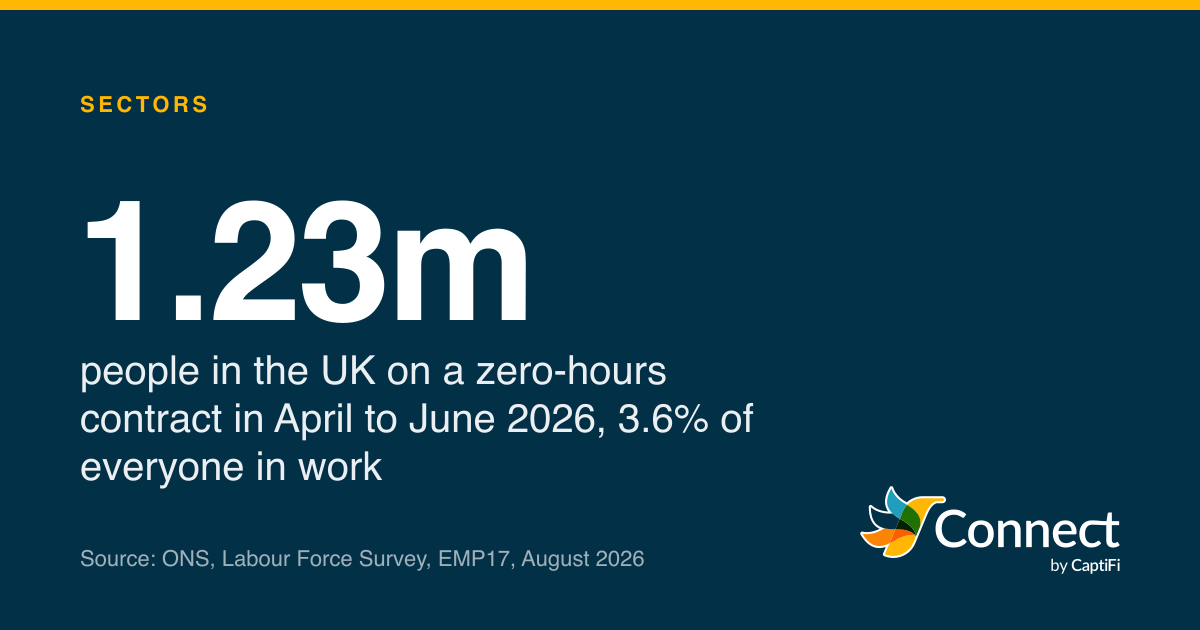
1.23m: people in the UK on a zero-hours contract in April to June 2026, 3.6% of everyone in work. Source: ONS, Labour Force Survey, EMP17, August 2026.
The ONS's Labour Force Survey put 1,230,049 people on a zero-hours contract in April to June 2026, which is 3.6% of everyone in work in the UK. That's 325,880 more than in the same quarter of 2016, and 337,425 of them, 27%, work in accommodation and food. Those are the people whose Saturday night depends on a message that arrives on Thursday, or on Saturday afternoon, or sometimes not at all.
A shift text is about the least glamorous message a business sends. It is also one of the few where the law is about to take an interest in how much notice it gives. The Employment Rights Act 2025 contains a right to reasonable notice of shifts and a right to be paid when a shift is cancelled or cut short at short notice, both due in 2027. The text that goes out from the manager's phone on a Thursday evening is where those rights will be tested, so it pays to get the habit right before the regulations arrive.
Who is on the end of the text
The ONS has published its zero-hours series since 2000. The count more than doubled between the end of 2012 and the end of 2013, from 252,289 to 585,321, and since then it has sat between 600,000 and 1.2 million. The two most recent readings, January to March and April to June 2026, are the highest in the series.
Labour Force Survey, not seasonally adjusted, rounded here to the nearest 10,000. The ONS reweighted the series from 2019 and changed its method from January to March 2020, so the earlier years are not strictly comparable with the later ones.
Source: ONS, EMP17 people in employment on zero-hours contracts, August 2026 (table 1)
See the figures as a table
| People (m) | |
|---|---|
| 2014 | 0.62 |
| 2015 | 0.75 |
| 2016 | 0.9 |
| 2017 | 0.88 |
| 2018 | 0.78 |
| 2019 | 0.9 |
| 2020 | 1.08 |
| 2021 | 0.92 |
| 2022 | 1.06 |
| 2023 | 1.22 |
| 2024 | 1.04 |
| 2025 | 1.18 |
| 2026 | 1.23 |
The detail in the August 2026 tables says a lot about how the texts need to work. People on zero-hours contracts in April to June 2026 worked an average of 18.1 actual hours a week, against 32.2 for people not on one, and 882,651 of them (71.8%) counted themselves as part time. Just under four in ten, 479,332, were aged 16 to 24, which is 12.7% of everyone that age in a job. The rest are spread across every age, including 83,395 people aged 65 and over.
The tables also show how much the hours move about. Table 9 compares the hours people worked in the survey week with the hours they usually work. Of the 1,230,049 on zero-hours contracts, 565,762 (46.0%) worked their usual hours, 168,982 (13.7%) worked up to five hours fewer, 102,687 (8.3%) five to ten fewer, and 193,778 (15.8%) more than ten hours fewer than usual. Roughly four in ten, in other words, had a week that was shorter than they'd planned for, which is the gap a cancellation text lands in.
By industry, hospitality dominates, and health and social work, retail and education make up most of the rest.
Labour Force Survey estimates, not seasonally adjusted. The ONS groups industries as shown; 'transport, arts, other services' combines SIC sections H, R, S and T.
Source: ONS, EMP17 people in employment on zero-hours contracts, August 2026 (table 6)
See the figures as a table
| People | |
|---|---|
| Accommodation and food | 337,425 |
| Transport, arts, other services | 229,613 |
| Health and social work | 162,538 |
| Wholesale and retail | 137,910 |
| Education | 107,027 |
| Admin and support services | 82,823 |
| Info, finance, professional | 64,558 |
| Production incl. agriculture | 50,593 |
| Construction | 33,160 |
| Public administration | 22,588 |
Put together, that's a workforce that is young and part time, working for a business that doesn't know on Monday how busy Friday will be. Email is the wrong tool for them, because a shift offer is time sensitive and nobody checks email between lectures. A text arrives on the phone in their pocket and can be answered with one word.
What the 2025 Act says about notice
The Employment Rights Act 2025 (chapter 36) inserts two new chapters into the Employment Rights Act 1996. Section 2 adds Chapter 3, "shifts: rights to reasonable notice". The core of it, new section 27BJ(1), says that "an employer must give to a worker reasonable notice of a shift that the employer requests or requires the worker to work", where the worker is on a zero hours contract, a zero hours arrangement, or another kind of contract to be specified in regulations. Section 27BK does the same for cancellations and changes, and it defines a change as "a change to when the shift is to start or end" or "a reduction in the number of hours to be worked during the shift because of a break in the shift". Under 27BJ(4), notice given "less than a specified amount of time before the shift is due to start" is presumed not to be reasonable "unless the contrary is shown". A worker who doesn't get reasonable notice can complain to an employment tribunal within six months, and under 27BO the tribunal may award compensation for "financial loss sustained by the worker which is attributable to the matter complained of", up to a specified cap.
Section 3 adds Chapter 4, the right to payment for cancelled, moved and curtailed shifts. New section 27BP(1) requires an employer to "make a payment of a specified amount to a worker" when it cancels, moves or curtails a qualifying shift at short notice. "Short notice" is, again, "less than a specified amount of time before the shift would have started", and section 27BQ(4) says that amount of time "may not" be more than seven days. The payment for a cancelled shift can't be set above "the amount of remuneration to which the worker would have been entitled" for the hours lost.
Every "specified" in those sentences means a number the Act leaves to regulations, and that's where the timing comes in. The first commencement regulations, SI 2026/3, brought sections 1 to 3 into force only "in so far as conferring a duty to consult or a power to make regulations". The government's own timeline, updated on 14 October 2026, lists the "introduction of the right to guaranteed hours and the right to reasonable notice and short notice payments" under "measures that will take effect in 2027", with a note that "timings will be updated after consultation". Its factsheet on the reforms says the regulations will "state how much notice should be presumed reasonable" and set out "the factors which should be considered", and that both rights "should only apply to people below an 'hours threshold'" that the regulations will define.
Two things in the factsheet matter for anyone writing the texts. The rights cover "employer-initiated changes only", so "if two workers agree between themselves to swap shifts at unreasonable notice" the employer isn't liable, and a worker who drops a shift at short notice or doesn't turn up isn't owed a short notice payment. And the government "intends that there may be some limited exceptions from the requirement to pay", also to be set in regulations. The Act extends both rights to agency workers too, with the hirer "responsible, by default, for making guaranteed hours offers" and the agency responsible for short notice payments, which it "will be able to recoup" from the hirer. So the record of who asked for what, and when, is going to matter, and a text thread is a record with timestamps on both sides.
What good practice already looks like
You don't have to wait for 2027 to be told what reasonable looks like. Acas's current guidance on zero-hours contracts says "employers should have a clear policy on cancelling work", including "the notice they will give and details of any compensation", and that they should use "a fair and transparent process for sharing out work", making clear that "the work is not guaranteed and can quickly end". A cancellation text that names the notice given and the compensation due is that policy in action, one message at a time, and it's a lot easier to write if the policy exists first. It also restates the thing that makes a zero-hours text different from a rota pinned to a wall: "you do not have to take any work offered". A shift text is an offer, and the reply is an answer, which is why it needs to be a two-way message and why the first word of the reply matters.
A note on the rules for sending them. Texts to your own staff about their work are not direct marketing, so PECR's consent rule for marketing texts doesn't apply. The ICO's direct marketing guidance describes a service message as one that is "for administrative or customer services purposes" and not promotional, and a rota text is plainly that. The one trap is mixing in a promotion ("extra shifts this weekend, and tell your mates about our new cocktail menu" is a different kind of message), so keep the staff number for staff business.
The texts themselves
Six messages cover most of a rota, and all of them fit in one 160-character part.
The offer, to one person or to everyone who can do the job:
The Anchor: shift available Sat 25 Oct, 18:00 to 23:00, bar. Reply YES to take it. First reply gets it and we'll confirm.
The confirmation, which is the one that counts as notice:
The Anchor: confirmed, you're on Sat 25 Oct 18:00 to 23:00 on the bar. Reply if anything changes.
The reminder, the day before, with a one-letter reply:
The Anchor: reminder, you're on tomorrow (Sat) 18:00 to 23:00. Reply C to confirm.
The change, which under the Act will count as a change if it moves the start or end time:
The Anchor: your Sat shift now starts at 19:00 (was 18:00), same finish. Reply OK so we know you've seen this.
The cancellation, which is the one to think hardest about, because it's the one that will carry a payment in 2027:
The Anchor: sorry, we've had to cancel your shift on Sat 25 Oct, 18:00 to 23:00. Jo will call you about it. Reply if you'd rather text.
And the cover request, to the group:
The Anchor: can anyone cover Sun 26 Oct, 12:00 to 17:00, kitchen? Reply YES and the first to answer gets it.
A few habits round them out. Send the offer and the confirmation as separate messages, because the confirmation is the evidence that notice was given and when. Send the reminder from a schedule rather than from memory. Reply to replies, and reply quickly to a YES on a cover request, because the person who said yes has reorganised their day on the strength of it. And give the firm's name first every time, since a message from an unknown number asking someone to come in looks like a scam and gets treated like one.
One more thing on group sends. A cover request to twenty people is a campaign in sending terms, and CaptiFi Connect's campaign quiet hours default to 21:00 to 09:00 London time, which is the right default for customers and, most weeks, for staff. The 23:30 request for a Sunday lunchtime shift can wait until morning, and the person who'd have answered it at midnight probably shouldn't.
Hospitality is where most of this lands, and our pages for pubs and bars and restaurants cover the customer side of texting in the same businesses. The staff side is on the staff alerts page. CaptiFi Connect gives a rota a UK mobile number with a two-way inbox, where replies are free, scheduled sends for reminders, and team logins so the duty manager can send from the same number as the owner. When the regulations fix the notice period, the sent time on every shift text in the inbox is the record of whether you met it.
Sources
Read for this post on 17 October 2026.
- ONS: EMP17, People in employment on zero-hours contracts (dataset page)
- ONS: EMP17, People in employment on zero-hours contracts, August 2026 edition (tables 1, 2, 5, 6 and 8)
- legislation.gov.uk: Employment Rights Act 2025, section 2 (shifts: rights to reasonable notice)
- legislation.gov.uk: Employment Rights Act 2025, section 3 (right to payment for cancelled, moved and curtailed shifts)
- legislation.gov.uk: Employment Rights Act 2025 (Commencement No. 1 and Transitional and Saving Provisions) Regulations 2026, regulation 2
- GOV.UK: Plan to Make Work Pay and Employment Rights Act, timeline update (14 October 2026)
- GOV.UK: Factsheet, reforms of zero hours and similar contracts
- Acas: Zero-hours contracts
- ICO: Direct marketing guidance, Identify direct marketing
Written by the CaptiFi Connect team. Published 17 October 2026. More in Sectors
Send your first text this week
Set up your account and contacts now; we check every new account before it can send.