
Rules and trust9 min read
Texting other businesses: where PECR draws the line
PECR's consent rule for texts protects individual subscribers, and 57% of UK businesses are sole traders. What that means before you text a trade customer.
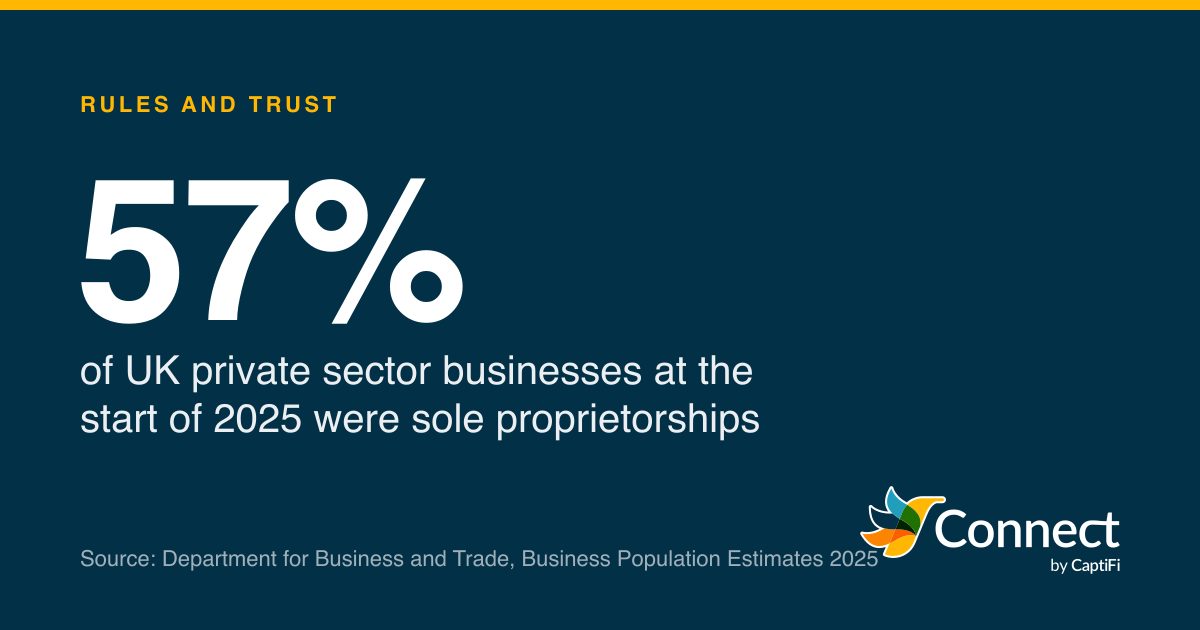
57%: of UK private sector businesses at the start of 2025 were sole proprietorships. Source: Department for Business and Trade, Business Population Estimates 2025.
At the start of 2025 the UK had 5.7 million private sector businesses, and 3.2 million of them were sole proprietorships. That's the Department for Business and Trade's count, published on 2 October 2025 in its Business Population Estimates, and it puts sole traders at 57% of the whole. Keep that number in mind the next time someone tells you the texting rules don't apply to business customers. For more than half the businesses in the country they apply in full.
The confusion is understandable, because the law does draw a line between businesses and people. It just doesn't draw it where most people assume. The line runs between two kinds of subscriber, and which side a business lands on depends on its legal form, not on whether it has a trading name and a van.
Two kinds of subscriber
The Privacy and Electronic Communications Regulations 2003 (PECR, if you want the short version) don't talk about customers or consumers. They talk about subscribers. Regulation 2 defines a subscriber as "a person who is a party to a contract with a provider of public electronic communications services", so the subscriber for a mobile number is whoever holds the contract for it. Then the regulation splits subscribers in two.
A corporate subscriber, in the regulation's own words, is "a company within the meaning of section 735(1) of the Companies Act 1985", a company incorporated by royal charter or letters patent, "a partnership in Scotland", a corporation sole, or "any other body corporate or entity which is a legal person distinct from its members". Limited companies, LLPs, Scottish partnerships, most public bodies. An individual, on the other hand, is "a living individual and includes an unincorporated body of such individuals". That second half is the bit people skip. A sole trader is a living individual. An ordinary partnership in England, Wales or Northern Ireland is an unincorporated body of them. Neither has a legal personality separate from its owners, so neither can be a corporate subscriber. The ICO's business-to-business marketing page says as much: sole traders and these partnerships are individual subscribers, and PECR treats them the same as it treats any other individual.
So the question to ask about a number on your list is who holds the contract behind it, a company or a person. "Is this a business?" gets you nowhere.
What regulation 22 says
Regulation 22 is the one that governs a marketing text, because PECR's definition of "electronic mail" is "any text, voice, sound or image message sent over a public electronic communications network", and the definition goes on to say that includes messages sent by SMS. Regulation 22(1) says the regulation "applies to the transmission of unsolicited communications by means of electronic mail to individual subscribers". Then 22(2) bans sending, or instigating the sending of, unsolicited marketing by electronic mail "unless the recipient of the electronic mail has previously notified the sender that he consents", with two exceptions.
The first exception, in 22(3), is the soft opt-in. You got the contact details in the course of a sale or negotiations for one, you're marketing only your own similar products or services, and you gave a simple, free way to refuse both when you collected the details and in every message since. The second, 22(3A), was inserted on 5 February 2026 by the Data (Use and Access) Act 2025 and gives charities a version of the soft opt-in for people who've shown an interest in their cause or supported it. (There's a separate post on that one: charity texting and the new soft opt-in.)
Look again at who 22(1) names: individual subscribers, and nobody else. The ICO's guidance draws the conclusion for you: "The PECR rule on direct marketing by electronic mail does not apply to corporate subscribers." As far as regulation 22 goes, you can text a limited company's number without asking first.
Two rules still cover every marketing text, whoever receives it. Regulation 23 bans marketing by electronic mail "where the identity of the person on whose behalf the communication has been sent has been disguised or concealed", and where no valid address has been given to which the recipient can send a request for the messages to stop. And although PECR doesn't spell out an opt-out right for corporate subscribers, the ICO's page says you should comply with a corporate subscriber's request to stop anyway, and keep a "do not email or text" list of the businesses that have asked.
Then there's the UK GDPR, which runs alongside PECR and cares about people rather than subscribers. The ICO's worked example is an email to a named HR director at a limited company. PECR's corporate rules apply to the email, but the address identifies a person, so it is personal data "even if they are acting in their business capacity", and that person's objection to direct marketing is absolute. The recruitment firm in the example had to stop and add the address to its do-not-contact list. A mobile number that rings one named person at a company is the same thing in a different format.
How many businesses sit on each side
The Business Population Estimates for 2025 give the legal form of every one of their 5.7 million businesses, and the split is lopsided.
Rounded as published: 3.2 million, 2.1 million and 368,000 out of 5.7 million in all. Companies are actively trading companies. The estimates leave out the not-for-profit sector.
Source: Department for Business and Trade, Business Population Estimates 2025
See the figures as a table
| Businesses (m) | |
|---|---|
| Sole proprietorships | 3.2 |
| Companies | 2.1 |
| Ordinary partnerships | 0.37 |
Sole proprietorships, 3.2 million, or 57%. Actively trading companies, 2.1 million, or 37%. Ordinary partnerships, 368,000, or 6%. Put the sole traders and the ordinary partnerships together and you have about 63% of the businesses in the country sitting on the individual-subscriber side of PECR before you've looked at a single phone number. (That total includes Scottish partnerships, which PECR counts as corporate, so the true share is a touch lower. It's still well past half.) And the individual side is the one that's growing: the release has sole proprietorships up 138,900 on 2024, a 5% rise, against 40,200 more companies at 2% and 12,200 more ordinary partnerships at 3%.
The employment figures tell the same story from another angle.
No employees means nobody on the payroll aside from the owners. About 3.0 million of the 3.2 million sole proprietorships are in that group.
Source: Department for Business and Trade, Business Population Estimates 2025 (table C)
See the figures as a table
| Businesses | |
|---|---|
| No employees | 4,272,535 |
| Employers | 1,417,730 |
4,272,535 businesses, 75% of the total, had no employees aside from the owners. 1,417,730 employed somebody. The no-employee group is where the sole trader's mobile lives: the plumber, the mobile hairdresser, the freelance designer, the window cleaner, the childminder, the bloke who does your gutters. Each of those is a business in every ordinary sense and an individual in PECR's. Because a sole trader has no legal existence apart from the person, any phone contract they hold is held by that person, which makes them the individual subscriber whether the phone is "for work" or not.
Which leaves the doubtful cases, and there are plenty. A trading name on a van, a number from a trade directory, a contact you met at a show who gave you a mobile without saying what the business was. The ICO's advice for those is short: if you're unsure whether a recipient is a corporate or an individual subscriber, treat them as an individual.
What this means for a trade campaign
Say you run a tool hire depot, or a builders' merchant, or a wholesaler, and you want to text your trade customers about a price or an event. The sums above say most of the numbers on your list belong to people, in law, however many of them have a company name painted on the door.
Sort the list by legal form before anything else. A Companies House number on an invoice means a company. A trading name with no Ltd or LLP after it is probably a sole trader or an ordinary partnership, and goes in the individual pile. Unknown goes in the individual pile too, per the ICO.
For the individual pile you need consent or the soft opt-in. For existing customers the soft opt-in usually does the job, provided you gave them the chance to refuse when you took the number and you give it again in every text. For prospects you need consent, and consent is a specific thing (the ICO's electronic mail page gives ticking an opt-in box as the example, and our post on writing a consent request that stands up goes through the wording). A number someone handed you at a show, with no word about texts, covers neither.
For the company pile regulation 22 doesn't bite, so you can text without prior consent. You still have to say who you are, still have to give a way to stop, still have to honour a stop when it comes, and still have to treat a text that reaches one named person as that person's data under the UK GDPR. In practice the company text ends up looking exactly like the individual one.
Keep one suppression list across both piles, and run every number through it before every campaign. A stop from a company and a stop from a sole trader land in the same place.
And remember what regulation 22 is about. PECR defines direct marketing as "the communication (by whatever means) of advertising or marketing material which is directed to particular individuals". A booking confirmation or an invoice reminder isn't advertising, so neither needs the consent dance, whoever the recipient is. The marketing text does.
Two samples, so the difference is on the page. A service text to a trade customer, any legal form:
Ashby Tool Hire: your mini digger is booked for Mon 24 Nov, collect from 07:30. Reply C to confirm.
And a marketing text to the same customer, which needs consent or the soft opt-in if the customer is a sole trader, and an honest sender and a way out whoever they are:
Ashby Tool Hire: trade customers get 10% off digger and dumper hire until 30 Nov. Reply HIRE and we'll ring you back. Reply STOP to opt out.
CaptiFi Connect treats STOP, STOPALL, UNSUBSCRIBE, CANCEL, END, QUIT and OPTOUT replies as an opt-out and blocks the number from future campaigns on its own, and campaign texts carry "Reply STOP to opt out" unless you remove it, so the regulation 23 address and the suppression list look after themselves. The sorting of the list is still your job.
Reading the rules yourself
Everything above is on two public sites. Regulations 2, 22 and 23 are on legislation.gov.uk, and the version of regulation 22 you want is the one dated 5 February 2026, which carries the charity paragraph. The ICO's business-to-business marketing page is the clearest statement of the sole trader point, and its electronic mail marketing page in the Guide to PECR covers the soft opt-in conditions and the identity rule. The Business Population Estimates for 2025 are on gov.uk as an HTML release with the tables underneath; table C has the exact counts for employers and non-employers, and the legal form figures are in the section on the composition of the business population.
One caution on the business figures. The Department for Business and Trade labels the series official statistics in development, because its estimate of unregistered businesses rests on Labour Force Survey data whose own status was downgraded in 2024. The direction of the numbers hasn't changed with the label. The 2025 count is 3.2 million sole proprietorships, 138,900 more than a year earlier, and every one of them is an individual subscriber.
Sources
Read for this post on 17 October 2026.
- legislation.gov.uk: PECR 2003, regulation 2 (interpretation)
- legislation.gov.uk: PECR 2003, regulation 22 (use of electronic mail for direct marketing)
- legislation.gov.uk: PECR 2003, regulation 23 (concealed identity or address)
- ICO: Business-to-business marketing
- ICO: Guide to PECR, electronic mail marketing
- Department for Business and Trade: Business Population Estimates for the UK and regions 2025
Written by the CaptiFi Connect team. Published 17 October 2026. More in Rules and trust
Send your first text this week
Set up your account and contacts now; we check every new account before it can send.