
Behind the scenes9 min read
UK mobile numbers: what the numbering plan says
Not every 07 number is a mobile. Ofcom's Numbering Plan gives 070 to personal numbers and 076 to pagers, and its weekly data file shows who holds the rest.
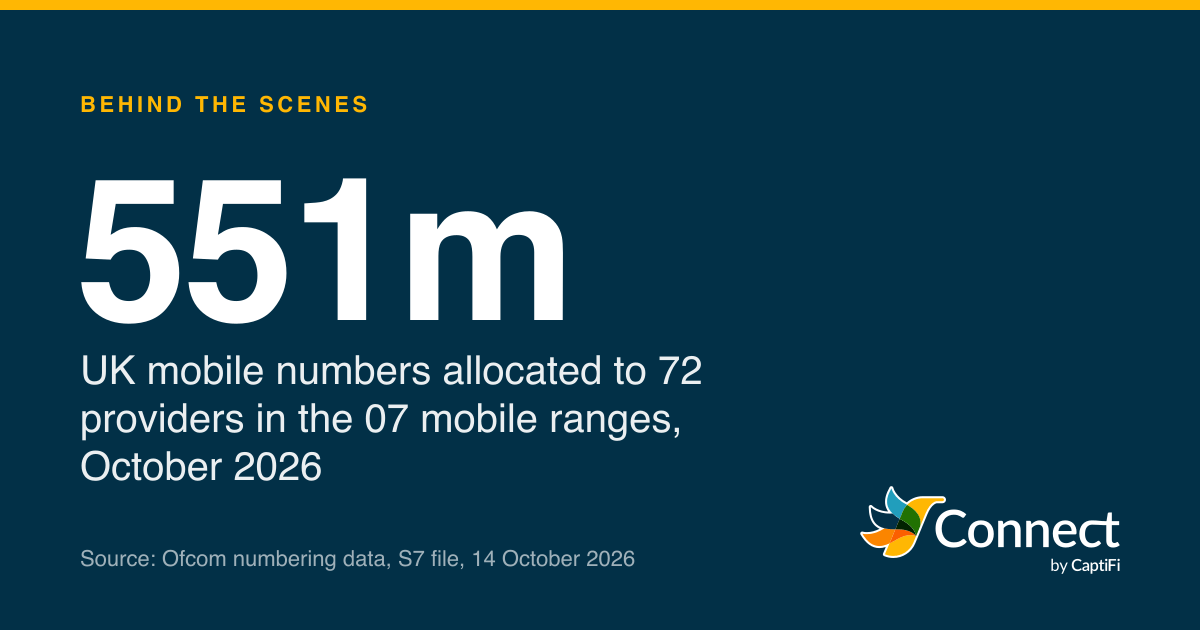
551m: UK mobile numbers allocated to 72 providers in the 07 mobile ranges, October 2026. Source: Ofcom numbering data, S7 file, 14 October 2026.
There are 100 million numbers beginning 070 and none of them is a mobile. Ofcom's numbering data file for 14 October 2026 shows 43 million of them allocated to providers, and a spreadsheet of customer numbers will have a few in it, because they look exactly like the mobiles either side of them. Send a text to one and you've paid for a message that may never reach a handset.
Which 07 numbers are mobiles, which aren't, and who holds them is all public. Ofcom publishes the rulebook as the National Telephone Numbering Plan and the inventory as a set of files updated every Wednesday. Between them they answer the question any sender should ask before loading a list: is this a number a text can reach?
What the Plan says about 07
The Plan is a PDF on Ofcom's numbering page, the current version in effect from 22 April 2025 (the page itself was last updated on 3 February 2026 and keeps a table of amendments going back to 2017). Part A1 is a table of every number range in the country with its designation, and the 07 rows are short:
- 070: Personal Numbers.
- 076: Radiopaging Service, "except 07624, see Part C5".
- 071 to 075 inclusive and 077 to 079 inclusive: Mobile Services.
So of the ten 07 ranges, eight are mobile and two aren't. The Plan defines a Mobile Number as "a Non-Geographic Number that is Adopted or otherwise used as part of a Mobile Service to identify Apparatus designed or adapted to be capable of being used while in motion", and a Mobile Service as one where every signal goes "through the agency of Wireless Telegraphy" to or from such apparatus. A phone in a pocket, in other words.
The Plan also fixes the length. Paragraph B2.1 says numbers in Part A1 "shall comprise ten (10) digits (excluding the national prefix code '0')" unless the Plan says otherwise, and B2.2 names the digit positions "SABCDEFGHI", where S is the first digit after the 0. A UK mobile is therefore 0 plus ten digits, 07 plus nine, and anything shorter or longer has been mistyped. The S7 data file agrees: every one of its 9,518 blocks is marked "10 digit numbers".
070: the numbers that look like mobiles and aren't
Ofcom's guidance on 070, first published in October 2004 and last updated in March 2023, puts it plainly: "070 is set aside for Personal Numbering Services". A personal number is one that "allows a Subscriber to receive calls or other communications at almost any Telephone Number", including a mobile. The Plan describes the service as one "based on number translation": the 070 number is a front door, and whatever sits behind it (a landline, a mobile, an office switchboard, nothing at all today) is up to the subscriber. Part B3.4 adds that anyone using a personal number "shall not directly or indirectly share" revenue from it with an end user or a caller, which is the Plan's answer to the years when 070 numbers were used to run up callers' bills.
For a texting business the point is simpler. A 070 number is not a handset. It may forward to one, or it may not, and an SMS gateway has no way to know. In the October 2026 file, 43.06 million 070 numbers are allocated, 56.34 million are marked Protected, and under a quarter of a million are Free, so the range is far from empty, and 070 numbers will turn up in any list long enough.
- Allocated
- Protected
Summed from the block sizes in the file. Smaller statuses are left off: 2.9m mobile-range numbers are Free and 4.2m Reserved; 5.47m in 076 are Free. 07624, the Isle of Man range, is counted with 076.
Source: Ofcom numbering data, S7 file (07 numbers), 14 October 2026
See the figures as a table
| Allocated (m) | Protected (m) | |
|---|---|---|
| 070 personal numbers | 43.06 | 56.34 |
| 076 radiopaging | 12.52 | 32.01 |
| 071 to 075 and 077 to 079 | 551.5 | 232.2 |
076: pagers, and the Isle of Man exception
The 076 range is for radiopaging, which the Plan defines as a service in its own right, separate from Mobile Services, and B3.4A applies the same ban on revenue sharing to it as to 070. The file shows 12.52 million 076 numbers allocated, 32.01 million Protected and 5.47 million Free. Pageone Communications Limited holds 39 blocks in the file, all of them in this range.
The exception is 07624, which Part C5 of the Plan lists under "Public Communications Network Numbers which have been individually Allocated" as "Radiopaging Service and Mobile Services (Isle of Man Communications Commission)". The Plan adds that "these numbers are no longer available for Allocation, but numbers which have been Allocated may be Adopted or otherwise used". In the file most of the 07624 blocks sit with Manx Telecom Trading Limited, with Sure (Isle of Man) Limited and BlueWave Communications Limited on the rest. So a number starting 07624 is a Manx mobile and a text can reach it, while a number starting 07625 is not.
Who holds the mobile ranges
The S7 file is the useful one for the eight mobile ranges. Ofcom says it aims to update the telephone number files "every Wednesday", and the version read for this post was published on 14 October 2026. It lists 9,518 blocks across all of 07, each with a status (Allocated, Protected, Free, Reserved or Quarantined), the communications provider it's allocated to, and the allocation date. The blocks come in three sizes, so the honest way to read it is to turn blocks into numbers.
Done that way, the 071 to 075 and 077 to 079 ranges contain 791 million numbers in the file, of which 551.5 million are allocated to 72 different providers, 232.2 million are Protected, 4.2 million are Reserved and 2.9 million are Free. In the mobile ranges the oldest allocation dates are from 1997 and the newest are 19 blocks dated 2026. The only older entries in the whole file are 30 blocks from 1995, all in 070 and split ten each between Vodafone, Flextel and Telefonica UK, which is a reminder that personal numbers were being handed out before most of the mobile ranges were.
Blocks in the 071 to 075 and 077 to 079 ranges marked Allocated, summed by block size (the file lists blocks of 10,000, 100,000 and 1,000,000 numbers). Holder names as written in the file. A ported number stays in its original block, so this shows who was allocated the range, not who serves the customer now.
Source: Ofcom numbering data, S7 file (07 numbers), 14 October 2026
See the figures as a table
| Numbers allocated (m) | |
|---|---|
| Telefonica UK Limited | 156.4 |
| Vodafone Limited | 115.6 |
| Hutchison 3G UK Ltd | 94 |
| EE Limited (TM) | 89 |
| EE Limited (Orange) | 62.5 |
| Lycamobile (UK) Limited | 8.1 |
| All other holders (66) | 25.9 |
Five company names hold 517.5 million of the 551.5 million. Telefonica UK Limited has 156.4 million, Vodafone Limited 115.6 million, Hutchison 3G UK Ltd 94.0 million, and EE Limited appears twice in the file, as "EE Limited ( TM)" with 89.0 million and "EE Limited (Orange)" with 62.5 million, which is 151.5 million between the two names. Lycamobile (UK) Limited is next with 8.1 million, then Virgin Mobile Telecoms Limited with 3.1 million and Gamma Telecom Holdings Limited with 2.4 million, and the remaining 64 holders share what's left.
One caveat the file can't carry. The Plan defines a Mobile Number Portability Code, "a Network Code used for the Portability of Mobile Numbers", and portability is the reason the holder of a block tells you less than it seems to. A customer who took a Vodafone number in 2009 and moved to another network in 2019 kept the number, so it still sits in a Vodafone block in the S7 file while the network that rings it is someone else's. The file is a map of where numbers came from, and only that.
Guernsey, Jersey and the Isle of Man
The three Crown dependencies are not part of the UK, but they share its country code and sit inside Ofcom's Plan. Appendix A lists their landline codes alongside everyone else's: 01481 Guernsey, 01534 Jersey, 01624 Isle of Man. Their mobile ranges are 07 blocks allocated to their own operators, and they're in the same S7 file as the UK networks.
Reading the file by holder: Jersey Telecom has 2.11 million allocated numbers (its 07509 and 07937 blocks, and 07797 7 to 9, with seven more 07797 blocks marked Reserved), Sure (Jersey) Limited has 300,000 and Jersey Airtel Limited another 300,000 in 07829. For Guernsey, Sure (Guernsey) Limited has 1.1 million, most of them the ten 07781 blocks allocated on 4 August 1997, with Guernsey Airtel Limited and JT (Guernsey) Limited on smaller blocks in 07839 and 07911. For the Isle of Man, Manx Telecom Trading Limited has 2.4 million across 07624, 07924 and a handful of 074 blocks, and Sure (Isle of Man) Limited has 210,000.
In practice that means a Jersey or Guernsey or Manx mobile dials, formats and texts exactly like a UK one: +44, then ten digits, with the island invisible in the number unless you know the blocks. CaptiFi Connect sends to the UK, Guernsey, Jersey and the Isle of Man, which is to say to the 07 mobile ranges in this file and nothing outside them.
From 07 to +44
The international form of a number is defined by ITU-T Recommendation E.164, "The international public telecommunication numbering plan", whose current edition was approved on 13 February 2026. The ITU's summary says it "provides the number structure and functionality for the eight categories of numbers", and the mobile standards lean on it directly: 3GPP TS 23.003, which ETSI publishes as TS 123 003, says mobile subscriber numbers "(i.e. E.164 numbers) are assigned from the E.164 numbering plan" and are built from a Country Code "followed by" a National (significant) number, itself made of a National Destination Code and a Subscriber Number. It adds that "a National Destination Code is allocated to each PLMN", a public land mobile network, and that "in some countries more than one NDC may be required for each PLMN", which is the UK's situation exactly: each network holds many 07 blocks, not one code.
Put the two documents together for a UK mobile. The country code is 44. The national significant number is the ten digits after the 0, per B2.1 of the Plan. So 07700 900123 becomes +44 7700 900123: drop the 0, add the 44, twelve digits in all. The glossary entry on E.164 covers the formatting rules and the mistakes (keeping the 0 after the 44, writing 0044, pasting spaces) that break them.
Checking a number before you send
Everything above turns into a short routine that a sending system, or a spreadsheet, can run on every number before it costs anything.
- Strip it. Remove spaces, brackets, dashes and dots, and convert a leading 0044 or +44 to 44.
- Check the length. A UK mobile in E.164 form is 44 followed by exactly ten digits. Nine or eleven is a typo, and no amount of goodwill fixes it.
- Check the range. The digits after 44 must start with 71, 72, 73, 74, 75, 77, 78 or 79, or with 7624. A 70 is a personal number and a 76 anything else is a pager; neither is a mobile under the Plan, so neither should be on a list of mobiles.
- If you want to go further, look the block up in S7. A block marked Free, Protected or Quarantined hasn't been given to any provider, so a number in it can't be live. The file is free, weekly and a single CSV.
None of this tells you whether a number is in service, or who answers it. For that there's only one test, which is sending to it and reading the delivery receipt, and a receipt is what the delivery reports page is about. What the Plan and the file do is stop you paying to find out the answer for numbers that could never have been mobiles in the first place.
If you send through the API, CaptiFi Connect's error codes page lists what a badly formed number gets back, and the test keys let you run a whole list through without sending a thing. The S7 file will have changed by next Wednesday. The 07 rows in the Plan have been the same since the ranges were set out, and 070 will still not be a mobile.
Sources
Read for this post on 17 October 2026.
- Ofcom: The National Telephone Numbering Plan, version with effect from 22 April 2025
- Ofcom: Telecoms numbering (the Plan and its amendments)
- Ofcom: Numbering data (weekly telephone number files)
- Ofcom: S7 numbering data file, 07 numbers, 14 October 2026
- Ofcom: Personal Numbering, guidance on the acceptable use of 070 numbers
- ETSI: TS 123 003 V18.8.0, Numbering, addressing and identification (3GPP TS 23.003)
- ITU: Recommendation ITU-T E.164, The international public telecommunication numbering plan
Written by the CaptiFi Connect team. Published 17 October 2026. More in Behind the scenes
Send your first text this week
Set up your account and contacts now; we check every new account before it can send.