
By the numbers8 min read
Delivery updates: what the parcel data says
Ofcom counted 4.2bn UK parcels in 2024-25; Citizens Advice found 37% of people had a problem with their last one. What the figures mean for a delivery text.
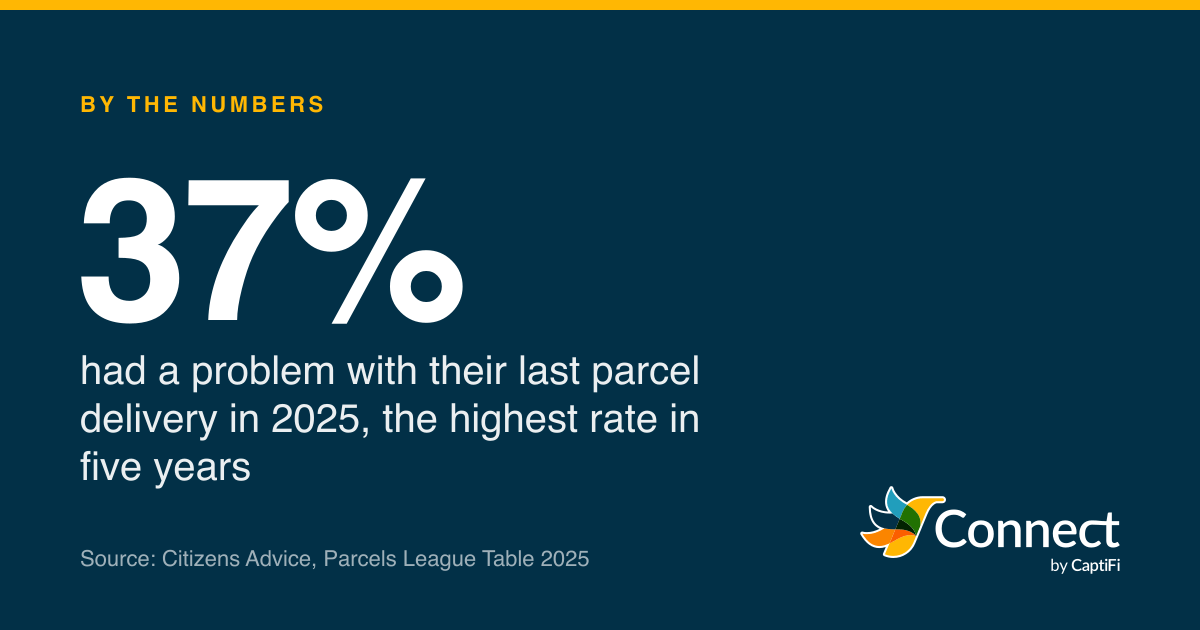
37%: had a problem with their last parcel delivery in 2025, the highest rate in five years. Source: Citizens Advice, Parcels League Table 2025.
Thirty-seven per cent of people had a problem with their last parcel delivery. That's the headline from the fifth Citizens Advice Parcels League Table, published on 19 November 2025 and built on an Opinium survey of 8,000 UK adults who'd had a parcel from one of the five biggest carriers in the previous month. It's the highest rate in the five years the table has run, and it has never once been below a third. Of the people with a problem, 29% said the driver left before they could get to the door, 24% said the parcel was left somewhere insecure, and 24% said it arrived late.
For four of those five years the single most common delivery problem in the country has been a driver leaving too quickly. That's a problem of information as much as logistics: the person didn't know the van was coming, or didn't know when. A text that says "between 11:20 and 13:20" fixes a fair share of it, and the rest of this post is about what the parcel figures say such a text should contain.
How many parcels, and where they come from
Ofcom's post monitoring report for 2024-25 measured 4.2 billion parcels across the UK market, up 7.1% on the year and 4% above the pandemic peak of 2020-21. Domestic parcels were 3.6 billion of that, up 5.8%. International inbound parcels grew 19.8%, which Ofcom says was "likely driven by parcels coming into the UK from China". Next day services carried 62.6% of domestic volume, down 2.5 percentage points as slower, cheaper services took a bigger share, and 12% of all parcels went to a locker or a shop instead of a front door. Parcel revenues came to £13.2bn, and the average parcel earned its carrier £3.13, 7.3% less in real terms than the year before.
Annual averages of the monthly ratio, value of internet sales as a percentage of all retail sales, Great Britain. The monthly figure peaks each November.
Source: ONS, Retail Sales Index, series J4MC (released 18 September 2026)
See the figures as a table
| Internet share (%) | |
|---|---|
| 2012 | 9.3 |
| 2013 | 10.4 |
| 2014 | 11.3 |
| 2015 | 12.5 |
| 2016 | 14.7 |
| 2017 | 16.3 |
| 2018 | 18 |
| 2019 | 19.2 |
| 2020 | 28.1 |
| 2021 | 30.7 |
| 2022 | 26.6 |
| 2023 | 26.7 |
| 2024 | 27.1 |
| 2025 | 27.5 |
Where do they all come from? The ONS retail sales index tracks internet sales as a share of all retail sales, and the long series tells the story in one line. In 2012 it was 9.3%. By 2019 it had crept up to 19.2%. Then 2020 jumped to 28.1% and 2021 to 30.7%, and when the shops reopened the share settled at about 27%: 26.6% in 2022, 27.1% in 2024, 27.5% in 2025. The monthly figure spikes every November (32.4% in November 2025, the highest month in the series) and the latest value at the time of writing, August 2026, was 27.3%. Just over a quarter of what's bought in British shops now arrives in a van, and that fraction has stopped falling.
What goes wrong, by Ofcom's count
Ofcom runs its own parcel tracker survey twice a year, and the 2025 report (Yonder Consulting, 4,058 people aged 16 and over who'd used a delivery company in the previous six months) is the most detailed public list of what goes wrong. Across all operators, 68% of people had at least one issue in six months; per company, the average was 36%. The ten most reported issues:
Share of 4,058 UK adults who had used a delivery company in the previous six months and reported each issue with any company. Fieldwork by Yonder Consulting, January and July 2025.
Source: Ofcom, Measuring user experience of parcel delivery to residential addresses, 2025
See the figures as a table
| Any delivery company (%) | |
|---|---|
| Delivery delayed | 28 |
| Left in inappropriate location | 26 |
| Did not knock or ring loudly | 20 |
| Too little time to answer door | 19 |
| No attempt to deliver in person | 16 |
| Parcel not delivered | 16 |
| Not left in nominated safe space | 16 |
| Parcel damaged | 15 |
| Poor tracking information | 14 |
| Timeslot process not accessible | 9 |
Delay is the top issue at 28%, and it's the one a sender can do least to prevent and most to explain. The next three (left in the wrong place, 26%; didn't knock loudly enough, 20%; not given enough time to answer the door, 19%) are all versions of the Citizens Advice finding: the person and the driver missed each other. "Incorrect or insufficient tracking information" sits at 14%, which Ofcom groups under "lack of information", the least common category at 23% overall. The information is, mostly, getting through. The handover is where things go wrong.
The same survey asked what people wanted improved. 78% wanted at least one thing, and the top answer was "more / better tracking information" at 18%, ahead of more time to answer the door (16%), drivers reading and following delivery instructions (15%) and delivering on time within the window given (13%). When something goes wrong and people get in touch, 47% are satisfied with the contact process, and the most common complaint about it is being unable to reach the company by phone, at 53%.
Satisfaction with delivery companies overall was 78%, the same as in 2024. So the picture is a service most people are fine with most of the time, which goes wrong for about a third of people on any given parcel, and whose failures cluster around the moment of handover.
Who does it best, and the trust gap
Citizens Advice scores the five largest carriers out of five stars on delivery, accessibility, customer service and trust. In 2025 Royal Mail came top on 3.25, the highest any company has scored in the table's five years, with Amazon Logistics on 3, DPD and Evri level on 2.25 and Yodel last on 2. No company moved more than a quarter of a star in the year. The trust scores are the ones a retailer should look at: Royal Mail scored 4 and Yodel 1.8, a gap of 2.2, and 76% of people who weren't happy with their parcel company put it down to a previous bad experience with that same company. Trust builds up over a lot of parcels and attaches to the name on the van, which is why the first text from the shop should say whose van it'll be.
The complaints side has improved a little and no more. Ofcom brought in guidance on complaints handling in April 2023 and an accessibility condition in November 2023, and Citizens Advice says customer service was the most improved category in 2025, up an average of 0.4 of a star. Even so, 47% of people who had a problem with their last delivery hit a further problem trying to resolve it (48% in 2024), and 38% of those weren't satisfied with the outcome. One in five people (20%) said they had an accessibility need they'd like to share with the carrier, 37% of them couldn't, and 56% of that group had a problem with their last delivery, against 37% of everyone. A delivery text that asks "reply with any instructions for the driver" is a small way round a form the carrier never offered.
The carrier's problem lands on the shop
Citizens Advice found that 77% of consumers didn't get to choose who delivered their parcel. The customer's relationship is with the shop, the shop's relationship is with the carrier, and when the driver leaves too quickly it's the shop that gets the email. In the same survey 13% of people said they'd had too little information about their delivery overall.
The carrier's tracking page belongs to the carrier. What the shop controls is the message it sends around the parcel, and the figures above say what it should do: give the window, name the carrier, say where the parcel is, and give the person a way to answer back that isn't a phone queue.
A delivery update is a service message in the ICO's terms, one that's "for administrative or customer services purposes", so it isn't direct marketing and doesn't need marketing consent under PECR. The ICO's guidance is equally clear that it stops being a service message the moment an offer goes in, even when the offer isn't the main point. Keep the voucher out of the delivery text. (The marketing rules guide covers where the line falls.)
The texts that cover the journey
Four texts cover the journey to the door, and a fifth covers the 12% of parcels that go to a locker or a shop. They're written for a made-up furniture shop, but the shape works for anyone.
Hollins & Co: your order 48213 left us today with DPD. Track it: hllns.uk/t/48213. Reply to this text if anything looks wrong.
Hollins & Co: your parcel is out for delivery today between 11:20 and 13:20. If you're out, DPD will try your safe place or a neighbour.
Hollins & Co: DPD says your parcel was delivered at 12:04 to the porch. Not there? Reply NOT HERE and we'll chase it today.
Hollins & Co: sorry, your parcel has been delayed in DPD's network. New estimate: Thu 12 Mar. We'll text again when it's out for delivery.
Hollins & Co: your parcel is at the Co-op on Mill Lane, ready to collect until Sat 14 Mar. Take the code 48213 and photo ID.
Each one does one job. The first proves the order is real and names the carrier, so the tracking text that follows from DPD doesn't read as a scam (our post on links in texts goes into why that matters). The second is the one that fixes the top problem in the Citizens Advice table: a window, and what happens if you're out. The third tells the person where to look, and turns a lost parcel (Citizens Advice found "lost" and "missing" among the most used words in parcel complaints on social media) into a reply that reaches a person the same afternoon. The fourth is the delay text, the only one that gets ahead of the problem. The fifth does for a collection what the second does for a doorstep: it says where, and until when.
Two habits follow from the figures. Send the window text on the day, as early as the carrier's data allows, because 19% of people said they weren't given enough time to get to the door and a text at 07:30 with a window is the one thing that fixes that from your side. And make every text answerable. Ofcom's finding that 53% of unhappy customers couldn't get the carrier on the phone is a gap a reply can fill.
Cost, and what to watch
All five samples fit in one 160-character part if the link stays short, so a text costs 3.5p to 5p plus VAT on CaptiFi Connect's packs, or under 25p for the whole journey. Ofcom's figure for what the average parcel earned its carrier was £3.13. Scheduling matters more than price. A delivery update at 07:30 is one of the few texts people welcome that early; a delay text at 22:00 is one they'd rather have in the morning, so hold the overnight ones. (Our SMS character counter shows where a text tips into a second part.)
What to watch is the reply. CaptiFi Connect sends from a UK mobile number with a two-way inbox, so NOT HERE lands with a person, and its short tracked links show whether the tracking page was opened at all. The 29% whose driver left before they got to the door were in. They just didn't know the van was outside.
Sources
Read for this post on 17 October 2026.
- Citizens Advice: Parcels League Table 2025
- Citizens Advice: Parcels League Table 2025, full report
- Ofcom: Post monitoring report, postal services in the financial year 2024-25
- Ofcom: Measuring user experience of parcel delivery to residential addresses, 2025
- Ofcom: Post monitoring reports
- ONS: Internet sales as a percentage of total retail sales, series J4MC
- ICO: Direct marketing guidance, identify direct marketing
Written by the CaptiFi Connect team. Published 17 October 2026. More in By the numbers
Send your first text this week
Set up your account and contacts now; we check every new account before it can send.