
Sectors8 min read
Dental recalls by text
Four in ten adults in England saw an NHS dentist in two years. NICE sets recall intervals of 3 to 24 months. How a recall text brings them back, with samples.
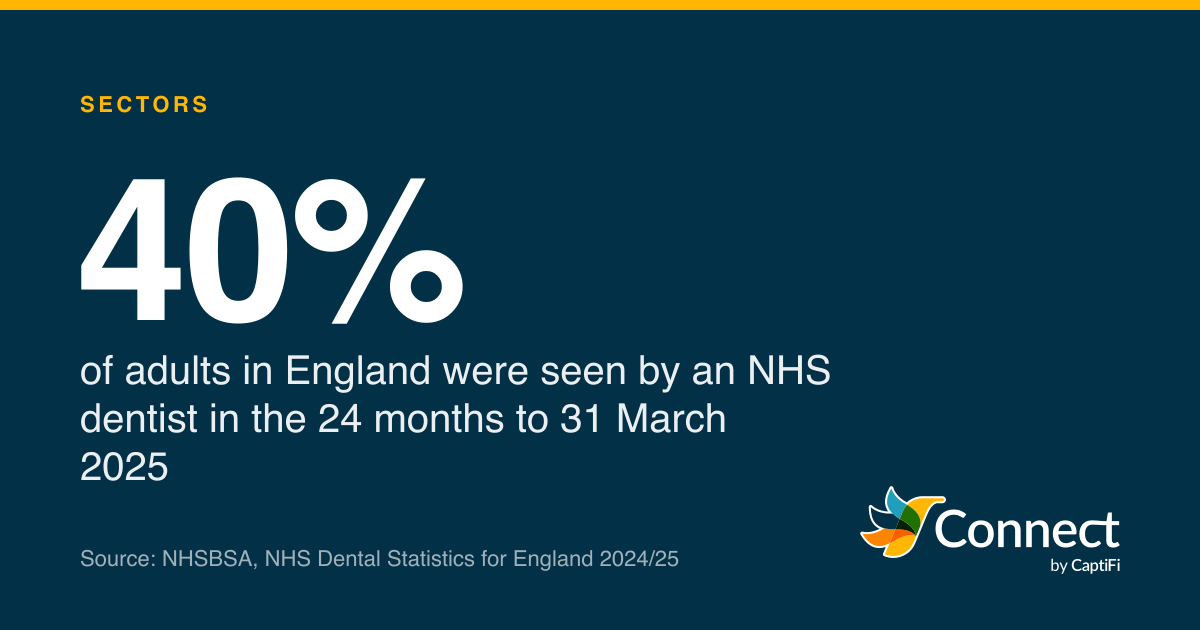
40%: of adults in England were seen by an NHS dentist in the 24 months to 31 March 2025. Source: NHSBSA, NHS Dental Statistics for England 2024/25.
Four adults in ten. That is the share of England's adult population that an NHS dentist saw in the two years to 31 March 2025, according to the NHS Business Services Authority's dental statistics published on 28 August 2025: 18 million people, counted over a 24-month window because that is the longest gap between check-ups the guidance allows. For children the window is 12 months and the figure is 6.9 million, 57% of them. Everyone else either goes private, doesn't go, or meant to go and forgot.
The forgetting is the part a text can do something about. A dental recall is the oldest reminder job there is (practices were sending postcards long before anyone had a mobile), and it is unusual among reminders because the date is set by a clinician, patient by patient, months or years ahead. That changes what the text has to say and when it has to go.
What the numbers say about recalls
The NHSBSA figures for 2024/25 describe a system that has mostly, though not entirely, recovered from 2020. Dentists delivered 35.4 million courses of treatment in the year, up 3.8%, with 23.5 million for adults and 11.9 million for children. Band 1, which the NHS defines as examination, assessment and advice with X-rays, fluoride and scaling where needed, was 60% of the total at 21.4 million courses, up 7% on the year before but still below the 23.1 million of 2019/20. Urgent courses, the ones a recall is meant to prevent, came to 3.66 million.
Band 2 was split into 2a, 2b and 2c for treatment accepted from 25 November 2022; the 1,897 courses still recorded under the old band 2, 90,194 free courses and 9,634 regulation 11 appliances are left out.
Source: NHSBSA, NHS Dental Statistics for England 2024/25, annual report (table 2)
See the figures as a table
| Courses of treatment | |
|---|---|
| Band 1 (check-up, simple work) | 21,404,762 |
| Band 2a | 6,586,560 |
| Band 2b | 2,246,241 |
| Band 2c | 111,933 |
| Band 3 (crowns, dentures) | 1,302,867 |
| Urgent | 3,658,273 |
Put another way: of every ten NHS courses of treatment, six are the routine check-up that a recall text asks someone to book, and one is an urgent visit. There were 24,655 dentists doing NHS work, 42 per 100,000 people, unchanged from the year before, so the capacity to see more people is not growing much; what a practice can do is make sure the slots it has are filled by the patients who are due.
The gap between who is due and who turns up is uneven across the country. South Yorkshire's integrated care board had the highest share of adults seen, 57%, and the highest share of children, 67%, against the England figures of 40% and 57%.
Adults are counted over the 24 months to 31 March 2025 and children over 12 months, against mid-2024 population estimates. South Yorkshire had the highest share of any integrated care board, by contract location.
Source: NHSBSA, NHS Dental Statistics for England 2024/25, annual report
See the figures as a table
| Seen (%) | |
|---|---|
| Adults, England | 40 |
| Adults, South Yorkshire ICB | 57 |
| Children, England | 57 |
| Children, South Yorkshire ICB | 67 |
Patients paid £807 million in charges in 2024/25, up 4.2%. The band 1 charge was £27.40 that year and is £27.90 on the NHS website as of its March 2025 review, with band 2 at £76.60 and band 3 at £332.10. That matters for the wording later: a check-up is the cheapest thing a patient will ever do at a dentist, and it's the thing most likely to be put off.
What NICE says the interval should be
The recall interval is not a practice convention. It is set out in NICE clinical guideline CG19, Dental checks: intervals between oral health reviews, published on 27 October 2004 and still current. The guideline says the shortest interval between oral health reviews "for all patients should be 3 months", and that an interval shorter than that "is not normally needed for a routine dental recall". The longest interval for patients aged 18 and over "should be 24 months", and for under-18s "should be 12 months", because decay can progress faster in children and in primary teeth.
Between those limits, the dentist chooses. NICE says the interval for the next review should be set "at the end of an oral health review if no further treatment is indicated, or on completion of a specific treatment journey", based on the patient's risk, with the 24-month interval reserved for people "who have repeatedly demonstrated that they can maintain oral health and who are not considered to be at risk of or from oral disease". The factors it lists include the outcome of previous care, how well earlier intervals suited the patient, "the patient's ability or desire to visit the dentist at the recommended interval" and the financial cost to them.
The guideline is more than twenty years old and still current. A practice that puts everyone on six months is working to habit; the guideline asks for a risk-based interval, which for a healthy adult may be two years. For a reminder system that has one practical consequence. A dental recall is a date per patient, somewhere between three and 24 months out, recorded at the end of the last visit. The text system has to take that date from the practice software, and the message has to be ready to go on a day nobody will be thinking about when it arrives.
What a recall text says
A recall is an invitation to book, which is a different message from a reminder of a booking that exists. Three things it needs: who it's from, that the patient is due, and one way to act. Here is the plain version, in the style we use:
Crown Dental: you're due a check-up. Reply B and we'll text you some times, or call 0114 496 0123 to book.
That is under 110 characters. The word is "due", not "overdue"; the first recall goes out when the interval the dentist set has arrived, and there's no reason to scold. If the patient doesn't reply, a second text a few weeks later can be a little firmer without becoming a lecture:
Crown Dental: your check-up was due in September and we haven't heard from you. Reply B to book. NHS check-ups are £27.90.
The price line is there for a reason. The trial evidence on reminder wording, which we go through in appointment reminder wording that gets replies, found that a specific number in the message did more than any general appeal. For a recall the useful number is the cost of the thing you're asking them to book, because the reason people put a check-up off is the belief that it will be expensive or will lead to something expensive. For a child, the parent's phone gets the text and the message says so:
Crown Dental: your child is due a check-up, which is free on the NHS under 18. Reply B to book.
Once a slot exists, the recall job is over and the ordinary reminder takes it from there: "Crown Dental: your check-up is on Thu 19 Nov at 10:30. Reply C to confirm." NHS England's guidance on reducing missed appointments describes a trust that sends reminders seven and three days before, and says providers see better results when patients can reply.
Keep the clinical detail out
Everything about a person's teeth is health data, and under Article 9 of the UK GDPR "data concerning health" is a special category whose processing is prohibited unless one of the listed conditions applies. A dental practice has a lawful basis for holding it. It does not follow that any of it should be in a text, because a text is displayed on a lock screen, read aloud by a car, previewed on a watch and seen by whoever has the phone in their hand. "Your check-up" is enough. "Your hygienist appointment" is fine. "Your appointment to review the lower left molar extraction" is not, and nor is anything about periodontal status, treatment plans or a missed course of treatment that names what the course was.
The same applies in the other direction. A reply inbox at a practice will get questions ("is it the one where you do the X-ray?", "can I bring my daughter at the same time?"), and the person answering should treat the thread as a public channel: confirm times, offer to call, and move anything clinical to the phone or the chair.
Consent, and what counts as marketing
A recall for a patient the practice already treats is a message about their care, sent because they're on the practice's books and due to be seen, and it should read like one. A text offering whitening, Invisalign or a hygienist package is marketing, and marketing by text needs the patient's consent under regulation 22 of PECR, or the narrow soft opt-in for existing customers with an opt-out on every message. Keep the two apart: no offers inside a recall, and no recall wording inside a promotion. Our guide to SMS marketing rules in the UK covers where the line sits and what the ICO expects you to be able to show.
Two housekeeping points follow. Give patients a way to say they've gone elsewhere ("Reply X if you're no longer registered with us") and act on it, because the fourth recall to someone who moved practices in 2023 is a nuisance text by any definition. And keep the mobile number current at every visit; a recall 24 months out goes to the number on file 24 months ago.
Running it
The practical shape of a recall programme is simple. Export who is due, by the date the dentist set, once a week. Send the recall text that week, with a reply keyword that books or asks for times. Follow up the non-responders once, three or four weeks later, with the firmer wording and the price. Then stop, and try again at the next interval, or when the practice system flags them again.
Measure it while you're at it. The number that matters is bookings made per hundred recall texts, week by week, and the second number is how many of those bookings were kept. A practice that sends 200 recalls a week and gets 30 bookings from them knows what the programme is worth, and knows within a month whether the firmer second text or the price line changed anything. Delivery reports and a CSV export are enough for that; nobody needs a dashboard.
CaptiFi Connect's dental practice page describes how practices run this with scheduled sends and reply keywords, so a "B" lands in the inbox with the patient's number attached and a member of staff can text back three slots. Replies are free, and a patient who answers "is this you?" gets a yes from a person.
One last number. The 18 million adults seen in those 24 months were, by definition, the ones who came back inside the interval. The other 60% of the adult population didn't, and a text that says "you're due" is the simplest thing a practice can send them.
Sources
Read for this post on 17 October 2026.
- NHSBSA: NHS Dental Statistics for England 2024/25
- NHSBSA: NHS Dental Statistics for England 2024/25, annual report narrative
- NICE: Dental checks, intervals between oral health reviews (CG19), recommendations
- NHS: How much NHS dental treatment costs
- legislation.gov.uk: UK GDPR Article 9, processing of special categories of personal data
- NHS England: Reducing did not attends (DNAs) in outpatient services
Written by the CaptiFi Connect team. Published 17 October 2026. More in Sectors
Send your first text this week
Set up your account and contacts now; we check every new account before it can send.