
Rules and trust9 min read
Does the TPS cover text messages?
No. The TPS is a register for marketing calls under PECR regulation 21. Marketing texts fall under regulation 22, which needs consent whatever the TPS says.
In short
- The Telephone Preference Service covers live sales and marketing calls only: its register is kept for regulation 21 of PECR, and the TPS says its remit does not extend further.
- Marketing texts to individuals fall under regulation 22 of PECR, which requires prior consent or the soft opt-in whether or not the number is registered with the TPS.
- The ICO says there is no text or email version of the TPS, because texts to individuals already need consent or an earlier chance to opt out.
- The ICO fined MCP Online £55,000 in September 2023 for 20,939 calls to TPS and CTPS numbers, and named its 92,265 delivered marketing texts as a serious breach of regulation 22.
- Unwanted calls made up 41,746 of the 48,395 marketing call and text reports the ICO received through its online tool in 2025/26, against 6,649 about spam texts.
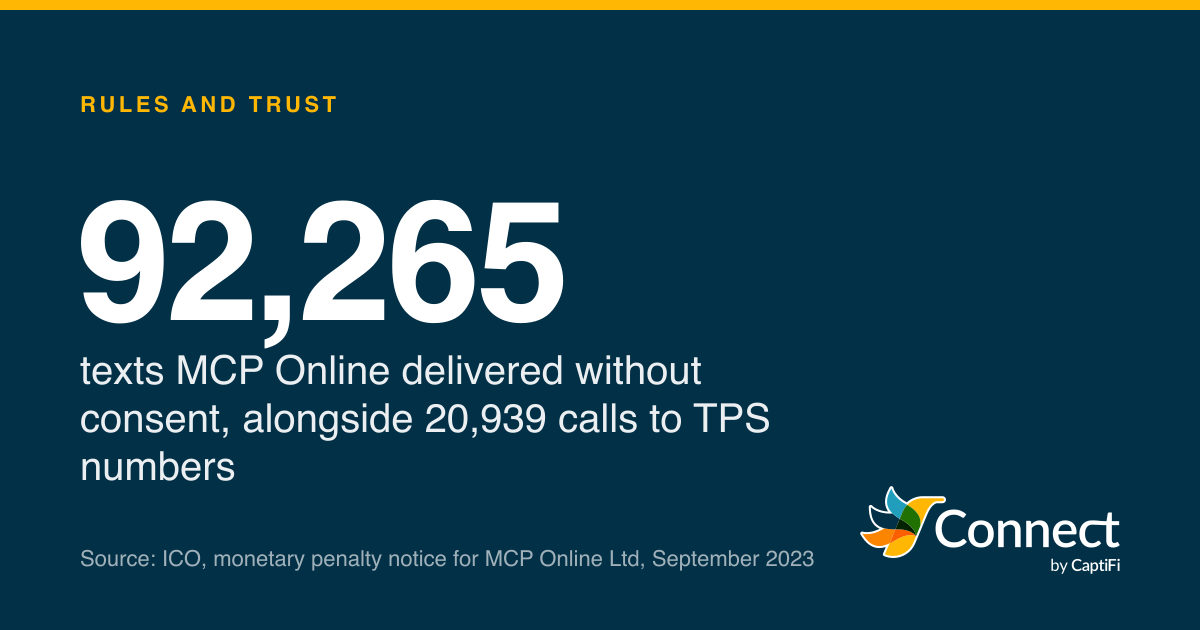
92,265: texts MCP Online delivered without consent, alongside 20,939 calls to TPS numbers. Source: ICO, monetary penalty notice for MCP Online Ltd, September 2023.
No. The Telephone Preference Service (TPS) is a register for marketing calls, and texts are outside it. It exists because regulation 26 of the Privacy and Electronic Communications Regulations 2003 (PECR) tells the regulator to keep a list of numbers whose owners don't want "unsolicited calls for direct marketing purposes", and regulation 21 makes it unlawful to make those calls to a listed number. Marketing texts come under a different rule, regulation 22, which says you need the person's consent before you send (or the narrow soft opt-in for your own customers). The TPS's own FAQ, read on 22 October 2026, puts its remit in a line: "Our remit only covers live unsolicited sales or marketing calls."
So a number missing from the TPS doesn't make a marketing text lawful, and a number on it doesn't make a consented text unlawful. The two rules run side by side, and businesses that both phone and text their customers mix them up more often than you'd think.
What is the TPS, in law?
The TPS calls itself "the UK's only official 'Do Not Call' register for landlines and Mobile numbers". Registration is free, and there's a twin register, the Corporate TPS (CTPS), for companies. You can register a mobile by texting "TPS" and your email address to 85095, which is a small irony given what the register doesn't cover.
The legal machinery is regulation 26. It says the regulator "shall maintain and keep up-to-date" a register of numbers whose subscribers have said they don't want unsolicited marketing calls, and it's explicit about why: the register is kept "for the purposes of regulation 21". The job was Ofcom's until 30 December 2016 and the Information Commissioner's after that, and since 30 September 2026 the text names the new Information Commission. Regulation 26(5) lets the regulator hand the day-to-day running to another body, which is what the TPS does. Corporate registrations must be made in writing and get a reminder every year (regulations 26(1A) and 26(2A)), which is why CTPS numbers need confirming annually and personal ones don't.
Regulation 21 is where the register bites. Nobody may make unsolicited marketing calls where the number "is one listed in the register kept under regulation 26", or where the subscriber has told that caller not to ring. Regulation 21(3) adds a 28-day grace period: a number listed for less than 28 days before the call doesn't count, which is where the TPS's instruction to "screen against TPS/CTPS at least once every 28 days" comes from. And regulation 21(4) lets someone on the register tell a particular caller they don't mind that caller's calls, in which case that caller may ring.
Why isn't a text a call?
PECR defines its terms in regulation 2, and the definitions settle it. A "call" is "a connection established by means of a telephone service available to the public allowing two-way communication in real time". Since 5 February 2026, after the Data (Use and Access) Act 2025, that includes an attempt to connect, so an unanswered marketing call to a TPS number still counts.
A text is none of that. It's "electronic mail", which regulation 2 defines as "any text, voice, sound or image message sent over a public electronic communications network which can be stored in the network or in the recipient's terminal equipment until it is collected by the recipient", and the definition adds that it "includes messages sent using a short message service". Short message service is SMS. Texts sit in the same box as emails, and the rule for that box is regulation 22.
The TPS says the same on its page about other kinds of contact: "SMS messages should only be sent with the prior consent of the recipient", and anyone who gets an unwanted one can report it to the ICO or forward it to 7726.
What does regulation 22 ask instead?
Regulation 22 works the other way round from the TPS. Marketing calls are allowed unless the person has opted out, while marketing texts to individuals are banned unless the person has opted in. A person shall not send unsolicited direct marketing by electronic mail "unless the recipient of the electronic mail has previously notified the sender that he consents for the time being to such communications being sent by, or at the instigation of, the sender."
The exception for businesses is the soft opt-in in regulation 22(3). You got the number "in the course of the sale or negotiations for the sale of a product or service" to that person, you're marketing "similar products and services only", and they were given "a simple means of refusing" when you collected the number and in every message since. (Charities have had a version of their own, regulation 22(3A), since 5 February 2026.) Our guide to SMS marketing rules in the UK goes through both.
The ICO's guide to electronic mail marketing answers the TPS question directly. Under the heading "Is there a text or email version of the TPS?" it says: "No. There is no equivalent email or text preference service. This is because you may only send emails or texts to individuals if you have their specific consent or have already offered them an opt-out, so this type of central opt-out register shouldn't be needed."
A central do-not-contact list only makes sense for a channel where contact is allowed by default, and for texts to individuals it isn't.
| Live marketing calls | Marketing texts | |
|---|---|---|
| Rule | PECR regulation 21 | PECR regulation 22 |
| Starting point | Allowed, unless the number is on the TPS or CTPS or the person objected to you | Not allowed to individuals, unless they consented or the soft opt-in applies |
| Central register | TPS for individuals, CTPS for companies | None |
| What you screen against | TPS and CTPS at least every 28 days, plus your own do-not-call list | Your own consent records and opt-out list |
| Companies | Screen against the CTPS as well | The consent rule covers individual subscribers only; regulation 23 on identity and opt-outs still applies |
Regulation 22(1) says it applies to "individual subscribers", so a marketing text to a limited company's phone doesn't need consent under PECR, while a marketing call to the same number has to be screened against the CTPS. Sole traders and some partnerships count as individuals, and the ICO's telephone guidance notes that they register with the TPS. Our post on texting other businesses has the detail.
Why "we screened against the TPS" is no defence for texts
Screening a list against the TPS tells you which numbers have opted out of sales calls. It tells you nothing about who has opted in to texts. A list that comes back clean is a list of people who haven't registered a preference about calls, and not one of them has consented to anything by being absent from the register. Send marketing texts to that list and each one is a regulation 22 breach unless you hold a consent record or a soft opt-in for the number. The same goes for a bought-in list sold as "TPS screened", which is the subject of our post on why bought-in lists fail the PECR test.
The reverse catches out careful businesses. A customer who registered with the TPS years ago, then ticked a box on your booking form agreeing to texts, can be texted. Registration "doesn't physically restrict a telephone line", in the TPS FAQ's words, and it was never a ban on texts. (It is a decent hint that the person dislikes unsolicited contact, so don't push your luck with the frequency.)
The ICO's case against MCP Online Ltd shows both rules applied to one company. MCP came to the ICO's attention through complaints to the TPS in November 2021 about unsolicited pension calls, one of which ended: "The caller was unapologetic and didn't have a clue what the TPS register is." The penalty notice, dated 28 September 2023, found that between 1 January and 28 September 2022 MCP made 20,939 marketing calls to numbers registered with the TPS or CTPS for more than 28 days, and fined it £55,000 for breaching regulations 21 and 24.
The texts are in the same notice. Between 7 April and 28 September 2022 the account linked to the company "sent 109,648 text messages, of which 92,265 were successfully delivered", which drew 386 complaints through 7726. The ICO called that "a serious breach of Regulation 22" and listed it among the aggravating features. One of the texts it quotes began: "The Debt Breathing Space scheme. STOP creditors from contacting you TODAY for 60 days." The mobile network had already restricted the account once, in July 2022, after texts went out "without including any means of opting out".
What the complaint figures show
The ICO's annual report for 2025/26, published in July 2026, shows how much of the nuisance it hears about is calls. Through its online reporting tool it received 48,395 reports of unwanted marketing calls and texts in the year to March 2026: 25,235 from people who spoke to a person, 16,511 from people who heard a recorded voice, and 6,649 about spam texts.
- Calls
- Spam texts
Reports through the ICO's online tool, April to March. Calls add the ICO's two call categories, spoke to a person and heard a recorded voice. Texts forwarded to 7726 are a separate service.
Source: ICO, Annual Report 2025/26 (nature of telesales and spam texts reported)
See the figures as a table
| Calls | Spam texts | |
|---|---|---|
| 2023/24 | 46,071 | 7,405 |
| 2024/25 | 42,603 | 6,891 |
| 2025/26 | 41,746 | 6,649 |
Calls outnumbered texts about six to one in each of the last three years. Complaints about live calls to registered numbers also reach the regulator another way, because the TPS runs its own complaint service for numbers registered for 28 days or more, and its enforcement page says "all complaint information is shared with the Information Commissioner's Office (ICO)". Texts have no route through the TPS. They go to the ICO's form or, far more often, to 7726, the free number for forwarding spam texts to your mobile network. Our post on what happens when someone reports your text to 7726 follows one through.
If you phone and text customers
Plenty of businesses do both: a garage that rings about a quote and texts MOT reminders, or a gym that calls lapsed members and texts class offers. The tidy way to run it is two separate permissions for each customer.
For calls, screen the list against the TPS and CTPS at least every 28 days, and keep your own do-not-call list of anyone who has told you to stop, because regulation 21(1)(a) covers people who objected to you directly whether or not they're on the TPS. The ICO's telephone marketing guidance asks for both checks.
For marketing texts, keep a record of how each number came to you: the consent wording and date, or the sale that gives you the soft opt-in. Put "Reply STOP to opt out" (or another free way to refuse) in every marketing text, as regulation 23 requires (and regulation 22(3) for anyone you text under the soft opt-in), and keep a suppression list of everyone who has opted out, so a later import can't bring them back.
Keep the two apart in your systems. An opt-out from texts isn't automatically an objection to calls, and a clean TPS result is never consent to text. If a STOP reply sounds like the person wants to hear less from you altogether, honour it on the phone as well.
CaptiFi Connect deals with the text side mechanically: STOP and the other opt-out words put a number on your opt-out list, and later sends to it are refused without charge. The consent records, and the TPS screening for any calls you make, stay with you.
The stakes went up this year. Since 5 February 2026 the ICO has been able to fine up to £17.5 million or 4% of global turnover for breaking PECR, up from £500,000, under the Data (Use and Access) Act 2025; its June 2026 update said it was still writing guidance on how it will use the higher fines. The ICO's telephone marketing guidance also carries a notice that it is "under review and may be subject to change" because of the same Act, so check it again before you build a calling programme on it.
Sources
Read for this post on 22 October 2026.
- legislation.gov.uk: PECR 2003, regulation 2 (interpretation)
- legislation.gov.uk: PECR 2003, regulation 21 (calls for direct marketing)
- legislation.gov.uk: PECR 2003, regulation 22 (electronic mail for direct marketing)
- legislation.gov.uk: PECR 2003, regulation 26 (register of numbers)
- TPS: What is TPS
- TPS: Frequently asked questions
- TPS: Nuisance, abusive and other calls
- TPS: Mobile registration
- TPS: ICO enforcement action
- ICO: Guide to PECR, telephone marketing
- ICO: Guide to PECR, electronic mail marketing
- ICO: Annual Report and Financial Statements 2025/26
- ICO: monetary penalty notice, MCP Online Ltd, 28 September 2023
- ICO: enforcement entry, MCP Online Ltd
- ICO: One year on, marking the 12-month commencement of the Data (Use and Access) Act
- legislation.gov.uk: Data (Use and Access) Act 2025 (Commencement No. 6) Regulations 2026, regulation 2
Written by the CaptiFi Connect team. Published 22 October 2026. More in Rules and trust
Send your first text this week
Set up your account and contacts now. Until we've approved it, a person reads each text before it goes out.