
By the numbers8 min read
Email vs SMS: what the benchmarks show
The DMA puts UK email at 35.9% opens and 2.3% clicks. A text has no open rate at all, so here is what it can measure, and the vendors' own SMS click figures.
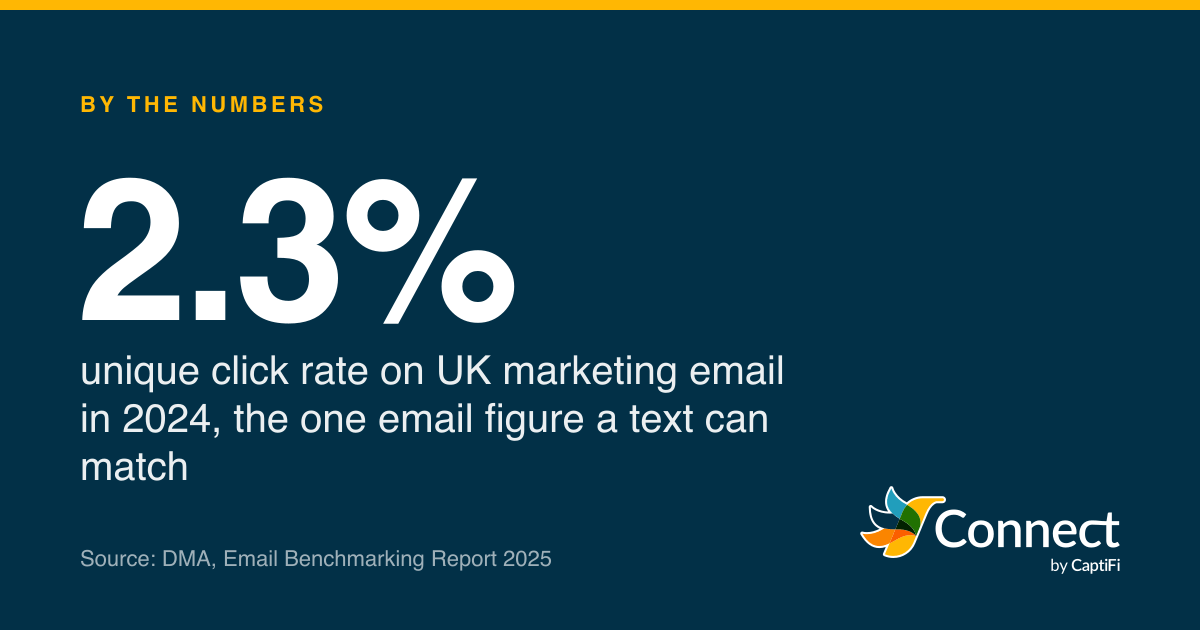
2.3%: unique click rate on UK marketing email in 2024, the one email figure a text can match. Source: DMA, Email Benchmarking Report 2025.
Every email benchmark leads with an open rate. The DMA's 2025 report for the UK puts it at 35.9%. Mailchimp's page says 35.63%. Nobody can publish the equivalent for a text, because a phone never tells anyone that a text has been read, and the vendors who quote 98% are quoting a number nobody measured (we went looking for its source in the 98% open rate myth and found none). So a straight comparison of the two channels has a hole in the middle of it, and the honest thing is to compare the figures each side can measure, and to say where they come from.
The email numbers below are from the DMA's benchmarking reports and from Mailchimp's own page. The SMS numbers are from Klaviyo's published ranges for its own customers, which is the only kind of SMS benchmark that exists, and from the one measurement a text does give you: the delivery receipt. Dates and caveats on everything, because the caveats are most of the story.
What the email benchmarks say
The Data & Marketing Association publishes an email benchmarking report for the UK each year, built on anonymised data from the big email service providers. The 2025 edition, published on 4 June 2025 and covering 2024, drew on "seven of the UK's leading email service providers" and gave three headline figures. Delivery rates "rose to 98% in 2024", with business-to-consumer senders at 99.2%. The average open rate kept "increasing to 35.9%". And the unique click rate rose "for the third year in a row", "reaching 2.3%". The DMA also noted a record number of emails sent in 2024.
The 2026 edition came out on 9 July 2026 with six contributing providers and a sponsor, Validity. Its public page gives the findings in words only: "improving deliverability, declining unsubscribe rates and record click-through rates". The figures are in the members' download, so the 2025 report is the latest I can put a number to.
Mailchimp's benchmarks are a different animal: one vendor's customers, worldwide, and self-reported industries. The page says the data is "as of December 2023", scanned from "billions of emails delivered by our system", counting only campaigns sent to "at least 1,000 subscribers" with tracking on. Across all users it gives an open rate of 35.63%, a click rate of 2.62% and an unsubscribe rate of 0.22%. The spread by industry is wide. Non-profits open at 40.04% and click at 3.27%; ecommerce opens at 29.81% and clicks at 1.74%.
- Open rate
- Click rate
Averages across Mailchimp campaigns sent to at least 1,000 subscribers with tracking on, as published on its benchmarks page. Open rates are as Mailchimp counts them, after Apple Mail Privacy Protection.
Source: Mailchimp, Email marketing benchmarks (data as of December 2023)
See the figures as a table
| Open rate (%) | Click rate (%) | |
|---|---|---|
| Non-profits | 40.04 | 3.27 |
| Education and training | 35.64 | 3.02 |
| All users | 35.63 | 2.62 |
| Business and finance | 31.35 | 2.78 |
| Ecommerce | 29.81 | 1.74 |
Two different populations, a year apart, landing within a third of a point of each other on opens and a third of a point on clicks. That's a decent sign the email figures are measuring something real. The question is what.
Why the open rate is the weakest number on the page
An email open is counted when a tiny image in the message is fetched from the sender's server. On 7 June 2021 Apple announced Mail Privacy Protection for iOS 15, which it said "helps users prevent senders from knowing when they open an email" and "stops senders from using invisible pixels to collect information about the user". Once the pixel can't be trusted, neither can the count.
The DMA's report says this out loud. Its 2025 summary describes open rates as having "continued to climb post-Apple MPP" and talks about the industry adjusting to a "year-zero" benchmark set in 2022, the first full year after the change. An open rate of 35.9% in 2024 counts the opens a sender can still see, with Apple's users in there on Apple's terms, and nobody outside Apple can say what share of it was a person reading. Which leaves the click. A click is a person doing something, it is counted the same way in every provider's dashboard, and the DMA's 2.3% and Mailchimp's 2.62% agree closely enough to use.
So the email side of any comparison comes down to this: about 98% of what you send arrives, and about 2.3 to 2.6 in every hundred get clicked.
What a text can measure
A text gives you four signals and withholds a fifth.
The first is delivery, and it's stronger than email's. The SMS standard, 3GPP TS 23.040, defines a status report as the service centre "informing the originating MS of the outcome of a short message submitted to an SME", and it's sent per message once the service centre "has concluded the status of the short message". The standard also says the facility is optional, so whether you get one depends on the route your provider uses. Where you do, it tells you the handset accepted the message, with a timestamp, which is more than any email receipt can say. Our delivery reports page shows what that timeline looks like, and the glossary entry covers what a receipt proves.
The second is a click, if the text carries a link you control. A shortened, tracked link records the tap the same way an email link does, so the one email figure worth having has a direct SMS equivalent. The third is a reply, which email also has but rarely counts. The fourth is an opt-out, a STOP reply, which is email's unsubscribe.
The fifth, the open, doesn't exist. There's no pixel in a text and no read receipt that reaches the sender. A delivery receipt says the phone has it. Whether the person looked is unknowable, and any vendor that says otherwise is guessing.
For the measurable figures, the only published SMS benchmarks come from vendors reporting on their own customers, and the clearest set is Klaviyo's. Its help centre article, updated 28 October 2025, gives ranges for SMS campaigns "from Klaviyo customers using SMS in the US". A click rate of 8.9% to 14.5% is "Good", 14.6% and above is "Great", 6.0% to 8.8% is "Room for improvement" and under 5.9% is "Critical". For conversion, 1.0% to 2.0% is good. For unsubscribes, under 0.5% is great, 0.6% to 1.4% good, and 2.0% or more critical. Its 2026 benchmark report, on the UK page, adds that automated SMS flows get click rates "nearing 10% on average", that top performers exceed 16%, and that flows are 7.6% of sends but 45.2% of SMS revenue.
Read those with the labels on. The customers are American online shops, the figures are Klaviyo's attribution, and a "good" band is a sales tool as much as a statistic. But they are the vendor's own data, published with a method, which is more than the 98% claim ever had.
Side by side, with the gaps showing
| Measure | Email (DMA 2025, Mailchimp) | SMS |
|---|---|---|
| Delivered | 98% average, 99.2% B2C | Per-message receipt where the route gives one |
| Opened | 35.9% (DMA), inflated by Apple MPP | Not measurable |
| Clicked | 2.3% (DMA), 2.62% (Mailchimp) | 8.9% to 14.5% "good" (Klaviyo, US customers) |
| Unsubscribed | 0.22% (Mailchimp) | 0.6% to 1.4% "good" (Klaviyo, US customers) |
| Replied | Rarely counted | Counted, and free to the customer |
The click gap is large even after you discount the vendor's framing. Klaviyo calls anything under 5.9% "critical" for a text, and 5.9% is more than double the DMA's average click on an email. Some of that is the channel: a text is short, it arrives on a device that's in a pocket, and the link is the only thing to tap. Some of it is selection: people who've handed a shop their mobile number and opted in are a warmer list than an email file built over ten years.
The unsubscribe gap runs the other way, and it's the one marketers forget. Mailchimp's 0.22% sits well under the bottom of Klaviyo's "good" band for SMS, which starts at 0.6%. STOP is one word and people use it, because a text interrupts in a way an email doesn't. Send a text that isn't worth the interruption and the list shrinks faster than an email list ever would. The opt-out rate is the best measure of whether the texts were wanted, and it's the first number to watch on any campaign.
And the open rate, the headline of every email report, has no counterpart. If you're used to judging email by opens, the habit to build on SMS is to judge by delivery, clicks and replies, and to measure email the same way, which the DMA's own caveat about Apple suggests you should anyway.
A scale check from the public sector
One organisation publishes live figures for both channels side by side, with no marketing in them. GOV.UK Notify is the government's sending platform, and its performance page, read on 17 October 2026, showed 13.7 billion messages since the service began in May 2016: 8.0 billion emails, 5.7 billion text messages and 105.2 million letters, from 1,764 organisations running 12,894 services.
Totals as shown on the performance page on 17 October 2026: 13.7bn messages in all, from 1,764 organisations and 12,894 services. Letters are 105.2m. The page updates daily.
Source: GOV.UK Notify, performance page, read 17 October 2026
See the figures as a table
| Messages (bn) | |
|---|---|
| Emails | 8 |
| Text messages | 5.7 |
| Letters | 0.11 |
The daily figures on the same page are close to level between the two channels on a working day (on 15 October 2026 it sent 4,985,855 emails and 5,232,207 texts), and the page reports 100% of messages handed over within ten seconds on each of the six days it showed. What Notify doesn't publish, for either channel, is an open rate. The one body sending at that scale with no commercial reason to flatter a channel measures sends and speed, and leaves opens alone.
What to do with the numbers
Set your own baselines and stop borrowing other people's. For email, track delivery and click, and treat the open rate as noise on Apple devices. For SMS, track delivery receipts, link clicks, replies and STOPs, per campaign, and keep the figures by month so you can see a list going stale before it goes quiet.
Use each channel for what it measures well. Email carries long content, images and the things people want to come back to, and it's cheap enough that a 2.3% click can pay. A text carries one line and one action, costs more per message, and gets read quickly or not at all, so it suits the message that has to land today: the appointment tomorrow, the order out for delivery, the table held until eight, the code that expires in ten minutes.
Count the opt-outs before the clicks. A text campaign with a 12% click and a 3% STOP rate has sold something today and lost 3% of the list, people who'll never hear from you again. The second figure is the expensive one.
If you send through CaptiFi Connect, every text comes back with a delivery report and a timeline, tracked links report each click, replies land in the inbox and STOP is handled for you, so the four SMS figures in the table above are there without any setting up; the link tracking page shows the click report. What you won't find anywhere in the dashboard is an open rate, because there isn't one, and the first vendor who shows you one for a text should be asked where it came from.
Sources
Read for this post on 17 October 2026.
- DMA: Email Benchmarking Report 2025
- DMA: Email Benchmarking Report 2026
- Mailchimp: Email marketing benchmarks
- Apple Newsroom: Apple advances its privacy leadership with iOS 15 (Mail Privacy Protection), 7 June 2021
- Klaviyo Help Center: Campaign SMS and MMS benchmarks
- Klaviyo: SMS marketing benchmarks 2026 (UK page)
- GOV.UK Notify: performance
- ETSI: TS 123 040 V19.0.0, Technical realization of the Short Message Service (3GPP TS 23.040)
Written by the CaptiFi Connect team. Published 17 October 2026. More in By the numbers
Send your first text this week
Set up your account and contacts now; we check every new account before it can send.