
Writing texts8 min read
The 98% open rate myth
Every SMS vendor quotes a 98% open rate and none can say where it came from. What a text can measure instead: delivery receipts, clicks, replies and opt-outs.
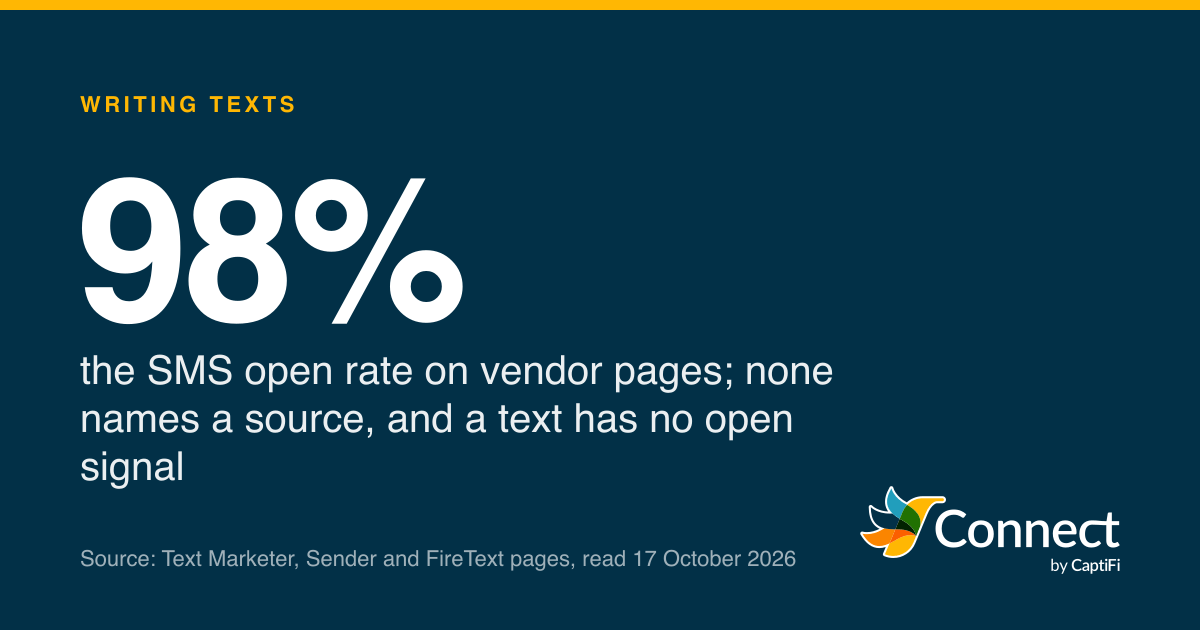
98%: the SMS open rate on vendor pages; none names a source, and a text has no open signal. Source: Text Marketer, Sender and FireText pages, read 17 October 2026.
"The only marketing channel with a 98% open rate and 90 minute response time." That's the first line under the heading on Text Marketer's SMS marketing page, and you'll find its twin on most of its competitors' pages. Ask where the 98% comes from and the trail goes cold within a click. I went looking again in October 2026, and it's still cold.
That matters more than it sounds, because the number does a lot of work. It's the line that gets texting into a marketing plan and the figure that ends up on a slide in front of a finance director. So it pays to know what it is (a claim nobody can trace) and what you can measure instead (more than you'd think).
Three pages, no source
Text Marketer gives the figure twice. The headline above, and lower down: "SMS Marketing boasts a huge 98% open rate". The second mention is a link, and the link goes to another page on Text Marketer's own site. No study, no year.
FireText's SMS marketing guide has "superior open rates of up to 98% (Source: Gartner)". That's the most common attribution you'll see, and it goes nowhere: no report title, no year, no link. I couldn't find a Gartner document that says it, and nobody who cites Gartner for it seems to have one either. "Up to" is carrying a fair bit of that sentence as well.
Sender's page on SMS open rates is the honest one, in a roundabout way. It opens with "SMS open rates average around 98%" and later says "According to research, on average, SMS messages have a 98%* open rate." The asterisk points to a list of eleven sources at the bottom of the page, none of them matched to the figure. The same page says the number "is best treated as an industry benchmark rather than a directly trackable metric", and that "exact industry-level open rates are rarely published due to SMS tracking limitations". Which is a long way of saying nobody measured it.
Esendex's marketing page sidesteps 98% and offers a cousin: "90% of people read a text message within three minutes of receiving it", credited to "Mobilesquared". No link, no year, no method.
Four vendors, one number (or its cousin), and no primary document between them. That's how a figure propagates when every page copies the one before it, and a number with no origin can't be checked. A number that can't be checked shouldn't be in your plan.
It survives because it feels about right. Most people do glance at a text when the phone buzzes, and anyone who has sent a reminder and watched the replies come in within minutes will nod along. A glance isn't a measurement, though, and nobody has published one. The pages above are repeating a hunch with a percent sign on it.
There is no such thing as an SMS open
An email open rate exists because an email can carry a tiny image that loads from the sender's server when the message is displayed, and the server counts the load. A text can't do that. It's plain characters, 160 of them to a part, and nothing in it phones home when it's read.
The standard that defines SMS, 3GPP TS 23.040, is precise about what the network can report back. Section 3.2.9, "Status report capabilities", lists two outcomes: the message was "Successfully delivered to the SME" (the short message entity, which for our purposes is the phone), or the service centre "was not able to forward the message", for a permanent reason such as "validity period expired, invalid SME address" or a temporary one such as "SME temporarily unavailable". The full list of status values is in section 9.2.3.15, and the best result on it reads "Short message received by the SME". Received is as far as it goes. There's no code for opened or read, because the phone has no way of knowing and no way of saying.
The standard adds a line worth remembering: "The status report capabilities of the SMS are optional, i.e. the choice of whether to offer status report or not is left to the SC operator." A provider's delivery report is built on whatever the operator returns, and a receipt is the ceiling. Everything above "received by the phone" is inference.
GOV.UK Notify, which has sent 5.7 billion texts for public bodies since May 2016, documents its text statuses the same way: created, sending, pending, delivered ("The message was successfully delivered") and three kinds of failure. Nothing about reading, because there's nothing to report.
Email's open rate isn't what it was either
The usual comparison puts a low email figure next to the 98%. The email half is shaky too, for a different reason.
On 7 June 2021 Apple announced Mail Privacy Protection alongside iOS 15. In its own words, the feature "stops senders from using invisible pixels to collect information about the user", "helps users prevent senders from knowing when they open an email", and "masks their IP address so it can't be linked to other online activity". Apple doesn't go into the mechanics on that page, but the effect shows up in the email trade's own benchmark.
The DMA's Email Benchmarking Report 2025, published on 4 June 2025 from the 2024 data of seven UK email service providers, puts the average open rate at 35.9% and says, in as many words, that "Open rates continued to climb post-Apple MPP". The same report has unique click rates at 2.3%, rising "for the third year in a row", and delivery rates at 98% (99.2% for consumer senders).
Averages across the 2024 data of seven UK email service providers. The DMA says open rates 'continued to climb post-Apple MPP', the Apple feature that hides when an email is opened.
Source: DMA, Email Benchmarking Report 2025
See the figures as a table
| Average rate (%) | |
|---|---|
| Delivery rate | 98 |
| Open rate | 35.9 |
| Unique click rate | 2.3 |
Read those three bars together. 98% of emails were delivered. About 36% registered an open, a number the DMA itself ties to Apple's change. 2.3% produced a click, and the click is the only one of the three that a person had to do something to create. The 2026 edition, out on 9 July 2026, reports "record click-through rates" and falling unsubscribes, though its headline numbers sit behind the DMA's member download.
What a text can measure
So email has a delivery rate, an open rate you can't trust, and a click rate. SMS has a delivery rate you can trust more, no open rate at all, and a click rate. Plus two things email mostly doesn't: a reply rate and an opt-out rate, both of which arrive as texts and both of which are counted exactly.
Take them in turn. Delivery is the status report from 23.040, passed back through your provider as "delivered" or a failure code, per message, with a time on it. Clicks come from a tracked link, a short address that records the tap before sending the person on. Replies are whatever comes back to your number, and a reply to "Reply C to confirm" is the hardest evidence you'll get that a text was read, because someone read it and typed. Opt-outs are STOP replies, and a rising STOP rate on a campaign is the clearest signal that your texts are landing with people who didn't want them.
The failure side is just as specific, which is the other thing an open rate can't give you. Notify's documentation splits it three ways. A permanent failure means the provider couldn't deliver, "if the phone number is wrong or the network operator rejects it". A temporary failure covers a phone that is "off, has no signal, or the inbox is full", and Notify notes the provider may keep trying for up to 72 hours while the message sits as sending or pending. A technical failure is a problem between Notify and its provider, and it's the only one of the three Notify doesn't charge for. Each of those states exists because the network reported what happened to the message. An email bounce tells you less, and an email "open" tells you almost nothing about the rest.
What none of this gives you is 98%. If you want a number to put next to email's 35.9%, you don't have one, and neither does anyone else.
- Emails
- Texts
The page updates daily. Notify publishes sends and the share handed over within ten seconds (100% on each of these days). It publishes no open rate for either channel.
Source: GOV.UK Notify, performance page, read 17 October 2026
See the figures as a table
| Emails | Texts | |
|---|---|---|
| Sat 10 Oct | 2,024,829 | 1,392,398 |
| Sun 11 Oct | 1,618,843 | 1,645,297 |
| Mon 12 Oct | 4,161,295 | 4,722,316 |
| Tue 13 Oct | 4,825,915 | 4,838,933 |
| Wed 14 Oct | 4,842,145 | 5,529,592 |
| Thu 15 Oct | 4,985,855 | 5,232,207 |
The biggest text sender in the country doesn't claim one. Notify's performance page, read on 17 October 2026, lists 1,764 organisations and 12,894 services, 13.7 billion messages in total, and a day-by-day table of sends. On Wednesday 14 October it sent 5,529,592 texts and 4,842,145 emails. The only quality figure it publishes is the share of messages "sent within 10 seconds", which was 100.00% on every day shown. There's no open rate on the page for either channel, because the people who run it know they can't measure one.
An honest comparison
Put the two channels side by side with only the measurable rows. Email: delivered 98%, clicked 2.3%, opened somewhere under 35.9% and unknowable. SMS: delivered per message with a receipt, clicked on tracked links at whatever rate your own campaigns show, opened unknowable, replied and opted out counted exactly.
The case for texting a customer is that a text is short, arrives on the device in their pocket, sits in an inbox with very little else in it, and can be answered in one word. Those reasons hold up without a made-up number in front of them.
If you need a defensible sentence for a plan, try this one: every text we send gets a delivery receipt, and we count clicks, replies and opt-outs on each campaign. Then show last month's figures. The arithmetic is short. Delivered divided by sent is your delivery rate, and it's the one to watch for list quality, because a dead number fails permanently and stays failed. Clicks, replies and STOPs each divided by delivered give you the other three, and they only mean anything compared with your own previous campaigns, since nobody publishes a UK benchmark for them either.
What to do with this
Take the 98% out of your deck, your proposal and your website, and put your own delivery, click and reply rates in its place once you have a few campaigns behind you. Write texts that ask for something you can count, a reply or a tap on a link. "Crown Dental: your check-up is on Thu 19 Nov at 10:30. Reply C to confirm." tells you exactly how many people read it, in the only way a text can.
CaptiFi Connect gives you those numbers per campaign, with a delivery report and timeline for every text and tracked links that record each tap. There's no open rate box, because there's nothing to put in it.
On 14 October 2026 Notify handed 5,529,592 texts to the networks and published one quality figure for them: all of them went within ten seconds. That's the kind of number a text can carry with a straight face.
Sources
Read for this post on 17 October 2026.
- Text Marketer: SMS marketing for business
- Sender: SMS open rates (updated 16 March 2026)
- FireText: SMS marketing, ultimate guide for businesses
- Esendex: SMS marketing use case page
- ETSI: 3GPP TS 23.040 version 19.0.0, Technical realization of the Short Message Service
- GOV.UK Notify: REST API documentation, message status
- GOV.UK Notify: performance
- Apple Newsroom: iOS 15 privacy announcement, 7 June 2021
- DMA: Email Benchmarking Report 2025
- DMA: Email Benchmarking Report 2026
Written by the CaptiFi Connect team. Published 17 October 2026. More in Writing texts
Send your first text this week
Set up your account and contacts now; we check every new account before it can send.