
Sectors8 min read
MOT reminder texts for garages
DVSA counted 33.3 million car and van MOTs in 2025 to 2026 and 27.51% failed first time. The free gov.uk reminder, and the texts a garage sends around a test.
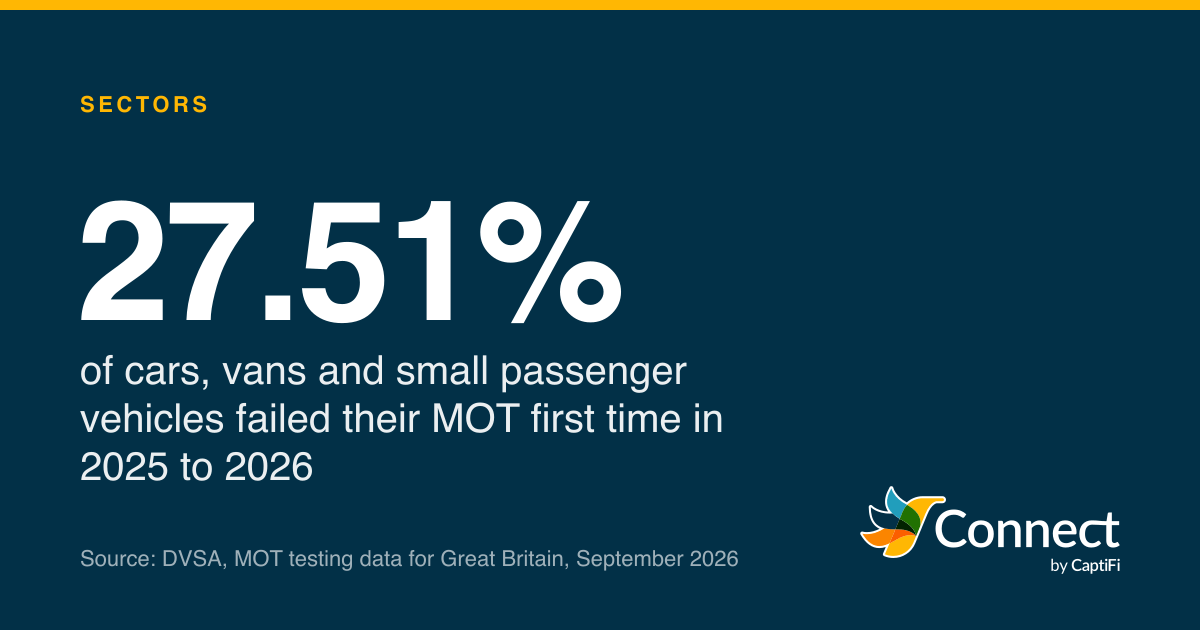
27.51%: of cars, vans and small passenger vehicles failed their MOT first time in 2025 to 2026. Source: DVSA, MOT testing data for Great Britain, September 2026.
DVSA counted 33,310,534 MOT tests on cars, vans and small passenger vehicles in the year to March 2026, and 9,163,007 of them failed as they were brought in. That's 27.51%, the lowest in the thirteen years of the published series. Garages put 1,733,209 of those right on the spot and passed them, which left 7,429,798 fails, or 22.30% of tests. Spread across the 23,092 private test stations DVSA lists for the same year, that's about 1,440 tests a station, of which roughly 320 left with a fail sheet.
Every one of those tests started with somebody remembering a date. The government texts drivers a month before their MOT is due, free, which means a garage's own reminder lands in a phone that may already have one. So the garage's text has a different job: getting the car booked in with you, and then carrying the customer through the day of the test with as few phone calls as possible.
What DVSA's figures show
The data set is published on GOV.UK every three months, with the caveat that it "is not classed as an 'official statistic'". It counts initial tests only, so abandoned tests, aborted tests and retests are left out, and it gives two failure rates: the initial rate, "for vehicles as they were brought for the MOT", and a final rate that excludes vehicles which "pass the test after rectification of minor defects at the time of the test".
For 2025 to 2026 the class 3 and 4 figures (cars, vans and passenger vehicles with up to 12 seats) were 33,310,534 tests, 9,163,007 initial fails and an initial failure rate of 27.51%. Of those fails, 1,733,209 passed after something was fixed on the spot, which brings the final failure rate down to 22.30%, or 7,429,798 vehicles. The first quarter of 2026 to 2027, April to June, ran at 26.75% on 7,808,594 tests.
Financial years, April to March. Initial tests only; abandoned, aborted and retests are excluded. The rate for vehicles as presented, before any defects are fixed at the test station. DVSA says the series is not an official statistic.
Source: DVSA, MOT test results by class of vehicle (table 1)
See the figures as a table
| Initial fail rate (%) | |
|---|---|
| 2013/14 | 40 |
| 2014/15 | 38.3 |
| 2015/16 | 36.8 |
| 2016/17 | 35.4 |
| 2017/18 | 34.5 |
| 2018/19 | 33.6 |
| 2019/20 | 31.69 |
| 2020/21 | 30.23 |
| 2021/22 | 29.21 |
| 2022/23 | 28.38 |
| 2023/24 | 28.58 |
| 2024/25 | 28.08 |
| 2025/26 | 27.51 |
The trend is the useful part. The initial failure rate was 40.0% in 2013 to 2014 and has fallen in all but one year since: 38.3%, 36.8%, 35.4%, 34.5%, 33.6%, then 31.69% in 2019 to 2020, 30.23%, 29.21%, 28.38%, a small rise to 28.58% in 2023 to 2024, 28.08% and now 27.51%. Test volumes went the other way, from 27,481,013 in 2013 to 2014 to 33.3 million. The number of test stations barely moved over the same period: 22,062 private stations in 2013 to 2014, 23,092 in 2025 to 2026, with 66,925 nominated testers.
What fails, and why it matters for the text
DVSA's defect table for 2025 to 2026 says which parts of the test the fails come from. Lamps, reflectors and electrical equipment were the largest category, with a failing defect in 10.44% of all tests. Suspension was next on 8.90%, then tyres on 6.23%, brakes on 6.10%, visibility (wipers, washers, the view out of the glass) on 4.28% and body, chassis and structure on 3.23%.
A test can fail in more than one category, so the shares do not add up to the 27.51% overall initial failure rate. DVSA counts an average of 2.39 defects per failed test.
Source: DVSA, class 3 and 4 initial failures by defect category (table 3)
See the figures as a table
| % of tests (%) | |
|---|---|
| Lamps, reflectors, electrical | 10.44 |
| Suspension | 8.9 |
| Tyres | 6.23 |
| Brakes | 6.1 |
| Visibility | 4.28 |
| Body, chassis, structure | 3.23 |
| Noise, emissions and leaks | 3.08 |
| Steering | 1.94 |
Two things in that table are worth a line in a reminder. The first is that the biggest category is the one a driver can check in their own driveway: a blown bulb is a fail. The second is tyres. Only 6.23% of tests failed on tyres, but tyre defects made up 60.60% of all the dangerous defects DVSA recorded, and 4.47% of tests had a dangerous tyre on them. Lights and tyres between them are the difference between a pass and a retest for a good share of those nine million fails, and a sentence in the booking confirmation ("check your lights and tyre tread before you come") costs nothing. DVSA also counts an average of 2.39 defects per failed test, so a fail sheet usually has more than one line on it. The fail text should name the main item and leave the rest to the estimate.
The reminder the government already sends
GOV.UK's reminder service lets drivers "get free MOT reminders by text message or email". It sends one reminder, "one month before your car, van or motorcycle MOT is due" (two months for a lorry, bus or large trailer), and needs only the number plate and a mobile number or email address. Drivers can view the reminders they've set up and stop them. Nothing on the page says it sends a second one, and it doesn't book anything.
The month matches a rule on GOV.UK's "getting an MOT" page: "you can get an MOT up to a month (minus a day) before it runs out and keep the same renewal date". Test earlier than that and the renewal date moves. So the government's reminder opens exactly the window in which a test can be done without losing days, and a garage's text that arrives in the same week is talking to a customer who has been told the date but not what to do about it. The page also carries the penalty, "up to £1,000 for driving a vehicle without a valid MOT", and the fee cap: "the maximum fee for a car is £54.85", £29.65 for a motorcycle and £58.60 for a class 7 van.
A garage's reminder does three things the government's doesn't: it names a garage, it offers a way to book in the same message, and it can be followed up, because the garage knows when the last test was and whether the customer came back.
Is an MOT reminder a marketing text?
Mostly, yes, and that's fine. The ICO's guidance on identifying direct marketing says a message sent "for administrative or customer services purposes", like confirming an appointment, isn't marketing, but one that "actively promotes or encourages people to make use of a particular service, special offer, or upgrade" is likely to be. "Your MOT is due by 14 November, reply BOOK" is encouraging someone to use your service, so treat it as marketing under PECR.
That means regulation 22, and for a garage the soft opt-in nearly always applies. The ICO's electronic mail guidance says you can text marketing to "an existing customer who bought (or negotiated to buy) a similar product or service from you in the past", as long as you gave them "a clear chance to opt out" when you took their details and in every message since. Someone whose car you tested last year is an existing customer who bought a similar service. Collect the mobile number at the desk with a line saying you'll text about their next MOT and they can opt out any time, keep "Reply STOP to opt out" on every reminder, and the box is ticked. Our guide to UK SMS marketing rules has the detail.
The texts on the day (confirmation, ready to collect, advisories) are service messages and don't need the opt-in.
The texts around a test
Six messages cover the year. Written for a garage called Hollins, with the customer's car and dates filled in from the booking.
The reminder, sent a month before expiry to match the government's window and a few days ahead of it if you can:
Hollins Garage: your Focus (AB12 CDE) is due its MOT by 14 Nov. Book in the next 4 weeks and keep the same renewal date. Reply BOOK and we'll text you some times. Reply STOP to opt out
The confirmation, once a slot is agreed:
Hollins Garage: MOT booked for Thu 6 Nov at 09:00, drop off from 08:30. Please bring the locking wheel nut key. Reply C to confirm or call us to change.
The day-before nudge, with the pre-check that addresses the top of DVSA's defect table:
Hollins Garage: reminder, your MOT is tomorrow at 09:00. Worth checking your lights and tyre tread tonight; bulbs and tyres are the two most common fails. Reply if you need to move it.
Ready to collect, which is the text that saves the phone ringing all afternoon:
Hollins Garage: good news, your Focus passed its MOT. Ready to collect until 17:30 today. Reply if you'd like us to keep it overnight.
Advisories, kept short and specific, with the quote to follow:
Hollins Garage: your Focus passed with 2 advisories: front tyres close to the limit and slight play in the offside rear wheel bearing. No action needed today. We'll text a price for both.
And the fail, which needs a decision from the customer, so it asks for one:
Hollins Garage: your Focus didn't pass its MOT. Main item: rear brake pads and discs below the limit. We've sent an estimate to your email. Reply YES to go ahead today or call us to talk it through.
A few wording habits run through all six. The garage's name is the first word every time, because a text from an unknown number about someone's car reads as a scam. The registration is in the reminder so the customer knows which car, which matters in a two-car household. Every message either tells the customer what happens next or asks them one question, and the question has a one-word answer. Nothing in the fail text argues the case; the estimate does that, and the text's job is to get a yes or a call.
Setting it up
The reminder is the only message that needs a date calculated. Everything else triggers off something that just happened. A garage with its test dates in a spreadsheet can schedule the reminder eleven months after each test, which lands it a month before the certificate runs out and inside the same week as the government's text. A keyword such as BOOK can send an automatic reply with the booking line or the next free slots, and the reply comes into a two-way inbox so the "can you do Saturday?" answers reach whoever runs the desk. The confirmations and collection texts are the same appointment reminder pattern any workshop uses, and our post on on-my-way texts for trades covers the mobile mechanic's version.
Campaign quiet hours on CaptiFi Connect run from 21:00 to 09:00 London time by default, which keeps the eleven-month reminder off anyone's phone at bedtime. Service texts sent from the workshop during the day aren't affected. Each text gets a delivery report with its own timeline, which is the first place to look when a regular customer doesn't book: a reminder that never reached the handset explains a lot of silences.
DVSA's test station table carries the last number. The 23,092 private MOT stations in 2025 to 2026 are 287 fewer than in 2021 to 2022, while tests rose by 1.7 million over the same four years. The work is going to fewer garages, which is one more reason for the reminder to carry your name.
Sources
Read for this post on 17 October 2026.
- DVSA: MOT testing data for Great Britain, updated 10 September 2026
- DVSA: MOT test results by class of vehicle (CSV)
- DVSA: MOT class 3 and 4 vehicles, initial failures by defect category (CSV)
- DVSA: MOT test stations and testers (CSV)
- GOV.UK: Get an MOT reminder
- GOV.UK: Getting an MOT
- GOV.UK: Getting an MOT, MOT test fees
- ICO: direct marketing guidance, identifying direct marketing
- ICO: Guide to PECR, electronic mail marketing
Written by the CaptiFi Connect team. Published 17 October 2026. More in Sectors
Send your first text this week
Set up your account and contacts now; we check every new account before it can send.