
Rules and trust9 min read
Prices in promotional texts: what the DMCC Act requires
Since 6 April 2025 a text with a price in it is an invitation to purchase under the DMCC Act: total price up front, no dripped fees and no false deadlines.
In short
- The CMA's unfair commercial practices guidance (CMA207) lists an email or text message promotion as an invitation to purchase, so a text that quotes a price must give the total price.
- Under section 230 of the DMCC Act 2024, in force since 6 April 2025, a quoted price must include every fee, tax or charge the customer will necessarily pay, such as VAT and booking fees.
- CMA guidance says limited space will generally not justify leaving required pricing out of an invitation to purchase, because a single all-in price fits on any device or medium.
- Falsely claiming an offer is available for a limited time is banned outright by paragraph 7 of Schedule 20 to the DMCC Act, and the CMA fined Wayfair £4.8 million for it in October 2026.
- The CMA fined Gold's Gym, a franchise running four London gyms, £45,000 in October 2026 for leaving its joining fee out of the total price of its memberships.
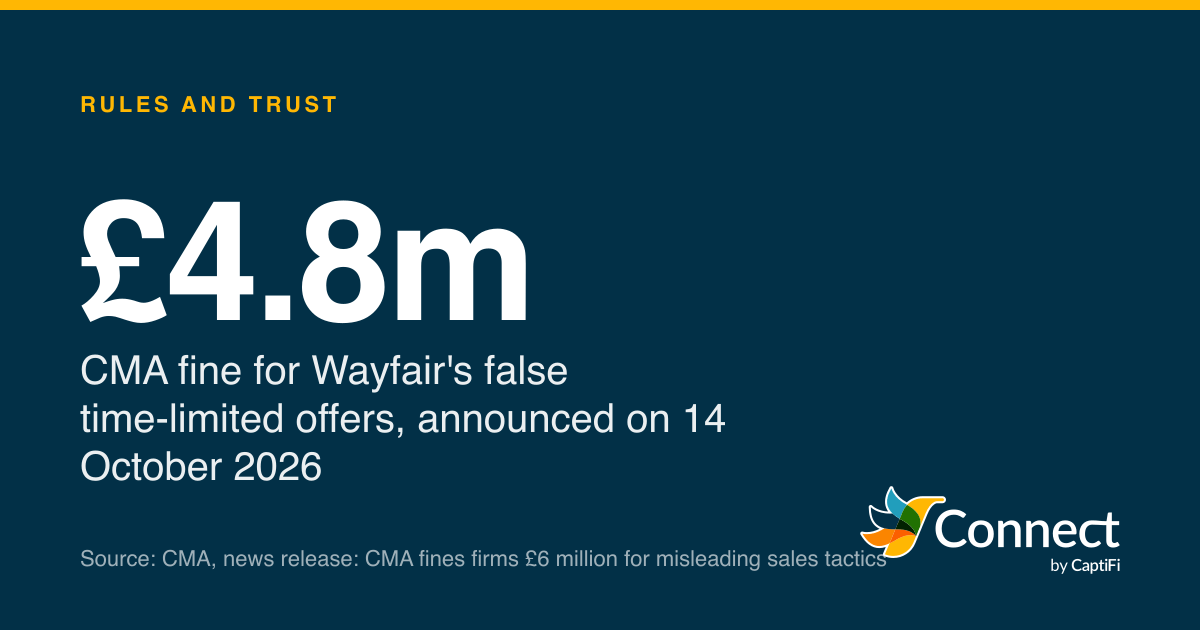
£4.8m: CMA fine for Wayfair's false time-limited offers, announced on 14 October 2026. Source: CMA, news release: CMA fines firms £6 million for misleading sales tactics.
A promotional text that names a product and a price is an "invitation to purchase" under the Digital Markets, Competition and Consumers Act 2024, and since 6 April 2025 that has meant it must show the total price, including every fee the customer can't avoid. The Competition and Markets Authority's guidance on unfair commercial practices (CMA207, first published on 4 April 2025 and last updated on 18 November 2025) lists "an email or text message promotion" among its examples. The same Act bans false deadlines outright, and the CMA has been fining for both since April 2026: £4.2 million for the AA over a £3 booking fee left out of its driving lesson prices, and £4.8 million for Wayfair over flash sales that didn't end when they said they would.
A text has 160 characters to work with, or 70 if it contains a character outside the standard set, which makes it tempting to drop the awkward bits. The guidance is specific about which parts can move to a web page, and the price isn't one of them.
Is a promotional text an invitation to purchase?
Section 230(10) of the Act defines an invitation to purchase as a commercial practice giving a consumer information "which indicates the characteristics of a product and its price" and which lets them decide whether to buy. CMA207's list of examples runs from a price on a shop shelf to a restaurant menu, and "an email or text message promotion" is on it. The guidance adds that an invitation to purchase "can exist even where the information indicating the price and characteristics of a product is minimal or incomplete", including where only the lowest price is given.
The other side is paragraph 4.11: "A commercial practice which does not include a price is not an invitation to purchase." A text saying your new menu has launched, with no price in it, isn't one. "Two courses for £22 this week" is. The Act's general rules on misleading actions and misleading omissions, in sections 226 and 227, still apply to a text with no price in it, so leaving the price out doesn't free you to say anything you like.
What has to be in it?
Section 230(2) lists the "material information" an invitation to purchase must give, unless it's already apparent from the context. For a typical promotional text the relevant items are:
- the main characteristics of the product, "to the extent appropriate considering the means used to communicate the invitation to purchase";
- the total price, which section 230(4) says "includes any fees, taxes, charges or other payments that the consumer will necessarily incur";
- the identity of the trader, meaning its name and any trading name;
- the business address and "any business email address of the trader";
- any optional delivery charges that aren't in the price;
- for products that carry them, the existence of cancellation rights.
Nobody fits a registered office address into a text, and the Act allows for that. Section 230(8) says that when judging whether something was left out, account is taken of "any limitations resulting from the means of communication used in the commercial practice (including limitations of space or time)" and "any steps taken by the trader to overcome those limitations by providing information by other means". CMA207 says what those steps can look like: "Such other means could include providing a hyperlink or QR code, or encouraging consumers to visit a website for more information."
What can't go behind the link is the price. Paragraph 4.20 of CMA207: "limitations of time and space will generally be unlikely to justify omitting required pricing information from an invitation to purchase", because "a single price figure inclusive of all mandatory charges will be able to fit on or within all types of devices and media." Paragraph 4.21 adds that required information "should not be omitted in favour of other, non-mandatory, information", which in a text means the price wins over the emoji and the exclamation marks. Identity, on the other hand, can be apparent from the context (the CMA's example is a clearly branded advert), so a text that opens with your business name, sent from a sender name that is your business name, has that one covered.
What counts in the total price?
The CMA's price transparency guidance (CMA209, published on 18 November 2025) lists the charges that are mandatory and so belong in the headline figure. Among them: purchase taxes such as VAT; "administration fees, however described, such as booking or processing fees"; "mandatory cover or service charges at a restaurant"; delivery charges where the customer can't arrange collection; and "joining fees that new members pay on top of their first regular payment when joining gyms or getting other subscriptions". Showing a charge separately doesn't make it optional. If the customer has to pay it to get what was advertised, it's mandatory.
For texts that turns into simple arithmetic. Three made-up examples:
| A text that says | The customer must also pay | What the text should say instead |
|---|---|---|
| Cut and finish £40 | A £5 online booking fee | Cut and finish £45 |
| Tasting menu £55pp | A 12.5% service charge added to every bill | Tasting menu £61.88pp |
| Membership £25 a month | A £30 joining fee | A price that includes the joining fee, shown as clearly as the monthly figure |
Extras that really are optional are a different matter. CMA209 says an optional service "does not have to be included in the headline price if it is genuinely optional", while warning that "merely presenting a charge separately to the headline price or describing it as an extra service does not make it optional". Pre-ticking it is another matter again: Marks Electrical was fined £720,000 on 18 June 2026 for opting customers into paid recycling and unwrapping services without their express agreement.
Can you still say "from £29"?
Yes, carefully. CMA209 calls indicative and "from" pricing "a useful tool that can help make complex pricing accessible to a consumer", and gives a hotel example: rooms can be advertised "from" the cheapest basic room. It then warns: "if the hotel were advertising a weekend break when prices are more expensive, it would be misleading to use a 'from' price based on staying midweek." A trader using a "from" ticket price, it adds, "should be able to demonstrate that a significant proportion of the tickets will be available at that price".
Schedule 20 of the Act, the list of practices banned in all circumstances, backs that up. Paragraph 5 bans an invitation to purchase at a specified price where the trader has reasonable grounds to believe it can't supply the product at that price "in reasonable quantities, for a reasonable period of time" and doesn't say so. A salon texting "Colour from £49" to fill Saturday appointments, when £49 is a weekday price with a junior stylist, is the hotel example in a different trade.
"Ends tonight": the false urgency ban
Paragraph 7 of Schedule 20 bans "Falsely stating that a product will only be available for a limited time, or that it will only be available on particular terms for a limited time, in order to elicit an immediate decision and deprive consumers of sufficient opportunity or time to make an informed choice." Because it's in Schedule 20, nobody has to show a customer was swayed by it. A false deadline is unlawful in itself.
CMA207's example is the countdown clock that hits zero and restarts. It also has a caution that matters for text campaigns: a true deadline is "unlikely to be problematic" unless it's misleading for another reason, "for example, because a substantially similar offer appears within a short period". Sending "Last chance, 20% off ends midnight" on Sunday and the same 20% code on Tuesday is the text version of the restarting clock.
The CMA has now fined for exactly this. On 14 October 2026 it fined Wayfair £4.8 million over "Daily Deals" and 24-hour "Flash Deals" sold with messages such as "Here Today, Gone Tomorrow" and countdown timers, finding that "many products remained available at the same price or lower after the stated deadline". The same day it fined Appliances Direct £1.2 million, partly for pop-up countdown banners offering £10 to £25 off for a limited time when "the same discount codes appeared repeatedly over many days". The advertising code has had its own version of this rule for years, and our post on the CAP Code and your promotional texts covers it.
What has the CMA done so far?
The Act's enforcement part, which lets the CMA decide for itself that consumer law has been broken and fine directly, came into force on 6 April 2025 alongside the unfair trading rules. The ceiling is 10% of global turnover, or £300,000 where that's higher. In November 2025 the CMA said it had reviewed the pricing of more than 400 businesses in 19 sectors, and it opened investigations into eight businesses while writing to 100 others. By its blog of 14 October 2026 it had settled seven of those eight and imposed more than £11.8 million in fines since April 2026.
From the CMA's release for each case, all listed under sources, with the month it was announced. Every amount is after the 40% discount each firm received for settling.
Source: CMA, news release: CMA fines firms £6 million for misleading sales tactics, 14 October 2026
See the figures as a table
| Fine (£) | |
|---|---|
| Wayfair, Oct 2026 | 4,800,000 |
| AA driving schools, Apr 2026 | 4,200,000 |
| Appliances Direct, Oct 2026 | 1,200,000 |
| StubHub UK, Jun 2026 | 889,200 |
| Marks Electrical, Jun 2026 | 720,000 |
| Gold's Gym, Oct 2026 | 45,000 |
Two of the cases are about the total price. The AA's driving schools showed lesson prices without a mandatory £3 booking fee between April and December 2025; the CMA found more than 80,000 learners were affected, ordered refunds of over £760,000 (about £9 each on average) and fined the AA £4.2 million on 15 April 2026. StubHub UK added mandatory delivery and service fees at the final checkout stage between 6 April and 7 December 2025, and was fined £889,200 on 23 June 2026, with refunds of more than £590,000 to 51,350 customers.
The smallest case is the one most like a business that texts its customers. Gold's Gym, a franchise running four gyms in London, didn't include its joining fee in the total price of its annual and Direct Debit memberships, or showed the total "in a way that was unclear and unlikely to be seen". The CMA fined it £45,000 and ordered refunds of £9,220 to 726 customers, £50 or £10 each. Every firm in the chart settled and got the 40% discount for doing so, which is how the AA's £7 million fine became £4.2 million.
Fines aren't the only exposure. Section 237 makes omitting material information from an invitation to purchase a criminal offence, and the same goes for most of the Schedule 20 practices, the false deadline included.
Before the text goes
CaptiFi Connect's short tracked links keep a terms link from eating the character count, which leaves room for the price. Our own packs run from 500 credits for £25 to 20,000 for £700 with no VAT added, so the figure on the pricing page is the figure you pay. Then a last pass over the wording:
- Does the price in the text include VAT and every fee the customer can't avoid? If not, change the price.
- If it says "from", can a fair share of customers get that price on the days the text is promoting?
- If it gives a deadline, will the offer end then, and are you sure the same offer won't go out again next week?
- Is your business name in the text, with a link to a page carrying your address, email address and the full terms?
- Have the price and the conditions had their characters before any decoration has?
Sources
Read for this post on 22 October 2026.
- legislation.gov.uk: Digital Markets, Competition and Consumers Act 2024, Part 4, Chapter 1
- legislation.gov.uk: Digital Markets, Competition and Consumers Act 2024, Schedule 20
- legislation.gov.uk: DMCC Act 2024 (Commencement No. 2) Regulations 2025, regulation 2
- CMA: Unfair commercial practices (CMA207), updated 18 November 2025
- CMA: Price transparency (CMA209), publication page
- CMA: Unfair commercial practices, price transparency (CMA209)
- CMA: news release, major consumer protection drive focused on online pricing practices, 18 November 2025
- CMA: news release, AA and BSM driving schools ordered to refund learner drivers over drip pricing, 15 April 2026
- CMA: news release, StubHub UK ordered to refund customers over hidden fees, 23 June 2026
- CMA: news release, Marks Electrical ordered to refund customers over pre-selected extra charges, 18 June 2026
- CMA: news release, CMA fines firms £6 million for misleading sales tactics, 14 October 2026
- CMA blog: Direct consumer enforcement, 18 months on, 14 October 2026
- CMA: Unfair commercial practices (CMA207), publication page
- GOV.UK Notify: text message pricing (message lengths)
Written by the CaptiFi Connect team. Published 22 October 2026. More in Rules and trust
Send your first text this week
Set up your account and contacts now. Until we've approved it, a person reads each text before it goes out.