
Rules and trust10 min read
The CAP Code and your promotional texts
A marketing text is an advert, so the CAP Code applies. The rules on misleading claims, "free", closing dates and alcohol, with the ASA rulings about texts.
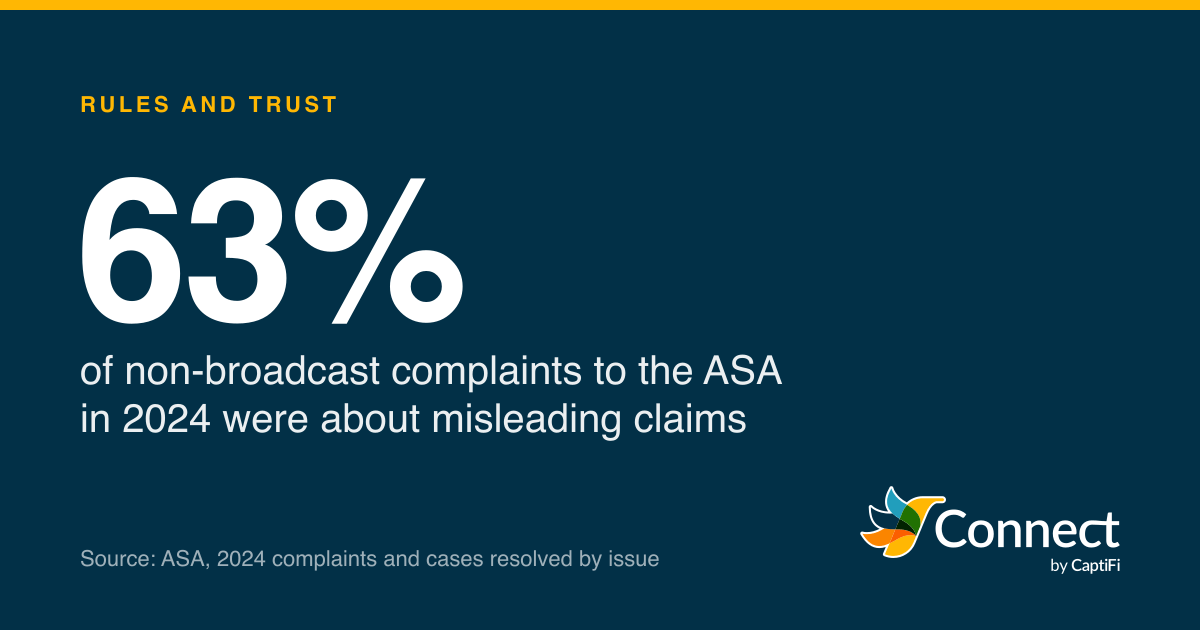
63%: of non-broadcast complaints to the ASA in 2024 were about misleading claims. Source: ASA, 2024 complaints and cases resolved by issue.
"Hi Mate I'm still out in town, just got £1000 in my account from these guys www.firstpaydayloanuk.co.uk". That text, and a near twin with £850 in it, went out from ordinary looking mobile numbers in 2013 on behalf of a payday lender called First Financial (UK) Ltd. Thirteen people complained to the Advertising Standards Authority. On 19 June 2013 the ASA upheld every point: the texts weren't recognisable as marketing (the "Hi Mate" opener and the standard mobile numbers made them look like a message from a friend), they implied a loan was a fine way to fund a night out, and the lender couldn't show that anyone had agreed to receive them.
Most people who text their customers think about PECR and the ICO, and that's right, because that's where the fines are. The CAP Code is the other rulebook, the one that covers what the text says, and the ASA has been ruling on texts for well over a decade.
A marketing text is an advert
The scope section of the CAP Code lists what it covers, and item I(a) names "e-mails, text transmissions (including SMS and MMS), fax transmissions" alongside adverts in newspapers, magazines and mailings. Item I(f) adds "promotions in non-broadcast media". So "20% off this weekend" is a marketing communication under the Code, and "your table is booked for 7pm" is not, because it isn't selling anything.
Rule 1.1 is the one everybody can recite: "Marketing communications should be legal, decent, honest and truthful." Rule 1.8 puts "primary responsibility for observing the Code" on the marketer, with agencies and service suppliers accepting an obligation too, so "our SMS company sent it" is no defence. And rule 1.7 is the quiet one: "Any unreasonable delay in responding to the ASA's enquiries will normally be considered a breach of the Code." A claims management company called Data Supplier found that out on 12 December 2012. It had texted people that their records suggested they could claim £3,750 for an accident (they'd had no accident), then didn't substantively answer the ASA. The ruling lists 1.7 among the breaches, next to the misleading claims and the missing consent.
The ASA can't fine you. What it does is publish the ruling, with your company name in the title, on a page that stays up. Three of the four text rulings in this post are from 2012 and 2013 and you can still read every word of them.
Misleading, in 160 characters
Section 3 is where most of the ASA's work is. Its breakdown of the non-broadcast complaints it resolved in 2024 puts 17,026 under misleading claims, which by its own reckoning is 63%, against 19% for harm and 6% for offence.
Non-broadcast media only (print, online, email, texts and the rest). The same four issues by cases rather than complaints: misleading 15,486, harm 4,479, no issue 1,229, offensive 912.
Source: ASA, 2024 complaints and cases resolved by issue
See the figures as a table
| Complaints | |
|---|---|
| Misleading | 17,026 |
| Harm | 5,226 |
| No issue | 3,401 |
| Offensive | 1,528 |
Rule 3.1 is short: "Marketing communications must not materially mislead or be likely to do so." Rule 3.3 adds that they "must not omit material information", and 3.9 that they must not mislead "by omitting significant limitations and qualifications". A text has less room than any other medium, which makes omission the natural failure. "Half price pizzas all week" misleads if it's collection only and the text doesn't say.
Then there's rule 3.7, the one the payday rulings turned on. Before sending, marketers "must hold documentary evidence" for any claim a consumer is likely to take as objective. On 23 January 2013 the ASA ruled on a lead generator called Get it Back, whose texts read "Do you need CASH B4 payday? £400 deposited in your account TODAY!" and promised "CASH in 1 HR". Get it Back said the claims came from the lenders' own websites. The ASA had seen no evidence anyone received cash within an hour, so the claims were misleading and unsubstantiated, breaching 3.1 and 3.7.
Puffery is allowed. Rule 3.2 permits "obvious exaggerations" the average consumer "is unlikely to take literally", so "the best coffee in Leeds" is fine. "Voted best coffee in Leeds" is a claim, and you'll need the vote.
Prices bite in a text because there's no small print. Rule 3.18 says quoted prices "must include non-optional taxes, duties, fees and charges that apply to all or most buyers", so a price to a consumer is the VAT-inclusive one, and 3.22 says "from" and "up to" claims "must not mislead by exaggerating the availability or amount of benefits".
Two rules carry an asterisk, which in the Code means the practice is unfair in all circumstances. Rule 3.23 forbids calling something "free" if the consumer "has to pay anything other than the unavoidable cost of responding and collecting or paying for delivery". Rule 3.30 is the false urgency rule: marketers "must not falsely state that a product, or the terms on which it is offered, will be available only for a limited time to deprive consumers of the time or opportunity to make an informed choice". If "ends tonight" is followed by the same offer on Tuesday, that's a starred breach.
"Ends Sunday": the promotion rules
Section 8 covers sales promotions, prize draws and competitions, which is most of what a shop or restaurant texts. A discount code or a draw for a hamper: both section 8.
Rule 8.17 says promotions "must communicate all applicable significant conditions or information" where leaving them out "is likely to mislead", then lists them: how to participate and any costs, "a prominent closing date, if applicable", any restrictions, any limit on availability, and the promoter's name and address unless obvious.
That is a lot to fit into a text, and CAP knows it. Rule 8.18 is written for exactly this: marketing communications "that include a promotion and are significantly limited by time or space" must "direct consumers clearly to an easily accessible alternative source" for the full conditions. The text carries the headline, the closing date and a link; the page behind the link carries the rest.
Bay Tree Deli: 25% off everything in store this Sat 25 Oct, 9am to 5pm. One use per customer, full terms at baytree.co/sat. Reply STOP to opt out
Closing dates are where promoters get into trouble, enough that CAP has a separate advice page on them. Rule 8.17.4.e: "Closing dates must not be changed unless unavoidable circumstances beyond the control of the promoter make it necessary." CAP's advice gives extreme weather delaying stock as a possible example of unavoidable, and says plainly that not receiving enough entries is not one. The rulings on that page tell the story. KS Competitions (2 December 2020) extended because not all the tickets had sold, which the ASA said was not an unavoidable circumstance. Boohoo.com (6 May 2020) ran a countdown clock that reset when it hit zero, which the ASA treated as misleading because the promotion never closed.
For a text campaign the lesson is to pick the date before you write the message, then leave it alone. If the weekend's quiet, run a new promotion with a new date. Don't text "extended until Wednesday".
Prize draws have a further set. Rule 8.19: "Promoters must not claim that consumers have won a prize if they have not." Rule 8.22: "Promoters must not claim that consumers must respond by a specified date or within a specified time if they need not." And 8.10 says promoters "must be able to demonstrate that they have made a reasonable estimate of the likely response", while 8.9 warns that "subject to availability" doesn't excuse an offer that runs out on day one. A draw announced by text should read like the first of these:
Harbour Gym: reply WIN by Fri 31 Oct for a chance at a year's free membership. One entry per member, draw on 3 Nov, terms at harbourgym.uk/win. Reply STOP to opt out
Harbour Gym: CONGRATULATIONS you've been selected! Claim your prize in the next 2 hours
The second one breaks 8.19 and 8.22 in 14 words.
Pubs, bars and the alcohol section
If you run a pub and text about Friday night, section 18 applies as well. The ASA's sector table for 2024 shows alcohol is a small part of its caseload (200 complaints, 167 cases, down 34% on 2023), but the rules are strict and a text to a customer list is squarely inside them.
Rule 18.1 wants alcohol marketing to be "socially responsible". The one written for promotions is 18.10: "Marketing communications that include a promotion must not imply, condone or encourage excessive consumption of alcohol." So "doubles for the price of singles all night" is a text you don't send. Rule 18.4 says drinking "must not be portrayed as a challenge", 18.2 says it mustn't be shown to "enhance confidence or popularity", and 18.9 allows factual information about strength without any implication that a drink "may be preferred because of its alcohol content".
Then the age rules. Rule 18.14 says alcohol marketing "must not be likely to appeal particularly to people under 18", and 18.15 adds "No medium should be used to advertise alcoholic drinks if more than 25% of its audience is under 18 years of age." A list built from people who've bought drinks in your pub is an adult audience; one built from a student event may not be. The safe text sells the night and treats the drink as part of it:
The Anchor: live music from The Coast Road this Fri 24 Oct, 8pm, free entry. Kitchen open till 9. Reply STOP to opt out
Our post on event nights by text for pubs has more wording along those lines.
What the text rulings have in common
Four published ASA rulings about texts, from 2012 to 2014, and the same handful of failures run through all of them.
Nobody could prove consent. First Financial, Get it Back, Data Supplier and Clarity Leeds (24 September 2014, ten texts about debt solutions and pensions) were all asked for evidence that the complainants had agreed to be texted, and none had any. Get it Back said one complainant had opted in during a phone survey; the ASA replied that it had seen no documentary evidence of that. An opt-out line at the bottom made no difference, and the First Financial ruling says so in terms. The current Code puts this in rule 10.6: marketers "must have obtained consent before using contact details to send marketing communications". (Our post on writing a consent request that stands up covers what the record needs to look like.)
STOP has to work. Get it Back's complainant replied STOP and kept getting texts; the company said the network had re-sent the message. Clarity Leeds told both the complainant and the ASA that his number had been suppressed, and the texts carried on. Both were upheld. Rule 10.7 requires "a valid address or short code to which recipients can send opt-out requests", 10.10 says databases "must be checked against suppression files", and 10.12 says withdrawing consent must be as easy as giving it. The STOP guide covers the mechanics.
Say who you are. Data Supplier's PPI text didn't name the sender, and the ASA told it to "identify the company as the advertiser in future texts". First Financial's "Hi Mate" went further and hid that the message was marketing at all, which breached rule 2.1 on recognisability. A registered sender name or your business name in the first three words settles both.
Hold the evidence first. "CASH in 1 HR" was upheld as unsubstantiated under 3.7. And answer the ASA when it writes: Data Supplier's silence was itself a breach.
The ASA's own tables show how rarely a text becomes a case. The 2024 breakdown by media has no row for text messages; the nearest are email (1,186 complaints) and "other" (905), a long way below online (20,423) and television (12,383). Complaints about unwanted texts go to the ICO under PECR, so what reaches the ASA is complaints about what a text said, and those are too few for a row of their own. Across all media the ASA resolved 37,284 complaints about 24,015 ads in 2024.
The ten largest of the 18 media the ASA reports. There is no row for text messages; the table total is 38,749 complaints.
Source: ASA, 2024 complaints and cases by media
See the figures as a table
| Complaints | |
|---|---|
| Online | 20,423 |
| Television | 12,383 |
| 1,186 | |
| Radio | 980 |
| Outdoor | 960 |
| Other | 905 |
| Packaging and point of sale | 528 |
| Leaflet, brochure or catalogue | 331 |
| Direct mail or circular | 258 |
| National press | 249 |
Before you press send
A short pass against the Code, in the order the rules come up:
- Is it recognisable as marketing from a named business? (Rules 2.1 and 10.7.)
- Is every factual claim one you hold evidence for today, with prices VAT inclusive? (Rules 3.7 and 3.18.)
- If it says "free" or "ends Sunday", is that true, and will you hold the date? (Rules 3.23, 3.30 and 8.17.4.e.)
- Are the significant conditions in the text or one tap away? (Rules 8.17 and 8.18.)
- If it's alcohol, is the offer about the night, with no quantity deal in it, and is the list adult? (Rules 18.10 and 18.15.)
- Can you show consent for every number, and does STOP suppress the number the same day? (Rules 10.6, 10.10 and 10.12.)
Our guide to UK SMS marketing rules covers the PECR side, which sits alongside all of this. CaptiFi Connect handles two of the mechanical items: campaigns carry "Reply STOP to opt out" by default and a STOP reply opts the number out automatically, and sender names are reviewed before first use. The wording of the offer is still yours. The First Financial ruling is still on the ASA's site, all three texts quoted in full, thirteen years on.
Sources
Read for this post on 17 October 2026.
- CAP: the CAP Code, scope of the Code
- CAP: the CAP Code, section 1 (compliance)
- CAP: the CAP Code, section 3 (misleading advertising)
- CAP: the CAP Code, section 8 (promotional marketing)
- CAP: the CAP Code, section 10 (use of data for marketing)
- CAP: the CAP Code, section 18 (alcohol)
- CAP: advice on closing dates in promotional marketing
- ASA: ruling on First Financial (UK) Ltd, 19 June 2013
- ASA: ruling on Get it Back, 23 January 2013
- ASA: ruling on Data Supplier, 12 December 2012
- ASA: ruling on Clarity Leeds Ltd, 24 September 2014
- ASA: 2024 complaints and cases in context
- ASA: 2024 complaints and cases resolved by issue
- ASA: 2024 complaints and cases by media
Written by the CaptiFi Connect team. Published 17 October 2026. More in Rules and trust
Send your first text this week
Set up your account and contacts now; we check every new account before it can send.