
Sectors9 min read
Retail texts: click and collect, stock and sales
Online is 28.8% of GB retail sales, so the text that says an order is ready matters. Collection and back-in-stock wording, and the CMA's rules for a sale text.
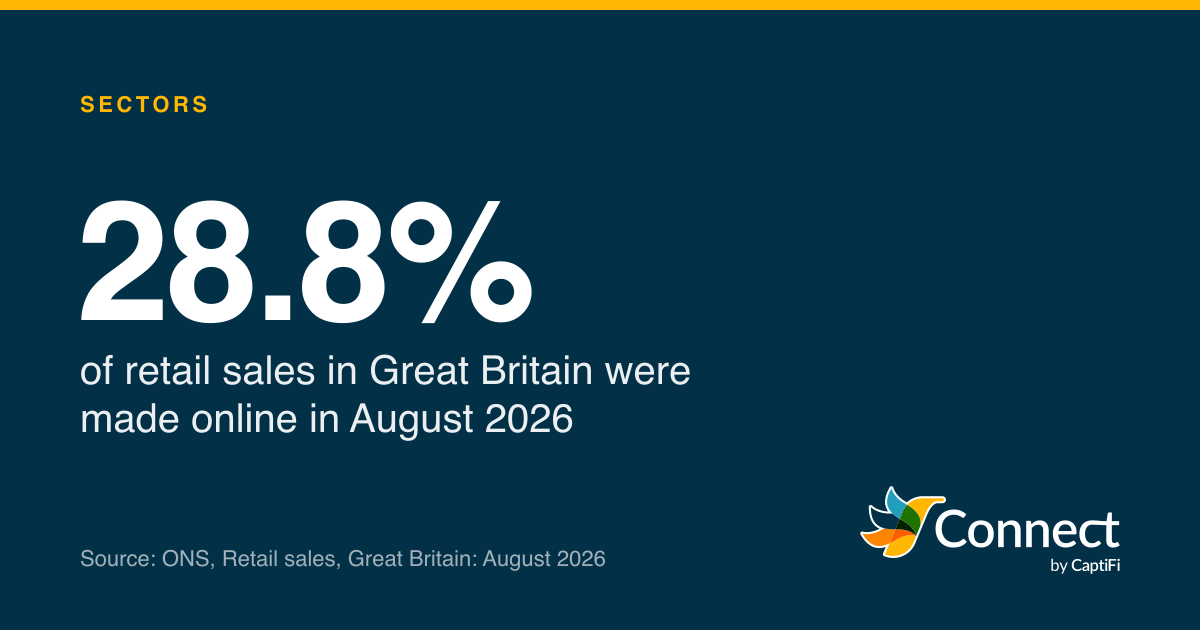
28.8%: of retail sales in Great Britain were made online in August 2026. Source: ONS, Retail sales, Great Britain: August 2026.
In November 2025, 32.4% of retail sales in Great Britain were made online. That is the ONS series on internet sales as a share of all retail, and it was the highest month since November 2021. The rest of the year sat between 27% and 30%, and the August 2026 bulletin, published on 18 September 2026, put the proportion of sales made online at 28.8%. Every one of those sales ends with a parcel, a collection or a disappointed "out of stock", and in each case a text is the thing most shops send to tell the customer what happens next.
So this post is about those three texts: the one that says an order is ready, the one that says an item is back, and the one that announces a sale. The first is a service message anyone can send. The second depends on who asked for it. The third has a set of rules behind it that changed on 6 April 2025, and the CMA has been specific about what a "was £120, now £96" claim has to be able to prove.
How much of retail is online now
The ONS has tracked internet sales as a share of total retail sales since 2007, when it was 3.4%. It took twelve years to reach 19.2% in 2019, then jumped to 28.1% in 2020 and 30.7% in 2021 while the shops were shut. It fell back to 26.6% in 2022 and has crept up since: 26.7% in 2023, 27.1% in 2024 and 27.5% in 2025. The whole series is in the chart below.
Annual values of the ONS series J4MC. The monthly proportion quoted in each retail sales bulletin is not the same series and runs about a point higher.
Source: ONS, time series J4MC, Retail Sales Index, released 18 September 2026
See the figures as a table
| Online share (%) | |
|---|---|
| 2010 | 7.3 |
| 2011 | 8.3 |
| 2012 | 9.3 |
| 2013 | 10.4 |
| 2014 | 11.3 |
| 2015 | 12.5 |
| 2016 | 14.7 |
| 2017 | 16.3 |
| 2018 | 18 |
| 2019 | 19.2 |
| 2020 | 28.1 |
| 2021 | 30.7 |
| 2022 | 26.6 |
| 2023 | 26.7 |
| 2024 | 27.1 |
| 2025 | 27.5 |
Month by month the pattern is seasonal and predictable. November is the peak (32.4% in 2025, 30.3% in 2024), December drops back as people go to the shops, and the rest of the year holds around 27% to 28%. The August 2026 bulletin reported online sales values 8.9% higher than in August 2025, and 10.1% higher across the three months to August than the same three months a year before. Online has grown faster than the shop floor every year since the 2022 dip.
November 2025, at 32.4%, was the highest month in the series since November 2021.
Source: ONS, time series J4MC, Retail Sales Index, released 18 September 2026
See the figures as a table
| Online share (%) | |
|---|---|
| Sep 2025 | 27.3 |
| Oct 2025 | 28 |
| Nov 2025 | 32.4 |
| Dec 2025 | 29.5 |
| Jan 2026 | 28.7 |
| Feb 2026 | 27.5 |
| Mar 2026 | 28.3 |
| Apr 2026 | 27.5 |
| May 2026 | 27.8 |
| Jun 2026 | 28.4 |
| Jul 2026 | 27.5 |
| Aug 2026 | 27.3 |
What the ONS does not publish is a split of online orders between home delivery and collection in store, so we have not quoted one. The texts below apply either way; only the wording of the "it's here" message changes.
The collection text
A click and collect order generates two moments a customer cares about: when it is ready, and when they must pick it up by. A text covers both in one part if it is written tightly:
Hadley & Co: order 48213 is ready to collect at our Bath shop, open 9 to 5:30 Mon to Sat. Bring this text. We'll hold it until Sat 24 Oct.
That is 138 characters, which keeps it in one SMS part at the GSM-7 limit of 160 (our character counter will tell you if an unusual character tips it over). The order number is near the front so staff can find the parcel. The hours are there so nobody turns up at six. The hold date is there because, without it, the first the customer hears of a return-to-stock is a refund they did not ask for.
A collection text is not direct marketing. Regulation 22 of PECR, the rule that requires consent before a marketing text, applies to "unsolicited communications for the purposes of direct marketing", and a message about an order the customer placed is neither unsolicited nor marketing. You do not need a tick box to send it. You do need to keep it to the order: the moment you add "and 20% off coats this week" the message becomes marketing and the consent rules apply to the whole text.
Two refinements earn their place. Send it from a name the customer will recognise, which in the UK means a registered alphanumeric sender name (our guide to UK sender IDs covers the review). And make it two-way: if the customer can reply "Can my partner collect it?" and get an answer, the text has replaced a phone call. A reminder on the day before the hold expires, same wording with "last day tomorrow", is the difference between a collected order and a restock. Our post on delivery updates covers the home delivery side.
Back in stock, and who asked
The back-in-stock text splits into two cases, and the split decides whether PECR consent is needed.
In the first case, the customer stood at a product page, found the size sold out, and typed their mobile number into a box that said "Text me when it's back". That single text, about that item, is what they asked for. Send it, once, and say what it is:
Hadley & Co: the Harris coat in 12 you asked about is back in stock. hadleyandco.uk/s/4k2 to order. We'll only text you about this item.
The last sentence does two jobs. It tells the customer the scope, and it holds you to it. If you want to text the same person about other things later, that is marketing, and it needs either consent or the soft opt-in.
The soft opt-in is paragraph (3) of regulation 22. A shop may send marketing texts without consent where it "obtained the contact details of the recipient of that electronic mail in the course of the sale or negotiations for the sale of a product or service to that recipient", the marketing is for "that person's similar products and services only", and the customer was given "a simple means of refusing" at the time the details were taken and in every message since. A checkout that captures the mobile number for the collection text, shows a clear opt-out line for marketing, and records the answer, meets that. A back-in-stock box on its own does not involve a sale, so it does not; a request is not a negotiation. Our glossary entry on the soft opt-in has the detail, and the marketing rules guide covers the rest.
Under either route, every marketing text ends with "Reply STOP to opt out", and the number is dropped from the list the moment someone replies.
The sale text and the pricing rules
A sale text is the shortest advert a shop will ever write, and from 6 April 2025 it sits under the unfair commercial practices provisions of the Digital Markets, Competition and Consumers Act 2024. The CMA's guidance on those provisions, CMA207, published on 18 November 2025, says at paragraph 1.15 that they "apply to practices that take place from 6 April 2025". Schedule 20 of the Act lists the practices that are unfair in all circumstances, and three of them are written for sale messages.
Banned practice 7 is "falsely stating that a product will only be available for a limited time, or that it will only be available on particular terms for a limited time, in order to elicit an immediate decision". The CMA's own example is a countdown clock that runs out and restarts, and a game skin sold as "only available for 5 days" that is back in the store ten days later. Practices 5 and 6 are bait advertising: inviting purchase at a price you cannot supply in reasonable quantities for a reasonable period, or advertising one item to sell a different one. Practice 23 is calling something "free" when the customer pays more than the unavoidable cost of responding.
The "was" price has its own rules. The CMA published its discount and reference pricing principles on 1 August 2024 for online mattress sellers, and said it would consider the same principles when looking at reference pricing in other sectors. The duration requirement: offer the product at or above the reference price "for a sufficient period", which is "more likely to be achieved if this period is at least 30 days", and run the discount for no longer than that establishment period. The volume requirement: the number sold at the reference price during the establishment period should be at least a third of the total sold across both periods, a 1:2 ratio. The two run together, so a product sold at £120 for 30 days can be sold as "was £120" for up to 30 days or until twice as many have gone at the lower price, whichever comes first. The CMA had earlier accepted undertakings from Simba Sleep for a 21-day establishment period against a discount period of no more than 10 days.
Behind both sits the CMA's open letter of 29 March 2023, which defines an urgency claim as "any scarcity, popularity, 'act fast' or time limited claim" and a price reduction claim as "any discount or special offer price that refers to a higher comparison price". It tells businesses to "make sure you have evidence to substantiate the urgency claims and price reduction claims that you make online; and keep adequate records to show that these claims genuinely reflect selling conditions". A text is 160 characters of exactly those claims.
So a sale text that stands up looks like this:
Hadley & Co: 20% off all coats until Sun 1 Nov, in store and online. Harris coat was £120, now £96. Reply STOP to opt out.
And what is behind it: the Harris coat was on sale at £120 for at least 30 days before the text went out; the offer ends on 1 November and no "extended by popular demand" text follows on the 2nd; the coat is in stock in the sizes people will ask for; and the records of all three are kept. Drop any one of those and the same 122 characters are a banned practice.
What a shop should set up
Keep three lists. A service list of people with a live order, who get collection and delivery texts and nothing else. A requests list of people waiting on one item, who get one text about that item. A marketing list of people who ticked the box at checkout or came in through the soft opt-in, who get the sale texts, every one ending with "Reply STOP to opt out". When the three are mixed, the collection text picks up an offer and the back-in-stock text goes to someone who never asked.
Time them. A collection text goes the minute the order is ready, because that is when it is useful. A sale text goes at a time the shop would be happy to receive it; CaptiFi Connect's campaign quiet hours run from 21:00 to 09:00 London time by default, and a scheduled send can be set for the morning the offer starts.
Measure the sale text by clicks. A tracked short link in the text tells you how many people opened the offer page, which is the only honest measure of a marketing text; delivery receipts tell you the phone received it and nothing more. Our link tracking page explains what a click report contains, and the sample texts above are written so the link is short enough to keep the message in one part.
Keep the pricing evidence beside the campaign. The date the reference price was set, the units sold at it, the date the offer ends. The CMA's letter asks for records that show the claims "genuinely reflect selling conditions", and a shop that can produce them for a 122-character text is in a better position than most websites.
Sources
Read for this post on 17 October 2026.
- ONS: Internet sales as a percentage of total retail sales, time series J4MC
- ONS: time series J4MC as CSV
- ONS: Retail sales, Great Britain: August 2026
- CMA: Unfair commercial practices guidance, CMA207, 18 November 2025
- CMA: Discount and reference pricing principles, 1 August 2024
- CMA: Urgency claims and price reduction claims, compliance advice, 29 March 2023
- legislation.gov.uk: Digital Markets, Competition and Consumers Act 2024, Schedule 20
- legislation.gov.uk: PECR 2003, regulation 22
Written by the CaptiFi Connect team. Published 17 October 2026. More in Sectors
Send your first text this week
Set up your account and contacts now; we check every new account before it can send.