
Sectors8 min read
Salon reminder texts that fill the diary
Nearly half of UK salons told the NHBF they only break even. What the figures say about no-shows, deposits and the reminder texts that keep a column full.
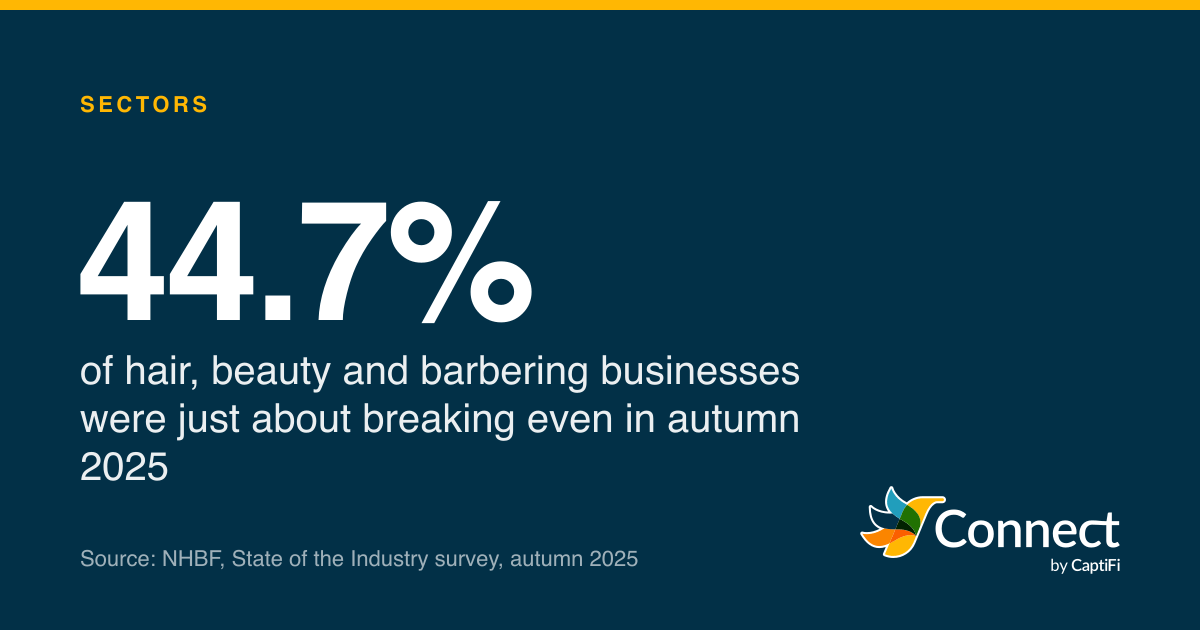
44.7%: of hair, beauty and barbering businesses were just about breaking even in autumn 2025. Source: NHBF, State of the Industry survey, autumn 2025.
Thursday, two o'clock, and the colour slot is empty. The client booked it three weeks ago and has not rung. In a trade where the stylist is paid for the afternoon either way, that gap is the most expensive thing in the room, and the National Hair and Beauty Federation's latest survey says most salons have no cushion to absorb it. Of 629 businesses that answered in autumn 2025, 44.7% said they were "just about breaking even", 14.8% were making a small loss each month and 4.5% a substantial one. Only 6.2% called their profit good.
A reminder text has one job in that situation: to turn the empty two o'clock into either a confirmed client or a slot you can refill in time. The industry figures explain why that job is worth more to a salon than it is to almost any other kind of business.
A sector of very small businesses
The Office for National Statistics counted 50,400 hairdressing and beauty treatment businesses registered for VAT or PAYE in March 2025, employing 178,178 people (161,261 of them employees) and turning over £6.1 billion between them. That's standard industrial classification 96.02, which covers hair salons, barbers, nail bars and beauty rooms, and it's the figure the NHBF uses in its own statistics. The ONS breakdown by turnover is the telling part: 10,300 of those businesses turn over less than £50,000 a year and 12,510 between £50,000 and £59,000. Only 19,390, fewer than two in five, are above the £90,000 VAT threshold.
Enterprises registered for VAT and/or PAYE in SIC 96.02, 50,400 in total. Counts are rounded by ONS for confidentiality. Sole traders below the VAT threshold and not running PAYE are not on the register.
Source: ONS, Hairdressing and beauty treatment by turnover size, 2025 (IDBR, SIC 96.02)
See the figures as a table
| Businesses | |
|---|---|
| Under £50,000 | 10,300 |
| £50,000 to £59,000 | 12,510 |
| £60,000 to £69,000 | 200 |
| £70,000 to £79,000 | 260 |
| £80,000 to £89,000 | 7,740 |
| £90,000 and over | 19,390 |
Those are the businesses on the register. Beneath them is a layer the register doesn't see. In August 2026 the ONS answered a freedom of information request on self-employment in the trade with figures from the Annual Population Survey: 87,000 self-employed hairdressers and barbers and 63,200 self-employed beauticians in the year to March 2026, the chair renters, mobile stylists and people working from a room at home. For every one of them a no-show comes straight out of that week's pay.
The NHBF's industry statistics round the picture out. Around 81% of registered businesses employ fewer than five people and 96% fewer than ten. In its autumn 2025 survey, 11.6% of respondents had no employees at all and 44.8% employed one to four. A salon with a team of three doesn't have a receptionist ringing round the next day's clients. The reminders either go out automatically or they don't go out.
What trade looks like right now
The NHBF ran its State of the Industry survey from 28 October to 21 November 2025, just before the Budget, and published it in January 2026. The trade question first: 57.4% described business as steady, 16.2% as busy, 22.6% as quieter and 3.8% as really quiet. So a little over a quarter were seeing weaker demand. The NHBF's own summary of the survey, published in February 2026, adds the detail that matters for this post: clients are "stretching appointments out", leaving longer gaps between visits.
629 respondents across hair, beauty, barbering and aesthetics, UK-wide. The survey ran from 28 October to 21 November 2025.
Source: NHBF, State of the Industry report, autumn 2025
See the figures as a table
| Share of respondents (%) | |
|---|---|
| Still making a good profit | 6.2 |
| Making a small profit | 29.9 |
| Just about breaking even | 44.7 |
| Small loss each month | 14.8 |
| Substantial loss each month | 4.5 |
Then the money. The chart above is the answer to "is your business earning enough to cover its outgoings": 36.1% in profit of some kind, 44.7% breaking even, 19.3% in loss. Over the three months before the survey 41.2% had put prices up and 61.8% expected to have to in the next three. Asked about the year ahead, 23.5% said they expected to "downsize, close, or hand over the business". And 32.9% were "not sure" they'd survive the next six months, against 62.2% who thought they would.
Read those together and the arithmetic of a missed appointment changes. If a client stretches a six-week colour to eight, the salon has lost a quarter of that client's visits for the year before a single no-show. Each slot that then goes unfilled is revenue the business cannot make up by working harder, because the hours are already sold. The NHBF's advice on no-shows, repeated in its July 2025 piece on planning for a busy summer, starts with the cheapest fix: "automated reminder texts a few days before appointments".
Reminders: what the evidence says
The trade's advice matches the trial evidence, which comes from healthcare because that's where the randomised trials were run. The Cochrane review of mobile phone messaging reminders, updated in December 2013, pooled eight randomised trials with 6,615 participants. Attendance was 67.8% with no reminder, 78.6% with a text reminder and 80.3% with a phone call. The text reminder's effect against no reminder was a relative risk of 1.14, from seven studies and 5,841 people, graded as moderate-quality evidence. Texts and calls did about the same job (relative risk 0.99), and in the two studies that counted the cost, the cost per text per attendance was 55% and 65% lower than per phone call.
Ten or eleven percentage points on attendance, for a message that costs a few pence and no staff time. A salon doing 120 appointments a week that moves from no reminders to a text would, on the Cochrane figures, expect roughly a dozen more clients to turn up each week. The clinic numbers won't map exactly onto a hair salon, where a regular client who's been coming for years is less likely to forget than a hospital outpatient, but the direction and the rough size are the best evidence there is, and we go through the trials in more detail in appointment reminder wording that gets replies.
Two details from the trials carry over directly. The reminder has to arrive while there's still time to act, which for a salon means two or three days ahead, so a cancellation can be refilled, with an optional second one the day before. And the reminder should ask for something. A text that says "Reply C to confirm" gives the salon a list of confirmed clients by the evening, and a list of silences to ring in the morning.
Deposits and no-show fees: what you can charge
The NHBF's position is short. "You can charge for no-shows or cancellations, but only to recover your actual loss. Policies must be reasonable and transparent." It also says not to apply penalties "too strictly, especially for long-standing, reliable clients". The legal footing is the Consumer Rights Act 2015, whose Schedule 2 lists terms that may be regarded as unfair. Paragraph 6 covers a term "requiring a consumer who fails to fulfil his obligations under the contract to pay a disproportionately high sum in compensation", and paragraph 4 covers keeping sums the consumer has paid when they cancel without an equivalent right the other way. A deposit that reflects the cost of the lost slot is defensible; a charge for the full price of a treatment the salon then sells to someone else is the kind of term the Schedule is aimed at.
The text is where the policy becomes real, because a cancellation policy nobody has read is hard to enforce and harder to enforce kindly. Put the notice period in the booking confirmation and again in the reminder. If you take deposits, say what happens to them and when, in the message that asks for one. A client who's had three texts mentioning 24 hours' notice knows the rule, and a stylist who can see the client confirmed on Tuesday has a much easier conversation on Thursday.
The texts
Every message below starts with the salon's name, says one thing, and tells the client what to do. The confirmation goes the moment the booking is made, the reminder two or three days before, the deposit request when a policy applies, and the two rebooking messages only to clients who have agreed to marketing (more on that below).
Loft Hair: your cut and colour with Sam is booked for Thu 23 Oct at 14:00. We ask for 24 hours' notice to change it. Reply if anything's wrong.
Loft Hair: a reminder that you're in with Sam on Thu 23 Oct at 14:00. Reply C to confirm, or call 0117 496 0123 to move it. 24 hours' notice please.
Loft Hair: see you tomorrow at 14:00 with Sam. Reply C to confirm.
Loft Hair: to hold Sat 1 Nov at 10:00 for a full colour we take a £20 deposit, which comes off your bill. Pay at lofthair.co.uk/deposit by Thu. Reply with any questions.
Loft Hair: it's six weeks since your last colour and Sam has space on Tue 4 and Thu 6 Nov. Reply BOOK and we'll ring you. Reply STOP to opt out.
Loft Hair: we haven't seen you since March. 10% off any appointment booked this month. Reply BOOK or call 0117 496 0123. Reply STOP to opt out.
The first four are service messages about a booking the client has made, and they don't need marketing consent. The last two promote the salon's services, so they count as direct marketing under regulation 22 of the Privacy and Electronic Communications Regulations. That regulation allows marketing by text without separate consent where the sender got the number during a sale or the negotiations for one, markets only its own similar services, and gave the person a simple, free way to refuse at the time and in every message since. Most salon clients fit that, provided the opt-out was offered when the number was taken. Our guide to the SMS marketing rules and the glossary entry on the soft opt-in cover what to record. The "Reply STOP to opt out" line on the marketing texts is the refusal mechanism the regulation requires.
A note on timing, since the NHBF's own software advice from 2020 was built around automatic reminders and automatic messages to lapsed clients. Reminders go when the booking system says so. Marketing texts go in working hours, and never at 9pm, which is why campaign sends in CaptiFi Connect observe quiet hours of 21:00 to 09:00 by default.
Replies are the part most salons underuse. A "C" is a confirmation, but a "Can I make it 3?" is a rescheduling request that needs a person, and a "Who is this?" is a client who's changed number and should be checked. The texts above go from a number clients can answer, and the answers land in a two-way inbox rather than vanishing, so the Thursday two o'clock gets dealt with on Tuesday, while there's still time to offer it to the next client on the waiting list.
Sources
Read for this post on 17 October 2026.
- NHBF: State of the Industry report, autumn 2025
- NHBF: State of the Industry, how is business going? (13 February 2026)
- NHBF: Industry statistics
- NHBF: Planning for a busy summer (4 July 2025)
- NHBF: Back to business, work smarter not harder (3 June 2020)
- ONS: Hairdressing and beauty treatment by turnover size, 2025 (ad hoc 3430)
- ONS: Self-employment trends in the hairdressing and barbering sector, FOI, 17 August 2026
- Cochrane: Mobile phone messaging reminders for attendance at healthcare appointments, 2013
- legislation.gov.uk: Consumer Rights Act 2015, Schedule 2
- legislation.gov.uk: PECR regulation 22
Written by the CaptiFi Connect team. Published 17 October 2026. More in Sectors
Send your first text this week
Set up your account and contacts now; we check every new account before it can send.