
Sectors9 min read
School absence texts and the DfE attendance guidance
DfE's statutory attendance guidance expects schools to contact parents on the first day of an unexplained absence. The latest figures and how to word the texts.
In short
- DfE's Working together to improve school attendance has been statutory since 19 August 2024 and expects schools to contact parents on the first day of an unexplained absence.
- DfE statistics published on 15 October 2026 put the overall absence rate in England's schools at 6.60% across the autumn and spring terms of 2025/26, against under 5% before the pandemic.
- DfE counted 1.27 million pupils, 17.50%, as persistently absent in the autumn and spring terms of 2025/26, which means missing at least 10% of their possible sessions.
- The School Attendance (Pupil Registration) (England) Regulations 2024 require schools to take the register at the start of each morning session and once during each afternoon session.
- DfE's national framework charges a first school absence penalty notice at £160, cut to £80 if paid within 21 days, once a pupil reaches 10 unauthorised sessions in 10 school weeks.
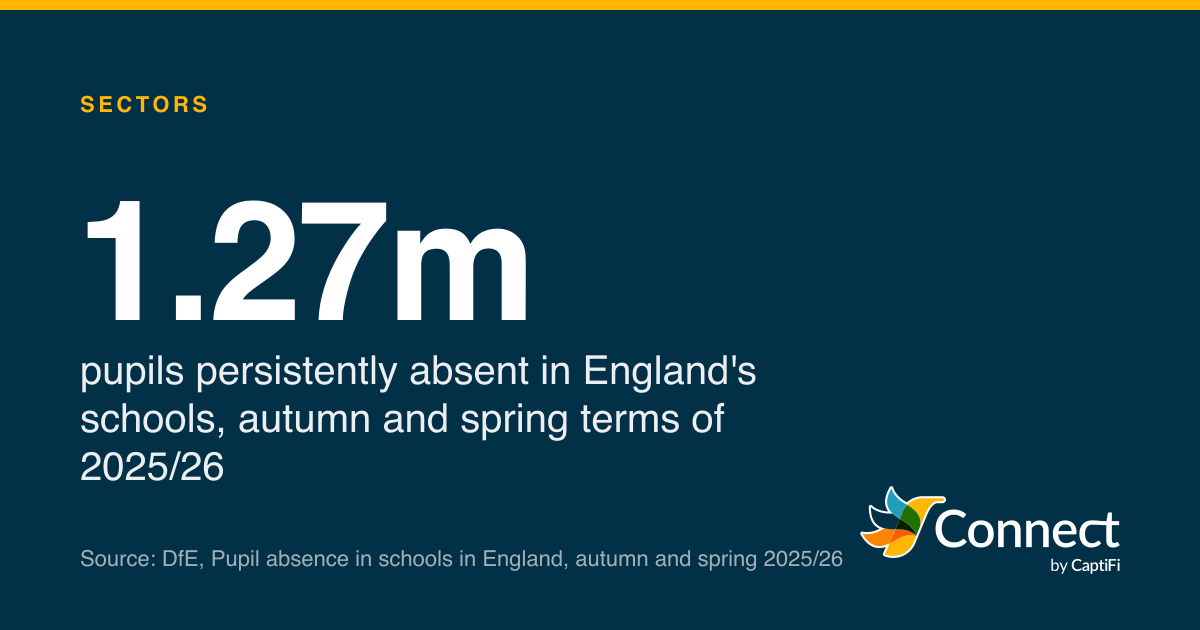
1.27m: pupils persistently absent in England's schools, autumn and spring terms of 2025/26. Source: DfE, Pupil absence in schools in England, autumn and spring 2025/26.
Since 19 August 2024, every school in England has had to have regard to the Department for Education's statutory guidance, Working together to improve school attendance, and one line in it decides what the school office does at 9:30 each morning. Schools should "expect parents to contact the school when their child is absent to explain the reason and put in place processes to contact parents on the first day of absence where a reason has not been provided. If absence continues without explanation, further contact should be made to ensure safeguarding." DfE's latest absence statistics, published on 15 October 2026, put the overall absence rate at 6.60% across the autumn and spring terms of 2025/26, with 1.27 million pupils persistently absent.
The guidance doesn't say how that first-day contact should happen; phone calls, letters and home visits all appear in it. A text is the quickest of them to send to a whole list, and it reaches a parent at work while the office is still working down the blank marks in the register.
What the guidance asks schools to do each day
The legal base is the School Attendance (Pupil Registration) (England) Regulations 2024, which came into force on the same day in August 2024. Regulation 10 says the attendance of each pupil must be recorded "at the beginning of each morning session and once during each afternoon session". Registers must be kept electronically and every entry preserved for six years. The July 2026 edition of the guidance, published on 9 July with what DfE calls technical clarifications, adds that the register should be taken at the same time for all pupils.
Paragraph 42 sets the minimum day-to-day process. Alongside first-day contact, schools are expected to:
- set how long the register stays open, the same for every session and no longer than 30 minutes, after which a pupil is marked absent
- identify every unexplained absence in each session and contact parents to find out why and when the pupil will return
- enter the correct code once the reason is known, and no later than 5 working days after the session
- hold more than one emergency contact number for each pupil where reasonably possible
- regularly tell parents about their child's attendance, avoiding headline percentages in favour of "the amount of time missed and the impact on the pupil's learning"
The admission register itself must hold "at least one telephone number" for each parent a pupil normally lives with, for emergencies, and DfE's advice is to hold a number for more than one person. Since the start of 2024/25, schools have also had to share their daily attendance data with DfE, which publishes national figures from it every fortnight.
How much school is being missed?
Two DfE releases give the picture. The full-year statistics for 2024/25, published on 26 March 2026, put the overall absence rate at 6.78%, down from 7.15% in 2023/24 but well above the 4.73% of 2018/19. One session is half a day. The persistent absence rate, the share of pupils missing 10% or more of their possible sessions, was 18.14% (about 1.34 million pupil enrolments), down from 19.95% the year before and against 10.86% before the pandemic. DfE's 2021/22 release translates that 10% into "around 19 days of absence across the school year".
- Overall absence rate
- Persistently absent pupils
2018/19, 2023/24 and 2024/25 are from the 2024/25 release; 2021/22 and 2022/23 from their own releases, which give one decimal place. 2019/20 and 2020/21 are left out because of the pandemic.
Source: DfE, Pupil absence in schools in England, academic year 2024/25
See the figures as a table
| Overall absence rate (%) | Persistently absent pupils (%) | |
|---|---|---|
| 2018/19 | 4.73 | 10.86 |
| 2021/22 | 7.6 | 22.5 |
| 2022/23 | 7.4 | 21.2 |
| 2023/24 | 7.15 | 19.95 |
| 2024/25 | 6.78 | 18.14 |
The newer release, for the autumn and spring terms of 2025/26, moved only slightly: overall absence of 6.60% against 6.63% a year earlier, persistent absence of 17.50% (1.27 million pupils) against 17.63%, and severe absence (missing half or more of sessions) up from 2.26% to 2.32%, or 168,000 pupils. Secondary schools ran at 8.01% overall absence, primaries at 5.13% and special schools at 12.86%. Persistent absence peaked in Year 10 at 24.68%, so roughly one Year 10 pupil in four. London had the lowest overall rate at 6.04% and the North East the highest at 7.10%.
The fortnightly figures, from the daily data, are the earliest look at this year. DfE's release of 22 October 2026 put absence at 5.46% for 2026/27 so far, up to 9 October. In the week starting 5 October it was lowest on Thursday (5.26%) and highest on Friday (6.22%), and DfE notes the Friday peak matches earlier years. Nationally, Friday has been the heaviest day for absence.
Why pupils are off
Illness is the biggest single reason by a distance. In 2024/25 it accounted for 3.22% of possible sessions, close to half of all absence, followed by unauthorised "other" absence at 1.56%, unauthorised holidays at 0.48% and authorised other reasons at 0.40%.
State-funded primary, secondary and special schools. The four reasons the release names as the largest; the overall absence rate was 6.78%.
Source: DfE, Pupil absence in schools in England, academic year 2024/25
See the figures as a table
| Sessions missed (%) | |
|---|---|
| Illness | 3.22 |
| Unauthorised, other | 1.56 |
| Unauthorised holiday | 0.48 |
| Authorised, other | 0.4 |
That has a direct bearing on what an absence text asks for. The guidance says schools "are not expected to routinely request that parents provide medical evidence to support illness absences, and should not have blanket rules requiring this", and that in most cases "a parent's notification that their child is too ill to attend school can be accepted without question or concern". A first-day text that demands a doctor's note is out of step with that.
Holidays are the other change. Since the start of 2024/25, term-time holidays can't be recorded as authorised absence, and the guidance says DfE generally doesn't consider "a need or desire for a holiday or other absence for the purpose of leisure and recreation to be an exceptional circumstance".
Writing the first-day text
The guidance frames the whole system as schools working "in partnership with, not against families", and a first-day text should read that way, as a question. Name the school first so the parent knows who's texting, use the child's first name, say which session, and give one way to reply. Keep the reason for absence out of anything you send back, since texts appear on lock screens and shared family phones.
For a hypothetical primary school, the set might look like this:
Hillcrest Primary: Amy wasn't in the register this morning and we haven't heard why. Please reply with the reason, or call the office on 01632 960456.
Hillcrest Primary: thanks for letting us know Amy is unwell. We hope she feels better soon. No need to reply.
Hillcrest Primary: Amy has been off since Monday and we haven't been able to reach you. Please call the office on 01632 960456 today so we know she's safe.
Hillcrest Primary: Amy has missed 9 days this term, almost 2 weeks of lessons. Mrs Patel would like to talk about how we can help. Reply with a good time to call.
The third is the further contact the guidance asks for "to ensure safeguarding", and it should go alongside a phone call, not instead of one. The fourth follows the advice to describe attendance as time missed: nine days is easier for a parent to picture than a percentage.
The text has to come from a number parents can reply to. A text sent under a sender name, such as HILLCREST, can't be answered, so a first-day text with "please reply" on it has to go from a mobile number, and the replies need to land where the office will see them before the register is finalised. The numbers also have to be current. A September text asking parents to reply if their contact details have changed costs little and saves the 9:30 scramble later in the year.
Which parent gets the text?
The guidance uses "parent" broadly: all natural parents, whether married or not, everyone with parental responsibility, and whoever has day-to-day care of the child. It leaves the school to "decide which adult is most appropriate to work with". The admission register helps here, because it has to record which parents the pupil normally lives with and an emergency number for each of them. For most families that settles it. Where a child splits the week between two homes, the first-day text works best going to the parent the child should have been with that morning, with the second number held for the follow-up the guidance asks for when absence continues.
Timing follows from the register. If the morning register closes at 09:10, a text at 09:30 gives parents who were about to ring a few minutes to do it, and the office isn't left chasing families who've already called. The afternoon register is the second chance to catch a pupil who went home at lunch. Whatever the schedule, the correct code has to go in as soon as the reason is known and no later than 5 working days after the session, so the reply is worth keeping with the record.
The 2025/26 figures show pupils with an education, health and care plan are over seven times as likely to be severely absent as pupils with no identified special educational needs. An automated "we haven't heard why" text lands badly with a family whose child's absence the school already knows about and is planning around, so if your system lets you leave named pupils off the first-day list, use it.
Texts to parents about their child's attendance are service messages, not marketing, so the consent rules for marketing texts don't apply to them. A text about the PTA's raffle is a different matter; our post on borderline cases covers where that line falls.
Penalty notices stay formal
When absence becomes a legal matter, the guidance sets out a formal route built on written notices. Under the national framework for penalty notices, every state school must consider whether a penalty notice is appropriate once a pupil reaches 10 sessions of unauthorised absence in a rolling period of 10 school weeks (any combination of unauthorised absence counts, such as term-time holiday plus arriving after the register closes). The first notice to a parent for a pupil costs £160 if paid within 28 days, reduced to £80 if paid within 21 days. A second within three years is a flat £160, and there can't be a third in that period; the guidance says alternative action should be taken, often considering prosecution. Where support is appropriate, schools are expected to keep it going, or issue a Notice to Improve if it isn't working, before a penalty notice.
Penalty notices have to follow the Education (Penalty Notices) (England) Regulations 2007 and the local authority's code of conduct, and the guidance expects the school's attendance policy to explain the framework. None of that belongs in a first-day text, and a text that mentions fines in passing undoes the partnership tone the rest of the system depends on. If a parent needs to know about the threshold, it goes in the policy, a letter or a meeting.
Running it from the office
Whatever sends the texts, a management information system or a separate service, three settings matter more than the wording: replies go to a shared inbox the attendance officer and the office can both see, a sent time is recorded against every message, and contact lists are refreshed from the admission register whenever it changes.
CaptiFi Connect sends to UK mobiles from a UK number, so parents can reply, and replies arrive in a two-way inbox that several staff can share through team logins, each with their own sign-in. Contact lists import from a CSV export, every text has a delivery report, and the same account can send staff alerts on the morning the heating fails.
Sources
Read for this post on 22 October 2026.
- DfE: Working together to improve school attendance, publication page
- DfE: Working together to improve school attendance, statutory guidance, July 2026 edition
- legislation.gov.uk: The School Attendance (Pupil Registration) (England) Regulations 2024
- DfE: Pupil absence in schools in England, autumn and spring term 2025/26
- DfE: Pupil absence in schools in England, academic year 2024/25
- DfE: Pupil absence in schools in England, academic year 2022/23
- DfE: Pupil absence in schools in England, academic year 2021/22
- DfE: Pupil attendance in schools, fortnightly release
Written by the CaptiFi Connect team. Published 22 October 2026. More in Sectors
Send your first text this week
Set up your account and contacts now. Until we've approved it, a person reads each text before it goes out.