Sectors9 min read
Self Assessment reminder texts for accountants
HMRC says 11.48 million returns beat the 31 January 2026 deadline and about 1 million missed it. The figures, the penalties and a reminder sequence that works.
In short
- HMRC received 11,489,825 Self Assessment returns by 31 January 2026 for the 2024 to 2025 tax year, and it estimates about 1 million customers missed the deadline.
- HMRC counted 475,722 people filing their Self Assessment return on deadline day in 2026, against 732,498 on deadline day in 2025.
- A late Self Assessment return gets an automatic £100 penalty from HMRC even when no tax is due, then £10 a day after three months, up to £900.
- Since 6 April 2026, sole traders and landlords with qualifying income over £50,000 must send HMRC quarterly updates under Making Tax Digital, and the threshold drops to £30,000 from April 2027.
- HMRC says it will never ask for personal or payment information by text message, so an accountancy practice should keep requests for UTRs, passwords and bank details out of its texts.
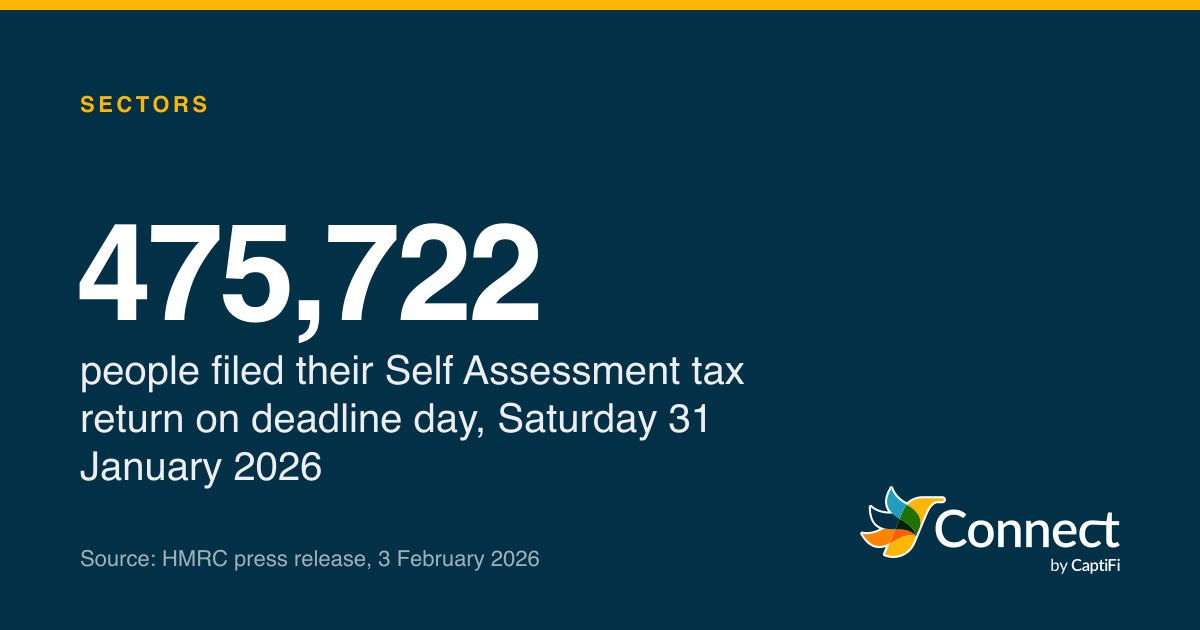
475,722: people filed their Self Assessment tax return on deadline day, Saturday 31 January 2026. Source: HMRC press release, 3 February 2026.
HMRC received 11,489,825 Self Assessment returns by midnight on 31 January 2026, out of the 12,029,168 it expected for the 2024 to 2025 tax year, and it estimates that about 1 million customers missed the deadline. Those figures are from the press release HMRC issued on 3 February 2026. On the last day alone 475,722 people filed, and 27,456 of them did it in the final hour before midnight. The next deadline, for the 2025 to 2026 tax year, is 11:59pm on Sunday 31 January 2027.
Plenty of those last-day filers have an accountant, and you can picture the trail behind them: the P60 asked for in October, arriving in the third week of January. Texts are good at the part before the bookkeeping. They get the rental statements, the mileage log and the bank interest figures onto your desk while there's still time to do something with them, and they get a yes from the client once the return is ready.
How late do people leave it?
HMRC publishes a running count in the run-up to the deadline, and the counts for the last cycle show the shape of the problem. Its "100 days" release on 23 October 2025 said more than 3.5 million people had already filed for 2024 to 2025. By 5 January 2026 the figure was 6.36 million, "which leaves almost 5.65 million who still need to complete their Self Assessment". On 23 January, eight days out, it was 8.6 million, with 3.3 million still outstanding.
Millions. The first three points are HMRC's rounded counts of people who had filed, from its releases of 23 October 2025, 5 January 2026 and 23 January 2026. The deadline figure is 11,489,825 rounded, and HMRC says it includes voluntary returns and late registrations.
Source: HMRC press releases, 23 October 2025 to 3 February 2026
See the figures as a table
| Returns filed (m) | |
|---|---|
| 23 Oct 2025 | 3.5 |
| 5 Jan 2026 | 6.36 |
| 23 Jan 2026 | 8.6 |
| 31 Jan 2026 | 11.49 |
So roughly 2.9 million returns came in during the final eight days. (The match isn't exact, because HMRC's deadline total also counts voluntary returns and late registrations, but the order of magnitude holds.) Even New Year doesn't stop people: HMRC counted 54,053 returns filed on New Year's Eve and New Year's Day, including 342 in the last hour of 2025.
The last-day figure has been falling. HMRC reported 861,085 customers filing online on 31 January 2023, 778,068 on deadline day in 2024 and 732,498 in 2025. In 2026 it was 475,722. HMRC hasn't said why the final-day count fell by more than a third in a year. The 2026 deadline fell on a Saturday, and HMRC's own release on 23 January told people that "for full phone support, contact HMRC before Friday 30 January". The 2027 deadline falls on a Sunday, so the same pattern may well repeat, and a practice that plans its chasers around a Friday cut-off of its own won't be caught by it.
Each year is the figure in the release HMRC published in the first days of February (2023, 2024 and 2025 on GOV.UK). HMRC gave the 2023 figure as customers who filed online on the day.
Source: HMRC, 11.48 million beat the Self Assessment deadline, 3 February 2026
See the figures as a table
| Filed on 31 January | |
|---|---|
| 2023 (Tuesday) | 861,085 |
| 2024 (Wednesday) | 778,068 |
| 2025 (Friday) | 732,498 |
| 2026 (Saturday) | 475,722 |
On the day itself in 2026, the busiest hour was 17:00 to 17:59, when 32,982 people filed. HMRC advisers handled 5,409 webchats and 10,483 helpline calls on what the press release called, fairly, an unusual Saturday opening.
What missing 31 January costs
The penalties are set out on GOV.UK and repeated in HMRC's deadline releases. A late return gets "an initial £100 fixed penalty, which applies even if there is no tax to pay, or if the tax due is paid on time". After three months there are daily penalties of £10, up to £900. After six months there's a further 5% of the tax due or £300, whichever is greater, and the same again after twelve months. Paying late is separate: 5% of the unpaid tax at 30 days, at 6 months and at 12 months, plus interest.
For a reminder text, the £100 is the number that matters, because it applies to everyone, including the client who's owed money back and assumes a late return can't cost them anything.
A few other dates sit around the big one. Anyone filing for the first time had to tell HMRC by 5 October. Paper returns for 2025 to 2026 have to reach HMRC by 11:59pm on 31 October 2026. A client who wants an eligible balance collected through their tax code needs the online return in by 11:59pm on 30 December 2026. And the second payment on account, for clients who make them, is due on 31 July.
Making Tax Digital adds four more dates a year
Since 6 April 2026, sole traders and landlords whose qualifying income was over £50,000 in the 2024 to 2025 tax year have had to use Making Tax Digital for Income Tax. HMRC's guidance says the threshold falls to £30,000 from 6 April 2027 (based on 2025 to 2026 income) and £20,000 from 6 April 2028. In scope, a client keeps digital records and sends HMRC a quarterly update, a cumulative summary of income and expenses for the tax year so far, through compatible software. Quarterly updates don't replace the return; HMRC is clear that the tax return deadline remains 31 January.
HMRC said on 12 August 2026 that more than 436,000 sole traders and landlords had sent their first quarterly update and over 570,000 had signed up. The first deadline was 7 August 2026. The next is 7 November 2026, a Saturday, for the period 6 April to 5 October.
Penalties are lighter this first year. HMRC "will not apply penalty points for late quarterly updates during the 2026 to 2027 tax year". From 2027 to 2028 each missed quarterly deadline earns a point, and four points bring a £200 penalty. Penalty points still apply for late tax returns now.
Put the two systems together and a practice with a mix of clients has these dates to text about over the next year:
| Date | What's due | Who it affects |
|---|---|---|
| 31 Oct 2026 | Paper return for 2025 to 2026 | Clients who file on paper |
| 7 Nov 2026 | Quarterly update, 6 April to 5 October | Clients in Making Tax Digital |
| 30 Dec 2026 | Online return, to pay through the tax code | Eligible PAYE clients who want it |
| 31 Jan 2027 | Online return, tax owed and any first payment on account | Everyone in Self Assessment |
| 7 Feb 2027 | Quarterly update, 6 April to 5 January | Clients in Making Tax Digital |
| 7 May 2027 | Final quarterly update for 2026 to 2027 | Clients in Making Tax Digital |
| 31 Jul 2027 | Second payment on account | Clients who make payments on account |
Is a deadline reminder a marketing text?
Not when it goes to your own clients about work they've engaged you for. The ICO's direct marketing guidance describes a service message as one that isn't promotional but is "for administrative or customer services purposes", and it says the rules "don't stop you from telling your customers important information that they need to know as part of their relationship with you". A request for records so you can file a client's return is exactly that, and it needs no marketing consent under PECR.
Two things change the answer. The first is content: "If your service message has elements that are direct marketing, even if that is not the main purpose of your message, then it will count as direct marketing." A records chaser that adds "and ask us about our new payroll package" has become a marketing text. The second is the audience. A text to last year's enquiry list saying you have capacity for new tax returns promotes your services, so it needs consent or the soft opt-in, and an opt-out in every message. Our guide to UK SMS marketing rules covers both.
A reminder sequence that gets records in
Six texts cover the year for most clients. Each fits in one 160-character part, each starts with the practice's name, and none of them carries a tax figure, because a text can be read by whoever is holding the phone. The amounts belong in the email or the client portal. These are written for a made-up practice, Hartley Accounts.
The opening request, in October, with a date well ahead of January:
Hartley Accounts: time to start your 2025/26 tax return. Please send your P60, bank interest and rental statements by Fri 13 Nov. Reply with any questions.
The Making Tax Digital nudge, ahead of the 7 November quarterly deadline:
Hartley Accounts: your next quarterly update (6 Apr to 5 Oct) is due with HMRC by Sat 7 Nov. Please send your receipts to us by Fri 30 Oct.
The first chaser, three weeks later:
Hartley Accounts: we're still waiting for the records for your tax return. Could you send them by Fri 4 Dec? Reply CALL and we'll ring you.
The approval request, once the return is drafted:
Hartley Accounts: your tax return is ready for you to check. We've emailed it with the amount due. Reply OK to approve it or call us with changes.
The confirmation, which saves a phone call from every client who wonders whether it went:
Hartley Accounts: we filed your tax return with HMRC today. Pay any tax due by 31 Jan in your HMRC account or the HMRC app. We never take payments by text.
And the last call in January, for the few who haven't replied to anything:
Hartley Accounts: we still need your records to file by 31 Jan. HMRC charges £100 for a late return even if no tax is due. Please call us today on 01632 960214.
Each of these asks for one thing and gives a date, and the dates sit well ahead of HMRC's, so the practice has room to do the work. A reply keyword like CALL or OK turns a one-word answer into a task for whoever runs the inbox. The approval text is where a two-way number earns its keep, because "OK" from a known client's phone is a quick, timestamped record that they saw the return. Our post on payment reminder texts covers the other chase a practice runs, for its own fees.
Not looking like the scams HMRC warns about
HMRC says scammers target people when they know Self Assessment customers are preparing to file, and it puts numbers on the problem. In a release on 20 August 2025 it said the public reported more than 170,000 scam referrals in the 12 months to 31 July 2025, a 12% fall on the year before, and that more than 47,000 of them involved fake tax refunds. HMRC's page on reporting suspicious contact is blunt: "HMRC will never send a notification of a tax rebate or ask you to disclose personal or payment information by text message." It asks people to forward suspicious texts to 60599.
Plenty of clients will have seen those warnings, which helps, because a text that mentions tax and asks for something now gets a second look. Yours has to pass it. Never ask for a UTR, a Government Gateway password, an access code or bank details by text; HMRC tells customers never to share login details "even with someone they trust or who helps them with their tax". Don't put a link to anything that looks like a refund. Use the same number all year so the thread builds up a history, and put the practice's name first every time. Our post on how to look legitimate with links in texts goes further, and smishing in the UK has the fraud figures.
Sending it without it becoming another job
The October request and the MTD nudge go to a whole client list at once, so they belong in a scheduled send. CaptiFi Connect runs scheduled campaigns with quiet hours, so nothing goes out to clients overnight, and replies to a dedicated UK mobile number land in a two-way inbox the whole team can work from. A keyword such as CALL can send an automatic acknowledgement while someone picks up the phone. Credits cost 3.5p to 5p a text depending on the pack, with no VAT added, so the six texts above come to 30p a client at most. Last January, 5.65 million people still hadn't filed by the first Monday of the year. That's the week to send the chaser.
Sources
Read for this post on 22 October 2026.
- HMRC press release: 11.48 million beat the Self Assessment deadline, 3 February 2026
- HMRC press release: 11.5 million file Self Assessment by 31 January deadline, 3 February 2025
- HMRC press release: A record 11.5 million tax returns filed by the deadline, 1 February 2024
- HMRC press release: A record 11.4 million tax returns received on time, 1 February 2023
- HMRC press release: The countdown begins, Self Assessment deadline is 100 days away, 23 October 2025
- HMRC press release: 5.65 million still to file as the Self Assessment deadline looms, 5 January 2026
- HMRC press release: Eight days left to file your Self Assessment, 23 January 2026
- GOV.UK: Self Assessment tax returns, deadlines
- GOV.UK: Self Assessment tax returns, penalties
- HMRC: Check if you need to use Making Tax Digital for Income Tax (updated 26 March 2026)
- HMRC: Use Making Tax Digital for Income Tax, send quarterly updates
- HMRC press release: 436,000 sole traders and landlords make their tax digital, 12 August 2026
- HMRC press release: Scams warning as Self Assessment customers targeted, 20 August 2025
- HMRC: Report suspicious HMRC emails, texts, social media accounts and phone calls
- ICO: Direct marketing guidance, identify direct marketing
Written by the CaptiFi Connect team. Published 22 October 2026. More in Sectors
Send your first text this week
Set up your account and contacts now. Until we've approved it, a person reads each text before it goes out.