
Behind the scenes8 min read
The 3G switch-off and your texts
Every UK 3G network is now off and 2G follows from 2029. Why SMS kept working through it, who is still on an old handset, and what a sender should check.
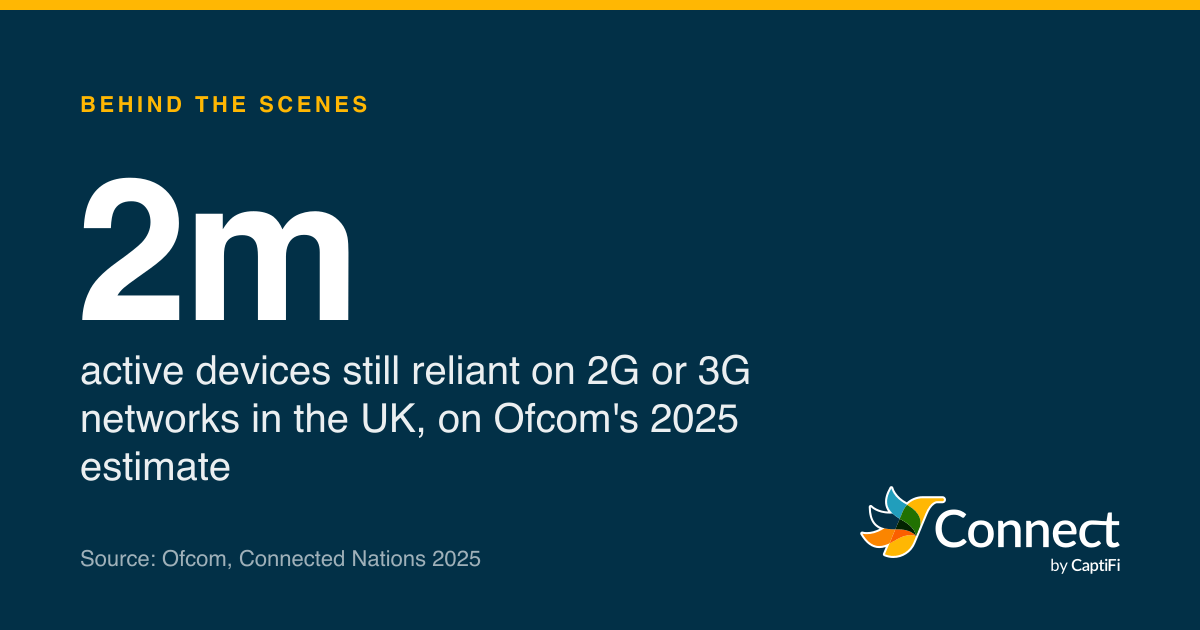
2m: active devices still reliant on 2G or 3G networks in the UK, on Ofcom's 2025 estimate. Source: Ofcom, Connected Nations 2025.
"3G mobile networks are now switched off." That's the first line of Ofcom's consumer page on the subject as of its 10 August 2026 update, and it closes a job that started with a government announcement on 8 December 2021. Between those dates, four operators turned off a network that carried the UK's mobile data for most of two decades, and if you send texts to customers you probably noticed nothing. Texts went out and came back "delivered" the same way they did before.
That isn't luck: SMS was designed before 3G existed and has been re-plumbed onto every generation since, which is why it survived the switch-off and will survive the 2G one that follows from 2029. It is also why, for the two million devices Ofcom says still rely on 2G or 3G, a text is now the only message a business can send that reaches them.
How the switch-off happened
The agreement was announced on 8 December 2021 in a joint statement from the then Department for Digital, Culture, Media and Sport: the UK's mobile network operators had confirmed they did "not intend to keep 2G and 3G networks running beyond 2033", and some would go earlier, "particularly their 3G networks", on timetables of their own. The press release the same day named the four, Vodafone, EE, Virgin Media O2 and Three, and gave the reasons: spectrum freed for 5G, a route in for new equipment suppliers (who at the time had to support 2G and 3G to sell to a UK operator), and lower power use.
Ofcom set out what it expected of the operators in a document of 2 February 2023, and by then the order of play was known. Vodafone went first, switching off 3G in Basingstoke and Plymouth in February 2023 before the rest of its network. EE, in its own words, "switched off our 3G network during January and February 2024". Ofcom's Connected Nations report of 19 November 2025 records that "in 2024, Vodafone and BT/EE both completed their respective 3G switch-offs". Three's support page says its "3G network was completely switched off across the UK in November 2025". Virgin Media O2 ran pilots through 2025, and on 18 December 2025 its chief technology officer wrote that it was "set to complete our programme in the coming weeks", with 3G by then carrying "less than 2% of mobile data usage on our network" and a signal lingering in some areas "for a short period in early 2026". Ofcom's page for device suppliers, updated 1 September 2026, has all four as complete.
Ofcom's verdict, in the same Connected Nations report: the switch-off "appears to have gone relatively smoothly", the operators reported no significant disruption, and Ofcom itself "received very few complaints". The complaints it did get in 2025 were mostly about a person's own coverage, or worry about what would happen to their phone.
Why your texts kept arriving
A text message doesn't travel on the data connection, and never did. In the 2G design, SMS rides on the network's signalling channels, the same ones that set up a voice call, and the specification that defines it (3GPP TS 23.040) describes a service centre that stores each message and forwards it when the phone can be reached. When 4G arrived with no circuit-switched core of its own, the standards bodies gave SMS a new route. The 3GPP specification TS 23.272, published by ETSI as TS 123 272, "defines the Stage 2 architecture and specification for the CS Fallback and for SMS over SGs for EPS". SMS over SGs is the mechanism: the 4G core passes a text between the phone and the old-style message centre over an interface called SGs, and the spec is explicit that this "does not trigger any CS Fallback", meaning the phone does not have to drop to 2G or 3G to send or receive one. Support for it is mandatory in any phone and core network that supports CS fallback at all.
That has three consequences you can see on the operators' own pages. On EE, Vodafone and O2, a phone that has no 4G can still text and call, because those networks keep 2G running and SMS lives on it; Ofcom's 2023 document says such customers "will still be able [to] make voice calls and send text messages, as these rely on the 2G network", while losing most mobile data. On Three, which has no 2G network, a 3G-only phone loses "calls, texts, and data services" together, and that was the one network where an old handset had to be replaced. And on Three a 4G phone without 4G Calling can still, in Three's words, "send and receive texts and use 4G data, but you won't be able to make or receive calls", because SMS over 4G doesn't need the voice-over-4G feature that calls do.
So a text addressed to a UK mobile reaches a 2G-only handset on Vodafone, a 4G phone with 4G Calling switched off on Three, and a 5G iPhone, by three different routes, and your delivery report looks the same for each. (The receipt comes from the network when the handset acknowledges the message; our post on what "delivered" means covers what it does and doesn't prove.) Wi-Fi calling adds a fourth route: Ofcom defines it as "the ability to make and receive a call and text/SMS over a Wi-Fi network", which is how a text arrives in a basement with no signal.
Who is still on an old handset
Ofcom's estimate in February 2023 was that "around 5.5m customers" used devices reliant on 2G or 3G, about 6% of the UK's 99 million mobile connections, and that 85% of active connections already had 4G or 5G. Its research then found that "the older customers are, the more likely they are to have an older device": 10% of over-45s had a phone more than ten years old, against 4% of 16 to 44-year-olds. It also pointed out that pay-as-you-go customers don't have to register their details, so "the only available option for mobile providers to contact these customers and tell them about the impact of switch-off is via a text message", and that PAYG skews towards the financially vulnerable (27% of the most financially vulnerable are on PAYG against 12% of the least).
By November 2025 the number had come down. Connected Nations 2025 puts it at "around 2 million active devices reliant on 2G/3G networks, broadly similar to the 2.1 million reported in 2024", of which "around 1.6 million have been identified by MNOs as residential devices (for example mobile handsets)". The rest are things: Ofcom lists telecare alarms, security alarms and payment terminals among the devices that run on 2G and 3G SIMs, often roaming SIMs bought through long supply chains.
For a business that texts customers, the 1.6 million handsets are the part that matters. They are disproportionately older people and people on PAYG, they are mostly on networks where 2G still carries texts, and they cannot open a link, run an app or receive a rich message. A plain text is the whole of what reaches them.
Where 4G is, and where it isn't yet
After 3G, the question for a phone in a given spot is whether it can see 4G (or 2G, on three of the four networks). Connected Nations 2025 says 4G from at least one operator "now reaches 96% of the UK geographic landmass and extends beyond 99% of UK premises". From all four operators at once the figure is lower and uneven, which is the table below, taken from Ofcom's Scotland report.
- 2024
- 2025
Landmass with 4G coverage from every one of EE, O2, Three and Vodafone, from operator data for September 2024 and July 2025. Coverage from at least one operator is higher: 96% of the UK landmass in 2025.
Source: Ofcom, Connected Nations 2025: Scotland report (table 3.2)
See the figures as a table
| 2024 (%) | 2025 (%) | |
|---|---|---|
| England | 90 | 90 |
| Northern Ireland | 85 | 85 |
| Wales | 75 | 77 |
| Scotland | 65 | 67 |
| UK | 80 | 81 |
The UK figure from all four networks moved from 80% of landmass in 2024 to 81% in 2025. Scotland is the lowest at 67%, Wales 77%, Northern Ireland 85%, England 90%. Those figures describe land; the 99% of premises figure describes where customers live and work. But a customer driving between those premises on a B road, where Ofcom's 2025 in-vehicle 4G coverage ranges from 81% to 83% by operator, can be out of 4G for a while, and for the duration a text waits in the network and arrives when the phone comes back (the mechanism is the subject of why a text can arrive late).
2G: the next one
The 2G switch-off has dates now. Ofcom's consumer page lists them: EE "will begin switching off its 2G network from May 2029"; O2 "starting in Summer 2029"; VodafoneThree "will switch off the Vodafone 2G network during 2030", Three having no 2G to switch off. The page notes a voluntary 2G switch-off charter published by the government in March 2026, and the 2033 commitment still stands as the backstop. The virtual operators follow their host: Lebara, Asda Mobile, Talk Mobile and VOXI on Vodafone; BT Mobile and Your Co-op on EE; Tesco Mobile, giffgaff and Sky Mobile on O2.
When 2G goes, so does the fallback route for texts and calls on old handsets. Ofcom's advice is blunt: "All 2G-only devices will need to be upgraded to at least 4G." For a sender, that is a change in who can receive, in 2029 and 2030, and no change in how you send; the text to a 4G or 5G phone goes over SGs or the IMS voice core, as it does today. The devices to think about are the ones that aren't phones: the alarm panel, the card terminal, the smart meter, which Ofcom names and which have been sold on 2G SIMs for years.
What a business sender should check
Nothing in the switch-off changed an SMS API, a sender name or a delivery receipt. The checks are about the people at the other end.
Put the information in the text, with no link needed to get it. "Crown Dental: your check-up is on Thu 19 Nov at 10:30. Reply C to confirm." works on a 2G handset. A text that says "tap here for your appointment details" does not, for the 1.6 million.
Keep to plain GSM characters where you can. A text in the 160-character alphabet is one part, and it is the format every handset was built to show. Our GSM-7 glossary entry lists what's in the set.
Give a phone number as the second route. The customers most likely to be on an old handset are the ones most likely to ring, and a number in the text costs nothing.
Read your delivery reports by network if you can. A sudden rise in failed deliveries to one operator's numbers in one area in 2029 will be the 2G switch-off reaching your customers before they've told you about it. CaptiFi Connect's delivery reports show each text's timeline and the final status from the network; the guide to how business texts reach UK phones explains the route a message takes before any of this applies.
The switch-off of 3G removed a network that carried, by Virgin Media O2's last count, under 2% of its data. The texts never used it. The next date in the diary is May 2029, when EE starts on 2G, and until then a plain SMS still reaches every working mobile phone in the country.
Sources
Read for this post on 17 October 2026.
- GOV.UK: A joint statement on the sunsetting of 2G and 3G networks, 8 December 2021
- GOV.UK: New measures to boost UK telecoms security, 8 December 2021
- Ofcom: Switching off the UK's 2G and 3G mobile networks, what you need to know
- Ofcom: Switching off 3G and 2G networks, advice for IoT and third-party device suppliers
- Ofcom: Ofcom's expectations of mobile providers for 2G and 3G switch-off, 2 February 2023
- Ofcom: Connected Nations 2025, UK report
- Ofcom: Connected Nations 2025, Scotland report
- EE: 2G and 3G switch-off
- Vodafone: 3G switch-off is coming, here's what you need to do
- Three: Our plans to switch off 3G
- O2: 3G switch-off
- Virgin Media O2: So long, farewell 3G, 18 December 2025
- ETSI: TS 123 040 (3GPP TS 23.040), technical realization of the Short Message Service
- ETSI: TS 123 272 (3GPP TS 23.272), CS fallback and SMS over SGs in EPS
Written by the CaptiFi Connect team. Published 17 October 2026. More in Behind the scenes
Send your first text this week
Set up your account and contacts now; we check every new account before it can send.