
By the numbers8 min read
Who you reach by text and not by email
Ofcom's 2026 tracker puts mobile use among over-75s at 89% and home internet at 78%. Who sits in that gap, how big it is, and what it means for your list.
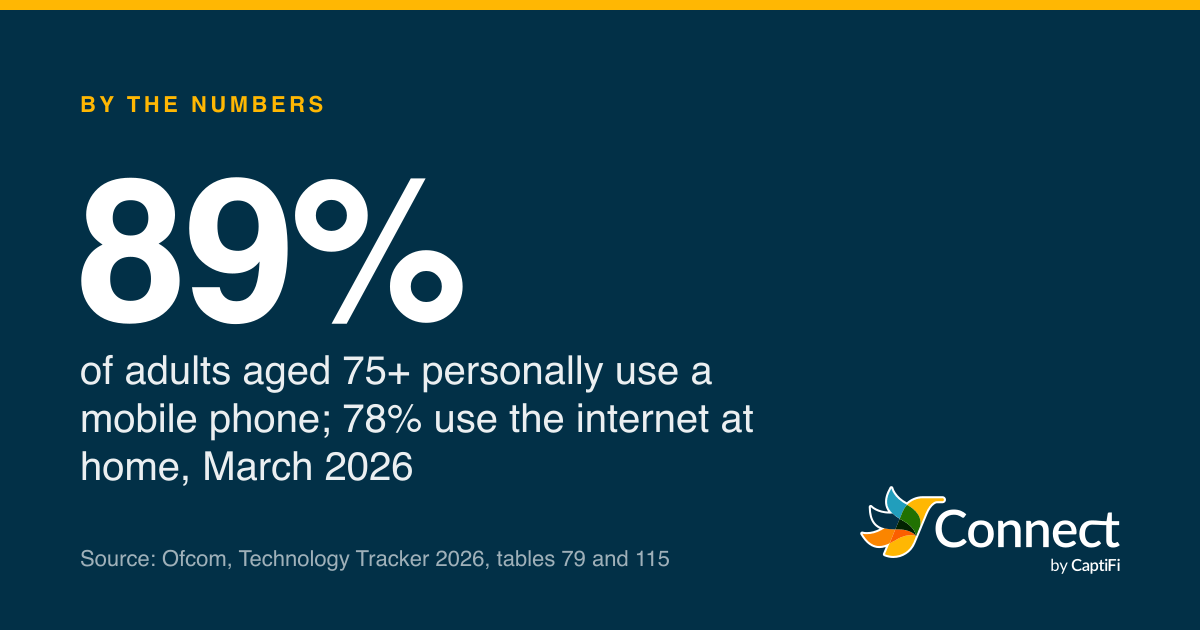
89%: of adults aged 75+ personally use a mobile phone; 78% use the internet at home, March 2026. Source: Ofcom, Technology Tracker 2026, tables 79 and 115.
Take a dental practice that sends its recall reminders by email and has, like most practices, a good number of patients over 75. Put those two facts next to Ofcom's latest Technology Tracker and you get a problem the practice can't see from its own reports: in March 2026, 17% of UK adults aged 75 and over had no internet access at home at all, while 89% of the same age group personally used a mobile phone. The reminder goes out, the system says sent, and for roughly one patient in six it lands nowhere.
That gap, between the people a text reaches and the people an email reaches, is the subject here. It's smaller than it was a decade ago and it's concentrated in the customers who most need a reminder they'll see.
Nearly everyone has a mobile
Ofcom's Technology Tracker is a survey run by Ipsos, 4,033 adults in the 2026 wave with fieldwork in March, and the core tables were published in August 2026. Table 79 asks whether there's a working mobile phone in the home and whether the person uses it. Across all adults, 98% personally use one. By age it runs 99% for 16 to 24s, 100% for 25 to 44s, 99% for 45 to 64s, 97% for 65 to 74s and 89% for those 75 and over. Only 7% of over-75s live in a home with no mobile at all, and another 3% live with one they don't use themselves.
And they use them for texts. Table 101 asks mobile users what they've done with the phone in the past three months. Sending or receiving a text message comes out at 96% overall, 94% for 65 to 74s and 86% for over-75s, which is a touch below voice calls (89% for over-75s) and well above anything that needs an app. Texting is the one thing a 1999 handset and a 2026 handset do the same way, so it doesn't matter which the customer has.
Which, for a fair number of older people, is the point. Table 81 puts smartphone use among mobile owners at 96% overall, 90% for 65 to 74s and 78% for over-75s. Nearly one in five over-75s with a mobile (18%) has no smartphone in the house. A text still arrives on that phone. A link in the text, an app notification or an email does not.
The internet gap is an age gap
Table 115 asks the same shape of question about the internet at home. 95% of adults personally use it, and 4% say they have no access at all. The age pattern is the one you'd guess, only steeper at the top: no access at home is 3% for 16 to 24s, 1% for 25 to 44s, 2% for 45 to 64s, 5% for 65 to 74s and 17% for over-75s.
- Use a mobile phone
- Use the internet at home
Share of all adults in each age group. Ipsos fieldwork in March 2026, 4,033 UK adults aged 16 and over.
Source: Ofcom, Technology Tracker 2026 core data tables (tables 79 and 115)
See the figures as a table
| Use a mobile phone (%) | Use the internet at home (%) | |
|---|---|---|
| 16 to 24 | 99 | 96 |
| 25 to 44 | 100 | 99 |
| 45 to 64 | 99 | 97 |
| 65 to 74 | 97 | 92 |
| 75 and over | 89 | 78 |
Lay the two series side by side and the lines sit on top of each other until about 65, then separate. For 65 to 74s there's a five-point gap between using a mobile (97%) and using the internet at home (92%). For over-75s it's eleven points, 89% against 78%. In a town with 2,000 customers over 75, that eleven points is 220 people a text reaches and an email, at best, doesn't.
Answered 'No, I do not have access to the internet in my home'. Ofcom's separate Media Literacy Tracker puts the all-adult figure at 6%; Ofcom says the two surveys land at around 5 to 6%.
Source: Ofcom, Technology Tracker 2026 core data tables (table 115)
See the figures as a table
| No internet access at home (%) | |
|---|---|
| All adults | 4 |
| 16 to 24 | 3 |
| 25 to 44 | 1 |
| 45 to 64 | 2 |
| 65 to 74 | 5 |
| 75 and over | 17 |
Ofcom's other big survey, the Adults' Media Literacy Tracker behind the Adults' Media Use and Attitudes report published on 2 April 2026, puts the offline share a little higher at 6% of all adults (Ofcom notes the two surveys land "at around 5-6%"), and it describes who they are. Of adults with no internet at home, 17% are aged 65 to 74 and 66% are 75 or over. 81% live in C2DE households. Among over-75s specifically, those without home internet are more likely to have no formal qualifications (63%, against 20% of over-75s who are online) and more likely to report a physical disability (69% against 42%), including problems with eyesight (16% against 4%). Nearly one in five (18%) are classed as most financially vulnerable, compared with 5% of online over-75s.
The report's own summary is blunter than the tables: the group is "disproportionately older", and most of them have decided. Asked why they're offline, 68% say they're not interested or feel no need, 38% mention complexity and 25% cost. Asked what would prompt them to get online, 82% say nothing would. Those aren't people a nicer email template will win over.
They do get things done online, though, through other people. The report finds 42% of adults without home internet have asked someone else to do something online for them, most often to shop (56%) or to use an online health service (37%), and 45% had sought that kind of help in the past year. For a business this matters in a specific way: an email to an offline customer, if it's read at all, is read by a son or a neighbour at some later point. A text to the same customer is read by the customer, on the day.
Being online isn't the same as reading email
There's a second gap inside the first. Having the internet at home doesn't mean using email, and the tracker asks about that too. Table 101's cousin for the internet, question QE14, asks internet users which activities they've done online in the past three months. "Sending and / or receiving emails" is ticked by 81% overall: 79% of 16 to 24s, 84% of 25 to 44s, 82% of 45 to 64s, 78% of 65 to 74s and 73% of over-75s.
So among over-75s who are online, more than a quarter haven't touched email in three months. Stack that on the access figure (83% of over-75s have internet at home, the nearest base the tables give) and you land at about six in ten over-75s who used email in that period, give or take the difference between home access and access anywhere. Against 89% with a mobile and 86% of those texting, the channel that reaches that customer is not in doubt.
The under-25 figure deserves a look too, because it cuts the other way. Only 79% of online 16 to 24s had emailed in three months, the lowest of any working-age band. They're online all day; they just aren't in their inbox. Their texting figure is 97%.
One more number from the Media Use report rounds this out. One in five online adults (20%) rely solely on a smartphone to get online, up from 12% in 2019. Their email lives on the same device as their texts, and a text gets a notification by default. An email, depending on the app and the settings, often doesn't.
How the gap has moved
It was wider, and it's closing from the top. The ONS ran its own series, Internet users, UK, on the Labour Force Survey until it discontinued the bulletin in May 2023 and pointed readers at Ofcom's tracker instead. Its last edition covered January to March 2020. Recent internet use among adults aged 75 and over had nearly doubled, from 29% in 2013 to 54% in 2020. Across all adults, 92% were recent users and 6.3% had never used the internet, down from 7.5% a year earlier. For 16 to 44s it was already 99%.
Six years on, Ofcom's 2026 figure for over-75s using the internet at home is 78%. That's a big move in a short time, and the "82% say nothing would prompt them" finding suggests much of it is people ageing into the band. The point for anyone texting customers is that the group is still there, it's still mostly over 75, and on Ofcom's own reading it isn't going to be talked online. It will be part of your customer base for years yet.
The ONS series had two other figures worth keeping. Among disabled adults, 81% were recent internet users in 2020, up from 78% the year before, so disability on its own is a smaller barrier than age, though the Ofcom figures show the two stack up together in the over-75s. And the regional spread was narrow even then: London highest at 95%, Northern Ireland lowest at 88%. Where you trade matters far less than how old your customers are.
What this means for your list
The practical reading is short. If your customers include anyone over 65, the mobile number is the contact detail that reaches nearly all of them, and the email address reaches most of them. For anything time-bound (an appointment, a collection, a delivery slot, a test result being ready) the text should be the default and the email the copy, for everyone, since the people who prefer email will read both and the people who don't have it will only see one.
A few habits follow from the figures. Collect the mobile number at the point of booking and check it reads back correctly, because it will be used. Put the facts in the text itself rather than behind a link: "Crown Dental: your check-up is on Thu 19 Nov at 10:30. Reply C to confirm." works on a phone with no browser, and 18% of over-75 mobile owners are on one. Ask for a reply with a single letter rather than a tap. Keep it to one part where you can (160 characters, no emoji), so it arrives whole on an older handset. And when the reply comes in, make sure a person sees it, because for this customer the text may be the only channel they have to you.
CaptiFi Connect sends to UK mobiles only and takes replies on a UK number, and for teams that live in email, email to SMS lets a reminder go out as a text from the inbox you already use. The guide to how business texts reach UK phones covers what happens between send and the handset.
The last ONS bulletin, in 2020, had 54% of over-75s online. Ofcom's tracker in March 2026 had 78% with internet at home and 89% with a mobile in their hand. Eleven points apart, and they're mostly your oldest customers.
Sources
Read for this post on 17 October 2026.
Written by the CaptiFi Connect team. Published 17 October 2026. More in By the numbers
Send your first text this week
Set up your account and contacts now; we check every new account before it can send.