
Writing texts8 min read
Writing texts for older customers
Ofcom's 2025 tracker has 27% of over-75s on a mobile that is not a smartphone and 32% with no internet at home. How to write a text they can read and act on.
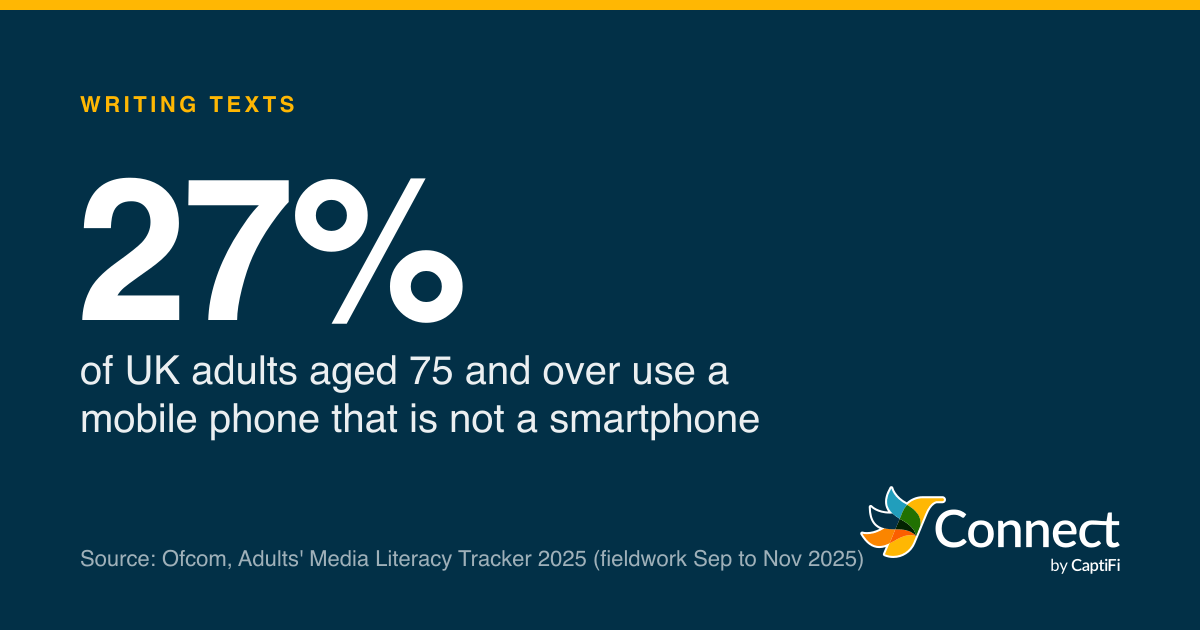
27%: of UK adults aged 75 and over use a mobile phone that is not a smartphone. Source: Ofcom, Adults' Media Literacy Tracker 2025 (fieldwork Sep to Nov 2025).
Just over half of UK adults aged 75 and over use a smartphone. Ofcom's figure, from interviews it ran between 29 September and 28 November 2025, is 56%. Another 27% use a mobile phone that isn't a smartphone, and 17% don't use a mobile at all. So when a business texts a customer in that age group, about one phone in three that receives it can't open a link, can't show a PDF and has never seen an app. The text still arrives. Whether it does any good depends on how it was written.
A reminder that works for a 40-year-old with an iPhone can be useless to the person it matters most to, and the figures above are why.
Who has what in their pocket
Ofcom's Adults' Media Literacy Tracker asks 7,533 people one plain question: do you personally use a mobile phone, and if so is it a smartphone? Table 10 of the 2025 data tables gives the answers by age, and the pattern only moves at the top of the range.
- Uses a smartphone
- Uses any mobile phone
Fieldwork 29 September to 28 November 2025, 7,533 UK adults aged 16 and over, of whom 820 were aged 75 or over. The gap between the two bars is people on a mobile that is not a smartphone.
Source: Ofcom, Adults' Media Literacy Tracker 2025 data tables (table 10)
See the figures as a table
| Uses a smartphone (%) | Uses any mobile phone (%) | |
|---|---|---|
| 16-24 | 99 | 100 |
| 25-34 | 99 | 100 |
| 35-44 | 98 | 99 |
| 45-54 | 98 | 100 |
| 55-64 | 93 | 99 |
| 65-74 | 84 | 96 |
| 75+ | 56 | 83 |
Under 55 the smartphone share is 98% or 99%, and all but a rounding error have a mobile of some kind. At 55 to 64 it slips to 93%. At 65 to 74 it's 84%, with 12% on a basic handset and 4% with no mobile. Then at 75 and over it drops to 56%, with 27% on a basic handset and 17% with no mobile. The basic handset is the number to hold on to. Across all adults it's 6%, so most businesses never think about it. Among the over-75s it's more than one person in four.
Age UK's July 2025 briefing, which draws on the previous year's Ofcom tables, puts people on the figures: at the end of 2024 around 8.7 million people aged 65 and over, 67%, personally used a smartphone. That leaves several million who didn't, and a basic phone does one thing with a message from a business. It shows the words, with no link preview and no booking page behind them. If the words don't do the job on their own, nothing does.
Why a text reaches people email doesn't
The same Ofcom survey asks about internet access at home, and table 11 is blunter still.
Same survey. The two youngest groups round to below 0.5% and are left off. Across all adults the figure is 6%.
Source: Ofcom, Adults' Media Literacy Tracker 2025 data tables (table 11)
See the figures as a table
| No home internet (%) | |
|---|---|
| 35-44 | 1 |
| 45-54 | 1 |
| 55-64 | 3 |
| 65-74 | 8 |
| 75+ | 32 |
32% of adults aged 75 and over had no internet access at home in late 2025, against 8% of those aged 65 to 74 and 6% of all adults. Ofcom's 2026 report on the same data notes that the offline group "is disproportionately older: 17% are aged 65-74 and 66% are aged 75+", and that 81% of them live in C2DE households. Having a connection isn't the same as using it, either. Age UK's analysis of the Understanding Society survey for 2022 to 2023 found 19% of people aged 65 and over, about 2.4 million, used the internet less than once a month or not at all; among the over-75s it was 29%, or 1.9 million people.
An email to those customers goes nowhere, or sits unread in an account a grandchild set up. A text goes to the handset in the coat pocket. The 83% of over-75s who use a mobile of some kind are reachable by SMS, including every one of the 27% on a basic phone, and that's the gap email can't close. (There's a longer look at this in who you reach by text and not by email.)
Age UK published a different cut of the problem on 3 September 2026, using the English Longitudinal Study of Ageing for 2023 to 2024. It sorted the over-65s in England into four groups: 15% fully digitally included (1.6 million people), 47% partially included (5.2 million), 25% partially excluded (2.7 million) and 13% not online at all (1.4 million). One of the people quoted, Andrew, in the partially included group, said: "If I came to a car park which required me to download a parking app, I would look elsewhere." Hold that sentence next to a text that says "tap here to confirm".
What gets in the way
Ofcom's 2026 report looks at the over-75s without home internet and finds the barriers stack up. Within that group, 69% report a physical disability, against 42% of over-75s who are online, and the gap is widest for the things a phone screen asks of you: eyesight (16% against 4%), mobility (43% against 21%) and dexterity (13% against 6%). Asked why they're not online, 68% of all adults without home internet say they're not interested or feel no need, 38% mention complexity and 25% cost. Age UK's briefing adds the skills figure from the Lloyds Consumer Digital Index for 2024: 48% of people aged 75 and over can't complete all eight of the foundation tasks the index treats as the starting point for being online.
Then there's what people do with a message they don't recognise. Ofcom showed its respondents a suspicious delivery email and asked what they'd do. Online adults aged 75 and over were the most likely to delete it (51%, against 42% of all online adults) or ignore it (38% against 29%), and the least likely to check where it came from: 8% said they'd look at the sender's address, against 15% of 16 to 24s. Ofcom's summary is that older adults "rely on low-interaction precautionary actions, such as deleting the email or ignoring it". That's a sensible way to survive scams. It also means a text from a name they don't know, or with a link in it, is the kind they've trained themselves to bin.
Put those together and you have the brief for a text to an older customer. It has to be readable on a small, old screen by someone whose eyes and thumbs may not be what they were, it can't depend on anything beyond the words, and it should look like it comes from somebody they already know.
Writing the text
Start with the name they know, as the sender name where you have one and as the first words regardless. The practice, the shop, the surgery, the garage, in the form it's written on the card in their purse. If the sender shows as a long number, the name at the front does the same job.
Put everything in the message. If you catch yourself writing "tap the link for details", the details go in the text instead. A basic phone shows a link as a string of characters it can't open, and even on a smartphone the over-75s are the group least likely to follow it. Where a link is useful, make it an extra, after the information, never the only route.
Ask for one thing and make the answer a single letter or word. "Reply C to confirm" or "Reply NO if you can't make it." Replying to a text is something every mobile can do and every mobile user already does. Then give the human route alongside it: "or ring the practice", "or call the number on your card". A fair share of this group will ring rather than reply, and the text has done its job if it prompts the call.
Write the whole word. Thursday where the diary says Thu, 19 November where it says 19/11, 10.30am where the booking system says 1030. Abbreviations save characters and cost comprehension, and there are 160 to play with, which is plenty for a reminder if nothing else is in it. Stick to the standard GSM-7 characters: a curly apostrophe or an emoji turns the limit into 70 and splits a long reminder into two parts (the character limit guide explains the split). Our character counter shows the count as you type.
Send it at a civil hour. Lunchtime or early afternoon is safe; first thing, late evening and overnight are not, and a text that lands at 11pm reads as an emergency.
A reminder written that way:
Crown Dental: your check-up is on Thursday 19 November at 10.30am with Dr Shah. Reply C to confirm, or ring the practice to change it.
And a collection message:
Westgate Pharmacy: your prescription is ready to collect. We are open until 6pm today and 1pm on Saturday.
Compare the version that gets deleted:
Hi! Your appt w/c 17/11 is booked. Tap bit.ly/3kQz to manage or reply 1
No name, three abbreviations, a shortened link and a bare number to reply with. On a basic phone it's gibberish, and on any phone it looks like the thing Ofcom's respondents said they'd ignore.
What a business should do about it
Ask, and write it down. "Shall we send you a reminder by text?" at the desk takes five seconds and tells you which customers want the text, which want a call and which, the 17% of over-75s with no mobile, need the letter or the phone call you already make. A text sent to a landline goes nowhere, and a text sent to someone who asked for a call is a small failure every time.
Keep the texts you send this group to the service kind: reminders, confirmations, collections, "your order has arrived". Those are the messages people over 75 are waiting for, and the ones the format handles well. Marketing to this group by text is harder to justify and easier to get wrong, and it still needs their consent (our SMS marketing rules guide covers that).
Read every template out loud as if to a parent, on the smallest screen in the building, and cut whatever needs explaining. Then test the reply route: send yourself the text, reply C from a basic handset if you can borrow one, and make sure the reply reaches a person who acts on it. A two-way inbox is what makes "Reply C" honest; with CaptiFi Connect the replies come into the same inbox as everything else, cost the customer nothing, and a reply of STOP opts the number out on its own.
The over-75s are the fastest way to find out whether a text is any good, because they're the readers with the least patience for a bad one and the fewest alternatives if it fails. Ofcom's 2025 fieldwork had 820 of them in the sample: 27% on a basic phone, 32% without the internet at home, and 83% carrying a mobile that will show a plain sentence from a name they know.
Sources
Read for this post on 17 October 2026.
Written by the CaptiFi Connect team. Published 17 October 2026. More in Writing texts
Send your first text this week
Set up your account and contacts now; we check every new account before it can send.