
Sectors9 min read
Car service and tyre reminder texts for garages
Tyres made up 60.60% of the dangerous defects DVSA found at MOTs in 2025 to 2026. How a garage times service and tyre reminder texts, and the rules on each.
In short
- Tyres accounted for 60.60% of the dangerous defects recorded at car and van MOTs in 2025 to 2026, and 4.47% of all those tests found at least one dangerous tyre, according to DVSA.
- Cars and light vans must have at least 1.6 mm of tread across the central three-quarters of the tyre and around its whole circumference, under regulation 27 of the Construction and Use Regulations 1986.
- Police recorded illegal, defective or under-inflated tyres as a contributory factor in 384 reported road collisions in Great Britain in 2023, and defective brakes in 553, in DfT figures.
- Using a vehicle with defective tyres carries 3 penalty points under endorsement code CU30, and the Highway Code tells drivers to check tyre pressures weekly, when the tyres are cold.
- The MOT does not cover the condition of the engine, clutch or gearbox, GOV.UK says, so a service reminder covers ground the MOT reminder does not.
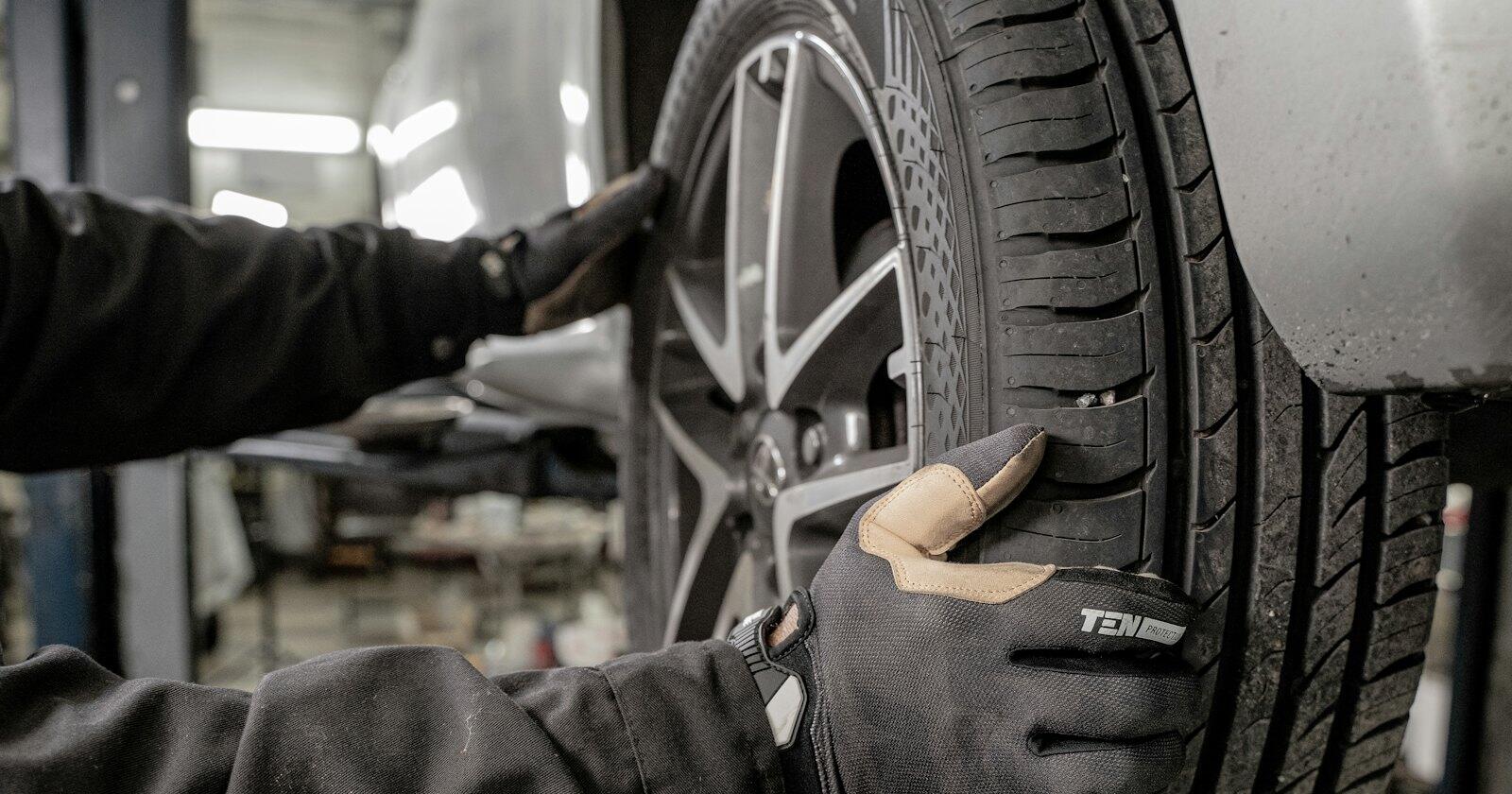
An MOT comes round on a date fixed by law, and the government will even text drivers about it. A car service has no such date. Tyres have no date at all, only a legal limit that creeps closer a millimetre at a time, and most drivers find out they've reached it when a tester tells them. That gap is where a garage's service and tyre reminder texts earn their keep: the customer has no other prompt, so the text from the garage that last had the car on the ramp is usually the only one they get.
DVSA's MOT figures show what happens when nobody prompts. In 2025 to 2026 tyres were behind 60.60% of all the dangerous defects testers recorded on cars and vans, and 4.47% of tests found at least one dangerous tyre. This post covers the rules behind tyre and service reminders, what the crash data says about worn parts, the texts themselves, and how to set them up.
What the law says about tyres
The rule is regulation 27 of the Road Vehicles (Construction and Use) Regulations 1986. For cars, light vans and light trailers, "the grooves of the tread pattern of every tyre" must be at least 1.6 mm deep "throughout a continuous band comprising the central three-quarters of the breadth of tread and round the entire outer circumference of the tyre". The same regulation bans a tyre that "is not so inflated as to make it fit for the use", a cut over 25 mm or 10% of the section width that reaches the ply or cord, and any "lump, bulge or tear". There's a ten year age limit too, but it applies to tyres on the front axles of buses and heavier lorries, not to cars.
The Highway Code repeats the limits in annex 6 and adds the habit that matters most for a reminder text: "Tyre pressures. Check weekly. Do this before your journey, when tyres are cold." It also warns that "Your brakes and steering will be adversely affected by under-inflated or over-inflated tyres".
GOV.UK's list of endorsement codes gives CU30, "Using a vehicle with defective tyre(s)", 3 penalty points. Points on the licence is a fact some customers will want to hear before they decide the tyres can wait another month.
What MOT testers find
DVSA publishes failure figures by defect category every quarter. For class 3 and 4 vehicles (cars, vans and passenger vehicles with up to 12 seats) in 2025 to 2026:
- tyres had a failing defect in 6.23% of tests, behind lamps and electrical (10.44%) and suspension (8.90%);
- a dangerous tyre turned up in 4.47% of tests;
- tyres made up 60.60% of all dangerous defects, and brakes another 28.80%.
So tyres aren't the most common reason a car fails, but when a tester finds something bad enough to call dangerous, it's a tyre more often than everything else put together. Brakes are next. Between them they account for nearly nine in ten dangerous defects.
The MOT also leaves things out. GOV.UK's guide says "The test does not cover the condition of the engine, clutch or gearbox", and a pass can still come with "a list of 'minor' or 'advisory' problems to monitor or fix in the future". An advisory on a tyre close to the limit is the garage telling the customer it'll need doing soon, and without a follow-up the next person to look at it may be next year's tester.
Tyres and brakes in the crash data
The Department for Transport publishes the factors police record at reported road collisions. The consistent series runs to 2023, because from late 2023 some forces began recording new "road safety factors" in place of the old contributory factors, and DfT advises against combining the two.
All severities. Only collisions a police officer attended where a contributory factor was recorded; one collision can have several factors. The tyre row is "illegal, defective or under inflated". 1,350 collisions had any vehicle defect factor.
Source: DfT, RAS0701 contributory factors, 10 years up to 2023
See the figures as a table
| Collisions | |
|---|---|
| Defective brakes | 553 |
| Tyres illegal, defective, soft | 384 |
| Steering or suspension | 211 |
| Lights or indicators | 138 |
| Overloaded or poorly loaded | 95 |
| Mirrors defective or missing | 11 |
In 2023, police attending reported collisions in Great Britain recorded at least one vehicle defect in 1,350 of them. Defective brakes were noted in 553 and "tyres illegal, defective or under inflated" in 384, with steering or suspension in 211 and lights or indicators in 138. Thirteen of the tyre collisions were fatal. Ten years earlier, in 2014, the tyre figure was 714.
Vehicle defects are a small part of that table. They appear in about 2% of the collisions where police recorded any factor at all, and driver error and behaviour factors are far more common. What the figures do support is a plain point: worn tyres and tired brakes are the defects that turn up in crashes, and they're exactly the items a service picks up.
When a service reminder should go out
Service intervals come from the manufacturer, usually as a time or mileage limit (whichever comes first), and they're in the handbook or the service schedule for the car. There's no single right number, so the reminder should use the interval for that car, recorded when you last serviced it. If you don't know it, a yearly reminder timed from the last service is a reasonable default.
Mileage is the harder half. Your job card has the odometer reading from the last visit, and DVSA's MOT history records one at every test, so two readings a year apart give you a rough annual mileage. A customer who covers twice the average will hit the mileage limit well before the anniversary, and their reminder should go sooner.
Two other timings work well. The first is alongside the MOT: plenty of customers would rather drop the car off once, so a reminder that offers "MOT and service together" saves them a trip. Our post on MOT reminder texts for garages covers the MOT side, and the SMS API version covers automating it. The second is the advisory follow-up, a few weeks after an MOT or service that flagged a tyre or brake pads as close to the limit.
Some customers believe their warranty dies if an independent garage services the car. The Competition and Markets Authority's 2023 guidance on motor vehicle agreements says a warranty made conditional on servicing "carried out only by members of the Authorised Network" is likely to be caught by competition law. A manufacturer can still refuse a claim linked to work that wasn't done "in the correct manner". If customers ask, that's the answer, and it's one more reason to follow the manufacturer's schedule to the letter.
Are service reminders marketing texts?
Yes, in almost every case. A reminder that the car is due a service, or that the tyres flagged last month need replacing, encourages the customer to buy something from you. Under PECR that makes it direct marketing, the same as an MOT reminder.
The ICO's guidance on the soft opt-in covers it for your own customers. You can text "an existing customer who bought (or negotiated to buy) a similar product or service from you in the past", so long as "you gave them a simple way to opt out both when you first collected their details and in every message you have sent". A customer whose car you serviced has bought a similar service. Say at the desk that you'll text about services, tyres and MOTs, record the answer, and put "Reply STOP to opt out" on every reminder.
The texts on the day (the car's ready, here's the quote for the extra work) are service messages and don't need that line.
Service and tyre reminder texts, from booking to collection
Written for a fictional garage, Pennington Motors, with the details filled in from its records.
The service reminder:
Pennington Motors: your Astra (AB12 CDE) is due its yearly service this month. Reply BOOK and we'll text you some dates. Reply STOP to opt out
The tyre advisory follow-up, sent three or four weeks after the visit that flagged it:
Pennington Motors: at your MOT we noted your front tyres were close to the 1.6mm limit. Want a price for two? Reply YES. Reply STOP to opt out
A pressure and tread nudge before a long trip season works too, as long as it stays short and specific:
Pennington Motors: off somewhere this half term? Check your tyre pressures cold and your tread before you go, or pop in and we'll check them free. Reply STOP to opt out
Booking confirmation and collection, which carry no opt-out line because they're service messages:
Pennington Motors: service booked for Tue 10 Nov, drop off from 08:00. We'll text when it's ready.
Pennington Motors: your Astra is ready to collect until 17:30. Brake pads replaced as agreed, total £186.40. Reply if you need to collect later.
A few habits run through them. The garage's name comes first every time, because a text from an unknown sender about someone's car reads like a scam. The registration appears where a household might have two cars. The free check is only in there if the garage really does it. And the advisory text quotes what was found at the visit, which is the customer's own record, so it doesn't read as a sales pitch out of nowhere.
Setting it up
Most garage systems export customers, vehicles, last visit dates and mileage to CSV. Import that into CaptiFi Connect with column mapping, keep the registration and service due month as custom fields, and they drop into the text as merge fields. Contacts you already have are updated in place, so a monthly re-import keeps the list current.
From there the reminders are scheduled texts: a send to the customers due next month, timed for a weekday morning. Campaign sends keep to quiet hours (21:00 to 09:00 London time by default), so a list send started late in the evening waits until morning. A BOOK keyword can reply with your booking link or a promise to call back, and anything else lands in the two-way inbox for the desk. STOP replies are handled automatically and the number is suppressed from every future send. For the day-of texts, the appointment reminder pattern is the one to copy.
If your garage software can call an API, the reminders can run from there instead; the MOT reminder API post walks through the daily job, and the same design works for services.
Common questions
How often should a garage send service reminder texts?
Once per service interval, timed from the last service and the manufacturer's time or mileage limit for that car. A yearly reminder is a sensible default where the interval isn't known. A follow-up a couple of weeks later for customers who didn't book is reasonable; more than that starts to feel like chasing.
What is the legal minimum tyre tread depth in the UK?
For cars, light vans and light trailers it's 1.6 mm across the central three-quarters of the tread and around the whole circumference, under regulation 27 of the Construction and Use Regulations 1986. Motorcycles and larger vehicles have a 1 mm limit. Using a vehicle with a defective tyre carries 3 penalty points (code CU30).
Do I need consent to text customers about tyres or a service?
A text encouraging a booking or a purchase is marketing under PECR. For your own customers the soft opt-in applies if you offered an opt-out when you took their number and you include one in every text. Booking confirmations and "ready to collect" texts are service messages and need no opt-out line.
Can an independent garage service a car without voiding the warranty?
The CMA's 2023 guidance says a manufacturer's warranty that depends on servicing only within its dealer network is likely to breach competition law. A warranty claim can still be refused if it's linked to work that wasn't done correctly, so the service should follow the manufacturer's schedule.
Sources
Read for this post on 4 November 2026.
- DVSA: MOT class 3 and 4 vehicles, initial failures by defect category (CSV)
- DfT: Reported road collisions, vehicles and casualties tables for Great Britain
- DfT: RAS0701, collisions by contributory factor, 10 years up to 2023 (ODS)
- legislation.gov.uk: Road Vehicles (Construction and Use) Regulations 1986, regulation 27
- GOV.UK: The Highway Code, annex 6, vehicle maintenance, safety and security
- GOV.UK: Penalty points (endorsements), endorsement codes
- GOV.UK: Getting an MOT (full guide)
- CMA: Guidance on motor vehicle agreements, June 2023
- ICO: Guide to PECR, electronic mail marketing
Written by the CaptiFi Connect team. Published 4 November 2026. More in Sectors
Send your first text this week
Set up your account and contacts now. Until we've approved it, a person reads each text before it goes out.