
Sectors8 min read
Driving instructor texts and the new test booking rules
DVSA's car test pass rate reached 50% in 2025 to 2026, and since May 2026 only learners can book. The texts an instructor sends around lessons and test day.
In short
- DVSA conducted 1,998,621 practical car driving tests in Great Britain in 2025 to 2026, and 50.0% of them were passes, the highest annual rate in its series back to 2007.
- In September 2026 the median wait between booking a car driving test and taking it was 11.6 weeks, and 29.5% of tests were taken more than 21 weeks after booking, according to DVSA.
- Since 12 May 2026 only the learner can book, change or cancel a car driving test in Great Britain, and DVSA says that includes driving instructors.
- A car driving test can be changed only twice since 31 March 2026, and changing or cancelling it free needs 10 full working days' notice, with Monday to Saturday counting as working days.
- DVSA cancelled 101,423 car driving tests in 2025 to 2026, and 60,092 of those cancellations were for examiner medical absences.
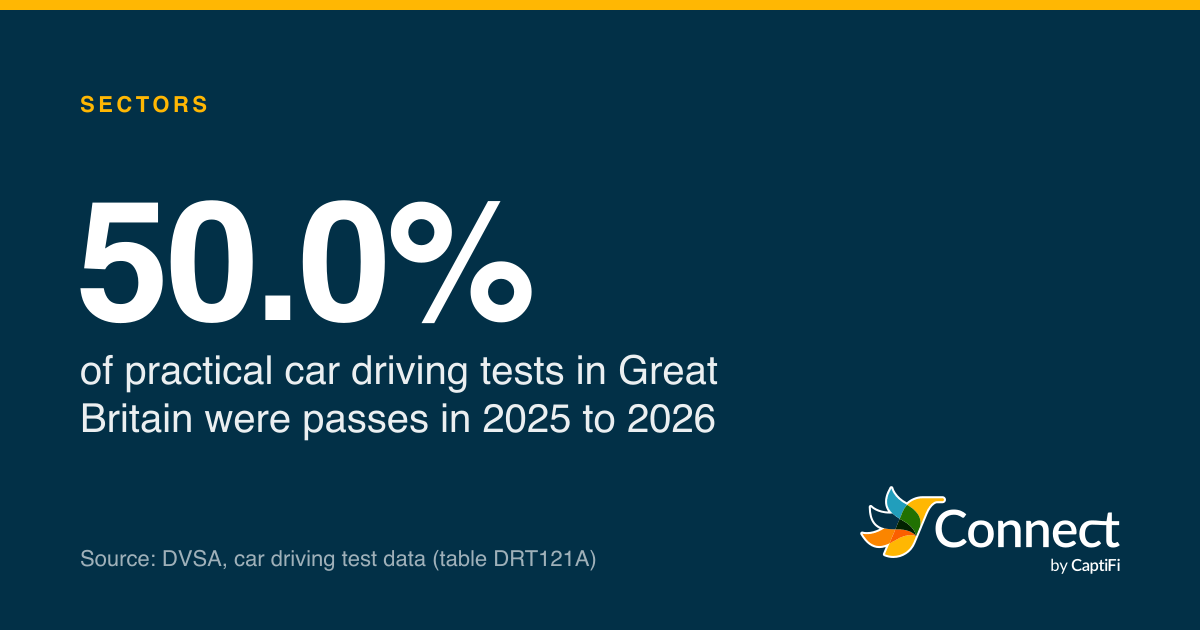
50.0%: of practical car driving tests in Great Britain were passes in 2025 to 2026. Source: DVSA, car driving test data (table DRT121A).
DVSA conducted 1,998,621 practical car driving tests in Great Britain in the year to March 2026, and 1,000,043 of them were passes. That's a pass rate of 50.0%, the highest for any year in DVSA's series, which goes back to 2007 to 2008. The waits are still long: in September 2026 the median learner waited 11.6 weeks between booking and taking their test. And since 12 May 2026 the booking itself has been the learner's job alone, because DVSA made it against the law for anyone else, instructors included, to book, change or cancel a car test.
That last change moves a lot of the admin onto the learner and a lot of the coordination onto texts. An instructor can no longer book a slot and tell the pupil afterwards. They have to tell the pupil when they're ready, make sure the pupil books with the instructor's reference number, and keep track of a date they don't control. DVSA's register listed 42,401 approved driving instructors at the end of March 2025, and the rule applies to every one of them for car tests.
How many tests, and how many passes?
DVSA's table DRT121A gives tests conducted and passed by quarter and financial year. The pass rate sat between about 46% and 47% for most of the 2010s, jumped to 49.8% in the pandemic year of 2020 to 2021 (when only 437,352 tests took place), and has climbed since 2023 to 2024 to reach 50.0%. The first quarter of 2026 to 2027, April to June, ran at 51.3% on 543,773 tests.
April to March, rounded here to one decimal place. Only 437,352 tests were conducted in 2020/21 because of the pandemic, against 1,998,621 in 2025/26.
Source: DVSA, car driving tests conducted, passed and pass rates (DRT121A)
See the figures as a table
| Pass rate (%) | |
|---|---|
| 2015/16 | 47 |
| 2016/17 | 47.1 |
| 2017/18 | 46.3 |
| 2018/19 | 45.8 |
| 2019/20 | 45.9 |
| 2020/21 | 49.8 |
| 2021/22 | 48.9 |
| 2022/23 | 48.4 |
| 2023/24 | 47.9 |
| 2024/25 | 48.7 |
| 2025/26 | 50 |
The volume matters as much as the rate. Nearly two million tests in a year is the most in the series too, ahead of the 1,945,225 of 2023 to 2024. DVSA's monthly table shows how much overtime goes into it: in September 2026 it made 30,873 test slots available through examiner overtime, in a month when it conducted 191,682 tests.
How long is the wait?
DVSA publishes two waiting measures each month in table DRT121G. One is the median time between booking a test and taking it, for people who took a test that month. The other is how many weeks ahead you have to look before 10% of a centre's weekly slots are still free to book, averaged across centres. They answer different questions. The first is what learners experienced, including the ones who found an earlier slot through a cancellation; the second is how far out a learner booking today would have to look for reasonable choice.
- Median wait, booking to test
- Weeks to 10% availability
Median wait is for people who took a test that month. Weeks to 10% availability is the average across test centres of the weeks until 10% of weekly slots are free to book. Rounded to one decimal place; 2025 and 2026 are provisional.
Source: DVSA, car driving test waiting times and availability (DRT121G)
See the figures as a table
| Median wait, booking to test | Weeks to 10% availability | |
|---|---|---|
| 2019 | 7.4 | 8.4 |
| 2020 | 6.3 | 10.5 |
| 2021 | 12.9 | 15.1 |
| 2022 | 11.1 | 14 |
| 2023 | 10.1 | 19.2 |
| 2024 | 9.7 | 18.3 |
| 2025 | 12.4 | 21.2 |
| 2026 | 11.6 | 19.7 |
Both are well above where they were before the pandemic. In September 2019 the median wait was 7.4 weeks and the 10% availability point was 8.4 weeks away. In September 2026 those figures were 11.6 and 19.7. DVSA's breakdown for September 2026 puts 41.1% of tests within 7 weeks of booking and 29.5% more than 21 weeks after it.
New appointments, the gov.uk guidance says, "are added 24 weeks in advance" and are "released every Monday at 6am". Cancellation slots appear whenever another learner changes or cancels, and "there's no waiting list or cancellation list for driving test appointments".
What changed in the booking rules in 2026?
DVSA brought in four changes for car tests in three stages, set out in its guidance updated on 19 June 2026:
| Rule | Before | Now | Since |
|---|---|---|---|
| Changes allowed after booking | Up to 6 | 2 | 31 March 2026 |
| Who can book and manage the test | Learner or instructor | Learner only | 12 May 2026 |
| Unofficial services that scan for slots | Allowed | Not allowed | 12 May 2026 |
| Where a test can be moved | Any centre | The 3 nearest centres, or the original one | 9 June 2026 |
The guidance is plain about the instructor's role now. "You need to book your car driving test yourself on GOV.UK. Your driving instructor is not allowed to book it for you." Before booking, it tells learners to agree with their instructor that they're ready and to ask for the instructor's reference number, because "you can enter this when you book to make sure your instructor is available". Learners have to confirm they're the person taking the test and accept DVSA's terms, and DVSA can suspend online access or cancel the booking if someone books in a way that breaks them.
For an instructor, the text that says "you're ready, book now, and use my reference number" has become one of the most important messages in the whole course of lessons. The guidance gives the reference number one job, making sure the instructor is available, so the text should ask for it in so many words.
Notice, changes and refunds
Changing or cancelling a car test for free needs "10 full working days' notice", and DVSA counts "Monday to Saturday" as working days, "but Sundays and public holidays do not". The exact cut-off is in the learner's booking confirmation email, and it's worth asking pupils to text it to you when they book.
A change of date, time or centre counts as one of the two, and changing date and centre together still counts once. Updating contact details or adding the instructor's reference number doesn't count, and if DVSA itself moves the test, "for example, due to bad weather", the learner is reset to two changes. After two changes, the only option is to cancel and rebook, with a full refund at 10 working days' notice. Short notice refunds are possible for illness or injury, bereavement, a school or college exam, or a stolen licence, with proof emailed to DVSA. A learner who fails and wants to resit has to choose a date "at least 10 working days away".
On the day, the learner needs a suitable car and their licence. GOV.UK warns that "your test will be cancelled and you will not get your money back if you do not take the right things with you". That's a sentence worth repeating in the day-before text.
What happens on the day, in a text's worth
A few facts from GOV.UK's guide to the test are worth having in writing, where the learner can reread them the night before. The test starts with an eyesight check, reading a number plate from 20 metres (20.5 metres for an old-style plate), and "you'll fail your driving test if you fail the eyesight check". The drive itself lasts "around 35 minutes", with 20 to 35 minutes of independent driving following a sat nav, traffic signs or both. A learner passes with "no more than 15 driving faults" and no serious or dangerous ones. The examiner will ask whether the learner wants someone in the back of the car and at the feedback, and GOV.UK notes that "this will usually be your driving instructor".
After a pass, "you can start driving straight away" without waiting for the full licence, and DVLA should be contacted if the licence hasn't arrived three weeks after applying. After a fail, the earliest new date is 10 working days away, so the text that follows a fail is usually about lessons in the meantime.
When DVSA cancels
DVSA's own cancellations are recorded in table DRT122B. In 2025 to 2026 it cancelled 101,423 car tests: 60,092 for examiner medical absences, 29,438 for leave, 11,884 for "acts of nature" (bad weather and bad light) and 9 for industrial action. The table counts all cancellations, including those made weeks ahead, and dates each one by when it was cancelled.
When weather stops a test, GOV.UK says DVSA will "automatically book the next available date" and send details "within 3 working days", or up to 7 days in a long spell of bad weather. Learners can't claim expenses for weather cancellations. If DVSA cancels at short notice for another reason, such as an examiner being unwell, the learner can apply for a refund of out-of-pocket expenses. Either way the instructor usually hears about it from the pupil, which is one more reason the thread needs to work in both directions.
The texts an instructor sends
These are written for a made-up school, Fernhill Driving, each in one part. The lesson reminder, the night before:
Fernhill Driving: lesson tomorrow (Tue) 16:00 to 17:30, pick-up at the school gates. Bring your provisional licence. Reply C to confirm or call to change.
The ready-to-book text, which replaces the instructor booking the slot:
Fernhill Driving: you're ready to book your test. Book it yourself on GOV.UK and add my instructor number from your lesson card. Text me the date once booked.
Confirming the booking and the plan for the day:
Fernhill Driving: great, test booked for Thu 3 Dec at 10:12. I'll pick you up at 08:45 for a warm-up drive. Please text me the change deadline from your email.
The change deadline, a fortnight out:
Fernhill Driving: if your test on Thu 3 Dec needs moving, it must be done by Fri 20 Nov to keep your fee. You only get 2 changes, so call me first.
The day before:
Fernhill Driving: test tomorrow at 10:12, I'll collect you at 08:45. Bring your photocard licence: without it the test is cancelled and the fee is lost.
The weather warning:
Fernhill Driving: icy roads tonight. If DVSA cancels tomorrow's test, they'll rebook you and send the new date within 3 working days. I'll text in the morning.
And the two that follow the result, one for each outcome:
Fernhill Driving: congratulations! You can drive straight away. If your full licence hasn't come 3 weeks after applying, contact DVLA. Drive safe.
Fernhill Driving: sorry it didn't go your way today. The earliest resit is 10 working days off, so book on GOV.UK when ready and I'll text lesson times.
All eight are service messages in the ICO's terms: they're "for administrative or customer services purposes", the kind that "confirm or remind them about appointments", so they need no marketing consent. A text to former pupils about a motorway lesson offer is different, because it "actively promotes or encourages people to make use of a particular service". That one needs consent or the soft opt-in, and an opt-out in every message. Our post on appointment reminder wording has more on reminders that get a reply.
Running it from one number
Texting pupils from a personal mobile works until a second instructor joins, or a pupil's parent is paying and wants the reminders too. CaptiFi Connect gives a school a UK mobile number with a two-way inbox, so "can we move Tuesday?" reaches whoever has the diary, and scheduled sends for the night-before reminders. Credits cost 3.5p to 5p a text depending on the pack, no VAT added, and they don't expire, which suits a diary that's busier some months than others. The one text no schedule can send for you is the ready-to-book message, because only the instructor knows when a pupil is ready, and since 12 May 2026 that text is the instructor's main part in the booking.
Sources
Read for this post on 22 October 2026.
- DVSA: Driving test and theory test data, cars (updated 14 October 2026)
- DVSA: Car driving tests conducted, passed and pass rates, Great Britain (DRT121A)
- DVSA: Car driving test volumes, pass rates and waiting times (DRT121G)
- DVSA: Practical car test DVSA cancellations (DRT122B)
- DVSA: Driving instructor and motorcycle instructor register data
- DVSA: Changes to driving test booking rules in 2026 (updated 19 June 2026)
- GOV.UK: Change your driving test appointment
- GOV.UK: Cancel your driving test
- GOV.UK: Driving test, cars
- ICO: Direct marketing guidance, identify direct marketing
Written by the CaptiFi Connect team. Published 22 October 2026. More in Sectors
Send your first text this week
Set up your account and contacts now. Until we've approved it, a person reads each text before it goes out.