
Sectors8 min read
Nursery texts to parents after the funded hours expansion
Since September 2025 working parents in England can get 30 funded hours a week from 9 months. The figures, the invoice rules and the texts nurseries send.
In short
- Since September 2025, children aged 9 months to 2 years with eligible working parents in England have been entitled to 1,140 funded hours a year, usually taken as 30 hours a week.
- DfE counted 501,700 children aged 9 months to 2 years registered for the working parent entitlement in January 2026, and their registered hours almost doubled to 13.5 million a week.
- Parents using Free Childcare for Working Parents must sign in to their childcare account every 3 months to confirm their details, and HMRC tells them by text or email when a code is ready.
- DfE's early education guidance says funded hours must carry no mandatory charges, and nursery invoices should itemise free hours, paid hours, food, consumables and activities separately.
- The EYFS framework requires nurseries to follow up absences in a timely manner and to contact parents and emergency contacts when a child is absent without notification.
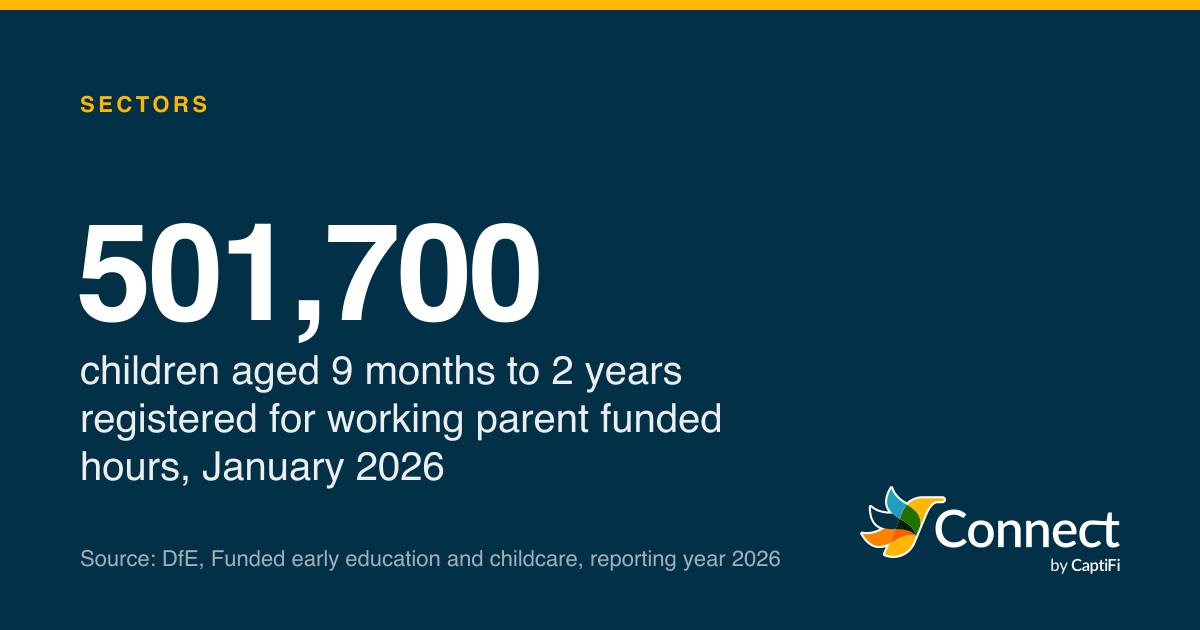
501,700: children aged 9 months to 2 years registered for working parent funded hours, January 2026. Source: DfE, Funded early education and childcare, reporting year 2026.
Since September 2025, children in England aged 9 months to 2 years whose parents are working have been entitled to 1,140 funded hours of childcare a year, usually taken as 30 hours a week for 38 weeks. DfE's January 2026 census, published on 2 July 2026, counted 501,700 of them registered for the working parent entitlement, up 7.5% on a year earlier, and their registered hours almost doubled, from 6.8 million to 13.5 million a week. Another 388,700 three and four-year-olds were on the older 30-hour offer.
For a nursery, that means more children on funded codes, more parents with a three-monthly deadline to remember, and invoices that now have to show the free hours as free. Those reminders are short, dated and personal to one child, which is the kind of message a text carries well.
What the expansion gives working parents
DfE's statistics set out how the offer grew. From April 2024, 2-year-olds with eligible working parents could get 570 funded hours a year (15 hours a week over 38 weeks). From September 2024 that extended down to children from 9 months. From September 2025 the entitlement for 9 months to 2 years doubled to 1,140 hours, matching what 3 and 4-year-olds with working parents have had since September 2017. Every 3 and 4-year-old also gets the universal 15 hours.
Eligibility is about work and income. GOV.UK says each parent must expect to earn a minimum over the next 3 months, £2,643.68 for someone over 21 (£203.36 a week), and neither can have adjusted net income over £100,000. Parents apply from when the child is 23 weeks old, and the hours start from 1 January, 1 April or 1 September depending on when the child turns 9 months, with deadlines of 31 December, 31 March and 31 August.
Some 2-year-olds qualify through a separate route. GOV.UK says a family counts as getting extra support if, for example, they get Universal Credit with household income of £15,400 a year or less after tax (not counting benefits), or the child has an education, health and care plan or gets Disability Living Allowance. Those children get 15 hours through that scheme, which they keep even if the parents stop qualifying as working, and can add 15 working parent hours on top. It's worth knowing which scheme each child is on before sending a reconfirmation reminder, because only the working parent hours need one.
Then comes the code. An approved parent gets an 11-digit code in their childcare account, and "HMRC will let you know by text or email that the code is in your account". The parent gives it to the nursery with their National Insurance number and the child's date of birth. To keep the hours, they "must sign in to your childcare account every 3 months to confirm your details are up to date".
If a parent stops being eligible at reconfirmation, DfE's statutory guidance for local authorities, valid from 1 April 2026, tells councils to keep funding the place for a grace period, running to the end of the funding block or the next one depending on when in the block eligibility ended. For a new place, the code has to be valid on the termly deadline (31 August, 31 December or 31 March) for the term that follows, and a child can't start a new working parent place during a grace period.
How many children, and who's providing the hours
The January 2026 figures break the under-3s down by age. Two-year-olds are the biggest group, at 260,200, and DfE estimates around 9 in 10 eligible 2-year-olds are registered, against around 5 in 10 for babies of 9 to 11 months. The average child aged 9 months to 2 years was registered for 26.9 hours a week (on a 38-week basis), up from 14.6 a year earlier.
- January 2025
- January 2026
Ages as at the previous 31 December. The entitlement was 15 hours a week in January 2025 and 30 hours in January 2026.
Source: DfE, Funded early education and childcare, reporting year 2026
See the figures as a table
| January 2025 | January 2026 | |
|---|---|---|
| 9 to 11 months | 29,200 | 30,700 |
| 1 year | 195,100 | 210,800 |
| 2 years | 242,500 | 260,200 |
Those hours were delivered by 55,300 providers, up 0.6% and the second annual rise in a row. Childminders were the largest group by count at 19,200, followed by private and voluntary providers at 17,300 and state-funded schools at 16,700. Staff numbers rose too: private, voluntary and independent settings had 286,700 staff delivering the entitlements, up 14,200 (5.2%) and the fifth annual rise in a row.
Providers with at least one child registered for any funded entitlement; 55,300 in total. DfE says fewer reclassification checks explain the rise in other PVIs.
Source: DfE, Funded early education and childcare, reporting year 2026
See the figures as a table
| Providers | |
|---|---|
| Childminders | 19,200 |
| Private and voluntary | 17,300 |
| State-funded schools | 16,700 |
| Independent schools | 800 |
| State-funded governor-run | 670 |
| Local authority day nurseries | 400 |
| Other PVIs | 260 |
Ofsted's register counts every registered provider, funded or not. At 31 March 2026 it held 59,700 childcare providers, 720 fewer than a year earlier, mostly because the number of childminders fell by 630 to 24,700. Places on the Early Years Register still rose by 26,500 to 1.31 million, driven by nurseries and pre-schools on non-domestic premises, where places rose by 30,500.
What the funding rules mean for attendance
The same statutory guidance sets out how councils pay providers, and two parts of it bear on the texts a nursery keeps. Councils should fund providers "based on the hours planned and agreed with the parent", and shouldn't claw funding back for short-term absences such as sickness or a family emergency, or for short closures beyond the provider's control such as damage to the premises. They can, though, look harder at children whose attendance runs in "a frequent pattern" that doesn't match the hours in the parental declaration, the form a parent completes before a child first takes up a free place, setting out the funded hours, the weekly pattern and any optional charges. Provider agreements should ask nurseries to review those declarations regularly.
A dated thread of absence texts and replies is a simple record of why a child wasn't in. The guidance also says that from October 2026, councils must pay any early years provider who asks, childminders included, monthly for the free entitlements, which makes keeping each month's attendance tidy more useful still.
The texts a nursery sends
The texts below are all about the child's place: codes, absences, collection, closures and invoices. Those are service messages, so the consent rules for marketing don't apply. A text promoting your new holiday club is marketing, and the SMS marketing rules guide covers what you need before sending it.
Codes and reconfirmation
The three-monthly sign-in is easy for a busy parent to forget, and a new starter's code has to be valid by the termly cut-off. For a hypothetical nursery, Little Oaks:
Little Oaks: a reminder to do your 3-monthly reconfirmation in your childcare account if it's due, so Maya's funded hours carry on without a gap. Reply once it's done.
Little Oaks: thanks for the new code. We've checked it and Maya's 30 funded hours continue from January. No need to reply.
Don't ask parents to text back the code, their National Insurance number and their child's date of birth in one reply. Point them to the form or portal you already use for that. A parent entering a grace period is a different matter again: it usually means a change in work, and the news is better given in person than in a text.
Absences and collection
The EYFS framework for group and school-based providers, in its September 2026 edition, says providers "must follow up on absences in a timely manner", and that where a child is absent without notification, "attempts must be made to contact the child's parents and/or carers and alternative emergency contacts". The attendance policy shared with parents has to say how to report an absence and what the nursery will do. The framework also asks settings to hold more than two emergency contact numbers per child where possible.
Little Oaks: Maya isn't in this morning and we haven't heard from you. Please reply or call 01632 960321 so we know she's OK.
Collection is stricter. The framework says children may only be released "into the care of individuals of whom the parent and/or carer has explicitly notified the provider". A text from the parent's registered number can be part of that, if your policy says so, and a reply confirming the arrangement gives both sides a record:
Little Oaks: noted, Grandma (Sue Patel) is collecting Maya today at 17:30. Please ask her to bring photo ID.
If your setting uses a collection password, keep it out of texts altogether; anyone holding the phone can read one.
Closures and sessions
Little Oaks: we're closed today, Thu 26 Nov, because the heating has failed. We'll text by 18:00 about tomorrow. Today's session won't be charged.
That last line is a commitment, so only send it if it's your policy. On the funded side, the statutory guidance says councils shouldn't withdraw funding for short closures caused by things outside the provider's control, so a short closure for a reason the nursery couldn't control shouldn't cost it the day's funding.
Invoices
DfE's statutory guidance is blunt: "There must not be any mandatory charges for parents in relation to the free hours." Providers can charge for consumables such as nappies or sun cream, meals and snacks, optional activities and extra paid hours, but those charges "must be voluntary for the parent", with a reasonable alternative such as bringing their own. Top-up fees, non-refundable deposits as a condition of a funded place, and general charges such as "sustainability" fees or non-itemised "enrichment" charges are all ruled out. Invoices "should be itemised", split into free entitlement hours, additional paid hours, food, non-food consumables and activities.
A text that summarises the invoice should follow the same split:
Little Oaks: Maya's December invoice is £186.40. Funded hours: no charge. Extra hours £142.00, meals £36.40, nappies £8.00. Full invoice emailed today.
Little Oaks: Maya's November invoice (£186.40) was due on 1 Dec and we haven't received it yet. If you'd like to spread the cost, reply and we'll set up a plan.
Some parents pay part of the bill through Tax-Free Childcare, and GOV.UK's sign-in page for the childcare account is also where they pay a provider from that account, so an invoice text can point them there if that's how they normally pay.
The statutory interest and fixed charges in our post on payment reminder texts don't come into it. The Late Payment of Commercial Debts (Interest) Act 1998 applies only where buyer and supplier "are each acting in the course of a business", and a parent paying nursery fees isn't.
Running it from the office
The termly rhythm suits scheduled sending. Codes need checking before 31 August, 31 December and 31 March, so a reminder a fortnight ahead of each, with a second a week later for anyone still outstanding, covers most of it. Room leaders and the office can work from one inbox, which matters on the morning half the absence replies arrive at once.
CaptiFi Connect sends to UK mobiles from a UK number, so parents can reply, and replies land in a two-way inbox shared through team logins. Reminders can be scheduled weeks ahead with quiet hours, contact lists import from a CSV export, and every text has a delivery report, which helps when a parent says the closure text never arrived.
Sources
Read for this post on 22 October 2026.
- DfE: Funded early education and childcare, reporting year 2026
- GOV.UK: Free Childcare for Working Parents, overview
- GOV.UK: Free Childcare for Working Parents, check if you're eligible
- GOV.UK: Free Childcare for Working Parents, when to apply
- GOV.UK: Free Childcare for Working Parents, after you've applied
- GOV.UK: Free Childcare for Working Parents, what you'll get
- GOV.UK: Free Childcare for Working Parents, sign in to confirm your details
- DfE: Early education and childcare, statutory guidance valid from 1 April 2026
- DfE: Early years foundation stage statutory framework, publication page
- DfE: EYFS statutory framework for group and school-based providers, effective 1 September 2026
- Ofsted: Main findings, childcare providers and inspections as at 31 March 2026
- legislation.gov.uk: Late Payment of Commercial Debts (Interest) Act 1998, section 2
Written by the CaptiFi Connect team. Published 22 October 2026. More in Sectors
Send your first text this week
Set up your account and contacts now. Until we've approved it, a person reads each text before it goes out.