
Sectors8 min read
Optician recall texts and NHS sight tests
England's last count was 13.4m NHS sight tests a year, and Wales did a record 910,000 in 2025-26. Who is eligible, how often people are due, and recall texts.
In short
- NHS-funded sight tests in England reached 13,355,060 in 2019-20, the last year NHS Digital published its General Ophthalmic Services activity series.
- Wales provided more than 910,000 NHS-funded eye examinations in 2025-26, a record and 5.1% more than the year before, according to Welsh Government statistics.
- The College of Optometrists says patients aged 16 and over should not be recalled more often than every two years without a clinical reason.
- In the 2021-22 National Survey for Wales, 8% of people asked why they did not have their eyes tested more often said they had not thought about it or had no reminder.
- The ICO counts texts that confirm or remind people about appointments as service messages, but a promotional element in the same text makes it direct marketing.
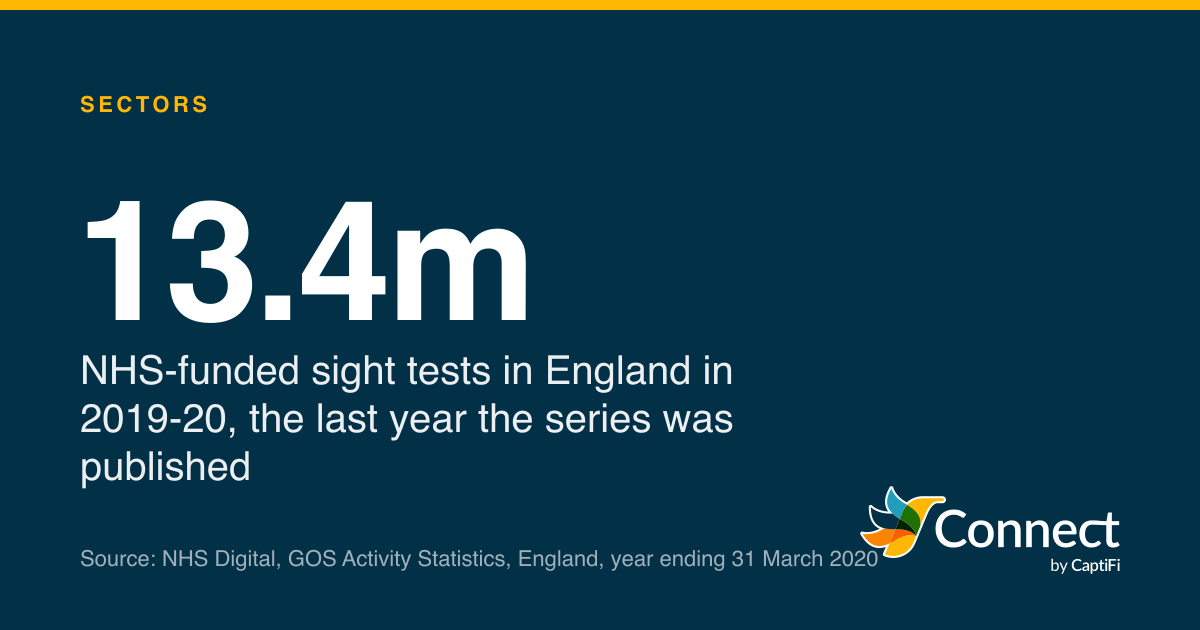
13.4m: NHS-funded sight tests in England in 2019-20, the last year the series was published. Source: NHS Digital, GOS Activity Statistics, England, year ending 31 March 2020.
England's opticians carried out 13,355,060 NHS-funded sight tests in the year to March 2020. That's the last national count there is: NHS Digital published it on 25 June 2020 and the series hasn't been updated since, so there's no published England figure for any later year. Wales still publishes, and its report of 8 October 2026 counted more than 910,000 NHS-funded eye examinations in 2025-26, a record and 5.1% up on the year before. Most of those tests end with a date when the patient is next due, and for an optician the recall text is what turns that date back into a booking.
How many NHS sight tests are there?
In England, NHS Digital's General Ophthalmic Services (GOS) activity statistics ran from 2002-03 until 2019-20. The final edition put that year's 13.4 million tests 1.0% above 2018-19 and 38.2% above 2002-03, with 3.5% of them domiciliary, carried out in someone's home or care home. Optometrists did more than 99.9% of the work, and the report's workforce figures count 14,087 of them that year, at an average of about 948 NHS tests each.
Financial years, rounded to two decimal places from the counts in table 1.1. The series has not been published for any year after 2019-20.
Source: NHS Digital, GOS Activity Statistics, England, year ending 31 March 2020, table 1.1
See the figures as a table
| Sight tests (m) | |
|---|---|
| 2009-10 | 11.81 |
| 2010-11 | 11.94 |
| 2011-12 | 12.31 |
| 2012-13 | 12.34 |
| 2013-14 | 12.79 |
| 2014-15 | 12.76 |
| 2015-16 | 12.98 |
| 2016-17 | 13 |
| 2017-18 | 13.03 |
| 2018-19 | 13.23 |
| 2019-20 | 13.36 |
The line barely wobbles: ten years of growth, never more than 3.7% in a year, with one small dip in 2014-15. It stops just before the pandemic. In Wales, whose figures carry on, the pandemic year is the only break in a long upward trend.
Wales has the fuller recent picture. Its Eye care statistics for April 2025 to March 2026, from the Welsh Government, show more than 910,000 NHS-funded examinations under the Wales General Ophthalmic Service, 17.1% more than ten years earlier, with nearly 29,000 of them domiciliary. At 31 March 2026, 313 practices were offering the full Welsh service and another 48 were mobile only. The Welsh report repeats the advice that drives every recall programme: the NHS recommends most people have an eye examination "at least once every 2 years to reduce preventable sight loss".
Then there's the money. The Department of Health and Social Care's letter published on 8 December 2025 set the NHS sight test fee in England at £24.13 from 1 April 2025, backdated, with an extra £40.80 for each of the first two patients at a domiciliary visit and £10.21 for each one after that. For a practice, every NHS patient who doesn't come back when due is a £24.13 fee that never gets claimed, which is why the recall list matters.
Who gets a free NHS sight test?
The NHS website's list for England is long, and a good share of any practice's patients will be on it. You're entitled to a free NHS sight test if you:
- are under 16, or 16 to 18 and in full-time education
- are 60 or over
- are registered as partially sighted or blind
- have been diagnosed with diabetes or glaucoma
- are 40 or over and a parent, sibling or child has been diagnosed with glaucoma
- have been told by an ophthalmologist that you're at risk of glaucoma
- are entitled to, or named on, an HC2 certificate for full help with health costs
- receive, or have a partner who receives, income-based Jobseeker's Allowance, Pension Credit Guarantee Credit or Universal Credit (meeting the criteria)
There are a few more categories (prisoners on leave, people eligible for a complex lens voucher, dependants under 20 of someone on those benefits), and people on an HC3 certificate may get help with the cost of a private test. Anyone eligible who can't get to a practice because of illness or disability may be able to have a mobile test at home, in a care home or at a day centre.
That list matters for the wording of a recall text, because "free on the NHS" is the strongest line you can put in one, and you can only say it to people who qualify.
How often should a patient be recalled?
The NHS answer is short. "If you're eligible for a free NHS sight or eye test, you can have a test every 2 years," and more often "if your ophthalmic practitioner or optometrist recommends you do." Someone who pays for a private test isn't eligible for a free NHS one "until your next sight test is due".
The College of Optometrists' guidance for professional practice is more detailed, and it's written the other way round, as a floor. It says practitioners should examine patients "at the most appropriate intervals, depending on their clinical needs", for private and NHS patients alike, and that "in the absence of clinical indications, you should not recall patients more frequently than the following intervals":
| Patient | Minimum re-examination interval |
|---|---|
| Up to 16, no binocular vision anomaly or refractive error | One year |
| Under 7, with binocular vision anomaly or corrected refractive error | Six months |
| 7 to 15, with binocular vision anomaly or rapidly progressing myopia | Six months |
| 16 and over | Two years |
| Diabetes, in a diabetic retinopathy monitoring scheme | Two years |
| Diabetes, not in a monitoring scheme | One year |
The College adds that the intervals "should not be taken as applying automatically to all patients in a category", and that contact lens wearers may need more aftercare appointments but aren't entitled to more NHS sight tests because of the lenses.
For a recall system, that settles one thing. The due date is set patient by patient: the optometrist chooses it at the end of each test, within those limits, and the text goes out when that date arrives. A practice that sends everyone a "time for your annual check" message is recalling adults earlier than the College's guidance allows without a clinical reason, and it's also sending a text that's wrong for most of the people who get it.
Why people don't come back
The best published answer comes from the National Survey for Wales, which asked about eye tests between April 2021 and March 2022. A third of people said they have their eyes tested at least once a year and another 34% every two years. Then 15% said less often than every two years, and 9% said never.
National Survey for Wales, April 2021 to March 2022. The four answers come to 91%; the release does not say how the rest answered.
Source: Welsh Government, Eye care statistics April 2021 to March 2023 (National Survey for Wales)
See the figures as a table
| People (%) | |
|---|---|
| At least once a year | 33 |
| Every two years | 34 |
| Less than every two years | 15 |
| Never | 9 |
Asked why they don't have their eyes tested more often, 80% said they hadn't had any eye problems. That's the belief a recall text is up against. Another 8% said they hadn't thought about it or hadn't had a reminder, 4% were too busy, 3% said appointments weren't available and 2% didn't feel safe going (the fieldwork started in April 2021). The 8% is the share a text can fix without arguing with anyone.
What a recall sequence looks like
Three texts, spaced out, then stop. Here's a pattern a practice can adapt, written for a made-up Hillside Opticians.
The first goes in the week the patient is due:
Hillside Opticians: Sam, your eye test is due this month. Reply BOOK and we'll text you some times, or call 01632 960456.
If there's no reply, a second goes three or four weeks later, with the strongest reason you can honestly give that patient. For someone on your list who's 60 or over, that's the price:
Hillside Opticians: your eye test was due in October. NHS eye tests are free if you're 60 or over. Reply BOOK or call 01632 960456.
For a child, the text goes to the parent's phone and says whose test it is:
Hillside Opticians: Ella is due her yearly eye test, which is free on the NHS for under 16s. Reply BOOK to choose a time.
A third, about two months after the due date, can be the last word for this cycle: "Hillside Opticians: we haven't seen you for a while. Reply BOOK any time, or STOP and we won't send more reminders." After that, the patient goes back into the pool for next year's list, and nobody gets a fourth text.
Once a slot is booked, the recall job is done and the appointment reminder takes over:
Hillside Opticians: your eye test is on Thu 12 Nov at 11:20. Reply C to confirm or R to rebook. Please bring your current glasses.
A few rules sit under all of these. The practice name goes first, every time. One action per text, and it's a reply where possible, because a reply lands in the practice inbox with the number attached. Each sample is under 160 plain characters, so each is one SMS part. And the clinical reason stays out. A patient may be due every year because of diabetes or a family history of glaucoma, but "your diabetic eye check is due" tells anyone holding the phone that the patient has diabetes. "Your eye test is due" does the job. Our post on health information in a text covers where that line sits.
Is a recall text marketing?
Mostly not, but it depends on the words. The ICO's guidance on identifying direct marketing, last updated on 20 August 2025, describes service messages as ones that "aren't promotional but are for administrative or customer services purposes", and its examples include messages to "confirm or remind them about appointments". A reminder of a booked eye test is clearly one of those.
A "you're due" recall with no booking yet is less clear-cut, and the ICO's guidance has no optician example. Its guidance says the phrasing, tone and context are "likely to be a key factor", that a neutral message giving information people "need to know as part of their relationship with you" is more likely to be a service message, and that a message that "actively promotes or encourages people to make use of a particular service, special offer, or upgrade" is likely to be marketing. It's also firm about mixing the two: "If your service message has elements that are direct marketing, even if that is not the main purpose of your message, then it will count as direct marketing."
So keep recall texts neutral and factual (due date, how to book, whether it's free on the NHS for that patient) and keep offers out of them. "Your eye test is due" is the neutral, factual kind of message the guidance treats as more likely to be a service message. "Your eye test is due, and frames are half price this month" promotes an offer, and needs consent or the soft opt-in, with an opt-out. The practical answer is to ask at the test whether the patient wants recall texts, record the answer, and take marketing consent separately. Our post on service and marketing texts works through the grey areas.
Running it
Pull the list of patients due from the practice system each week. Send the first recall that week, at a civil hour, and the follow-ups to non-responders only. Count bookings per hundred texts, and how many of those were kept; a month of that tells you whether the second text earns its place.
CaptiFi Connect's keywords can send an automatic reply to BOOK and put the message in the practice inbox, where replies are free, and scheduled sends let the week's recalls go out on Monday morning whoever is on the front desk. A reply of STOP opts the number out on its own.
Sources
Read for this post on 22 October 2026.
- NHS Digital: General Ophthalmic Services Activity Statistics, England, year ending 31 March 2020
- NHS Digital: General Ophthalmic Services activity statistics, all editions
- NHS: Free NHS eye tests and optical vouchers
- NHS: How often can I have a free NHS sight test?
- College of Optometrists: Frequency of eye examinations or sight tests
- Welsh Government: Eye care statistics, April 2025 to March 2026
- Welsh Government: Eye care statistics, April 2021 to March 2023
- DHSC: Letter setting out general ophthalmic services fees and payments from 1 April 2025
- ICO: Identify direct marketing
Written by the CaptiFi Connect team. Published 22 October 2026. More in Sectors
Send your first text this week
Set up your account and contacts now. Until we've approved it, a person reads each text before it goes out.