Sectors8 min read
Pharmacy texts: prescriptions and Pharmacy First
England's pharmacies dispensed 102m items and ran 352,975 Pharmacy First consultations in June 2026. Prescription texts, reminders and what to leave out.
In short
- Community pharmacies in England dispensed 102.4 million prescription items in June 2026, 97% of them through the Electronic Prescription Service, according to NHSBSA's dispensing data.
- Pharmacy First, launched by NHS England on 31 January 2024, lets community pharmacists treat seven common conditions, including sore throat, earache and uncomplicated urinary tract infections.
- Pharmacy First clinical pathway consultations reached 352,975 in June 2026, more than double the 164,737 in June 2024, according to NHSBSA's monthly dispensing data.
- By the end of August 2026, 2,477 pharmacy sites in England, 24% of the total, were live with NHS App "Ready to Collect" notifications, according to NHS England.
- The GPhC's nine standards for pharmacy professionals include respecting and maintaining the person's confidentiality and privacy, which covers what a pharmacy puts in a text.
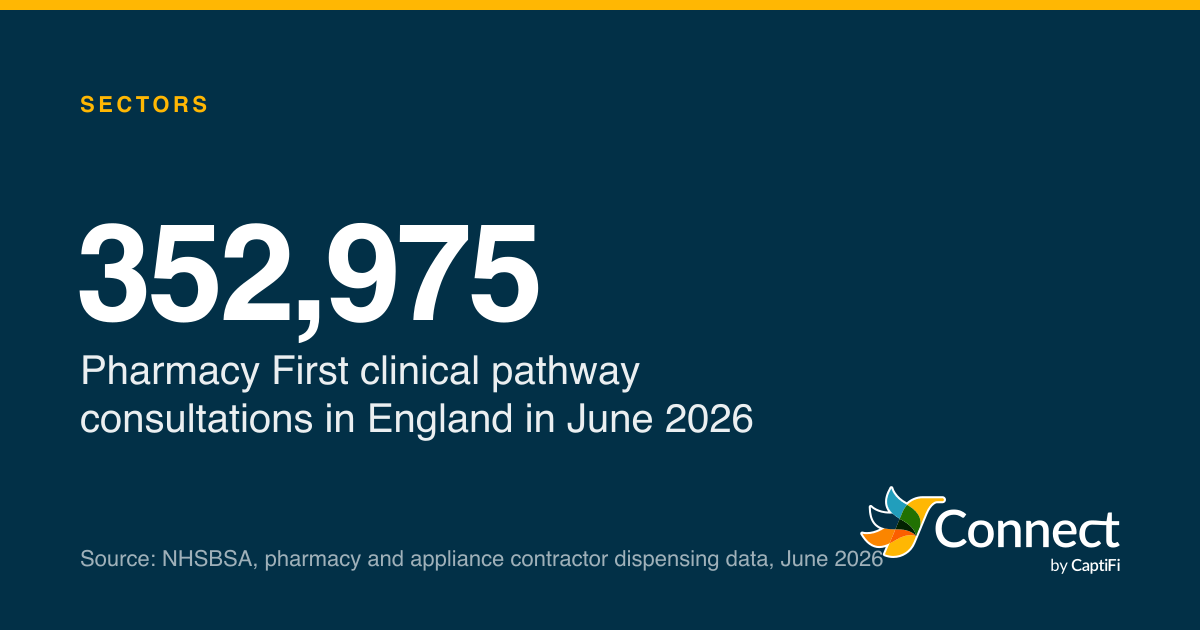
352,975: Pharmacy First clinical pathway consultations in England in June 2026. Source: NHSBSA, pharmacy and appliance contractor dispensing data, June 2026.
Community pharmacies in England dispensed 102.4 million prescription items in June 2026, and they ran 352,975 Pharmacy First consultations on top. Both numbers come from the NHS Business Services Authority's monthly dispensing data, which lists every pharmacy's claims for the month, and the 10,385 pharmacies in that file each had, on average, close to 10,000 items to hand over. Each of those items has to get to a patient, and Pharmacy First has added a new kind of contact on top: a consultation that may need arranging or following up. Texts can do most of that, as long as they say very little about why.
How much do pharmacies dispense?
NHSBSA's open data portal publishes a file for each month, covering every community pharmacy and appliance contractor in England. In the June 2026 file, pharmacies claimed for 51.3 million prescription forms and 102.4 million items, and 99.6 million of those items, about 97%, came through the Electronic Prescription Service. In June 2024 the same figure was 92.2 million items, so a typical June now brings about 10 million more items than it did two years earlier.
The number of pharmacies is going the other way. The February 2024 file had claims from 10,627 pharmacy contractors; June 2024 had 10,523, June 2025 had 10,393 and June 2026 had 10,385. So there are fewer pharmacies handling more items, with Pharmacy First on top, and that's the setting in which a pharmacy decides whether to text people when their prescription is ready, or let them turn up and wait.
What is Pharmacy First?
NHS England launched Pharmacy First on 31 January 2024. It builds on the Community Pharmacist Consultation Service, which had run since October 2019 and let patients be referred to a pharmacy for a minor illness or an urgent supply of a repeat medicine. The new part lets pharmacists "complete episodes of care for 7 common conditions following defined clinical pathways", which can include supplying a restricted set of prescription-only medicines without a GP appointment.
| Clinical pathway | Age range |
|---|---|
| Acute otitis media (earache) | 1 to 17 years |
| Impetigo | 1 year and over |
| Infected insect bites | 1 year and over |
| Shingles | 18 years and over |
| Sinusitis | 12 years and over |
| Sore throat | 5 years and over |
| Uncomplicated urinary tract infections | Women aged 16 to 64 |
Patients can be referred by general practice, urgent and emergency care or NHS 111, and for the seven conditions they can also walk in or contact the pharmacy directly. Distance selling pharmacies don't do the earache pathway. After the consultation, NHS England says, the pharmacy notifies the patient's GP on the same day or the next working day.
How fast is it growing?
The NHSBSA files make the growth easy to see. The seven clinical pathways together came to 125,275 consultations in February 2024, the first full month, and 352,975 in June 2026.
Our totals of the seven clinical pathway lines for pharmacy contractors in each monthly file. February 2024 was the first full month of the service. Minor illness referrals and urgent medicine supplies are counted separately and left out.
Source: NHSBSA, pharmacy and appliance contractor dispensing data, monthly files
See the figures as a table
| Consultations | |
|---|---|
| Feb 2024 | 125,275 |
| Jun 2024 | 164,737 |
| Jun 2025 | 254,692 |
| Jun 2026 | 352,975 |
June to June, consultations went from 164,737 in 2024 to 254,692 in 2025 and 352,975 in 2026, so they more than doubled in two years. Some of the mix is seasonal: infected insect bites went from 3,412 consultations in February 2024 to 78,301 in June 2026, which says as much about the time of year as about the service.
Community pharmacy contractors in England, June 2026 claims. UTI is urinary tract infection; acute otitis media is a middle ear infection.
Source: NHSBSA, pharmacy and appliance contractor dispensing data, June 2026
See the figures as a table
| Consultations | |
|---|---|
| Sore throat | 106,750 |
| Uncomplicated UTI | 80,132 |
| Infected insect bites | 78,301 |
| Acute otitis media | 36,352 |
| Sinusitis | 30,850 |
| Impetigo | 10,767 |
| Shingles | 9,823 |
The older referral strands carry on beside the pathways. In June 2026 pharmacies claimed for 114,353 minor illness referral consultations and 164,120 urgent medicine supply consultations. And the New Medicine Service, in which a pharmacist supports someone through "3 conversations, usually during the first several weeks after the medicine is started", in person or by phone, had 1,151,931 interventions declared in the same month.
The prescription-ready text
The most useful pharmacy text is also the simplest: it's ready, here's where and until when.
Westgate Pharmacy: your prescription is ready to collect. We're open until 6pm today and 1pm on Saturday.
What it leaves out matters as much. No medicine name, no condition, no "your inhaler" or "your antidepressants". NHS England's information governance guidance for health and care staff says to think carefully about what goes into messages "where the content might appear on devices' locked screens", and that care messages should generally go only "to people who the services directly relate to". For a pharmacy that means the patient's own number, or a proxy recorded on the patient's record, such as a parent for a child. The seventh of the General Pharmaceutical Council's nine standards for pharmacy professionals says they must "respect and maintain the person's confidentiality and privacy", and a lock screen is a fairly public place. Our post on health information in a text goes through the wording in more detail.
Some patients will get this notice from the NHS App instead. NHS England's figures for August 2026 count 2,477 pharmacy sites live with prescription tracking and "Ready to Collect" notifications, 24% of all pharmacy sites, sending 4,060,592 of those notifications that month, with a read rate of 53%. That's useful where it works. For the other three quarters of pharmacy sites, and for patients without the app or with notifications switched off, the pharmacy's own text is still the message. There's more on how far the app reaches in why the NHS is moving messages into the NHS App.
Repeat reminders and New Medicine Service calls
Repeat prescriptions run to a rhythm, which suits a scheduled text. The NHS App handled 7,620,985 repeat prescription orders in August 2026, so many patients now order online, and for those who don't, a prompt from the pharmacy does the same job.
Westgate Pharmacy: your repeat prescription may be due soon. Reply YES if you'd like us to request it, or call 01632 960789.
Keep it neutral and give a way to say no. "Reply STOP if you'd rather order it yourself" is fair and saves the next text.
New Medicine Service conversations need arranging, and a text that asks for a convenient time saves a round of missed calls. Here the wording needs the most care. Since 29 October 2025 the New Medicine Service has covered medicines for depression, alongside conditions such as asthma, type 2 diabetes and epilepsy, so a text about "your new medicine for..." can say far more than intended.
Westgate Pharmacy: our pharmacist would like a short call about your prescription. Reply with a day and time that suits you.
That's all it needs. The detail belongs in the conversation, in the consultation room or on the phone.
Five pharmacy texts and what to leave out
Most of what a pharmacy sends falls into a handful of messages. The pattern is the same each time: the pharmacy name first, one fact, one action, and nothing that tells a stranger what the patient takes or why.
| Message | Wording that works | Leave out |
|---|---|---|
| Ready to collect | Your prescription is ready to collect, open until 6pm | The medicine and how much of it |
| Part supply | The rest of your prescription is now ready to collect | Why it was short or what it was |
| Still on the shelf | Your prescription is still waiting for you at the counter | Any hint of urgency about the medicine itself |
| Repeat due | Your repeat prescription may be due soon. Reply YES to request it | The condition the repeat is for |
| Call to arrange | Our pharmacist would like a short call. Reply with a time | The service name if it reveals the condition |
Two more habits help. Send collection texts in working hours, so nobody reads "your prescription is ready" at 11pm and wonders whether something is wrong. And let people reply with a question, because the questions a pharmacy gets back ("is it the usual one?", "can I collect tomorrow?") are quicker to answer by text than by phone, and the answer still shouldn't name the medicine unless the patient has asked for it.
Where the marketing line sits
Prescription and appointment messages are service messages. The ICO's guidance on identifying direct marketing, last updated on 20 August 2025, describes them as messages that "aren't promotional but are for administrative or customer services purposes", including ones that "confirm or remind them about appointments".
Telling customers about services is different. The same guidance says that a message which "actively promotes or encourages people to make use of a particular service, special offer, or upgrade" is likely to be direct marketing, and "if your service message has elements that are direct marketing, even if that is not the main purpose of your message, then it will count as direct marketing." So a text announcing that the pharmacy now treats sore throats under Pharmacy First, offering a travel clinic, or adding a line about vitamins to a collection notice is likely to count as marketing, which needs the customer's consent, or the soft opt-in where it applies, with an opt-out. Keep the collection text plain and send anything promotional separately, to people who agreed to it. Our guide to SMS marketing rules covers the two routes.
Setting it up
Take the mobile number at the counter and confirm it with the first text. Record who else may collect or receive messages for a patient, and why. Send collection texts as the bag is labelled, and a reminder only if it's still on the shelf a few days later. Answer replies the same day, because "can my husband pick it up?" is exactly the question a two-way text should settle.
CaptiFi Connect's two-way inbox takes those replies on a UK mobile number, with no charge to the pharmacy for receiving them, and keywords can send an automatic answer to YES while a person picks up the rest. A reply of STOP opts the number out on its own.
Three quarters of pharmacy sites in England were still outside the NHS App's collection notices at the end of August 2026, so for their patients any "your prescription is ready" message is one the pharmacy has to send itself.
Sources
Read for this post on 22 October 2026.
- NHSBSA Open Data Portal: Pharmacy and appliance contractor dispensing data
- NHS England: Pharmacy First
- NHS England: NHS New Medicine Service
- NHS England: NHS App Management Information, August 2026
- General Pharmaceutical Council: Standards for pharmacy professionals
- NHS England: Texting, emailing and messaging patients, guidance for health and care professionals
- ICO: Identify direct marketing
Written by the CaptiFi Connect team. Published 22 October 2026. More in Sectors
Send your first text this week
Set up your account and contacts now. Until we've approved it, a person reads each text before it goes out.