By the numbers7 min read
Why the NHS is moving messages into the NHS App
The NHS App delivered 335m messages in 2025-26 and NHS providers are told to send through it first. What the figures show, and where texts still fit.
In short
- The NHS App delivered 36.5 million messages in August 2026, 61% more than a year earlier, according to NHS England's NHS App management information.
- Monthly NHS App figures add up to 335 million messages delivered in 2025-26, against the 270 million the government expected when it announced a £50 million upgrade in June 2025.
- At the end of August 2026, 66.1% of the NHS App's 39.06 million registered users were opted in to notifications, which left about 13.2 million who were not.
- NHS Notify charges nothing for NHS App messages and emails, 2.4p plus VAT for a text and 64p for a letter, and moves to the next channel when a message is not read in time.
- Only 41.7% of NHS App messages delivered in August 2026 were read within 24 hours, the window NHS Notify uses in its own example of when to try the next channel.
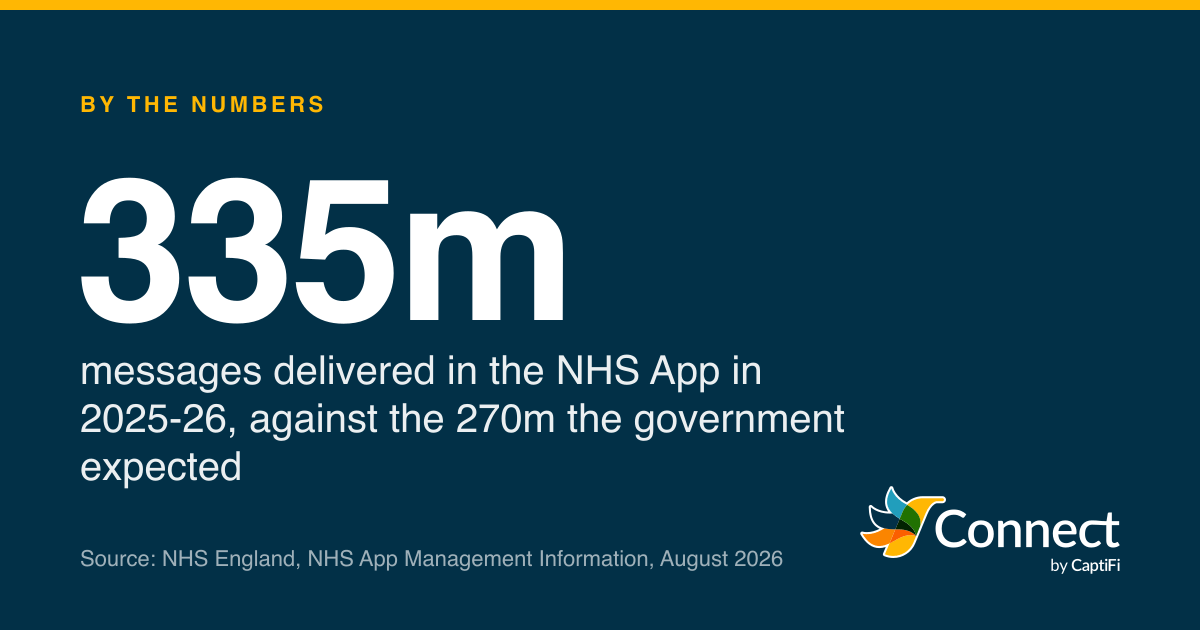
335m: messages delivered in the NHS App in 2025-26, against the 270m the government expected. Source: NHS England, NHS App Management Information, August 2026.
The NHS App delivered 36,499,843 messages in August 2026, 61% more than in August 2025. That's from NHS England's monthly NHS App management information, published on 25 September 2026, and it's the visible result of a policy the Department of Health and Social Care set out on 7 June 2025: "over the next 3 years, patients in England will receive all appropriate NHS messages through the app first. Where app messaging is not available, communications will be sent via SMS and then by letter as a last resort." The case for it rests mostly on cost, and the same monthly figures show where texts still fit.
How many messages go through the NHS App?
NHS England's release counts messages delivered inside the app each month, leaving out rejected messages and push notifications. Add the months up by financial year and the growth is steep: about 6.6 million in 2022-23, 73.7 million in 2023-24, 221 million in 2024-25 and 335 million in 2025-26.
April to March, our sums of the monthly counts in the August 2026 release, rounded to two decimal places. In-app messages only, excluding rejected messages and push notifications.
Source: NHS England, NHS App Management Information, August 2026 (England CSV)
See the figures as a table
| Messages (m) | |
|---|---|
| 2022-23 | 6.58 |
| 2023-24 | 73.68 |
| 2024-25 | 220.98 |
| 2025-26 | 335.36 |
When it announced a £50 million upgrade in June 2025, the government said "270 million messages are expected to be sent through the NHS App this year", which the monthly series overtook comfortably. (It also called that "an increase of 70 million on the last financial year", which implies about 200 million for 2024-25; the published monthly figures for that year add up to 221 million, so the two counts don't quite line up.) The busiest month so far was October 2025, at 43.0 million.
Behind those messages sit 39,061,451 registered users at the end of August 2026, 8% more than a year earlier. In August alone, 15.5 million different people logged in and 7.6 million repeat prescriptions were ordered through the app. When NHS England last put a share on it, in May 2024, it said 34 million registered users was "around three quarters of the adult population in England".
What is moving into the app?
The June 2025 announcement named three kinds of message: appointment reminders, screening invitations and test results. It said the national vaccination programmes had already "delivered 85 million messages via digital channels" the year before, and that the breast, bowel and cervical screening programmes would make the switch later in 2025. It also said NHS App services were live in 87% of hospitals in England, and that users would soon be able to add appointments to their phone's calendar and log in faster with Face ID.
The case it made was partly about attendance. "In 2023 to 2024, there were around 8 million missed appointments in elective care, and around 30% of people missed a screening appointment," it said, and push notifications would reduce "the risk of these missed appointments". That's the same problem a reminder text has always been sent to solve, and our post on missed appointments has the NHS's own figures on it.
NHS England's 2024 release described what patients can already see, depending on their GP surgery or provider: messages from their NHS services, replies from their practice and follow-ups on test results, and messages they've sent to hospital teams. For many patients, that makes the app the place where the back-and-forth with their practice happens.
Why the NHS wants messages there
Money comes first in the official statements. On 7 May 2024 NHS England said 22.5 million messages sent through the app during 2023/24 "would have previously been sent as a text message or letter", that "the average cost of sending a text message is around 5p", and that the switch had saved "at least £1.1 million". Its national transformation director, Dr Vin Diwakar, put the bigger number on it: an "estimated £450 million per year that is currently spent on communicating with patients".
The 10 Year Health Plan, published on 3 July 2025, uses a narrower figure. "The NHS spends over £200 million communicating with patients through SMS and letters alone each year," it says. "Much of this should be saved via the direct messaging functionality in the NHS App." It also promises that "by 2028, the app will be a full front door to the entire NHS". The June 2025 announcement added that the shift would avoid "at least 50 million costly letters" and save "an estimated £200 million across the system over the next 3 years".
The prices explain the order. NHS Notify, the messaging service NHS England runs for health organisations, lists NHS App messages and emails as free, a text at 2.4p plus VAT and a letter at 64p with standard postage (its home page shows 2.33p for a text, so check before you budget). NHS Notify's own page says that "in line with the 2025 to 2026 operational planning guidance, all NHS providers are expected to send messages to patients through the NHS App first, using NHS Notify as the default service." Its service page, edited on 20 October 2026, counts 212 million messages sent and 19 services using it.
Set side by side, the four channels look like this:
| Channel | NHS Notify price | Confidential detail, per NHS England's IG guidance |
|---|---|---|
| NHS App message | Free | Acceptable, because the patient has to log in |
| Free | Acceptable if encrypted | |
| Text message | 2.4p plus VAT | Only where necessary, kept to the minimum |
| Letter | 64p | Not covered by the texting guidance |
There's an information governance reason too. NHS England's guidance for staff on texting patients says confidential information is acceptable "in messages which you send through secure platforms, such as encrypted email or the NHS app, which require individuals to log in", while a plain text should carry it only where necessary. A test result can go in the app. In a text, the guidance's own example says to tell the patient the results are ready and ask them to call (our post on health information in a text goes into that).
Who doesn't get an app message?
Two numbers in the same release answer that. At the end of August 2026, 25,817,559 registered users were opted in to notifications, 66.1% of the total. That leaves about 13.2 million people who have the app but won't be told when a message arrives, on top of everyone who has never registered. And of the messages delivered in August, 41.7% were read within 24 hours and 45.7% within 72 hours.
- Registered users opted in to notifications
- Messages read within 72 hours
Opt-in is a month-end snapshot of registered users; reads are a share of in-app messages delivered that month. NHS England notes reads after month end are missed, so the latest month may be understated.
Source: NHS England, NHS App Management Information, August 2026 (England CSV)
See the figures as a table
| Registered users opted in to notifications (%) | Messages read within 72 hours (%) | |
|---|---|---|
| Dec 2024 | 54.1 | 34.7 |
| Mar 2025 | 57.1 | 39.4 |
| Jun 2025 | 59.3 | 41.2 |
| Sep 2025 | 61.6 | 42.2 |
| Dec 2025 | 63.8 | 43 |
| Mar 2026 | 65.7 | 45.7 |
| Jun 2026 | 65.2 | 44.1 |
| Aug 2026 | 66.1 | 45.7 |
Both lines are rising. Opt-in was 54.1% in December 2024, and the 72-hour read rate was 34.7%. Even so, on the latest figures more than half of app messages hadn't been read 72 hours after they arrived.
That matters because of how NHS Notify decides when to try something else. Its guidance on message plans says a fallback happens if a recipient has no valid contact details for a channel, if "the message is not read or delivered within a certain amount of time", or if sending fails. Its worked example: "If the recipient reads the message within 24 hours, no further messages get sent. If the recipient does not read the first message within 24 hours, we'll then try to send an email." On August's read rates, a plan built that way would move on to its next channel for well over half of what it sent. The order in its example runs "NHS App, email, text message, letter", so a text is next in line whenever there's no email address on record or the email fails too.
Where texts still fit
Inside the NHS, the policy leaves texts three jobs.
The first is the fallback. DHSC's own wording puts SMS second, ahead of the letter, for anyone the app can't reach. The second is people without a smartphone. The June 2025 announcement says traditional routes mean "people without access to smartphones and elderly patients can still receive messages", and Ofcom's figures on who that is are in our posts on who you reach by text and writing for older customers. The third is time. A text needs no login and no notification setting, and it shows on the lock screen when it arrives, so a message about something happening today is a poor fit for a channel where more than half of messages are still unread after three days.
Outside the NHS, very little changes. A vet, a salon or a garage has no NHS App to send through, and a private clinic's own reminders sit outside NHS Notify's purpose as NHS England describes it: you can use it "if you work in or with NHS England to support patient care". Even prescription collection is only partly in the app. NHS England's release counts 2,477 pharmacy sites live with "Ready to Collect" notifications at the end of August 2026, 24% of all pharmacy sites, so the other three quarters can't send that notification through the app at all.
What a business can borrow from it
The NHS's design has a sensible shape that a smaller organisation can copy without any of the infrastructure. Put the full detail somewhere that needs a login, if you have one (a portal or a booking page). Send a short text that says something is waiting and who it's from. And keep the time-critical messages, the "your appointment is tomorrow" and "your order is ready", on a channel that doesn't depend on a login or a notification setting.
Watch your own figures, too. NHS England publishes its read rates every month. For a business, the equivalent is the delivery report on each text and the replies that come back. CaptiFi Connect sends to UK mobiles only, gives every text a delivery report, and puts replies in a shared inbox, where replies are free.
On August 2026's figures, 54.3% of app messages had not been read within 72 hours, and that's the gap the NHS's own message plans fill with a text or a letter.
Sources
Read for this post on 22 October 2026.
- NHS England: NHS App Management Information, August 2026
- DHSC and NHS England: Patients to receive reminders and test results via the NHS App, 7 June 2025
- NHS England: NHS App messaging saved NHS more than £1 million in last year, 7 May 2024
- DHSC: Fit for the future, 10 Year Health Plan for England, July 2025
- NHS England: NHS Notify service page
- NHS Notify: home page
- NHS Notify: Pricing and commercial
- NHS Notify: Message plans
- NHS Notify: NHS App for messages, new NHS digital-first strategy
- NHS England: Texting, emailing and messaging patients, guidance for health and care professionals
Written by the CaptiFi Connect team. Published 22 October 2026. More in By the numbers
Send your first text this week
Set up your account and contacts now. Until we've approved it, a person reads each text before it goes out.