
By the numbers8 min read
What GOV.UK Notify's numbers say about texting at scale
GOV.UK Notify has sent 5.7 billion texts since 2016 and over five million on one weekday. Its live figures, its prices, and what a public service sends by text.
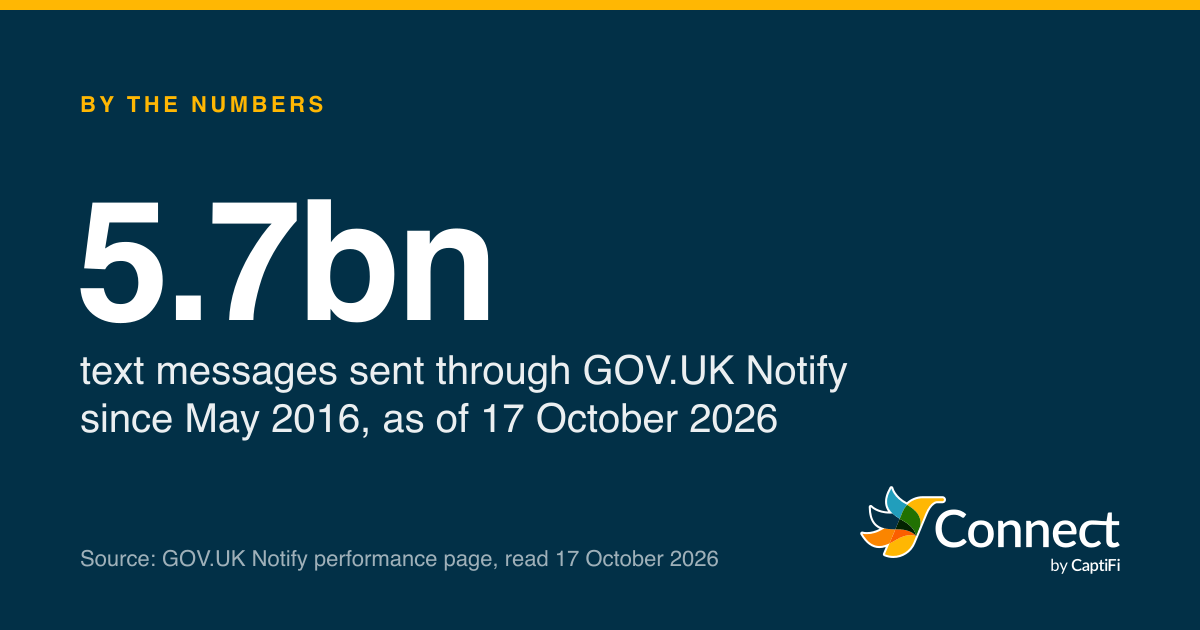
5.7bn: text messages sent through GOV.UK Notify since May 2016, as of 17 October 2026. Source: GOV.UK Notify performance page, read 17 October 2026.
On Thursday 15 October 2026 the government's own messaging service sent 5,232,207 text messages. It also sent 4,985,855 emails and 72,500 letters, and it put all three numbers on a public web page by the next morning. GOV.UK Notify has been doing that every day since it launched in May 2016, and the running total on 17 October stood at 13.7 billion messages, of which 5.7 billion were texts.
Nobody publishes a figure for the UK business messaging market as a whole, so Notify is the nearest thing to a public yardstick: one platform, used by public bodies only, with its volumes, its prices and its delivery rules all in the open.
What the performance page shows
The performance page is a plain table that refreshes daily. On 17 October 2026 it listed 1,764 organisations and 12,894 services, and a seven-day log of what went out. Texts outnumbered emails on five of the six complete days.
- Text messages
- Emails
Rounded to the nearest 10,000; the exact counts are in the text. The page shows only the last seven days, and the current day is incomplete.
Source: GOV.UK Notify performance page, read 17 October 2026
See the figures as a table
| Text messages (m) | Emails (m) | |
|---|---|---|
| Sat 10 Oct | 1.39 | 2.02 |
| Sun 11 Oct | 1.65 | 1.62 |
| Mon 12 Oct | 4.72 | 4.16 |
| Tue 13 Oct | 4.84 | 4.83 |
| Wed 14 Oct | 5.53 | 4.84 |
| Thu 15 Oct | 5.23 | 4.99 |
The week has the shape you'd expect from public services. Saturday 10 October saw 1,392,398 texts and 2,024,829 emails. Sunday was 1,645,297 and 1,618,843. Then Monday jumped to 4,722,316 texts, Tuesday to 4,838,933, Wednesday to 5,529,592, Thursday to 5,232,207. Appointments, results, reminders and codes go out in office hours because the people and systems that trigger them work office hours. A business sending reminders will see the same curve, at a smaller scale.
The page also tracks speed. Notify's delivery times page commits to "sending 95% of text messages within 10 seconds", and on every one of the six days shown the figure was 100.00%. That measures the hand-off to the mobile network, which is the part Notify controls. What happens after that is the network's job, and we'll come back to it.
Then there's the list of who uses it. The organisations are ranked by live services, and the top of the list in October 2026 looked like this:
| Organisation | Live services |
|---|---|
| Ministry of Defence | 1,201 |
| Home Office | 798 |
| Ministry of Justice | 387 |
| Department for Education | 205 |
| Cabinet Office | 190 |
| Department for Science, Innovation and Technology | 135 |
| Environment Agency | 133 |
| Department of Agriculture, Environment and Rural Affairs | 119 |
| Department for Work and Pensions | 99 |
| Department for Environment, Food and Rural Affairs | 88 |
Three NHS bodies sat just below, each on 80 live services: the NHS Business Services Authority, the UK Health Security Agency and Bradford Teaching Hospitals NHS Foundation Trust. In September 2019 the government press release announcing Notify's £175m five-year saving named the Cabinet Office, the Ministry of Justice and the Home Office as the biggest users, with "more than 1,200 services" across the whole platform. The Ministry of Defence now has as many on its own.
How it got to 12,894 services
GDS published a year-by-year table in the annex of its March 2023 product strategy post, and it's the only one of its kind.
- Services
- Organisations
2016 to 2022 are the year-end figures in the annex of the March 2023 post. The last point is the performance page on 17 October 2026. Nothing is published for 2023 to 2025 on the same basis.
Source: GDS blog, Notify's product strategy and upcoming features, 21 March 2023 (annex)
See the figures as a table
| Services | Organisations | |
|---|---|---|
| 2016 | 24 | 14 |
| 2017 | 127 | 52 |
| 2018 | 515 | 152 |
| 2019 | 1,540 | 463 |
| 2020 | 3,715 | 919 |
| 2021 | 5,349 | 1,212 |
| 2022 | 6,931 | 1,431 |
| Oct 2026 | 12,894 | 1,764 |
Twenty-four services and 14 organisations at the end of 2016. Then 127, 515, 1,540, and the jump: 3,715 services by the end of 2020, with "nearly 2,000 services" starting that year alone. The post is frank about why. Transaction volumes rose "by up to ten times" during the pandemic, and Notify "sent all the COVID test results and vaccination reminders". After that, "since February 2021, growth has normalised and our annual rate of growth is around 30%": 5,349 services at the end of 2021, 6,931 at the end of 2022, 7,343 by 21 March 2023. The 12,894 on the performance page in October 2026 is a little under double the 2022 figure, so the pace has eased since the post was written.
The message totals tell the same story from a different angle. The September 2019 press release said Notify had sent "more than half a billion messages since it was launched less than four years ago", and put the effect as "half a billion fewer phone calls, letters or reminders over the last four years". By August 2020 a GDS research post had the total at 1.5 billion emails, texts and letters "in the past 4 years". The February 2026 post on Notify's support desk lays out the rest: "The first 1 billion took 4 years", the second billion came about six months later, the 10 billion mark passed in 2025, and less than a year after that the count was 12 billion. Eight months on, it's 13.7 billion.
That 2026 post has two other numbers worth having. Notify had "10,000 users signing in to their accounts each week", and its support rota answered "33 tickets a day" on average, a figure that had stayed flat while the number of services kept climbing. For a platform moving five million texts a day, 33 tickets is a quiet inbox.
What a text costs the public sector
Notify's pricing is one line long. "A single, 160-character text message costs 2.4 pence (plus VAT)." Longer texts cost more in steps: "If a text message is longer than 160 characters (including spaces), it counts as more than one message", and the table runs 160, 306, 459, 612, 765 and 918 characters for one to six messages. One non-standard character, an emoji for instance, drops the first step to 70 characters.
Before anyone pays, there's an allowance. Each service gets a free yearly quota that depends on who runs it: 20,000 texts for central government departments and national organisations, 10,000 for local authorities and regional organisations, 5,000 for state-funded schools, 5,000 for other organisations, and none at all for GP surgeries. It renews on 1 April and unused messages expire on 31 March. The allowance page is careful to say it "is discretionary" and that "GOV.UK Notify can stop your free allowance at any time if you do not keep to the terms".
For comparison, CaptiFi Connect's prepaid packs work out at 3.5p a text at the largest size and 5p at the smallest, plus VAT, with no allowance and no procurement, which is the trade-off a private sender makes for not being a government department.
A few other numbers from Notify's documentation describe the operating envelope. A new service starts in trial mode with "a daily limit of 50 emails and 50 text messages", can only message its own team members, and "it can take up to one working day" to go live. A live service can send 250,000 text messages a day by default. Receiving texts is free: "It does not cost you anything to receive text messages", and replies come in on "a unique 11-digit phone number" that appears on the dashboard. Texts go out under the sender name GOVUK unless the service changes it.
What "sent" and "delivered" mean on Notify
The 100.00% figure on the performance page is easy to misread. Notify defines "sent" at the point its provider accepts the message, and its status page is unusually direct about what follows.
A message shows as "Delivering" when "Notify has sent the message to the provider. The provider will try to deliver the message to the recipient for up to 72 hours." It becomes "Delivered" when "the message was successfully delivered", with the caveat that "Notify will not tell you if a user has opened or read a message". Two kinds of failure are spelled out. "Not delivered" means "the provider could not deliver the message", which "can happen if the phone number was wrong or if the network operator rejects the message". "Phone not accepting messages right now" is the one that catches people out: "This can happen when the recipient's phone is off, has no signal, or their text message inbox is full." You can try again, and you're still charged. Only a "Technical failure", a problem between Notify and its provider, is free.
Two more details. Delivery status is "only available for 7 days after a message has been sent", so anyone who needs a record has to export it. And Notify sends through more than one provider: "If one provider fails, Notify switches to another so that your text messages are not affected." The 72-hour window is the mobile networks' store-and-forward behaviour, which is the same for everyone; our post on why a text can arrive late goes through it.
What a public service sends by text
The GOV.UK Service Manual's guidance for teams on Notify is short on theory and long on examples. Its text example is a booking confirmation from Transport for London: "Dial-a-Ride: Your vehicle will arrive in approximately [number of minutes] at [time of day] on [date]." Its rules are the ones that make five million texts a day tolerable: "Say only one important thing in each message", "say who the message is from", send transactional messages automatically "so that the user gets it straight away", and "avoid sending text messages late at night". It also notes that transactional messages need no permission, while "subscription messages" must never be sent "unless the user has explicitly asked for them".
The GDS blog fills in the kinds of thing that go through. COVID test results and vaccination reminders, as above. Children's centre class announcements in Leicester, where a 2022 rewrite took one template from four texts to two, saving up to 4,000 messages a year on one service and up to 24,000 across the council's six similar services. And one finding from the 2020 research: "a third of teams that let recipients send them text messages never get any replies". Notify's own guess at the time was that better messages were shorter and easier to understand; in my experience the ones that get replies are the ones that ask for one.
Read across to a business and the categories are identical. A result, a confirmation, a reminder, a code, an update on something the customer is waiting for. The arithmetic is identical too: 160 characters, 2.4p a part for government and a little more for everyone else, and a 72-hour window the networks control.
Reading the numbers yourself
The performance page is public and updates every day, so every figure above will have moved by the time you read it. The pricing and allowance pages carry the current rates. The year-end table is in the annex of the March 2023 product strategy post, and the milestone dates are in the February 2026 support post. For an older baseline, the September 2019 press release has the 500 million figure and the £175m estimate. The links are at the bottom.
CaptiFi Connect publishes its delivery reports per text, with a timeline from accepted to delivered or failed, and keeps them past seven days. If Notify's week is a guide, a business sending reminders should expect its own Wednesdays to be busier than its Saturdays by a factor of about four, and a text to a phone that's switched off to be retried for up to three days before anyone gives up on it. On the Thursday, Notify's counter added 5,232,207.
Sources
Read for this post on 17 October 2026.
- GOV.UK Notify: performance
- GOV.UK Notify: Text message pricing
- GOV.UK Notify: Free text message allowance
- GOV.UK Notify: Delivery times
- GOV.UK Notify: Message status, text messages
- GOV.UK Notify: Receive text messages
- GOV.UK Notify: Trial mode
- GOV.UK Notify: Daily limits
- GDS blog: Notify's product strategy and upcoming features, 21 March 2023
- GDS blog: More than a helpdesk: user support's role in helping GOV.UK Notify send 12 billion messages, 5 February 2026
- GDS blog: Can GOV.UK Notify help the public sector write better emails, text messages and letters?, 18 August 2020
- GDS blog: How rewriting text messages can help services to save money, 20 July 2022
- GOV.UK: Government's streamlined messaging service to save taxpayer £175m, 26 September 2019
- GOV.UK Service Manual: Sending emails and text messages
Written by the CaptiFi Connect team. Published 17 October 2026. More in By the numbers
Send your first text this week
Set up your account and contacts now; we check every new account before it can send.