
Behind the scenes8 min read
Emergency alerts aren't texts: how cell broadcast works
UK Emergency Alerts use cell broadcast, not SMS: no phone numbers, every 4G and 5G phone near a mast. How that differs from texting, and what to copy.
In short
- The UK Emergency Alerts service broadcasts from mobile phone masts to every compatible phone in range, and the government says it does not need anyone's phone number to send an alert.
- UK emergency alerts reach phones on 4G and 5G networks only; gov.uk says phones that are switched off, connected to 2G or 3G, or wifi only will not get them.
- The government says about 4.5 million mobile phones received the Storm Éowyn emergency alert in January 2025, which it called the largest live deployment of the system.
- 3GPP TS 23.041 sets a cell broadcast page at 93 characters in the default alphabet, with up to 15 pages in one message, sent to every phone in the chosen area.
- GOV.UK Notify limits API sending to 3,000 messages a minute and a live service to 250,000 texts a day, which is why texting cannot match a broadcast for reach in minutes.
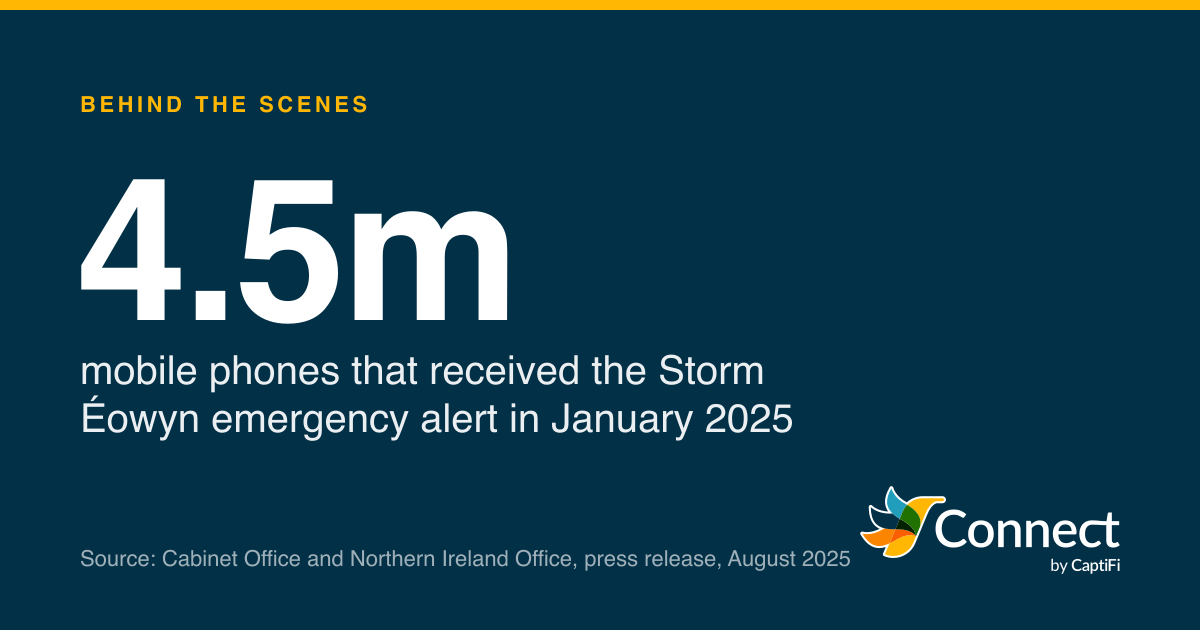
4.5m: mobile phones that received the Storm Éowyn emergency alert in January 2025. Source: Cabinet Office and Northern Ireland Office, press release, August 2025.
The UK's Emergency Alerts aren't text messages. The Cabinet Office said so plainly before the first national test on 23 April 2023: the alert "will be sent using mobile broadcasting technology which uses cell towers rather than SMS". The gov.uk alerts service spells out what follows from that: "The emergency services and the UK government do not need your phone number to send you an alert." The second national test went to every 4G and 5G network at about 3pm on Sunday 7 September 2025, and the largest live alert the government has put a number on, for Storm Éowyn in January 2025, reached about 4.5 million phones.
Why would a business that texts care? Because the alert that shrieks on your phone and the text from your venue look alike on the screen and work nothing alike underneath, and the differences decide what an alert by text can and can't do for you. This post sets out how cell broadcast works, what the tests and live alerts reached, and what's worth copying when you need to warn your own staff or customers.
How is an emergency alert different from a text?
Both are defined by 3GPP, the body that writes mobile standards, in two different documents.
Cell broadcast is in TS 23.041, which likens it to teletext on television: it lets "unacknowledged general CBS messages" be "broadcast to all receivers within a particular region". The region is a set of cells chosen for the message, which "may comprise of one or more cells, or may comprise the entire PLMN" (a whole mobile network). The broadcasts are unacknowledged: the masts send, every phone in range listens, and nothing comes back. A page "comprises of 82 octets, which, using the default character set, equates to 93 characters", up to 15 pages make one message, and cells repeat it "cyclically" for an agreed time so a phone arriving late still picks it up.
SMS is in TS 23.040, and it works the other way round. Every text goes through "a Service Centre, which acts as a store and forward centre for short messages". It's addressed to one number, the centre holds it until that phone can take it, and it can send back a status report saying what happened. (Our post on what delivered means covers what those reports do and don't prove.)
| Emergency alert (cell broadcast) | Business text (SMS) | |
|---|---|---|
| Addressed to | Every compatible phone in range of the chosen masts | One phone number at a time |
| Needs the person's number | No | Yes |
| Tells the sender it arrived | No, broadcasts are unacknowledged | A delivery report for each text |
| Can be answered | No | Yes, when sent from a number |
| Length | 93 characters a page, up to 15 pages | 140 octets a part, 160 characters in the default alphabet (153 once parts are joined) |
| Sent by | Public bodies, on every alert published so far | Any business, to the numbers it holds |
Who gets an emergency alert, and who doesn't?
The gov.uk page on how alerts work is short and specific. "In an emergency, mobile phone masts in the surrounding area will broadcast an alert. Every compatible mobile phone or tablet in range of a mast will receive the alert." Alerts work on all 4G and 5G networks, the phone doesn't need mobile data or wifi, and there's nothing to sign up for. Compatible means an iPhone on iOS 14.5 or later, or Android 11 or later, though some older and other phones receive them too.
The exclusions matter more for planning. You won't get an alert if your device is turned off, "connected to a 2G or 3G network", wifi only, or not compatible, and you may not get one in airplane mode. People can also opt out by turning off "severe alerts" and "extreme alerts" in their settings; gov.uk gives the example of "victims of domestic abuse with a concealed phone". (Our post on the 3G switch-off covers what's left of the older networks.)
Two details are worth passing on to staff. Android phones "may get more than one reminder about the same emergency alert", which can look like a second alert. And the government and the networks occasionally run operator tests, which most phones never see; gov.uk says such a message "will always have 'operator' in the title and will confirm that no action is needed".
When the system launched, the Cabinet Office described broadcasting as a way to reach "nearly 90 percent of mobile phones in a defined area" when there's a risk to life. Its question-and-answer page for the 2025 test put the number of mobile phones in the UK at approximately 87 million. And on privacy: "Data about you, your device or location will not be collected or shared."
What have the tests and live alerts reached?
The gov.uk past alerts page lists every alert sent, and it's a short list. Two local trials ran in 2021, in East Suffolk in May and Reading in June. The first national test went out on Sunday 23 April 2023, in English and, for Wales, in Welsh too: "This is a test of Emergency Alerts, a new UK government service that will warn you if there's a life-threatening emergency nearby."
By the Cabinet Office's count in July 2025, five live alerts followed. Plymouth City Council used one on 23 February 2024 while a Second World War bomb was moved through the city. The Environment Agency used two for severe flooding, on the rivers Roe and Ive near Dalston in May 2024 and at caravan parks near Barrow upon Soar in January 2025. Storm Darragh in December 2024 brought alerts across Wales and south-west England, which around three million people received. Then Storm Éowyn, on 23 January 2025: alerts to the whole of Northern Ireland (broadcast at about 6pm) and to 22 council areas in Scotland. The government's figure is approximately 4.5 million phones, "the largest-ever live deployment of the system".
Approximate figures as published: Storm Darragh from the Cabinet Office release of 26 August 2025, Cornwall and the Isles of Scilly (two alerts, about 500,000 people) from the Resilience Action Plan 2026 implementation report. No count was published for the August 2026 wildfire alert.
Source: Cabinet Office and NIO, Emergency Alert test follows use in Storm Éowyn
See the figures as a table
| Phones reached (m) | |
|---|---|
| Storm Éowyn, January 2025 | 4.5 |
| Storm Darragh, December 2024 | 3 |
| Cornwall and Scilly, Jan 2026 | 0.5 |
The second national test followed on 7 September 2025, a message of under 100 words, sent "to all 4G and 5G phone networks in the UK". Since then, the Cabinet Office sent two alerts to approximately 500,000 people in Cornwall and the Isles of Scilly on 8 January 2026, during a red warning for wind. And on 14 August 2026 the government sent a wildfire warning to England and Wales from about 7pm, which it called "the most extensive use of the UK's Emergency Alert system in response to an active incident". It didn't publish a count of phones for that one, and we couldn't find a published count for either national test, so we haven't given one.
Why can't a business send an emergency alert?
Look at who signed the alerts on that list: the UK Government, the UK and Scottish governments together, the UK and Northern Ireland governments, the Environment Agency, Plymouth City Council. Every one is a public body, and the purpose has been the same from the start, to warn people when "there is an imminent risk to life, such as wildfires or severe flooding". A venue, a school or an employer that needs to warn its own people has to use its own channels: texts, calls, an app, the public address system. If you run a venue, our post on Martyn's Law covers where that fits in your procedures.
What can a business alert by text learn from them?
Read the past alerts and a pattern shows. Nearly every one says who issued it in the first line. The live ones say what is happening, where and when ("winds peaking from 6:00pm on Thursday 8 January 2026"), and gives one clear instruction ("Stay indoors if you can"). Plymouth's gave the time, the route and the cordon, and asked people to stay away. Most end with where to find out more, and the Welsh alerts come in Welsh and English. That's a good template for any urgent text.
Then there's what a text does that a broadcast can't:
- It reaches your people wherever they are. A broadcast covers whoever is near the masts, including strangers, and misses the staff member at home who needs to know not to come in.
- It tells you who got it. A delivery report per text, where a broadcast is unacknowledged by design.
- It can be answered. "Reply 1 when you are safe" turns an alert into a roll call, if you send from a number people can reply to.
- It works on older phones. TS 23.040 describes SMS for GSM, UMTS and EPS mobiles, the 2G, 3G and 4G generations, so a basic phone on 2G gets your text even though it misses an emergency alert.
And what it can't. A text needs a number you hold and keep up to date. It goes one phone at a time, so volume takes time. GOV.UK Notify, the government's own texting platform, limits sending through its API to 3,000 messages a minute and a live service to 250,000 texts a day. At those rates, texting the 4.5 million phones that got the Storm Éowyn alert would take 25 hours at the per-minute limit and 18 days at the daily one. A cell broadcast does it in one pass per cell. For a venue texting 200 staff, on the other hand, the same per-minute limit is nowhere near reached.
A staff alert written to the government's template might read:
Riverside Arena: fire alarm in the East Stand. Staff go to assembly point C now. Reply 1 when you are safe.
Name first, what and where, one instruction, and a reply that tells the duty manager who is accounted for. It's 107 characters, so it fits in one SMS part with room to spare. An alert can run to 15 broadcast pages; a text that runs past 160 characters is split into parts of 153, and in an emergency there's no reason to make anyone scroll.
CaptiFi Connect sends texts to UK mobiles with a delivery report for each one, and replies to texts sent from a number land in a shared two-way inbox, so a roll call like that shows who has answered; the staff alerts page covers setting one up. The government's commitment is to test its alert system regularly so it works when needed, and the same habit helps here. Send a test to your staff list on an ordinary day, and fix the numbers that come back as failed before a real alarm finds them.
Sources
Read for this post on 22 October 2026.
- GOV.UK: How emergency alerts work
- GOV.UK: Past emergency alerts
- GOV.UK: Opting out of emergency alerts
- GOV.UK: Emergency alerts, operator tests
- Cabinet Office: UK Emergency Alerts test, "Keep calm and carry on", April 2023
- Cabinet Office: Time set for UK Emergency Alerts test, April 2023
- Cabinet Office: Full message of second national Emergency Alerts test revealed, 28 July 2025
- Cabinet Office and NIO: Emergency Alert test follows use in Storm Éowyn, 20 August 2025
- Cabinet Office: Emergency Alert test follows use in Storm Darragh, 26 August 2025
- Cabinet Office: Emergency Alert test, frequently asked questions, July 2025
- GOV.UK: Emergency Alert to be sent to England and Wales, 14 August 2026
- Cabinet Office: UK Government Resilience Action Plan, 2026 implementation report
- 3GPP TS 23.041 (ETSI TS 123 041 V19.4.0): Technical realization of Cell Broadcast Service
- 3GPP TS 23.040 (ETSI TS 123 040 V19.0.0): Technical realization of the Short Message Service
- GOV.UK Notify: API documentation, rate and daily limits
Written by the CaptiFi Connect team. Published 22 October 2026. More in Behind the scenes
Send your first text this week
Set up your account and contacts now. Until we've approved it, a person reads each text before it goes out.