
By the numbers8 min read
How many texts the UK still sends
Ofcom's figures put UK mobile messages at 21.5bn in 2025, down from a 151bn peak in 2012. What the series counts, where the messages went, and why that matters.
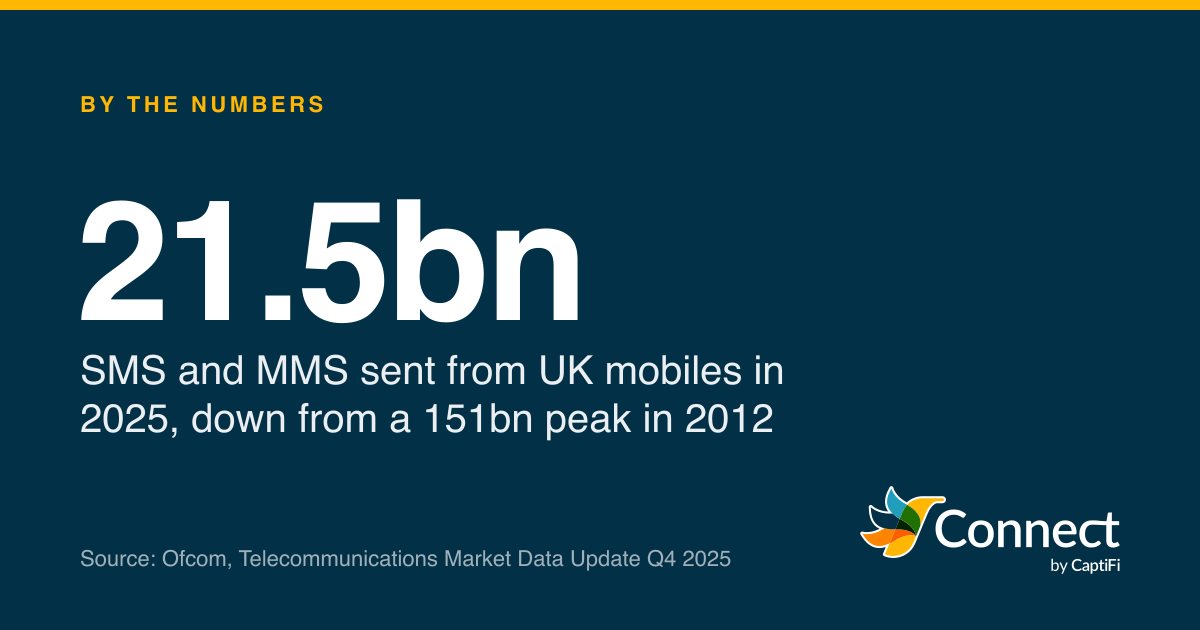
21.5bn: SMS and MMS sent from UK mobiles in 2025, down from a 151bn peak in 2012. Source: Ofcom, Telecommunications Market Data Update Q4 2025.
People in the UK sent 21.51 billion text and picture messages from their mobiles in 2025. That's Ofcom's number, from the data update it published in April 2026 for the last quarter of the year, and it's about a seventh of what the same series showed in 2012. The last three months of 2025 on their own came to 4.96 billion, which was 1.79 billion (26.5%) fewer than the same quarter a year earlier. The fall isn't slowing down, either: across the whole year it was 23%, twice the fall of the year before.
So texting is finished, then? Not quite. The number is real, but it measures one thing, and that thing isn't the text a dentist sends you about Thursday. It pays to know what the series counts before you decide what it means for a business that texts its customers.
What Ofcom's figures count
Four times a year Ofcom publishes a Telecommunications Market Data Update. It's a short PDF with a set of tables, and table 2 is the one that matters here: "call, message and data volumes by call type". Alongside the outgoing call minutes from fixed lines and mobiles, it has a column headed "SMS & MMS messages", in billions, with a row per quarter and a row per year. The data comes from the operators, and Ofcom says plainly that it includes estimates where a provider doesn't send figures.
Two things follow from where the column sits. First, it's an outgoing count: messages people sent from mobile subscriptions, in the same table as the minutes they spent on calls. Second, it lumps SMS and MMS together, so there's no clean SMS-only figure in the modern series. For a post about texts that's a small annoyance rather than a problem, because MMS was never a large share.
Quarter by quarter, 2025 went 5.86 billion, 5.44, 5.24 and 4.96, each lower than the last, and each lower than the 6.75 billion of the final quarter of 2024. Ofcom restates earlier quarters when better data arrives, which is why the same year can carry slightly different values in different updates (2018 was 73.41 billion in the Q4 2018 update and 74.11 billion a year later, and 2024 was 27.98 billion in the Q4 2024 update and 28.03 billion in the Q4 2025 one). The chart below takes each year from the latest update that gives it, and the six older years from the Communications Market Report 2017, which rounds them to the nearest billion.
2011 to 2016 are from the Communications Market Report 2017, rounded to the nearest billion. 2017 onwards are from the quarterly Telecommunications Market Data Updates, each year taken from the latest update that gives it. Ofcom includes estimates where a provider sends no data.
Source: Ofcom, Telecommunications Market Data Update Q4 2025 (table 2)
See the figures as a table
| Messages (bn) | |
|---|---|
| 2011 | 150 |
| 2012 | 151 |
| 2013 | 129 |
| 2014 | 110 |
| 2015 | 102 |
| 2016 | 96 |
| 2017 | 78.78 |
| 2018 | 74.11 |
| 2019 | 65.07 |
| 2020 | 48.68 |
| 2021 | 40.86 |
| 2022 | 36.44 |
| 2023 | 31.68 |
| 2024 | 28.03 |
| 2025 | 21.51 |
The shape is hard to argue with. From 150 billion in 2011 to 151 billion in 2012, then down every single year: 129, 110, 102, 96, and so on through the seventies and sixties to 48.68 billion in 2020, 40.86 billion in 2021, 28.03 billion in 2024 and 21.51 billion last year. The sharpest falls came early, 22 billion between 2012 and 2013 and 19 billion the year after, and the drop from 2019 to 2020 was the last one over 16 billion. Since then the series has lost somewhere between four and eight billion a year, and 2025's six and a half sits at the upper end.
Where the messages went
Ofcom has been saying the same thing about the cause for years, in the same words. Its Communications Market Report 2019 put it like this: "More than 5 billion fewer traditional SMS and MMS messages were sent in 2018, as people switched to messaging services such as WhatsApp." The 2018 edition of the report went a step further and put a per-person number on it. Average outgoing messages per mobile subscription "had fallen to 82 per month, having peaked in 2012 at 162 per month".
SMS and MMS combined, averaged across active mobile subscriptions including machine-to-machine connections.
Source: Ofcom, Communications Market Report 2018, telecoms and networks
See the figures as a table
| Messages a month | |
|---|---|
| 2012 | 162 |
| 2013 | 139 |
| 2014 | 117 |
| 2015 | 106 |
| 2016 | 96 |
| 2017 | 82 |
Halved, in five years, per person. And that was 2017. Run the same sum on the 2025 figures (21.51 billion messages across the 91.06 million subscriptions Ofcom counted at the end of the year) and you get about 20 a month. Two every three days. Some of those will be the automatic ones, a delivery code here and a verification code there, so the number of texts the typical person sits down and types is lower still.
The other half of the picture is in Ofcom's Online Nation report for 2024. Its audience measurement data had WhatsApp reaching 87% of UK online adults in May 2024, and 64% of them opening it on a given day, up from 58% a year earlier. Ofcom's own survey found 86% of internet users aged 16 and over had used WhatsApp in June 2024, with Facebook Messenger next on 59% and Instagram direct messages on 30%. When the group chat, the family and the football team all live in one app, the SMS thread with your mate goes quiet. People still message each other all day. They just do it somewhere else.
What the series doesn't tell you
The Ofcom number gets quoted in two opposite directions: as proof that SMS is dead, or not at all. Both miss what the column measures.
The series counts what subscribers send. It says nothing at all about what lands in their inbox from an organisation. The reminder from the surgery, the code from the bank, the "your parcel is two stops away" update: a person receives those, they don't send them, and they're sent from systems rather than from handsets on consumer contracts. There's no row in table 2 for that traffic, so the fall in person-to-person texting tells you nothing, in either direction, about business texting. (Our guide on how business texts reach UK phones explains the two routes, and why they're counted and billed differently.)
For a sense of the scale that traffic can reach, the government's own sending service is a useful yardstick because it publishes live numbers. GOV.UK Notify's performance page, read on 17 October 2026, showed 5.7 billion text messages sent since the service started in May 2016, with 1,764 organisations and 12,894 services using it. On a single weekday that week, 15 October, it sent 5,232,207 texts, slightly more than the 4,985,855 emails it sent the same day. That's one platform, used by public bodies only, and every one of those five million texts landed in the same inboxes Ofcom's series says are going quiet. It isn't a figure for the whole business messaging market, which nobody publishes in the UK, but it's a long way from dead.
Why a quieter inbox is good news if you text customers
Put the two halves together and you get something a bit counterintuitive. The SMS inbox has emptied out of chatter. What's left in it is, mostly, the stuff that arrives from organisations: appointments, deliveries, codes, bookings, and the occasional offer from a shop the person has bought from. Twenty messages a month, give or take, with a decent share of those being the automatic kind.
That has two consequences for anyone sending texts to customers. The first is that a text doesn't compete with much. Email is where the newsletters go, and the messaging apps are where the friends are. The second is that the inbox has become a serious place, and people treat it as one. A text from a business arrives next to the one from the hospital, so the bar for what's worth sending is higher than it was when people were firing off 162 a month. A pointless text stands out more in a quiet room.
What does that look like in practice? A few habits, none of them clever:
- Send texts people are waiting for. Confirmations, reminders they can reply to, codes, and updates on something they've ordered. Those are the messages that make the inbox useful, and they're the ones people read.
- Say who you are in the first few words, every time. "Crown Dental: your check-up is on Thu 19 Nov at 10:30. Reply C to confirm." The quieter the inbox, the more an anonymous message looks wrong.
- Keep marketing texts rare and worth it, and only to people who've agreed to them. The rules on that are in our guide to SMS marketing rules in the UK.
- Treat a reply as the point of the text. If someone can answer it and reach a person, the channel works the way it did when it was busy. If they can't, you've sent a notice, and notices get ignored.
One more thing the figures suggest. Because so much of what's left in the inbox is automatic, people have got used to the format of a good service text: short, plain, one job, a name at the front. Copy that format and you're writing in the language the inbox already speaks.
Reading the numbers yourself
If you want to check any of this, Ofcom's data updates are free, and the messaging figure is in table 2 of each one. The Q4 edition of each year is the one to use, because it carries the annual totals. The per-subscription figures are in the telecoms chapter of the 2018 Communications Market Report, and the WhatsApp reach figures are in the messaging section of Online Nation 2024. GOV.UK Notify's performance page updates daily, so the numbers above will have moved by the time you read this. All of the links are at the bottom.
One caution when you compare years. Ofcom's older reports sometimes used a different cut of the data, which is why you'll see 2016 given as 96 billion in one document and 90.95 billion in another. The direction of travel is the same whichever you pick. We've used the later, more conservative figures wherever two exist.
CaptiFi Connect sends to UK mobiles only, and every text gets a delivery report with a timeline, so you can see for yourself what reached a phone and when, whatever the national totals are doing. The next Ofcom update will take the 2025 figure down again, in all likelihood. The 20 a month that are left are the ones people keep.
Sources
Read for this post on 17 October 2026.
- Ofcom: Telecommunications Market Data Update Q4 2025
- Ofcom: Telecommunications Market Data Update Q4 2024
- Ofcom: Telecommunications Market Data Update Q4 2022
- Ofcom: Telecommunications Market Data Update Q4 2021
- Ofcom: Telecommunications Market Data Update Q4 2019
- Ofcom: Telecommunications Market Data Update Q4 2018
- Ofcom: Communications Market Report 2017, telecoms and networks
- Ofcom: Communications Market Report 2018, narrative report
- Ofcom: Communications Market Report 2019
- Ofcom: Online Nation 2024
- GOV.UK Notify: performance
Written by the CaptiFi Connect team. Published 17 October 2026. More in By the numbers
Send your first text this week
Set up your account and contacts now; we check every new account before it can send.