
Sectors8 min read
Vet practice reminders by text
PDSA's 2026 report puts 92% of UK dogs with a vet and 82% on regular boosters. The reminder texts a practice sends, and where the ICO draws the marketing line.
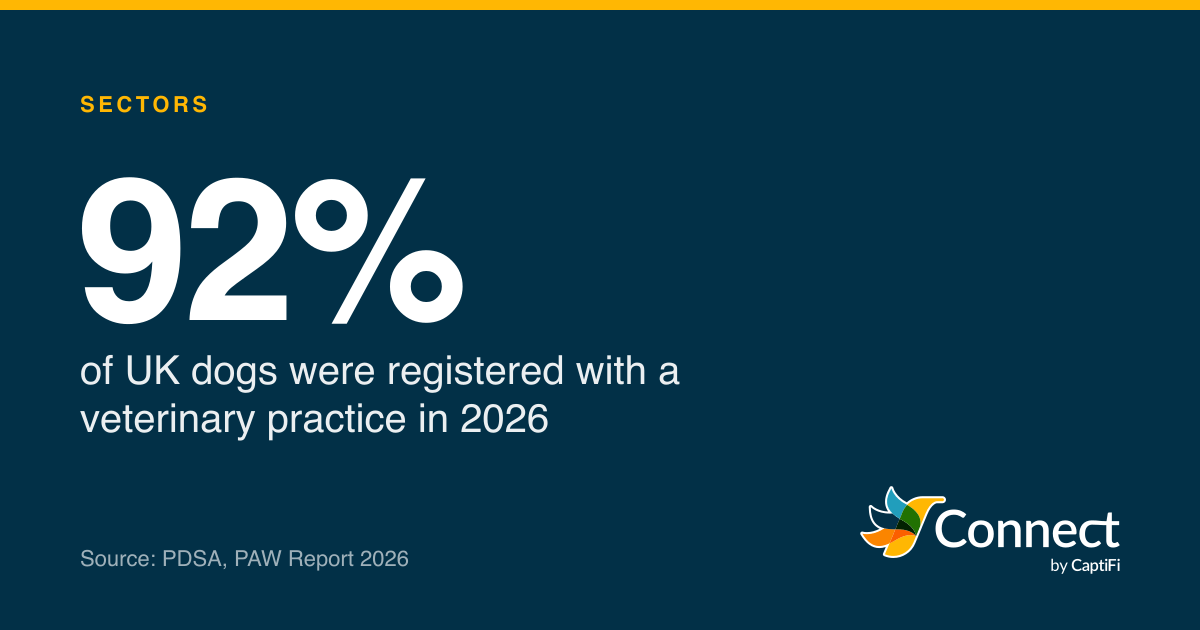
92%: of UK dogs were registered with a veterinary practice in 2026. Source: PDSA, PAW Report 2026.
Nine dogs in ten in the UK are registered with a vet. PDSA's PAW Report 2026, built on a YouGov survey of 3,440 owners between 25 June and 16 July 2026, puts the figure at 92% for dogs, 86% for cats and 75% for rabbits, and says it has been roughly level for years. Registration is the easy part. The same report says 82% of dogs get regular booster vaccinations and 66% of cats do, which leaves a long tail of pets on a practice's books whose boosters, worming and check-ups have drifted. A reminder text is the cheapest thing a practice can do about that tail, and this post is about writing one that works and stays on the right side of the marketing rules.
The numbers a practice is working with
PDSA estimates the UK had 11.3 million cats and 10.2 million dogs in 2026, with dogs down from a peak of 11.1 million the year before and cats back as the most common pet. Rabbits are around 700,000. Dog ownership among adults fell from 30% in 2025 to 27% in 2026; cat ownership, at 24%, has barely moved since 2014.
Dogs fell from an 11.1 million peak in 2025. PDSA rounds its estimates to two significant figures.
Source: PDSA, PAW Report 2026, pet populations
See the figures as a table
| Pets (m) | |
|---|---|
| Cats | 11.3 |
| Dogs | 10.2 |
| Rabbits | 0.7 |
On the care side, the 2026 report has a figure for each thing a practice might remind an owner about. Among dog owners, 82% say their dog had its primary vaccination course and the same 82% say it gets regular boosters, up from 79% in 2025. For cats the primary course is 75% and the booster figure 66%, both above the averages PDSA has recorded since 2017 (69% and 61%). Rabbits are at 54% for boosters. Parasite treatment is high: 81% of dog owners treat for fleas and 88% for worms, 82% and 77% for cats, and in each case the main reason given is prevention. Neutering rose for dogs from 64% to 69%, and microchipping from 82% to 88%, with cats at 83% across the UK. Insurance is where the gap opens: 67% of dogs, 48% of cats, 25% of rabbits.
- Dogs
- Cats
YouGov survey of 3,440 UK dog, cat and rabbit owners, 25 June to 16 July 2026. Cat microchipping is the UK figure; the England figure is 84%.
Source: PDSA, PAW Report 2026, preventive care
See the figures as a table
| Dogs (%) | Cats (%) | |
|---|---|---|
| Registered with a vet | 92 | 86 |
| Primary vaccinations | 82 | 75 |
| Regular boosters | 82 | 66 |
| Treated for fleas | 81 | 82 |
| Treated for worms | 88 | 77 |
| Neutered | 69 | 89 |
| Microchipped | 88 | 83 |
The other side of the counter comes from RCVS Facts 2024. On 1 January 2025 there were 31,224 UK-practising veterinary surgeons and 24,952 registered veterinary nurses on the register, working out of 6,522 registered veterinary premises across the UK, 3,586 of them accredited under the Practice Standards Scheme (premises in the Channel Islands are not required to register, so they are outside the count). Divide the pets by the premises and each one is, on paper, looking after around 3,400 cats and dogs. No practice can ring all of those about a booster. That is the arithmetic behind the reminder text.
Four reminders and the words in them
A vet practice sends four kinds of reminder, and each has its own date, which is what makes them suited to texts: the system knows when the booster falls due, and the owner, mostly, does not.
The annual booster is the big one, because PDSA's figures say roughly one dog in five and one cat in three is not getting it. The text names the pet, says what is due and when, and gives one way to act:
Oakfield Vets: Bella's annual booster is due in November. Reply B to book or call 01632 960123.
Parasite treatment comes round more often and is usually a collection or a posting, so the text says which:
Oakfield Vets: Milo's flea and worm treatment is due on Mon 2 Nov. Collect from reception or reply P to have it posted.
The check-up reminder for an older pet or a repeat prescription review is the same shape, with the reason kept general:
Oakfield Vets: Rosie is due her six-month check-up. Reply B to book a time that suits or call 01632 960123.
And the appointment reminder, once something is booked, is the one every practice already understands:
Oakfield Vets: Bella's appointment is on Thu 19 Nov at 10:30 with Dr Hart. Reply C to confirm or call 01632 960123 to change it.
A few things are the same across all four. The practice name comes first, because a text that starts "Bella's booster is due" from an unknown number reads as spam. The pet's name is in it, because a household with three animals will otherwise ring to ask which one. There is one action, and it is a reply where it can be, because a reply is free for the owner and lands in the practice inbox with the number attached. And the clinical content is kept to the category: "booster", "check-up", "treatment". A text sits on a lock screen, it gets read by whoever picks the phone up, and a dog's medical history has no business there. Our post on appointment reminder wording covers what the trials say about the "Reply C to confirm" line, and the dental recalls post works through the same problem for another kind of practice.
Keep each text in one part. All four samples above are under 160 characters in the GSM-7 alphabet, so each costs one credit and arrives as one message. The character limit guide explains why a stray curly apostrophe or an emoji can double that.
Where the ICO draws the marketing line
PECR regulation 22 is the rule that needs consent before a marketing text goes to an individual. The question for a vet is whether a reminder is marketing, and the ICO's guidance on identifying direct marketing, updated on 20 August 2025, answers most of it.
The ICO describes service messages as ones that "aren't promotional but are for administrative or customer services purposes", and its list of examples includes messages to "confirm or remind them about appointments". A booked appointment reminder is in the clear. The ICO's public sector guidance goes a step further with a worked example that is close to a booster reminder: a GP text reading "Our records show you are due for x screening, please call the surgery on 12345678 to make an appointment", which the ICO says "is a service message and does not constitute direct marketing". That example is for a public body, and there is no vet-specific one, so a practice is applying it by analogy. The booster text above is written the same way: a record, a due date, a neutral way to book.
The line is crossed when something promotional gets in. In the ICO's words: "If your service message has elements that are direct marketing, even if that is not the main purpose of your message, then it will count as direct marketing." Its example is a gym ringing about a failed payment (a service message) and the same call that also outlines the gym's personal training (direct marketing). For a vet, "Bella's booster is due in November" is a service message; "Bella's booster is due in November, and dental cleans are 20% off this month" is a marketing text that needs consent or the soft opt-in, in full, including the opt-out. General branding in the text, the ICO says, does not tip it over.
Two practical consequences. Keep reminders and offers in separate texts, sent from separate lists, so a reminder never picks up a line of promotion from a template. And take marketing consent at registration anyway, as a separate tick, so the practice can send the occasional offer to the owners who said yes. Regulation 22(3), the soft opt-in, also covers an existing client for similar services where an opt-out was offered when their details were taken and in every message since; our guide to the marketing rules sets out both routes. Under either, every marketing text ends "Reply STOP to opt out" and the number is removed the moment someone replies.
What a practice should set up
Start with the registration form. Two lines on it do most of the legal work: a plain statement that the practice will text reminders for boosters, treatments and appointments to the mobile number given, and a separate, unticked box for "Text me offers from the practice". The first is the service relationship; the second is the consent regulation 22 asks for. Record the date and the wording that was shown, because that record is what the practice produces if anyone ever asks.
Pull the due dates from the practice management system. Each pet record carries the next booster date, the parasite treatment interval and the last check-up, and a reminder is only as good as that date. A text a month before the booster, a second one two weeks later to those who have not booked, and then stop. PDSA's figures suggest the owners who have let a booster lapse are a minority, so a reminder sent to everyone will mostly land with people who were going to book anyway, and the second text should go only to those who have not replied.
Make replies do the work. A reply of B to the booster text should reach a person who books it, and a reply of P to the parasite text should trigger a posting without anyone copying a number into a form. CaptiFi Connect's keywords send an automatic acknowledgement and route the reply to the practice inbox on a UK mobile number, where replies are free, and a scheduled send can go out at 10:00 on the Monday the reminders are due, whoever is on reception that morning. Campaign quiet hours default to 21:00 to 09:00 London time, so a batch set up late on a Friday waits until Saturday morning.
Send from the practice name. An approved alphanumeric sender shows "Oakfield Vets" on the phone; a long number lets the owner reply. The trade-off is in our sender ID guide. Many practices use the number for reminders they want answered and the name for a confirmation that needs no reply.
Watch the opt-outs and the replies. A booster reminder that gets a B back has done its job; one that gets a STOP back means the owner has stopped wanting any texts, including the appointment reminders, so the practice needs a note on the record and another way to reach them. Our guide to STOP replies explains what the practice sees and what the owner is told.
PDSA's 2026 figures leave 18% of dogs and 34% of cats off regular boosters. A reminder a month before the due date, with the pet's name and a one-letter reply, costs the practice one credit per pet, and the reply back costs the owner nothing.
Sources
Read for this post on 17 October 2026.
Written by the CaptiFi Connect team. Published 17 October 2026. More in Sectors
Send your first text this week
Set up your account and contacts now; we check every new account before it can send.