
Sectors8 min read
Council tax reminders and bin day texts
Councils in England collected 95.6% of 2025-26 council tax in year and £7.4bn is outstanding. The reminder notice rules, the bin changes and where texts fit.
In short
- MHCLG figures show councils in England collected 95.6% of 2025-26 council tax by 31 March 2026, with £7.4 billion of council tax arrears outstanding at that date.
- Under regulation 23 of the Council Tax (Administration and Enforcement) Regulations 1992, not paying a reminder notice within 7 days makes the rest of the year's bill due 7 days later.
- MHCLG confirmed on 12 October 2026 that from April 2027 councils in England must send a reminder and a final notice before anyone loses the right to pay council tax by instalments.
- Regulation 2(4) of the 1992 council tax regulations lets an English council serve billing notices by electronic communication to an address the taxpayer has given for that purpose.
- Since 1 April 2026, section 45A of the Environmental Protection Act 1990 has required most councils in England to collect household food waste at least once a week.
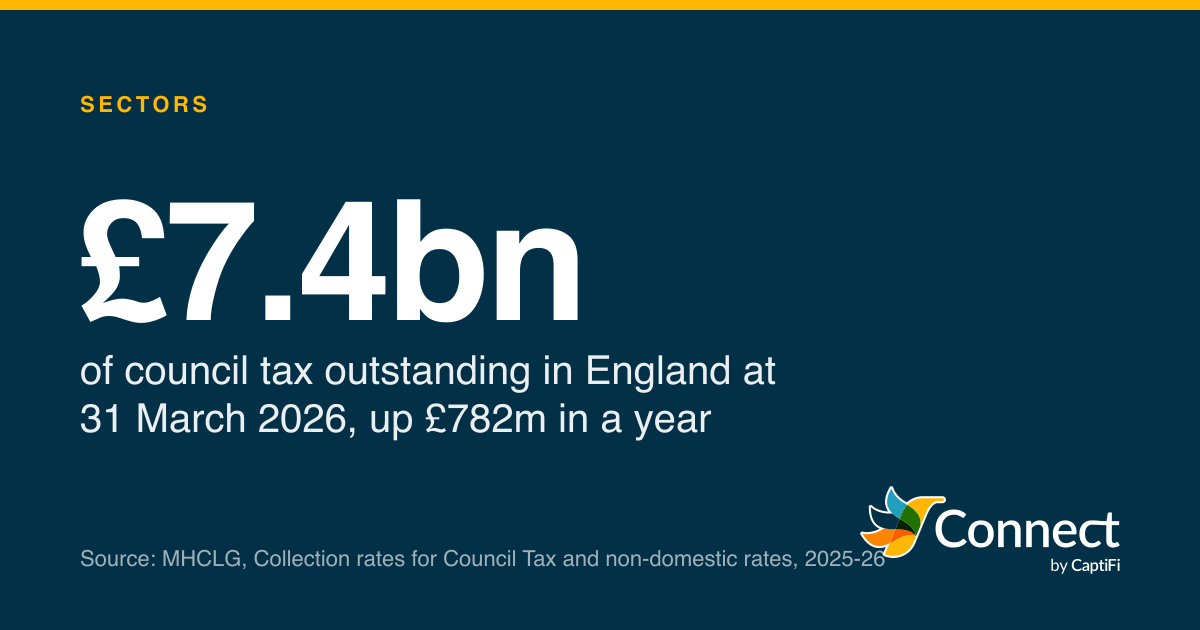
£7.4bn: of council tax outstanding in England at 31 March 2026, up £782m in a year. Source: MHCLG, Collection rates for Council Tax and non-domestic rates, 2025-26.
Councils in England collected 95.6% of the council tax due for 2025-26 by the end of that financial year, according to MHCLG statistics published on 24 June 2026 and revised on 31 July. That's £43.0 billion of the £45.0 billion due, and 0.3 percentage points down on the year before. Across all earlier years, £7.4 billion was still outstanding on 31 March 2026, £782 million more than a year earlier. The law already sets out what happens after a missed instalment, starting with a reminder notice, and from April 2027 that sequence gets longer.
Bins have moved too. Since 1 April 2026 most councils in England have had to collect food waste from households every week, which has meant new caddies, new days and a lot of residents wanting to know what goes out when. Both jobs suit a text, as long as it's clear which messages are the formal notice and which are the nudge.
How much council tax goes unpaid?
The statistics come from the quarterly returns of all 296 billing authorities. The in-year collection rate is the share of a year's council tax collected by 31 March of that year; councils keep chasing after that, so the final rate ends up somewhere between this figure and 100%. Shire districts collect the most in year, 97.0% in 2025-26, and metropolitan districts and inner London the least, at 93.3% and 93.0%. Every type of authority slipped a little.
- 2024-25
- 2025-26
Amount collected by 31 March as a share of the net collectable debit for that year. Inner London includes the City of London. Revised 31 July 2026.
Source: MHCLG, Collection rates for Council Tax and non-domestic rates in England, 2025 to 2026 (table 2)
See the figures as a table
| 2024-25 (%) | 2025-26 (%) | |
|---|---|---|
| Shire districts | 97.2 | 97 |
| Unitary authorities | 96 | 95.8 |
| Outer London | 95.3 | 95 |
| Metropolitan districts | 93.6 | 93.3 |
| Inner London | 93.8 | 93 |
| England | 95.9 | 95.6 |
The arrears figure is the one that keeps growing. During 2025-26 councils didn't collect £2.2 billion of the council tax due for that year, collected £1.0 billion (15.7%) of the £6.6 billion of older arrears they started with, and wrote off £306 million. The cumulative total at 31 March has risen every year in the series, from £5.0 billion in 2021-22 to £7.4 billion in 2025-26, and £488 million of the latest figure is court and administration costs.
Cumulative arrears for all earlier years, including £488m of court and administration costs at 31 March 2026.
Source: MHCLG, Collection rates for Council Tax and non-domestic rates in England, 2025 to 2026 (table 7)
See the figures as a table
| Arrears outstanding (£) | |
|---|---|
| 2021-22 | 4,966 |
| 2022-23 | 5,479 |
| 2023-24 | 5,982 |
| 2024-25 | 6,642 |
| 2025-26 | 7,424 |
Business rates follow the same pattern on a smaller scale. Councils collected 96.7% of 2025-26 non-domestic rates in year (£28.1 billion of £29.0 billion), down 0.6 points, and £2.6 billion was outstanding at 31 March 2026, up £286 million. The release notes that businesses have been allowed to spread their rates over 12 months instead of 10, so councils are unlikely to start recovery action on those arrears until the following year.
What the reminder notice rules say now
The sequence is set by regulation 23 of the Council Tax (Administration and Enforcement) Regulations 1992. When an instalment on a demand notice isn't paid, a billing authority in England "shall" serve a reminder notice. The notice has to state the unpaid instalments plus any falling due in the next seven days, that this amount must be paid within that period, and what happens if it isn't.
What happens is set out in paragraph (3). If the person doesn't pay within 7 days of the reminder being issued, the rest of the year's bill "shall become payable by him at the expiry of a further period of 7 days". Paragraph (4) is harsher for the second reminder of a year: pay that one, then miss a later instalment, and the balance falls due the day after the missed payment. Wales changed its version from 1 April 2026, so a Welsh council "may" now choose whether to send a reminder, and the notice there says what is overdue and what falls due in the next seven days.
In practice that's a short window. A resident who misses the 1st of the month, doesn't open the reminder and doesn't pay within the week can find the whole year's balance due a week later, with an application to the magistrates for a liability order, which starts with a summons, as the next step. A text that says the reminder is on its way gives them a chance to catch it.
What changes from April 2027
The government's response to its consultation on modernising council tax, published in April 2026, said households would get "at least 63 days after the first missed payment" before losing the right to pay in instalments, and that councils' costs for seeking a liability order would be capped at £100. On 12 October 2026 MHCLG's council tax information letter 5/2026 filled in the steps. From April 2027:
- councils will have to send both a reminder and a final notice before a household loses the right to pay by instalments, with the requirement resetting if the account is brought up to date for the year
- a final notice can't go out earlier than 41 days after the first missed payment, or 14 days after the last reminder
- the taxpayer then has 21 days after the final notice to catch up
- guidance, with an optional template for reminder and final notices, is being drawn up
Billing is changing too. Councils are expected to tell newly liable households from April 2027 that they can ask to pay over 12 months, and all households move to 12 monthly instalments by default from April 2028, with the right to ask for 10. None of this is law yet. The April response said the enforcement changes need a statutory instrument, to be laid later in 2026 with the intention that they take effect from April 2027, and the October letter says more on the delivery timeline will follow.
For texting, the useful part is the gaps. A 41-day minimum before a final notice, and at least 14 days after a reminder, is a lot of time for a resident to forget about a letter, and a short text at each stage is cheap insurance against that.
Can a council tax notice go by text?
Regulation 2(4), inserted in 2003, lets a billing authority in England give notices under Parts II, III and V of the regulations (information, exempt dwellings and billing, which takes in demand and reminder notices) "by electronic communication to such address as may be notified by that person for that purpose". There's a second route: the council and the taxpayer agree that notices can be read on a website, the document is published there, and the taxpayer is told it's up "in a manner for the time being agreed" between them. Either way the notice is treated as served on the second business day after it was sent or the taxpayer was told, unless the contrary is proved, and the taxpayer can withdraw by writing to the council.
That second route is where a text can do formal work, as the agreed way of telling someone a notice is on their online account, provided the arrangement was agreed first. Final notices sit in Part VI, on enforcement, which regulation 2(4) doesn't list, and councils made the same point in the April consultation response: reminder notices could go digitally where requested, final notices couldn't, and they asked for that to change. The government decided against digital by default for council tax communications, after assessing that it would hit older and disabled people hardest, and asked councils to keep non-digital routes open.
So for most councils a text sits alongside the paper notice, pointing at it. For a hypothetical Northdale Council, that might read:
Northdale Council: your council tax instalment of £148.20 is due on 1 Nov. If you pay by Direct Debit, there's nothing to do. Account 40123456.
Northdale Council: we haven't received your council tax instalment due on 1 Oct. A reminder notice is in the post. Paying the amount on it within 7 days keeps you on instalments. Help: 01632 960789.
Northdale Council: if you're finding it hard to pay your council tax, reply to this text or call 01632 960789 and we'll talk through your options.
The account number, the amount and the date do the work. Leave out the arrears total and anything about enforcement agents; a text can be read by anyone holding the phone, and the formal notice is where the consequences belong.
The bin changes, and why residents need telling
Section 45A of the Environmental Protection Act 1990, as rewritten by the Environment Act 2021, says recyclable household waste must be collected separately, in streams for glass, metal, plastic, paper and card, food and garden waste, and that "recyclable household waste which is food waste must be collected at least once a week". The section came into force on 17 May 2024, but transitional rules gave councils until 31 March 2026 for household collections. Defra's Simpler Recycling policy update of November 2024 set the same date, with kerbside plastic film collections to follow by 31 March 2027.
Not everyone had to switch on the same day. The commencement regulations name 31 councils with later dates for weekly food waste, from Blackburn with Darwen on 1 June 2026 and Tower Hamlets on 1 April 2027 through to City of York and North Yorkshire on 1 February 2043. So "weekly food waste from April 2026" holds for most of England, not all of it.
The scale of the change shows in Defra's waste figures, updated on 31 March 2026. In 2024, separately collected food waste came to 535 thousand tonnes, up 6.7% on 2023 but still only 2.4% of the 21.9 million tonnes of waste from households. The recycling rate for waste from households was 43.7% in 2024/25, down from 44.0%.
Bin reminders work best as something residents sign up for: a form on the bin day lookup page, or a keyword texted to a number, with the address attached so each reminder matches the right round. New services mean new days, and old days move at bank holidays and in bad weather:
Northdale Council: your weekly food waste collection starts on Tue 3 Nov. Put your caddy out by 07:00 on collection day. Reply to this text if it isn't collected.
Northdale Council: Christmas collections move by a day. Your general waste due on Fri 25 Dec will be collected on Sat 26 Dec.
Northdale Council: we couldn't get to Elm Road today because of ice. We'll collect your recycling on Thu 12 Nov, so please leave your bin out.
These are service messages about a service the resident receives, which is a different category from marketing. Our post on GOV.UK Notify's numbers covers how public bodies send them at scale.
Notify or another sender
Many councils already send through GOV.UK Notify. On 22 October 2026 its performance page listed 1,764 organisations, and close to 400 of them had "Council" in their name (a handful are national bodies such as the British Council). Of the councils, Haringey London Borough Council had the most live services, 73. Each local authority service gets 10,000 free texts a year, renewed on 1 April, and after that a single 160-character text costs 2.4p plus VAT. Receiving replies costs the council nothing.
For anyone sending outside Notify, CaptiFi Connect sends to UK mobiles with replies to a UK number in a two-way inbox, keywords so residents can text a word to join a reminder list, and scheduled campaigns with quiet hours, so the Christmas bin text goes on the Monday morning and not at midnight.
Sources
Read for this post on 22 October 2026.
- MHCLG: Collection rates for Council Tax and non-domestic rates in England, 2025 to 2026
- legislation.gov.uk: Council Tax (Administration and Enforcement) Regulations 1992, regulation 23
- legislation.gov.uk: Council Tax (Administration and Enforcement) Regulations 1992, regulation 2
- MHCLG: Council tax information letter 5/2026, response to technical consultation on enforcement
- MHCLG: Modernising and improving the administration of council tax, government response
- legislation.gov.uk: Environmental Protection Act 1990, section 45A
- legislation.gov.uk: Environment Act 2021 (Commencement No. 9 and Transitional Provisions) Regulations 2024
- Defra: Simpler Recycling in England, policy update
- Defra: Local authority collected waste management, annual results 2024/25
- GOV.UK Notify: performance
- GOV.UK Notify: Free text message allowance
- GOV.UK Notify: Text message pricing
Written by the CaptiFi Connect team. Published 22 October 2026. More in Sectors
Send your first text this week
Set up your account and contacts now. Until we've approved it, a person reads each text before it goes out.