
Rules and trust9 min read
Debt collection texts: what the FCA rules say
FCA rules in CONC 7 and the Consumer Duty set how lenders and debt collectors text people in arrears: who's writing, when, who can see it, what never to say.
In short
- FCA rule CONC 7.9.4 says lenders and debt collectors must not contact customers at unreasonable times and must respect reasonable requests about when, where and how they are contacted.
- Under FCA rule CONC 7.9.7, a firm contacting a customer about a debt must avoid anything likely to be publicly embarrassing and take reasonable steps so third parties do not learn of the debt.
- CONC 7.11.1 bans a firm from misrepresenting its authority or the legal position when contacting customers, and the FCA's example is claiming to act for the courts as bailiffs.
- The FCA's Consumer Duty, in force since 31 July 2023, requires firms to be satisfied that a communication channel lets customers review the information and assess their options.
- In England and Wales 89,130 Breathing Space moratoriums were registered in 2025, and while one is in place a creditor must not contact the debtor to enforce the debt.
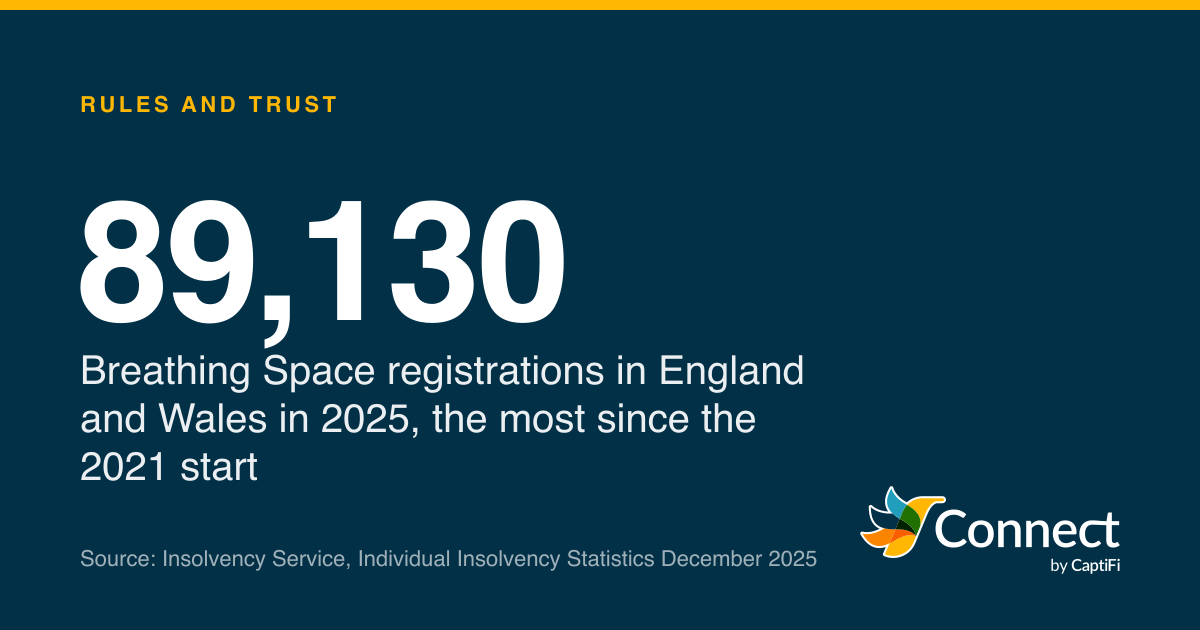
89,130: Breathing Space registrations in England and Wales in 2025, the most since the 2021 start. Source: Insolvency Service, Individual Insolvency Statistics December 2025.
The Financial Conduct Authority's rules for chasing consumer debts never mention text messages by name, but they cover every one a lender or debt collector sends. They sit in chapter 7 of the Consumer Credit sourcebook (CONC 7), many of them dated 1 April 2014 in the FCA Handbook and a large set revised on 4 November 2024. A text to someone in arrears has to say who is contacting them and why (CONC 7.9.1), arrive at a reasonable time (CONC 7.9.4), keep the debt from anyone else who might see the phone (CONC 7.9.7) and never misstate the firm's authority or the legal position (CONC 7.11.1). Over all of it sits the Consumer Duty, in force since 31 July 2023, which asks whether the channel a firm picks lets the customer take in the information and weigh their options.
Who do these rules cover?
CONC 7.1.1 applies the chapter to firms carrying on consumer credit lending, consumer hiring, peer-to-peer lending platforms and debt collecting. If you lend to consumers, hire goods to them on agreements, or collect consumer credit debts, these rules apply to every text you or your agents send. A business chasing its own unpaid invoices from other businesses, with no credit agreement involved, is outside CONC; our post on payment reminder texts and late payment covers that case.
The guidance in CONC 7 also points firms at the FCA's wider expectations. CONC 7.2.2A tells firms to have regard to the FCA's guidance on vulnerable customers (FG21/1), and CONC 7.3.13A, in its current form since 26 June 2026, reminds firms that communications with customers in arrears must meet the Consumer Duty or Principle 7, whichever applies.
Who is texting, and why?
CONC 7.9.1 says a firm must make sure anyone contacting a customer on its behalf explains "who the person contacting the customer works for", "the person's role in or relationship with the firm" and "the purpose of the contact". CONC 7.9.2 adds that a firm must not make a statement "which may induce the customer to contact the firm misunderstanding the reason for making contact". The FCA's example is a calling card that "states or implies that the customer has missed a delivery". The clear, fair and not misleading rule in CONC 3.3.1 applies to these communications too.
In a text, that means the firm's name at the start and enough of the purpose that the reader knows what kind of message it is. A text from an unnamed mobile number saying "please call us urgently about an important matter" leaves the reader guessing why, which is the misunderstanding CONC 7.9.2 is written against. A sender name that is the firm's trading name settles the first part before the message is even opened.
When, how often, and who else might see it
CONC 7.9.4 is the timing rule: "A firm must not contact customers at unreasonable times and must pay due regard to the reasonable requests of customers (for example, customers who work in a shift pattern) in respect of when, where and how they may be contacted." It doesn't define unreasonable, and for a text that's a judgement about the customer as much as the clock. A nurse on nights who has asked for no messages before noon has made exactly the kind of request the rule describes.
Frequency is covered from a different angle. CONC 7.13.10 says a firm that uses a third party to collect should take reasonable steps so the customer "is not subject to multiple approaches by different persons, resulting in repetitive or frequent contact". If your own reminder sequence is still running after the account has gone to an agency, that's two lots of texts about one debt.
Then there's privacy. CONC 7.9.6 says a firm "must not unfairly disclose or threaten to disclose information relating to the customer's debt to a third party", and CONC 7.9.7 says that when contacting a customer, a firm must not act "in a way likely to be publicly embarrassing to the customer" and must take reasonable steps so "third parties do not become aware that the customer is being pursued in respect of a debt". The guidance in CONC 7.9.8 gives the letter version: post marked "private and confidential", and a firm whose name signals debt collection keeping that name off anything a third party might see.
A text has its own version of the envelope. The sender name and the first line usually show on a locked screen, to anyone holding or glancing at the phone. A sender name that announces debt recovery, or an opening line that reads "Final notice: your account is £412 in arrears", puts the debt on display. The safer pattern is a neutral first line and the detail only after the customer has engaged.
That ties into CONC 7.9.10: a firm "must not disclose details of a debt to an individual without first establishing, by suitably appropriate means, that the individual is (or acts on behalf of) the borrower". If you haven't confirmed that a mobile number still belongs to the customer, the first text shouldn't mention the debt at all.
What a text must never say
CONC 7.11.1: "When contacting customers, a firm must not misrepresent its authority or its legal position with regards to the debt or debt recovery process." The guidance gives the obvious example, claiming to work on instructions from the courts as bailiffs when that is untrue. CONC 7.3.18 says a firm must not threaten court action "in order to pressurise a customer in or approaching arrears or in default to pay more than they can reasonably afford". CONC 7.3.10 bans pressurising a customer to pay in one or very few payments, within an unreasonably short time, or by selling property or borrowing more. And CONC 7.15.7 calls it misleading to suggest court action over a statute-barred debt when the firm knows, or ought to know, the limitation period has expired.
For a sense of what the forbidden version looks like on a phone, the ICO's June 2026 case against KRA Consultancy (a firm selling debt services, fined £300,000 under the marketing rules) quoted texts sent under the sender name DEMAND: "an Enforcement agent will attend ****** within 48 hours to remove your goods as per Court Order." The ICO called them fabricated bailiff threats. Our post on the ICO's text marketing fines has the full case.
Pointing people towards free debt advice
CONC 7.3.7A says that where a customer is in or approaching arrears, a firm should, where appropriate, tell them that "free and impartial money guidance and debt advice is available from not-for-profit debt advice bodies and can be accessed through a range of delivery channels, including digital tools", explain the benefits, and refer them on. The guidance says a referral can be as simple as giving "the name and contact details of a not-for-profit debt advice body or MoneyHelper". A text can carry that in a line.
Two other rules change what an automated sequence should do. CONC 7.3.11 says a firm "must suspend the active pursuit of recovery of a debt" for a reasonable period when it hears the customer, or someone acting for them, is developing a repayment plan, and CONC 7.3.12 puts that period at generally 30 days, extendable by another 30 where there's progress. And for lenders, CONC 7.12.2 says that where someone is acting for the customer, the firm shouldn't contact the customer directly without their consent unless there's an objectively justifiable reason (a contact whose sole purpose is to signpost free debt advice is one the guidance accepts). So when a debt adviser gets in touch, the reminder texts to the customer should stop.
Breathing Space: when the texts have to stop
In England and Wales there's a legal stop as well. The Debt Respite Scheme came into force on 4 May 2021, and the Insolvency Service describes it as giving people "legal protections from their creditors for 60 days, with most interest and penalty charges frozen, and enforcement action halted", or for the length of mental health crisis treatment plus 30 days. Regulation 7 of the scheme's regulations lists the enforcement action a creditor may not take during a moratorium, and it includes "take a step to collect a moratorium debt from a debtor" and "contact a debtor for the purpose of enforcement of a moratorium debt". A payment reminder is hard to describe as anything other than a step to collect.
Standard and mental health crisis registrations together, not seasonally adjusted. The scheme started on 4 May 2021, so 2021 covers eight months.
Source: Insolvency Service, Individual Insolvency Statistics December 2025 (table 6)
See the figures as a table
| Registrations | |
|---|---|
| 2021 (May to Dec) | 41,126 |
| 2022 | 70,787 |
| 2023 | 88,390 |
| 2024 | 89,020 |
| 2025 | 89,130 |
The numbers make this a routine event. The Insolvency Service's statistics show 89,130 breathing spaces registered in 2025, 87,813 standard and 1,317 for mental health crisis, the highest annual total since the scheme began and close to the 89,020 of 2024. Between May 2021 and the end of 2025, StepChange Debt Charity registered 59% of them. A lender or collector with any volume of customers in arrears will get breathing space notices every month, and each one has to reach whatever system sends the texts.
Vulnerability and the Consumer Duty
The FCA's guidance on vulnerable customers, FG21/1, published in February 2021, defines a vulnerable customer as "someone who, due to their personal circumstances, is especially susceptible to harm, particularly when a firm is not acting with appropriate levels of care". It groups the risk under four drivers: health, life events, resilience and capability, which includes "literacy, or digital skills". The FCA's Financial Lives survey for May 2024 found 49% of UK adults, 26.4 million people, showed at least one characteristic of vulnerability, and 8% (4.5 million) were in financial difficulty, meaning they had missed bills or credit payments in three or more of the previous six months.
All UK adults (17,950 surveyed), using the FCA's updated algorithm. People can show characteristics under more than one driver, so the four drivers add up to more than 49%.
Source: FCA, Financial Lives 2024 survey: vulnerability and financial resilience
See the figures as a table
| Share of adults (%) | |
|---|---|
| Any characteristic | 49 |
| Low resilience | 26 |
| Recent negative life event | 20 |
| Low capability | 17 |
| Poor health | 9 |
The Consumer Duty turns that into rules about communications. PRIN 2A.5.3 says communications must "meet the information needs of retail customers", be "likely to be understood" and "equip retail customers to make decisions that are effective, timely and properly informed". PRIN 2A.5.6 says a firm must satisfy itself that the communication channel "provides an appropriate opportunity for retail customers to review the information and, where relevant, assess their options", and PRIN 2A.5.8 requires communications to be tailored to the customer's characteristics, including vulnerability, and to the channel used. CONC 7.3.13A makes the practical point: a firm should support customers "to engage through appropriate channels, changing the channel if necessary".
A text suits a reminder, a payment date, or a link to a page with the detail. It doesn't suit an income and expenditure conversation or an explanation of how forbearance will show on a credit file, and the rules above expect a firm to move to a channel that does. When the FCA reviewed almost 100 lenders' treatment of borrowers in difficulty, it reported in May 2023 that it had secured up to £47m of redress from 17 of them for over 195,000 customers, citing failures to tailor support, to respond to vulnerability and to engage customers about debt advice. The Financial Lives survey also found that only 21% of adults in financial difficulty had arranged support from a lender in the two years to May 2024.
What an arrears text can look like
Two made-up examples for a car finance firm. The first is for a number that hasn't been confirmed recently, so it says nothing about a debt:
Northgate Finance: please get in touch about your account on 01632 960123 (Mon to Fri, 9am to 6pm) or log in at example.co.uk. Not you? Reply WRONG and we'll stop.
The second is for a confirmed number, sent mid-morning on a weekday:
Northgate Finance: your payment of £186.40 due 1 Nov hasn't arrived. If money is tight, reply or call 01632 960123 to talk about options. Free debt advice: MoneyHelper.
Both name the firm and say what the message is about, and the second points to free advice. Replies are the useful part, because "I've lost my job" or "I'm in a breathing space" has to reach a person who can act on it.
CaptiFi Connect fits that pattern: replies land free in a two-way inbox, scheduled campaigns observe quiet hours, sender names are reviewed by our staff before use, and team logins come with roles and two-step sign-in. Which texts to send, and when to stop, stays your decision under the rules above.
Sources
Read for this post on 22 October 2026.
- FCA Handbook: CONC 7, arrears, default and recovery
- FCA Handbook: CONC 7.9, contact with customers
- FCA Handbook: PRIN 2A.5, Consumer Duty outcome on consumer understanding
- FCA: PS22/9, a new Consumer Duty, feedback and final rules
- FCA: FG21/1, guidance for firms on the fair treatment of vulnerable customers, February 2021
- FCA: Financial Lives 2024 survey, vulnerability and financial resilience
- FCA: Financial Lives 2024 survey, forbearance and debt advice
- FCA: press release, lenders to pay out up to £47m in redress to borrowers in difficulty, 25 May 2023
- legislation.gov.uk: Debt Respite Scheme Regulations 2020, regulation 1
- legislation.gov.uk: Debt Respite Scheme Regulations 2020, regulation 7
- Insolvency Service: Individual Insolvency Statistics December 2025
- Insolvency Service: commentary, Individual Insolvency Statistics December 2025
- ICO: news release, Manchester firm fined £300,000 over unlawful texts to people in debt
Written by the CaptiFi Connect team. Published 22 October 2026. More in Rules and trust
Send your first text this week
Set up your account and contacts now. Until we've approved it, a person reads each text before it goes out.