
Sectors10 min read
Awaab's Law and repair texts for social landlords
Awaab's Law has set social landlords in England fixed repair deadlines since 27 October 2025. The timescales, the duty to update tenants, and where texts fit.
In short
- Awaab's Law, the Hazards in Social Housing (Prescribed Requirements) (England) Regulations 2025, has applied to social landlords in England since 27 October 2025.
- Under Awaab's Law a social landlord must investigate a possible damp and mould hazard within 10 working days and give the tenant a written summary within 3 working days of finishing.
- Regulation 10 of Awaab's Law lets a landlord send the written summary electronically to a number the tenant gave for tenancy communications, and MHCLG's Phase 2 guidance lists text message.
- A draft amendment to Awaab's Law, due to come into force on 30 November 2026, adds excess cold and heat, falls, fire, electrical, explosion, structural collapse and domestic hygiene hazards.
- The English Housing Survey found surveyor-recorded damp in 7% of social rented homes in 2024, up from 5% in 2022, while 41% of social renting households reported condensation, damp or mould.
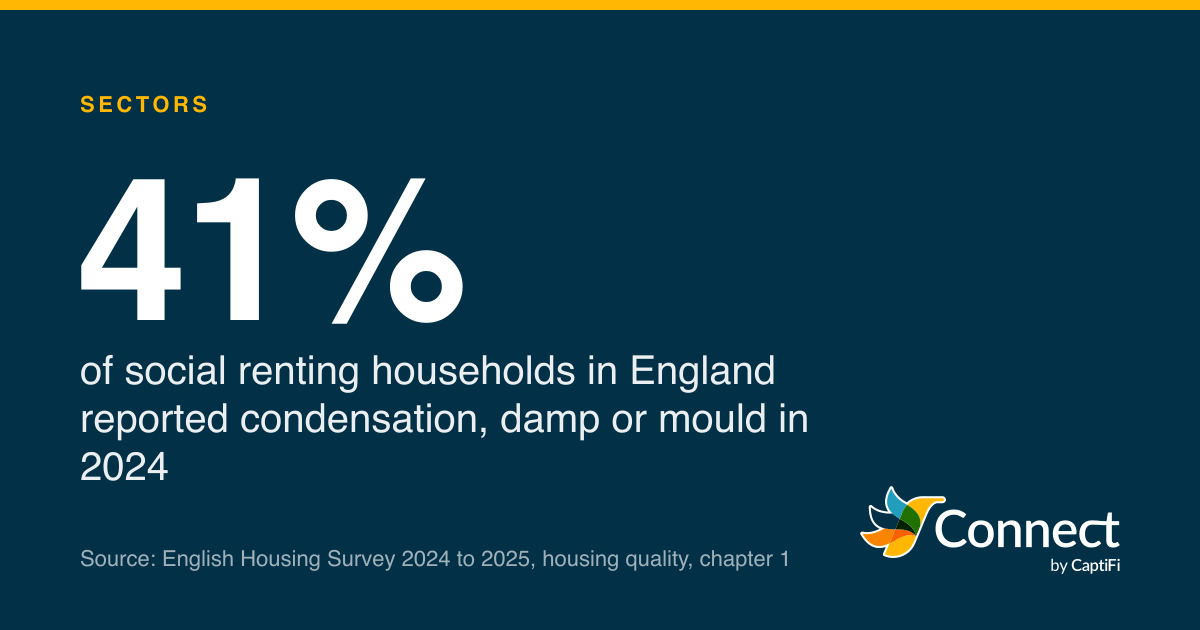
41%: of social renting households in England reported condensation, damp or mould in 2024. Source: English Housing Survey 2024 to 2025, housing quality, chapter 1.
Since 27 October 2025, every council and housing association in England with social tenants has been working to a set of legal clocks. The Hazards in Social Housing (Prescribed Requirements) (England) Regulations 2025, known as Awaab's Law, say an emergency hazard must be investigated and made safe within 24 hours, a possible damp and mould hazard investigated within 10 working days, the tenant given a written summary within 3 working days of that investigation, and the safety work done within 5 working days after it. Regulation 14 adds a duty that runs through the whole thing: the landlord "must take reasonable steps to keep the lessee informed about the timing and progress of the required work".
That last duty, and the written summary, are where texts come in. A text gets a surveyor through the door on the right morning and leaves a timestamped record that the tenant was told what was happening, which is the kind of evidence MHCLG's guidance tells landlords to keep.
What Awaab's Law requires, and when the clock starts
The regulations (S.I. 2025/1042, made on 23 September 2025) apply to registered providers of social housing, which MHCLG's guidance spells out as local authorities and private registered providers such as housing associations. They're named after Awaab Ishak, who died in 2020 aged two from a respiratory condition caused by prolonged exposure to mould in his home. The guidance records that his parents had complained repeatedly to their landlord in the three years before he died.
The start of every clock is the moment the landlord becomes aware of a possible hazard. The Phase 1 guidance, last updated on 16 July 2026, puts it plainly: "The day the landlord becomes aware of a potential hazard is counted as day 'zero', with day one of timeframes commencing the following working day." Awareness doesn't need a formal report. A tenant mentioning mould to a maintenance officer counts, and so does a report from a contractor, a neighbour or an advice worker, from the date the landlord hears it. A working day, in regulation 2, is any day except a weekend, Christmas Day, Good Friday or a bank holiday.
Here's the sequence as the regulations set it out:
| Step | Deadline | Regulation |
|---|---|---|
| Investigate an emergency hazard and do the safety work | Within 24 hours | 5 |
| Investigate a possible significant hazard (damp and mould, for now) | 10 working days from the day after the landlord becomes aware | 6 |
| Investigate again if the tenant asks for a physical inspection | 10 working days from the request | 6 and 7 |
| Give the tenant a written summary | 3 working days after the investigation ends | 9 |
| Make a significant hazard safe | 5 working days after the investigation ends | 11 |
| Start work to stop it coming back | Within 5 working days, or within 12 weeks if that isn't practicable | 13 |
| Can't make it safe in time | Suitable alternative accommodation, at no cost to the tenant | 16 |
| Enter the home to do any of this | Reasonable times, after 24 hours' notice in writing | 20 |
The written summary isn't needed if the work is finished within those 3 working days. Otherwise it has to say whether the investigation found a significant or emergency hazard and what it is, what further action is planned with a target timescale for starting and finishing, or that no further action is needed and why, and how the tenant can contact the landlord.
What changes on 30 November 2026
So far the "significant hazard" clocks cover damp and mould only (emergency hazards of any kind except overcrowding are already in). A draft amending instrument, the Hazards in Social Housing (Prescribed Requirements) (England) (Amendment) Regulations 2026, gives 30 November 2026 as its start date. Its explanatory note says it adds excess cold, excess heat, domestic hygiene, falls, electrical, explosion and structural collapse hazards, and redefines a significant hazard as one a reasonable landlord would make safe within 15 working days. Fire hazards that come from the parts of a block of flats covered by the Regulatory Reform (Fire Safety) Order 2005 (the structure, external walls and common parts) are left out. When we checked legislation.gov.uk on 22 October 2026 the instrument was still listed as a draft laid before Parliament for approval by both Houses, so treat the date as the government's plan until it's made.
MHCLG has already published guidance for that phase, updated on 31 July 2026, written for the rules "as it will apply from 30 November 2026". A third phase is meant to bring in the remaining hazards from the Housing Health and Safety Rating System, apart from overcrowding. The Phase 1 guidance said that would be 2027; the Phase 2 guidance gives no year.
How much damp and mould is out there?
The English Housing Survey's housing quality chapter, published on 29 January 2026, found that 5% of homes in England, 1.4 million dwellings, had a damp problem in 2024, up from 4% in the modelled data for 2021 and 2022. That's damp a surveyor judged serious enough to count in a hazard assessment, so minor patches don't feature. By tenure it was 10% of private rented homes, 7% of social rented homes and 4% of owner occupied ones, and the rise in the social sector (from 5% in 2022) was statistically significant. Council homes came out at 8% and housing association homes at 6%. Serious condensation, the most common kind, was in 5% of social rented homes.
Ask the households themselves and the numbers jump. In the same survey, 41% of social renting households said their home had problems with condensation, damp or mould (44% of council tenants and 38% of housing association tenants).
- Surveyor found a damp problem
- Household reported condensation, damp or mould
Surveyor figures are the share of dwellings with damp serious enough to count in a hazard assessment; reported figures are the share of households mentioning a problem at interview. Published 29 January 2026.
Source: English Housing Survey 2024 to 2025, housing quality, chapter 1
See the figures as a table
| Surveyor found a damp problem (%) | Household reported condensation, damp or mould (%) | |
|---|---|---|
| Private rented | 10 | 46 |
| Local authority | 8 | 44 |
| Housing association | 6 | 38 |
| Owner occupied | 4 | 22 |
The gap between those two series matters for anyone sending repair texts. The survey found that, across all tenures, only 13% of households who mentioned a damp problem lived in a home where a surveyor recorded one. So plenty of reports will be investigated and found not to be a significant hazard, and that's exactly the case where the written summary has to explain "that there is no further action required under these Regulations, and the reasons why". A tenant who reported black mould and hears nothing back for a fortnight will assume the worst.
Who those tenants are shapes how you reach them. The survey's profile chapter counts 4.1 million social renting households in 2024-25 (16% of households), 2.5 million renting from housing associations and 1.5 million from councils. In 61% of them someone has a long-term illness or disability, and 86% have internet access at home, the lowest figure of any tenure even after a rise from 79% in 2019-20. About one household in seven has no internet at home, and a text doesn't need it.
What tenants say about repairs and updates
The Regulator of Social Housing's Tenant Satisfaction Measures for 2024/25, published on 4 November 2025, cover landlords with 1,000 or more homes. For the median landlord, 73.6% of tenants who'd had a repair were satisfied with the repairs service and 69.5% with the time taken for the latest one. On being kept informed about things that matter to them, it was 72.0%, and on the landlord listening to their views and acting on them, 61.6%.
- 2023/24
- 2024/25
Low cost rental tenants of landlords with 1,000 or more homes. The two repairs questions go only to tenants who had a repair in the last 12 months.
Source: Regulator of Social Housing, Tenant Satisfaction Measures 2024/25, headline report
See the figures as a table
| 2023/24 (%) | 2024/25 (%) | |
|---|---|---|
| Overall service | 71.3 | 71.8 |
| Repairs service | 72.3 | 73.6 |
| Time taken for latest repair | 67.4 | 69.5 |
| Keeps tenants informed | 70.3 | 72 |
| Listens and acts on views | 60.4 | 61.6 |
| Complaints handling | 34.5 | 35.5 |
The regulator's report also counts just under 15.1 million responsive repairs completed in 2024/25, 3.8 million of them emergencies, with landlords recording 79% of non-emergency and 91% of emergency repairs as done within their own target times. Just over 18.7 million repairs were raised, more than 2.5 million were closed without being done (cancelled by the landlord or the tenant), and almost 1.2 million were still in progress at the year end. The regulator also notes that, on its National Tenant Survey evidence, the "kept informed" score tends to reflect formal communications such as newsletters and letters.
The Housing Ombudsman's Annual Complaints Review for 2025-26, covering cases decided between 1 April 2025 and 31 March 2026, found that 34% of the repairs complaints it investigated were about condensation, damp and mould and 23% about leaks, and it upheld more than 75% of them. Poor communication and inadequate record keeping are both on its list of failures that recur in the repairs cases where it found severe maladministration. It also says the first Awaab's Law cases have started reaching it.
Where a text fits in the timeline
Regulation 10 settles how the written summary can be given. Alongside handing it over, leaving it at the home or first class post, it can be "transmitted electronically to an address or number provided by the lessee to the lessor for the purpose of receiving communications from the lessor in relation to the lease or the social home". It counts as given when it's transmitted. The Phase 2 guidance lists "by text message" among the ways to deliver it, and both sets of guidance say the 3 working days are for the landlord to send the summary, not for the tenant to receive it, so keep a record of when it went.
The number has to be one the tenant gave you for tenancy matters, which is a good reason to confirm it on the first contact. And if the summary goes by text, it has to carry everything regulation 9 lists. A landlord can instead send the summary as a letter or email and use the text to say it's on its way, which also suits tenants who need it in another language or format (the guidance asks landlords to take those preferences into account).
Regulation 14's duty to keep the tenant informed is the natural home for texts: appointment slots, a contractor running late, a date moved, and the message the regulation specifically requires, that "the required work is completed". The Phase 1 guidance's own example of a missed appointment suggests "following up through a phone call, text, or email to confirm the appointment" and offering evening or weekend slots. Here's how that might look for a hypothetical housing association, Northfield Homes, with a tenant who reports mould on Thursday 22 October 2026:
Northfield Homes: we've logged your report of mould in the back bedroom at 4 Ash Court, ref DM4471. We'll be in touch within 2 working days to book an inspection. Reply to this text with anything we should know.
Northfield Homes: damp inspection at 4 Ash Court on Tue 27 Oct, 08:00 to 12:00 (ref DM4471). Reply 1 to confirm, or 2 if you need an evening or Saturday slot.
Northfield Homes: the written summary of your damp inspection (ref DM4471) was emailed to you today. It explains what we found and what happens next. Reply if it hasn't arrived.
Northfield Homes: mould treatment at 4 Ash Court is booked for Mon 2 Nov, 09:00 to 13:00. Reply 2 if that day doesn't work.
Northfield Homes: the mould treatment at 4 Ash Court is complete. If the mould comes back, reply to this text or call 01632 960123 and quote DM4471.
Each one names the landlord first, the address and the reference, and asks for a reply where one helps. None of them mentions anyone's health, which belongs in a conversation and not on a lock screen. They're also all service messages (texts about the tenancy, not marketing), so no marketing consent is involved; our guide to SMS marketing rules explains where that line sits. The entry notice in regulation 20 is a separate requirement, 24 hours' notice in writing, so check how your tenancy agreement gives written notice before relying on the appointment text alone.
Keeping the record
Both sets of guidance press the same point: keep "clear records of all engagement, investigations and communications with tenants", including reports that came through a third party. When a case reaches the Ombudsman, a log showing the acknowledgement on day zero, the inspection slot, the summary sent on day three and the completion text is the sort of record that backs up the defence the law gives a landlord who took all reasonable steps to comply (section 10A(5) of the Landlord and Tenant Act 1985). Courts can order specific performance of the duties under regulation 19, and regulation 18 makes any tenancy term that tries to contract out of them void.
CaptiFi Connect sends to UK mobiles from a UK number, so tenants can reply, and replies land in a shared two-way inbox that a repairs team can work through with team logins. Every text gets a delivery report with a timeline, which is the timestamp you'd want when someone asks whether the summary went within 3 working days. For anyone also texting private tenants, our post on the Renters' Rights Act covers the private sector, where Awaab's Law has not yet been applied.
Sources
Read for this post on 22 October 2026.
- legislation.gov.uk: The Hazards in Social Housing (Prescribed Requirements) (England) Regulations 2025, S.I. 2025/1042
- legislation.gov.uk: draft Hazards in Social Housing (Prescribed Requirements) (England) (Amendment) Regulations 2026
- GOV.UK: Awaab's Law in the social rented sector (collection)
- MHCLG: Awaab's Law Phase 1, guidance for social landlords, updated 16 July 2026
- MHCLG: Awaab's Law Phase 2, guidance for social landlords, updated 31 July 2026
- MHCLG: English Housing Survey 2024 to 2025, headline findings on housing quality, chapter 1
- MHCLG: English Housing Survey 2024 to 2025, profile of households and dwellings
- Regulator of Social Housing: Tenant Satisfaction Measures 2024/25, headline report
- Housing Ombudsman: Annual Complaints Review 2025-26
Written by the CaptiFi Connect team. Published 22 October 2026. More in Sectors
Send your first text this week
Set up your account and contacts now. Until we've approved it, a person reads each text before it goes out.