Writing texts9 min read
Texting customers in Welsh: the rules and the cost
Welsh councils and health boards treat texts as correspondence under the Welsh Language Standards. Who reads Welsh, and why one ŵ cuts a text to 70 characters.
In short
- The Welsh Language Commissioner's code of practice for councils counts text messages, and automatically generated reminders, as correspondence under the Welsh Language Standards.
- Census 2021 counted 538,300 people in Wales aged three or over who could speak Welsh, 17.8% of that population, down from 562,000 (19.0%) in 2011.
- The Annual Population Survey for the year to 30 June 2026 put Welsh speakers at 27.4% of people in Wales aged three or over, and Welsh readers at 25.0%.
- Welsh letters with a circumflex, such as â, ŵ and ŷ, are not in the GSM 7-bit alphabet of 3GPP TS 23.038, so one of them cuts a text from 160 characters to 70.
- Private businesses and charities in Wales are not required to meet the Welsh Language Standards, but texts a contractor sends for a council count as the council's own.
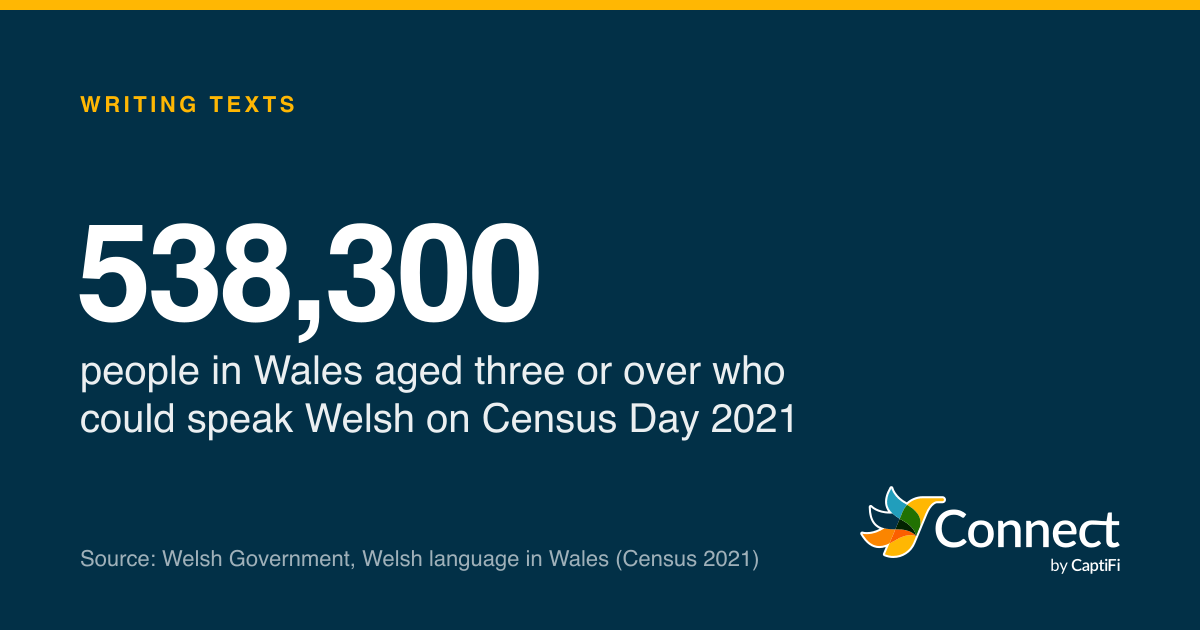
538,300: people in Wales aged three or over who could speak Welsh on Census Day 2021. Source: Welsh Government, Welsh language in Wales (Census 2021).
If you're a council, a national park or a health board in Wales, a text message to the public counts as correspondence under the Welsh Language Standards, and the Welsh Language Commissioner's code of practice says so in as many words: correspondence "may include letters, emails, text messages", and it includes anything "generated automatically by a system or machine, such as bills, reminders". That code, for the standards in the Welsh Language Standards (No. 1) Regulations 2015, came into force on 19 February 2020. If you're a private business or a charity, nothing makes you text in Welsh. Plenty of firms want to anyway, and both groups hit the same practical snag, which is that the letters Welsh uses most often with an accent aren't in the alphabet a standard text is sent in.
Do the Welsh Language Standards cover text messages?
The 2015 Regulations came into force on 31 March 2015 and set out the standards a body can be required to meet. Standards 1 to 7 are about correspondence, and four of them matter most for anyone sending texts.
- Standard 1: if someone writes to you in Welsh, you reply in Welsh (if a reply is needed).
- Standard 2: the first time you correspond with someone, you ask whether they want correspondence in Welsh, and if they say yes, you record it and write in Welsh from then on.
- Standard 4: "When you send the same correspondence to several persons, you must send a Welsh language version of the correspondence at the same time as you send any English language version."
- Standard 5: if you don't know someone's preference, you provide a Welsh language version.
The Commissioner's code is explicit that a bulk text sits under standard 4. Its example list for that standard is "the same circular, e-circular, newsletter, email, text message or letter to several homes or persons". The code for health boards, under the No. 7 Regulations of 2018, gives the same example, text messages included, in its 29 April 2024 edition. So a bin collection change a council texts to a whole ward, or a clinic reminder a health board sends to everyone on a list, needs a Welsh version going out at the same moment as the English one.
Standard 6 adds that the Welsh version must not be treated less favourably than the English, and the code spells out what "less favourably" can cover: "the material's language order", its quality and accuracy, its content, and "when the material is sent by the body and received by the person". That last one rules out the tempting shortcut of sending the English text at 9am and the Welsh one when someone gets round to the translation. The schedule does say a Welsh requirement doesn't mean Welsh only, or Welsh first, unless a particular standard states it.
Then there's standard 7, which asks bodies to state, in correspondence, that they welcome correspondence in Welsh and that replying in Welsh won't cause delay. The code even supplies a sentence for it, which turns out to be a neat illustration of the character problem. More on that below.
Which standards bind a particular body depends on its compliance notice from the Commissioner, so a council's own notice is the place to check the detail.
Who has to follow them, and who doesn't
The No. 1 Regulations define a "body" as "the Welsh Ministers, a county council or county borough council or a National Park authority". Health boards come under the No. 7 Regulations, which have their own code. The legal footing for all of it is the Welsh Language (Wales) Measure 2011, section 1 of which reads simply: "The Welsh language has official status in Wales."
Private firms are outside it. A training presentation published by the Commissioner puts the position plainly: "private organisations/ businesses and charities in Wales are not required to meet the Welsh Language Standards but the Welsh Language Commissioner strongly encourages them to provide services in Welsh." The Commissioner's Hybu team runs a voluntary recognition, the Cynnig Cymraeg (Welsh Offer), for businesses and charities with a Welsh language development plan, and its page says more than 160 organisations have received it.
There's one case where a business is pulled in. Regulation 1(5) says activity carried out "on the body's behalf" by a third party counts as the body's own, and that, unless the compliance notice says otherwise, a body fails a standard if the contractor doesn't meet it. If you send texts for a council, a park authority or the Welsh Government (as a supplier, an agency or a platform the body has contracted), the body's standards follow the work. Ask for the compliance notice before you quote.
How many of your customers read Welsh?
Two official sources answer that, and they disagree by a wide margin.
Census 2021, held on 21 March 2021, counted 538,300 usual residents of Wales aged three or older who could speak Welsh. That's 17.8%, down 23,700 people and 1.2 percentage points on 2011, and the Welsh Government notes it's the lowest percentage any census has recorded. The fall was concentrated among children: the share of 5 to 15 year olds reported as Welsh speakers dropped from 40.3% to 34.3%. Among people aged 20 or older the picture shifted the other way: 20 to 44 year olds are now the group most likely to speak Welsh (16.5%), where in 2011 it was people aged 75 or older.
- 2011
- 2021
Usual residents of Wales aged three or older, self-assessed (or assessed by a parent or guardian for children) on Census Day, 21 March 2021, and in 2011.
Source: Welsh Government, Welsh language in Wales (Census 2021), table 1
See the figures as a table
| 2011 (%) | 2021 (%) | |
|---|---|---|
| 3 to 4 | 23.3 | 18.2 |
| 5 to 15 | 40.3 | 34.3 |
| 16 to 19 | 27 | 27.5 |
| 20 to 44 | 15.6 | 16.5 |
| 45 to 64 | 13.3 | 13 |
| 65 to 74 | 15 | 12.8 |
| 75 or older | 17.5 | 15.1 |
| All ages (3+) | 19 | 17.8 |
Geography matters more than the national figure. Gwynedd had 64.4% Welsh speakers and the Isle of Anglesey 55.8%, against 6.2% in Blaenau Gwent and 7.5% in Newport. Carmarthenshire saw the steepest fall, from 43.9% to 39.9%. Across Wales as a whole, 74.8% of people aged three or older reported no Welsh language ability at all. And for anyone texting across the border, the census in England asked about main language: 7,000 people there gave Welsh.
The second source is the Annual Population Survey, which the Welsh Government publishes every quarter. The latest release, out on 21 October 2026 for the year to 30 June 2026, puts Welsh speakers at 27.4%, around 845,200 people. It's a much higher number, and the Welsh Government is careful about it: the survey's accredited status has been removed because of falling sample sizes, it says the APS results "should not be compared with census results", and it treats the census as the key source for counting Welsh speakers. It also dropped its figures on how often people speak Welsh from this release while it reviews a methodological problem, so any "daily speakers" number you see quoted from earlier releases is under review.
Year ending 30 June 2026, published 21 October 2026. Official statistics, no longer accredited; the Welsh Government says not to compare them with the census.
Source: Welsh Government, Welsh language data from the Annual Population Survey, July 2025 to June 2026
See the figures as a table
| People aged 3 or over (%) | |
|---|---|
| Understand spoken Welsh | 31.5 |
| Speak Welsh | 27.4 |
| Read Welsh | 25 |
| Write Welsh | 22.5 |
The useful part of the APS for a business that texts is the skills split. In the same release 31.5% said they could understand spoken Welsh, 27.4% speak it, 25.0% read it and 22.5% write it. The census points the same way: 14.2% could speak, read and write Welsh, against the 17.8% who could speak it. A text is read, so the reading figure is the one that counts, and in every source it's lower than the speaking one. Some people who speak Welsh don't read it, which is one more reason to ask people which language they want instead of guessing from a postcode.
Why a Welsh text often costs more
The Commissioner's guidance on technology, websites and software sets out the alphabet. Welsh has 29 letters, its vowels are a, e, i, o, u, w and y, and "the most commonly used accent in Welsh is the circumflex (â) but acute (á) and grave (à) accents are also used, as is the dieresis (ä)". The guidance says any character set has to "contain all the accented and non-accented characters of the Welsh alphabet", and points to Unicode.
A standard text uses the GSM 7-bit default alphabet from 3GPP TS 23.038, and that table holds 160 characters in one message. It does include some accented letters (à, è, é, ì, ò, ù, ä, ö and ü among them) but no letter with a circumflex at all. No â, ê, î, ô or û, and no ŵ or ŷ. The standard does define extra "national language" tables, but only for 13 languages (Turkish, Spanish, Portuguese and ten languages of South Asia), and Welsh isn't one of them. So a text with a single circumflex goes in UCS2, where one message holds 70 characters and each part of a longer one holds 67. Our guide to the character limit has the arithmetic, and Unicode SMS explains the encoding.
GOV.UK Notify, the government's own sending service, puts it in its pricing page without any fuss: "Languages such as Welsh, Arabic and Mandarin use non-standard characters", and with one of those in a message, "anything longer than 70 characters (including spaces) counts as more than one message". Its table goes 70, 134, 201 and 268 characters for one to four messages.
Here's the Commissioner's own suggested standard 7 statement, from the 2020 code:
Croeso i chi gysylltu â ni yn Gymraeg. Byddwn yn ymateb yn Gymraeg, heb oedi.
That's 77 characters. In the 7-bit alphabet it would be one part with room to spare, but the â in "â ni" makes it 77 UCS2 characters, so two parts. The English version ("You are welcome to contact us in Welsh. We will respond in Welsh, without delay.") is 80 characters and one part. Put them together in a single bilingual text and you get 158 characters, which would squeeze into one standard part if it weren't for that one letter. With it, it's three parts of 67, 67 and 24.
Not every Welsh sentence trips the switch. The Welsh Government's own line under its contact details, "Rydym yn croesawu gohebiaeth yn Gymraeg / We welcome correspondence in Welsh.", has no accented letters, so it's 77 characters in one standard part. You can't plan around that, though. Stripping the to bach out of a message to save money would mean sending Welsh with letters missing, which the Commissioner's guidance is written to prevent.
One bilingual text or two?
There are three ways to send Welsh and English by text, and the cost difference between them is worth working out before you pick.
| Approach | What goes out | What it costs (the statement above) |
|---|---|---|
| One bilingual text to everyone | Welsh and English in the same message | 3 parts per person |
| Two texts to everyone | A Welsh text and an English text, sent together | 2 parts plus 1 part, so 3 per person |
| One text each, by recorded preference | Welsh to those who chose it, English to the rest | 2 parts or 1 part per person |
The third row is the cheapest and the kindest to read, and it's what standard 2 sets up: ask at first contact, record the answer, and correspond in that language from then on. It fits texts tailored to the person, such as a reminder with their own appointment date and time. A message that's identical for everyone (a road closure, new opening hours) falls under standard 4 instead, and the code says a person's answer under standard 2 doesn't change that duty, so everyone gets the Welsh version and the choice is between the first two rows. They cost the same here, which leaves the question of which reads better on a lock screen. In a single bilingual text, the code's line about language order is the reason to think about which language comes first.
For a private business with no standards to meet, the same method is simply good manners. Ask once, on the booking form or at the counter, which language someone wants their texts in, store the answer against the contact, and send each person one message in their language.
CaptiFi Connect charges one credit per SMS part on every message, in whatever language, so a two-part Welsh reminder costs two credits and a one-part English one costs one. Contact lists import and export as CSV, so splitting a list by language before a bulk send is a spreadsheet job, and each group can then get its own message.
Whichever route you take, count the Welsh template on its own before it goes out. A reminder that fits in one 160-character part in English can need two or three parts in Welsh once a single circumflex is in it, and our free character counter shows the encoding, the part count and the letter that forced Unicode.
Sources
Read for this post on 22 October 2026.
- legislation.gov.uk: The Welsh Language Standards (No. 1) Regulations 2015, Schedule 1
- legislation.gov.uk: The Welsh Language Standards (No. 1) Regulations 2015, regulation 1
- legislation.gov.uk: Welsh Language (Wales) Measure 2011, section 1
- Welsh Language Commissioner: Code of Practice for the Welsh Language Standards (No. 1) Regulations 2015
- Welsh Language Commissioner: Code of Practice for the Welsh Language Standards (No. 7) Regulations 2018, 29 April 2024
- Welsh Language Commissioner: Codes of practice
- Welsh Language Commissioner: Technology, websites and software, Welsh language considerations
- Welsh Language Commissioner: Private businesses, organisations and charities in Wales (presentation 4)
- Welsh Language Commissioner: Businesses and charities, the Cynnig Cymraeg
- ONS: Welsh language, Wales: Census 2021, 6 December 2022
- Welsh Government: Welsh language in Wales (Census 2021)
- Welsh Government: Welsh language data from the Annual Population Survey, July 2025 to June 2026
- ETSI: TS 123 038 V19.0.0, Alphabets and language-specific information (3GPP TS 23.038)
- GOV.UK Notify: Text message pricing
Written by the CaptiFi Connect team. Published 22 October 2026. More in Writing texts
Send your first text this week
Set up your account and contacts now. Until we've approved it, a person reads each text before it goes out.