Writing texts8 min read
Texting customers whose first language isn't English
Census 2021 found 5.1 million people in England and Wales with another main language. Which languages force Unicode, and when a text is worth translating.
In short
- Census 2021 found that 8.9% of usual residents of England and Wales aged three or over, 5.1 million people, had a main language other than English (or Welsh in Wales).
- Of the 5.1 million people with another main language in Census 2021, the ONS found 43.9% spoke English very well and 35.8% well, while 880,000 could not speak it well and 161,000 not at all.
- Polish was the most common main language after English in Census 2021, spoken by 612,000 people, followed by Romanian (472,000), Panjabi (291,000) and Urdu (270,000).
- Every accented letter in the Polish, Romanian and Lithuanian alphabets is missing from the GSM 7-bit alphabet, so one of them limits a text to 70 characters a part.
- The Home Office's guidance on writing for people with limited English asks for sentences of about 15 words on average and no contractions, idioms or phrasal verbs.
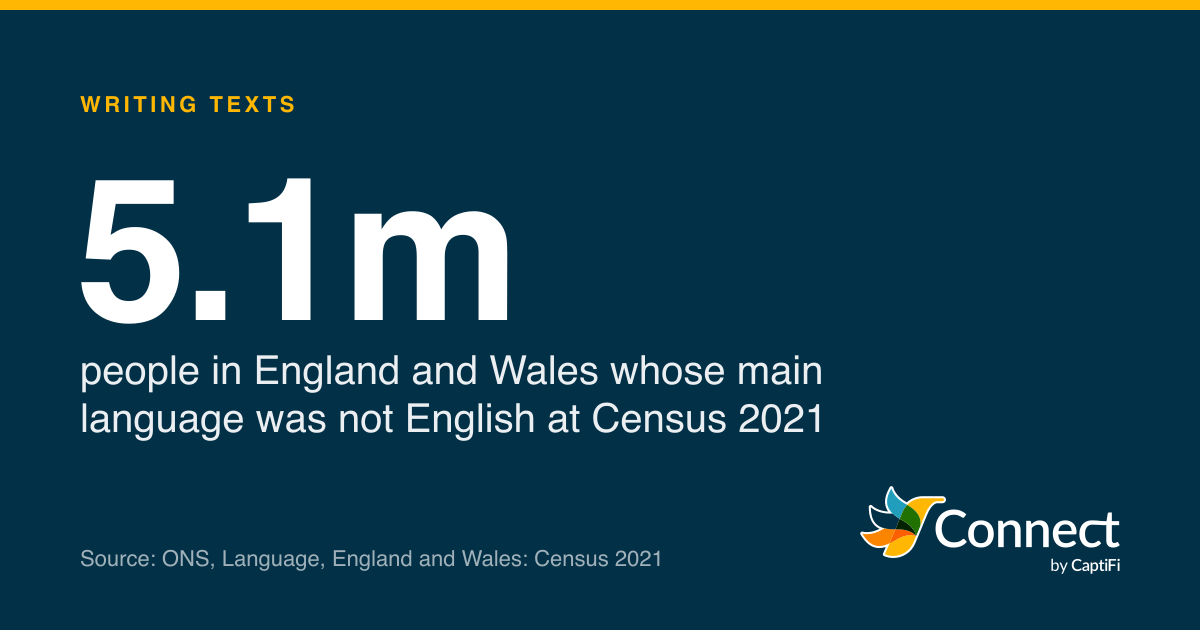
5.1m: people in England and Wales whose main language was not English at Census 2021. Source: ONS, Language, England and Wales: Census 2021.
At Census 2021, 5.1 million people in England and Wales aged three or over had a main language other than English. That's 8.9% of usual residents, according to the Office for National Statistics bulletin published on 29 November 2022; English was the main language of 91.1%, down from 92.3% in 2011. Most of the 5.1 million speak English well. The ONS found 43.9% of that group spoke it very well and 35.8% well, which leaves 880,000 people who couldn't speak English well and 161,000 who couldn't speak it at all.
So for most customers whose first language isn't English, a plain English text works, provided it really is plain. For roughly a million people it may not, and translating a text brings a cost of its own: most of the languages on the census list need characters that a standard text can't carry, which cuts a message from 160 characters to 70.
Which languages do your customers speak?
Polish was the most common main language after English in 2021, with 612,000 speakers (1.1% of usual residents). Romanian came second on 472,000, the biggest change of the decade: it was 68,000 in 2011. Then Panjabi on 291,000 and Urdu on 270,000, both 0.5%. The rest of the top ten were Portuguese, Spanish, Arabic, Bengali, Gujarati and Italian, each between 160,000 and 225,000.
Usual residents aged three and over on 21 March 2021. Bengali includes Sylheti and Chatgaya. English includes Welsh for people in Wales.
Source: ONS, Language, England and Wales: Census 2021 (figure 1 data)
See the figures as a table
| People | |
|---|---|
| Polish | 611,845 |
| Romanian | 471,954 |
| Panjabi | 290,745 |
| Urdu | 269,849 |
| Portuguese | 224,719 |
| Spanish | 215,062 |
| Arabic | 203,998 |
| Bengali | 199,495 |
| Gujarati | 188,956 |
| Italian | 160,010 |
The national figures hide a lot of local variation, and for a business the local picture is the one that matters. English was the main language of 96.5% of people in the North East but 78.4% in London. Boston, in Lincolnshire, had the highest share of Polish speakers of any local authority (5.7%), Harrow the highest share of Romanian speakers (7.5%) and Wolverhampton the highest share of Panjabi speakers (6.5%). In Wales, Polish was the next most common main language after English or Welsh, at 0.7%, rising to 2.5% in Wrexham. A salon in Boston and a salon in Durham will be writing for quite different customers.
The census also looked at households for the first time. In 6.0% of them (1.5 million), members had different main languages, and in 480,000 the main language differed between generations. The person whose number you hold isn't always the person in the house who reads English most easily, which is one more reason to keep a text simple enough to pass on.
Scotland's census was a year later and asked a different question. Its report, published on 21 May 2024, found 94.2% of people said they could speak, read and write English well or very well in 2022, against 93.8% in 2011.
One caution on the England and Wales numbers. The census asked people with another main language to report how well they could speak English. It didn't ask about reading. Someone who chats easily at the reception desk may still find a dense text hard going, especially one full of idioms, and that's the gap the next two sections are about.
Which languages push a text into Unicode?
A standard text uses the GSM 7-bit default alphabet from 3GPP TS 23.038, which fits 160 characters into a message. The table has the English alphabet, digits, punctuation and a short list of accented letters (à, è, é, ì, ò, ù, ä, ö, ü, ñ and a few Nordic ones). Any character outside it moves the whole message into UCS2, which holds 70 characters in one part and 67 in each part of a longer text. Our character limit guide has the detail.
To see how that plays out language by language, we took the main letters each language uses from the Unicode Common Locale Data Repository (CLDR, version 49), the Unicode Consortium's reference data on the letters each language uses, and checked every accented letter against the GSM table.
- Letters beyond a to z
- Not in GSM 7-bit
Our count of each language's lower-case main letters in CLDR 49 against the GSM 7-bit default alphabet. Capital letters are not counted; the table lacks most accented capitals.
Source: Unicode CLDR 49, main exemplar letters, checked against the table in 3GPP TS 23.038
See the figures as a table
| Letters beyond a to z | Not in GSM 7-bit | |
|---|---|---|
| Polish | 9 | 9 |
| Romanian | 5 | 5 |
| Lithuanian | 9 | 9 |
| Portuguese | 12 | 10 |
| Spanish | 7 | 4 |
| Italian | 6 | 0 |
Polish has nine letters beyond a to z (ą, ć, ę, ł, ń, ó, ś, ź and ż) and the GSM table has none of them. Romanian's five (ă, â, î, ș and ț) are all missing too, as are all nine of Lithuanian's. Portuguese loses 10 of its 12, keeping only à and é. Spanish does a bit better, because é, ñ and ü are in the table, but á, í, ó and ú aren't. Italian is the exception: its six accented lower-case letters are all in the table, so an Italian text can stay on the 160-character scale (an accented capital at the start of a sentence would still break it).
The scripts are simpler, if not cheaper. Panjabi, Urdu, Arabic, Bengali and Gujarati aren't written in the Latin alphabet at all, so every letter falls outside the default table. TS 23.038 does define extra "national language" tables for 13 languages, including Urdu, Panjabi, Bengali and Gujarati (Arabic isn't one of them), but a sender can only use those if its platform and the receiving phone both support them, so plan on 70 characters a part. Put another way, a 140-character reminder in Polish is three parts (67, 67 and 6), where the same length in English is one. GOV.UK Notify's pricing page takes the same line for its own service: "Languages such as Welsh, Arabic and Mandarin use non-standard characters", and with one of them in a message, anything over 70 characters counts as more than one text.
It isn't only translated texts that get caught. A customer's name does it too. Take a reminder from a hypothetical garage:
Mill Lane Garage: Łukasz, your MOT is booked for Tue 24 Nov at 8:30am. Reply YES to confirm or call 01632 960582 to change it.
That's 126 characters. Spelled "Lukasz" it's one standard part. Spelled correctly, with the Ł, it's two UCS2 parts. Misspelling someone's name to save a few pence isn't something to do, so the answer is to leave room in the template and to count the parts after the names go in.
Plain English that survives a translation app
The most useful guidance on this comes from the Home Office, whose services (visas, passports, asylum) are used by a lot of people with limited English. Its design team publishes ten principles: use clear language, check how it translates, test with users, avoid idioms, avoid phrasal verbs, use simple tenses, write acronyms in full, avoid all contractions, consider images or video, and consider translation services.
A few of those are specific enough to apply to a 160-character text straight away. It says to "keep sentences short and on average 15 words", which is tighter than the GOV.UK general guidance of splitting sentences over 25 words. It points out that people with limited English "need to read every word, unlike fluent speakers who often skim read", and that many use online translators, so it suggests running your text through one and translating it back to see what survives. Words it found don't always translate well include "deadline" and "get in touch". It gives an example from passport research: users with limited English didn't recognise "wear and tear" as meaning damage, translated the words one at a time, and decided the question didn't apply because their passports weren't torn.
On phrasal verbs it has a table worth pinning up: "complete" for "fill in", "cancel" for "call off", "solve" for "sort out", "check" for "go over". And on contractions it goes further than GOV.UK's general rule. GOV.UK says to use positive contractions like "you'll" and avoid negative ones like "can't". The Home Office says to avoid all contractions, "including positive contractions like 'we'll', 'you've' or 'they're'", if your users have limited English. Acronyms should be written out unless 80% of your users know them, with UK, US and NHS as its examples, because translation tools leave acronyms untranslated.
Here's what that does to an ordinary text, from a hypothetical gym:
Riverside Gym: heads-up, we've had to call off Saturday's 10am class. Get in touch and we'll sort out another slot for you.
Six problems in 123 characters: an idiom ("heads-up"), three phrasal verbs ("call off", "get in touch", "sort out") and two contractions. Rewritten:
Riverside Gym: we have cancelled the class on Saturday 28 November at 10am. Reply NEW and we will book another class for you.
It's slightly longer and still one part. It gives a date as well as a day, and it asks for a one-word reply instead of an open-ended "get in touch", which helps anyone who'd find writing a reply in English harder than reading one.
When is a translation worth it?
GOV.UK's own guidance on translations is a good test for a business, because it starts from evidence. If your organisation doesn't have a policy, it says, "it's up to you to decide whether you need a translation", and you should look for signs of a user need: search terms in other languages, existing services in other languages, calls to contact centres in other languages, and requests for translations. Swap "contact centre" for "front desk" and that's a list any practice, shop or agency can run through. If three customers a week are asking a colleague to explain your texts in Polish, the need is there.
The Home Office list of things to weigh before translating is just as practical, and two items on it matter more for texts than for web pages. One is "if responses need to be translated": a Polish reminder that says "reply to confirm" will get replies in Polish, and someone has to read them. The other is "how translated content will be kept up to date": a translated template that still has last year's opening hours in it is worse than a clear English one. Its list also asks whether content will be translated by a person or a machine, and how you'll check the quality.
In practice that points to a small, deliberate setup:
- Ask customers which language they'd like texts in, and store it with their number.
- Translate the few templates that carry real consequences (reminders, cancellations, anything about money or safety), using a person who reads the language well.
- Keep the English version plain enough to survive a translation app, for everyone else.
- Count every translated template on its own, because most will be on the 70-character scale.
- Make sure someone can read the replies.
The cost side is predictable. CaptiFi Connect charges one credit per SMS part, so a reminder that is one part in English and two parts in Polish costs one credit for one customer and two for the other, and replies come into the two-way inbox free, in whatever language they're written. Our character counter shows which letter forced Unicode and how many parts a draft will use.
For most of the 5.1 million, the text that works best is an English one with short sentences, a date next to every day, a one-word reply and no idioms. A translation earns its place where the census and your own front desk both say people can't read that comfortably, and there it's worth paying for the second part.
Sources
Read for this post on 22 October 2026.
- ONS: Language, England and Wales: Census 2021, 29 November 2022
- National Records of Scotland: Scotland's Census 2022, ethnic group, national identity, language and religion, 21 May 2024
- ETSI: TS 123 038 V19.0.0, Alphabets and language-specific information (3GPP TS 23.038)
- Unicode CLDR: Main Exemplars chart, version 49
- GOV.UK Notify: Text message pricing
- Home Office design and content: Designing for people with limited English
- GOV.UK content and publishing guidance: Use clear language
- GOV.UK content and publishing guidance: Consider translations
Written by the CaptiFi Connect team. Published 22 October 2026. More in Writing texts
Send your first text this week
Set up your account and contacts now. Until we've approved it, a person reads each text before it goes out.