
Writing texts8 min read
When to send a business text: the data and the rules
No UK law sets hours for business texts, though FCA rules ban debt contact at unreasonable times. What GOV.UK Notify and ONS data say, and sensible quiet hours.
In short
- PECR regulations 22 and 23, the UK rules on marketing texts, set out who can be texted and what a text must contain, and say nothing about the time of day.
- The FCA's CONC 7.9.4 rule says a firm collecting debts must not contact customers at unreasonable times and must respect reasonable requests, such as from shift workers.
- GOV.UK Notify sent 8,520,425 texts on Wednesday 21 October 2026 and 1,294,223 on Saturday 17 October, in a week when each weekend day carried far fewer texts than any weekday.
- The ONS counted 8.7 million UK workers, 27% of the workforce, who usually worked in the evening or at night in 2022.
- NHS screening guidance from OHID recommends a reminder 7 to 10 days before a timed appointment and another 2 days before, and no more than two texts before it.
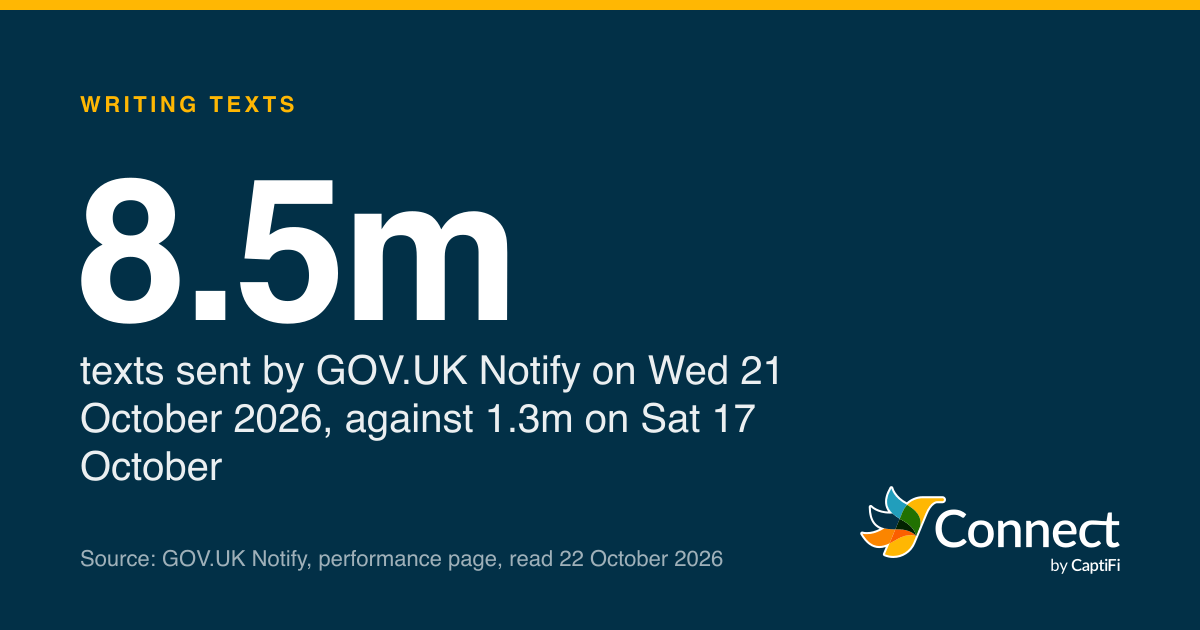
8.5m: texts sent by GOV.UK Notify on Wed 21 October 2026, against 1.3m on Sat 17 October. Source: GOV.UK Notify, performance page, read 22 October 2026.
No UK law says what time a business may send a text. The Privacy and Electronic Communications Regulations (PECR), which govern marketing texts, decide who you can text and what the message must contain; regulations 22 and 23 never mention the clock. The nearest thing to a time rule sits in the FCA's consumer credit rules: CONC 7.9.4 says a firm collecting a debt "must not contact customers at unreasonable times". So timing is a judgement, and the published data gives it a few fixed points. GOV.UK Notify, the government's own sending platform, sent 8,520,425 texts on Wednesday 21 October 2026 and 1,294,223 on Saturday 17 October.
That gap between weekdays and weekends is one of the clearer signals in the published data, and it says something about who's on the other end when the replies come in.
Is there a law on what time you can text customers?
Take PECR first. Regulation 22 says you can't send unsolicited marketing by electronic mail (which includes texts) to individuals without their consent, unless the soft opt-in applies. Regulation 23 says a marketing message mustn't disguise who sent it and must give "a valid address to which the recipient of the communication may send a request that such communications cease". Neither says a word about hours. A marketing text sent at 3am with consent and an opt-out breaks neither regulation, though it's a poor way to treat a customer. Our SMS marketing rules guide covers consent and the opt-out in full.
The FCA's rule is narrower and firmer. CONC 7, the chapter on arrears, default and recovery, applies to firms collecting consumer credit debts, and 7.9.4 reads in full: "A firm must not contact customers at unreasonable times and must pay due regard to the reasonable requests of customers (for example, customers who work in a shift pattern) in respect of when, where and how they may be contacted." It doesn't define unreasonable, and it doesn't fix hours. What it does do is make the customer's own stated preference count, and it names shift workers as the example. Our post on debt collection texts and the FCA rules goes through the rest of CONC 7.
So for most businesses the timing question is one of manners, with a regulator only in the background.
When organisations send: what GOV.UK Notify shows
GOV.UK Notify is the government's platform for sending texts, emails and letters, open only to public sector organisations such as central government departments, local authorities, the NHS, GP surgeries and state-funded schools, and it publishes its volumes every day. On 22 October 2026 its performance page showed 13.8 billion messages since May 2016, 5.7 billion of them texts, and a table for the previous seven days.
Texts sent through the government platform by public bodies. The page shows the last seven days only and updates daily.
Source: GOV.UK Notify, performance page, read 22 October 2026
See the figures as a table
| Text messages | |
|---|---|
| Thu 15 Oct | 5,232,207 |
| Fri 16 Oct | 3,652,086 |
| Sat 17 Oct | 1,294,223 |
| Sun 18 Oct | 1,501,584 |
| Mon 19 Oct | 4,601,700 |
| Tue 20 Oct | 5,055,313 |
| Wed 21 Oct | 8,520,425 |
The weekend dip is the obvious feature. Saturday 17 October had 1,294,223 texts and Sunday 1,501,584, against 3.65 million to 8.52 million on each weekday. Wednesday 21 October was the busiest day by a distance, and the page doesn't say why. The same page reports that 100% of messages on every one of those days were sent within 10 seconds of the request, which measures Notify's speed and tells you nothing about when anyone read them.
What this tells you is when public bodies choose to send. The bulk goes on working days, when the surgeries and council offices that will take the replies and the calls are open. That's a sensible model for any business whose texts generate questions: send when someone can answer them.
When people have their phones in hand
Ofcom is the obvious place to look for when people use their phones, and its figures only go so far. Its Online Nation 2025 report, published on 10 December 2025, found that UK adults spent an average of 4 hours 30 minutes a day online on personal devices in May 2025, up 10 minutes on a year earlier. It doesn't break adults' time down by hour of the day. The time-of-day figures in the report are about children: across YouTube, Snapchat, TikTok and WhatsApp, 15% to 24% of the time 8 to 14-year-olds spent on them was between 9pm and 5am, depending on the service. That's a finding about children's late-night use, and it says nothing about when an adult reads a dentist's reminder. (Nobody can measure that for texts anyway; there's no read signal in SMS, as our post on the 98% open rate myth explains.)
What the data can tell you is that "office hours" describes fewer of your customers than you'd think. The ONS looked at this in January 2023, using the Labour Force Survey question on whether people usually work during the day, the evening or the night. In 2022, 27% of the UK workforce, roughly 8.7 million people, usually worked in the evening or at night. Most of them (23% of the workforce) did so as well as day work, and 4% worked evenings or nights only.
- Evenings or nights, and days
- Evenings or nights only
Labour Force Survey. Respondents say whether they usually work days, evenings or nights. Eleven of the 19 industry sections shown, with shortened names.
Source: ONS, The night-time economy, UK: 2022, figure 6
See the figures as a table
| Evenings or nights, and days (%) | Evenings or nights only (%) | |
|---|---|---|
| Accommodation and food | 45.65 | 15.94 |
| Arts and entertainment | 41.13 | 3.46 |
| Transport and storage | 33.05 | 11.06 |
| Agriculture and fishing | 39 | 0.46 |
| Health and social work | 31.15 | 5.24 |
| Wholesale and retail | 22.18 | 6.27 |
| Admin and support services | 19.87 | 5.45 |
| Manufacturing | 17.77 | 3.65 |
| Education | 17.7 | 1.48 |
| Finance and insurance | 13.85 | 0.52 |
| Construction | 10.41 | 0.65 |
In accommodation and food, 61.6% of workers usually worked evenings or nights, and 15.9% never worked days at all. Transport and storage had 11.1% working evenings or nights only, and health and social work 5.2%. For someone working nights, a 10am text can land in the middle of their sleep. That's the case CONC 7.9.4 has in mind, and the fix it points to works for everyone: when a customer tells you when to contact them, record it and use it.
How far ahead should a reminder go?
For appointment reminders, the most specific published guidance in the UK comes from NHS screening. The Office for Health Improvement and Disparities' screening text message principles, updated on 5 April 2022, recommend two reminders for a timed appointment: one "7 to 10 days before the appointment to give someone the chance to add the details to their diary, and make necessary work or childcare arrangements", and one "close to the appointment (2 days in advance)", which is near enough that people don't forget but leaves time to offer the slot to someone else if they can't come.
The same guidance sets limits. It recommends "not sending more than 2 text messages before a specific appointment and only one text message after the appointment if the person did not attend", with the missed-appointment text sent "as soon as possible" and worded so it isn't accusatory. And it suggests a confirmation text "immediately after a booking has been made". Those are written for screening services, but the reasoning carries over to a salon or a garage: the early text gives people time to rearrange their week, and the late one catches the people who forgot. Our appointment reminders page has wording that follows the same pattern.
Here's how that plays out for a hypothetical dental practice in Leeds, open Monday to Friday. A patient is booked for 10:30 on Thursday 19 November 2026. The first reminder goes at 10am on Tuesday 10 November, nine days before, and the second at 10am on Tuesday 17 November, two days before. Both land on working days, at an hour when reception can pick up the replies, and a "can't make it" on the Tuesday still leaves Wednesday to fill the slot.
Now move the appointment to Monday 23 November. Two days before is Saturday 21 November, when the practice is shut. A reminder that says "reply to rearrange" on a day nobody reads the replies is worse than no reminder, because the patient thinks they've told you. The practical answer is to bring that text forward to the Friday, three days out, and accept the small departure from the guidance. The same goes for anything that falls on a bank holiday.
Three kinds of text, three timing rules
Most of the confusion goes away once you sort texts by who asked for them and when.
| Kind of text | When it should arrive | Why |
|---|---|---|
| Codes, alerts, "your driver is outside" | The moment it's triggered, at any hour | The person is waiting for it |
| Reminders and other service texts | Daytime on the day you choose, a set number of days before | Someone can act on it, and reply |
| Marketing and offers | Daytime, when the offer can be used | Nobody asked for it at that moment |
The first row needs no quiet hours at all. A verification code that waits until morning is a broken login. The second row is where scheduling earns its keep: a reminder calculated as "24 hours before a 9am appointment" goes at 9am the day before, which is fine, while one calculated from a 7am appointment goes at 7am, which may not be. Setting a fixed send time on the day before avoids that.
For marketing, our own suggestion (there's no rule behind it) is to send between about 9am and 8pm, on days when the customer can do something about the offer, and leave Sunday mornings alone.
Dates to check before you schedule
Two dates are close enough to matter as this is written. The clocks go back at 2am on Sunday 25 October 2026, according to GOV.UK, which is the one night of the year when an hour happens twice. Any reminder scheduled as a local time in that hour needs checking, and our post on scheduling texts around the clock change explains the fix. In March 2027 the clocks go forward on the 28th.
Then Christmas. GOV.UK's bank holiday list for England and Wales has Christmas Day on Friday 25 December 2026, with Boxing Day falling on the Saturday and the substitute bank holiday on Monday 28 December, then New Year's Day on Friday 1 January 2027. Scotland adds St Andrew's Day on Monday 30 November and a substitute holiday for 2 January on Monday 4 January. If you send weekly reminders on a Monday, the 28th is a day many of your customers won't be thinking about appointments, and a "see you tomorrow" sent on Christmas Eve may be about a business that's closed. Check the run of texts that falls across those two weeks before it goes.
CaptiFi Connect lets you schedule any text or campaign for a set date and time, and campaigns respect quiet hours you set, so a list send that runs late doesn't spill into the night. Notify's page only ever shows the last seven days, so the figures above will have moved on by the time you read this; the next weekend is the one to compare.
Sources
Read for this post on 22 October 2026.
- legislation.gov.uk: PECR 2003, regulation 22
- legislation.gov.uk: PECR 2003, regulation 23
- FCA Handbook: CONC 7.9, contact with customers
- GOV.UK Notify: performance data
- GOV.UK Notify: who can use Notify
- Ofcom: Online Nation 2025, published 10 December 2025
- ONS: The night-time economy, UK: 2022, released 24 January 2023
- OHID: NHS population screening, screening text message principles, updated 5 April 2022
- GOV.UK: When do the clocks change?
- GOV.UK: UK bank holidays
Written by the CaptiFi Connect team. Published 22 October 2026. More in Writing texts
Send your first text this week
Set up your account and contacts now. Until we've approved it, a person reads each text before it goes out.