
Writing texts8 min read
Texts when something goes wrong: recalls and closures
The FSA issued 96 allergy alerts and 66 recall notices in 2024/25. How to text customers about a recall, closure or outage, and still look nothing like a scam.
In short
- The Food Standards Agency published 96 allergy alerts and 66 product recall information notices in 2024/25, against 62 and 65 the year before.
- The FSA's guidance on recall notices asks for the reason for the recall, the product details and batch codes, what customers should do and a number to call.
- FSA recall guidance lists text and email alerts through retailer loyalty schemes among the channels for telling consumers about a food recall.
- Cabinet Office guidance on warning the public says a first alert may be a very basic message, with more detail given in later messages as an incident unfolds.
- The NCSC's signs of a scam message are authority, urgency, emotion, scarcity and current events, and a genuine recall or closure text often shows several of them.
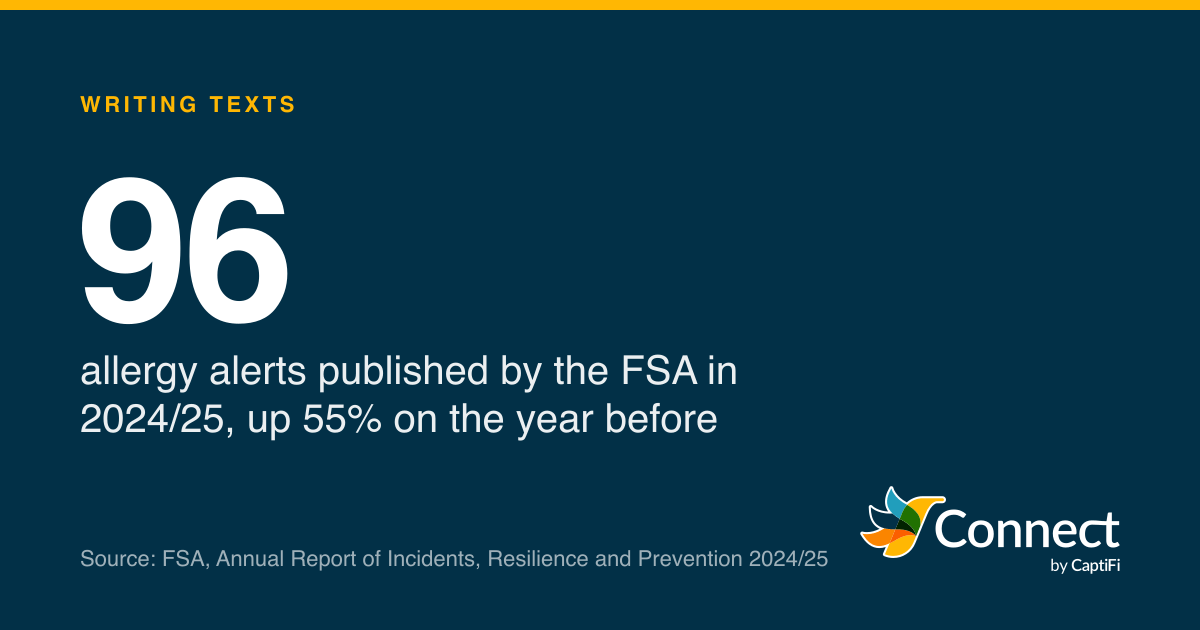
96: allergy alerts published by the FSA in 2024/25, up 55% on the year before. Source: FSA, Annual Report of Incidents, Resilience and Prevention 2024/25.
When something goes wrong, the first text should say what has happened, what the reader should do about it and where to check the details, in that order, from a name the reader already knows. That's the shape the Food Standards Agency (FSA) asks for in its guidance on recall notices, and the shape the Cabinet Office describes for warning the public in an emergency. The FSA published 96 allergy alerts and 66 product recall information notices in 2024/25, according to its annual report of incidents, and the 96 was a 55% jump on the year before.
Food has good published numbers and detailed guidance, so it's the main example here. The same approach works for a venue that has to close, a class that's cancelled or a booking system that has fallen over.
How often things go wrong
The FSA's Annual Report of Incidents, Resilience and Prevention for 2024/25 says it was notified of 1,825 food and feed safety incidents in England, Wales and Northern Ireland that year, 0.7% fewer than the 1,837 the year before. The count has drifted down from 2,478 in 2019/20, but the report says "the proportion classed as medium or high priority is increasing year on year".
Incidents notified to the FSA in England, Wales and Northern Ireland. Scotland is covered by Food Standards Scotland.
Source: FSA, Annual Report of Incidents, Resilience and Prevention 2024/25, figure A1
See the figures as a table
| Incidents | |
|---|---|
| 2018/19 | 2,323 |
| 2019/20 | 2,478 |
| 2020/21 | 1,978 |
| 2021/22 | 2,336 |
| 2022/23 | 2,038 |
| 2023/24 | 1,837 |
| 2024/25 | 1,825 |
Not every incident reaches the public. The ones that do become Food Alerts, which the FSA publishes "to notify consumers and businesses of food safety risks with particular foods": allergy alerts, and product recall information notices for other recalls. The report puts the 55% rise in allergy alerts down mainly to one case, peanut found in mustard at the end of 2024. Between 18 September and 20 November 2024 the FSA published three allergy alerts and 31 follow-up alerts, covering 59 brands and 307 individual products.
- Allergy alerts
- Product recall notices
Financial years. Values read from the labels on figure A3. Food Alerts for Action, which go to local authorities, are left out (none to six a year).
Source: FSA, Annual Report of Incidents, Resilience and Prevention 2024/25, figure A3
See the figures as a table
| Allergy alerts | Product recall notices | |
|---|---|---|
| 2018/19 | 120 | 78 |
| 2019/20 | 104 | 67 |
| 2020/21 | 67 | 72 |
| 2021/22 | 84 | 66 |
| 2022/23 | 82 | 61 |
| 2023/24 | 62 | 65 |
| 2024/25 | 96 | 66 |
That mustard case is worth a second look, because it's what a recall looks like from the inside: 34 alerts over about two months, covering 307 products by the end. A business caught up in something like that needs a first text that's right as far as it goes, and a way to send the next one.
Outside food, the Office for Product Safety and Standards (OPSS) publishes recalls and safety notices for other consumer products on GOV.UK, and points businesses to PAS 7100:2022, the code of practice on product recalls that OPSS sponsored and BSI published, which came into effect on 31 March 2022. Its annexes include guidance on the content and layout of corrective action announcements.
What the first text should say
The FSA's guidance on food traceability, withdrawals and recalls has an annex of "key principles and best practice" for recall notices, written for point of sale posters but just as useful for a text. It asks for:
- the reason for the recall, under a title that says "what this is and what the danger or risk to consumers is"
- product details: brand, product name, pack size, dates and batch codes
- how to identify the product, such as where the date is printed
- clear direction on what to do: "Do not eat this product", return it, how to get a refund
- where to go for more information, with a contact number
It also says that consumers "prefer language that is simple and easily understood", and its suggested wording for a missing allergen follows the pattern "X product is being recalled because it contains" the allergen "which is not mentioned on the label". Where the problem isn't confirmed, it suggests "may contain", and it warns that this softer wording "should not be used in any incident where product is known to be contaminated".
A text can't carry a photograph or a full batch list, so the job is to get the essentials into the message and link to the rest. For a hypothetical deli:
"Hartley's Deli: we're recalling our hummus (use by 6 Nov). It contains sesame, which isn't on the label. If you're allergic to sesame, don't eat it. Refund in store. example.co.uk/recall"
That's 186 characters, two SMS parts, and a recall is the one time the second part is easily worth it. Name first, then the product and the date that identifies it, then the reason in the FSA's plain form, then what to do, then where the full details live. The FSA's guidance lists "text/e-mail alerts" through retailer loyalty schemes as one of the channels for a recall, alongside notices at the tills, the retailer's website and social media. If you hold customers' mobile numbers because they bought from you, a text reaches the ones who already have the product at home.
If the recall grows, as the mustard one did, the follow-up should say plainly that it updates the first text, so nobody wonders whether it's a second, separate problem: "Hartley's Deli: update to our text of 4 Nov. The hummus recall now also covers use by 13 Nov. Same advice: don't eat it if you're allergic to sesame." Send it to the people who could have bought the newly added batches, and skip anyone the first text already covered in full.
Keep offers out of it. A recall or closure notice about something a customer bought is a service message. The moment it adds "and 10% off your next visit" it becomes marketing, and the consent rules for marketing apply to the whole text.
Closures, cancellations and outages
The Cabinet Office's guidance on communicating with the public, last updated in March 2012, was written for emergency responders, but two paragraphs translate well to a business. On speed: responders "should issue an early warning or alert of an incident as quickly as possible", and because information may be short at first, "the warning/alert will be restricted to a very basic message". On what follows: "As the incident unfolds, more detail can be given". Later messages should cover what's being done, what people themselves can do and "details of how further information can be obtained".
For a business, that becomes a first text with what you know now and a promise about when the next one will come. A hypothetical restaurant on a Saturday morning:
"The Granary, Frome: we're closed today, Sat 7 Nov, after a burst pipe, so your 7pm table is cancelled. Your deposit will be refunded. Next update by 4pm."
At 153 characters it fits one part. It says what's shut and when, what happens to the booking and the money, and when the customer will hear again. Then keep the promise, even if the news is that there's no news:
"The Granary, Frome: update at 4pm. The pipe is fixed and we reopen tomorrow (Sun 8 Nov) from 9am. Reply REBOOK and we'll find you a new table."
Outages work the same way, with one extra rule: text only the people the outage affects. If the online booking system is down for a morning, the customers who need to know are the ones with appointments today:
"Northgate Physio: our online booking is down this morning. Your 11:15 appointment today still stands. To change it, call 01632 960456 until we're back up."
Sending that to the whole list would just worry people who weren't going to book anyway. And if the problem is with your phone lines, say so, and make the text the place to reply.
| Situation | First text | Follow-up |
|---|---|---|
| Product recall | Product, identifying date or batch, reason, what to do, link to details | Only if the list of products changes |
| Closure | What's closed, from when, bookings and refunds, time of next update | At the time you promised, then on reopening |
| Cancellation | What's cancelled, refund or rebooking, who to contact | When the new date is set |
| Outage | What isn't working, what still stands, the other way to reach you | When it's fixed |
Why a genuine alert can look like a scam
The National Cyber Security Centre's guide to spotting scams lists five signs to watch for in a message: authority (it claims to be from someone official), urgency (a limited time to respond), emotion (it makes you panic or fear), scarcity and current events (a message tied to news or a big event). Read that list next to a recall text. "Don't eat this, it may make you ill, act now, here's a link" has three or four of the five. A genuine alert and a scam can share most of their structure, so the difference has to come from details the reader can check.
The NCSC's advice to the public is to check through a route they already trust: if in doubt, "contact the organisation directly", and don't use the numbers or address in the message but "use the details from their official website". So write your alert to survive that check:
- Put the same notice on your website and at the counter before the text goes, so anyone who checks finds it.
- Use your own web address in the text, one people can type from memory, never a link shortener from a domain they don't recognise. Our post on links in texts covers this in detail.
- Never ask for card details, bank details or passwords by text. Refunds can go back to the card that paid.
- Send from the name or number your customers already get texts from. A recall from a sender name they've never seen before is a hard sell.
- Keep the tone flat. "Is being recalled because" reads as a notice; capital letters and "URGENT" read as phishing.
Then let people reply. A two-way number turns "is this real?" into a question you can answer in a minute, and each reply tells you one more person has seen it.
CaptiFi Connect can send one text to a list imported from a CSV, such as everyone who bought a product in a given week, bring the replies back to a two-way inbox for the team to answer, and keep a delivery report for each message, a record of whose phone the notice reached and when. Replies only come back on texts sent from a number, so use one for anything people may need to answer. The FSA's mustard case ran to 34 alerts over 63 days, so plan the second and third texts when you write the first.
Sources
Read for this post on 22 October 2026.
- FSA: Annual Report of Incidents, Resilience and Prevention 2024/25 (board paper FSA 25/06/09)
- FSA: Food incidents, product withdrawals and recalls
- FSA and FSS: Guidance on food traceability, withdrawals and recalls within the UK food industry, March 2019
- OPSS: Product recalls and alerts
- BSI: PAS 7100:2022, Product recall and other corrective actions, code of practice
- Cabinet Office: Emergency preparedness, chapter 7, communicating with the public
- NCSC: Phishing scams, how to spot scam messages or calls
Written by the CaptiFi Connect team. Published 22 October 2026. More in Writing texts
Send your first text this week
Set up your account and contacts now. Until we've approved it, a person reads each text before it goes out.