
Writing texts7 min read
Accessible text messages: writing for every customer
One in four people in the UK are disabled, and the NHS standard calls texts a highly effective format for many of them. How to write texts everyone can use.
In short
- The Family Resources Survey counted 16.7 million disabled people in the UK in 2024-25, 25% of the population, according to DWP's release of 26 March 2026.
- NHS England's Accessible Information Standard, revised and republished on 30 June 2025, says texts can be a highly effective format for many people with a disability, impairment or sensory loss.
- Under the Equality Act 2010, a service provider's duty to make reasonable adjustments is owed to disabled people generally, which NHS England describes as an anticipatory duty.
- The Survey of Adult Skills found 18% of adults in England had low literacy in 2023, meaning they struggle with longer texts that contain distracting information.
- The GOV.UK style guide warns that screen reading software can read 'eg' aloud as 'egg', and advises writing 'for example' instead.
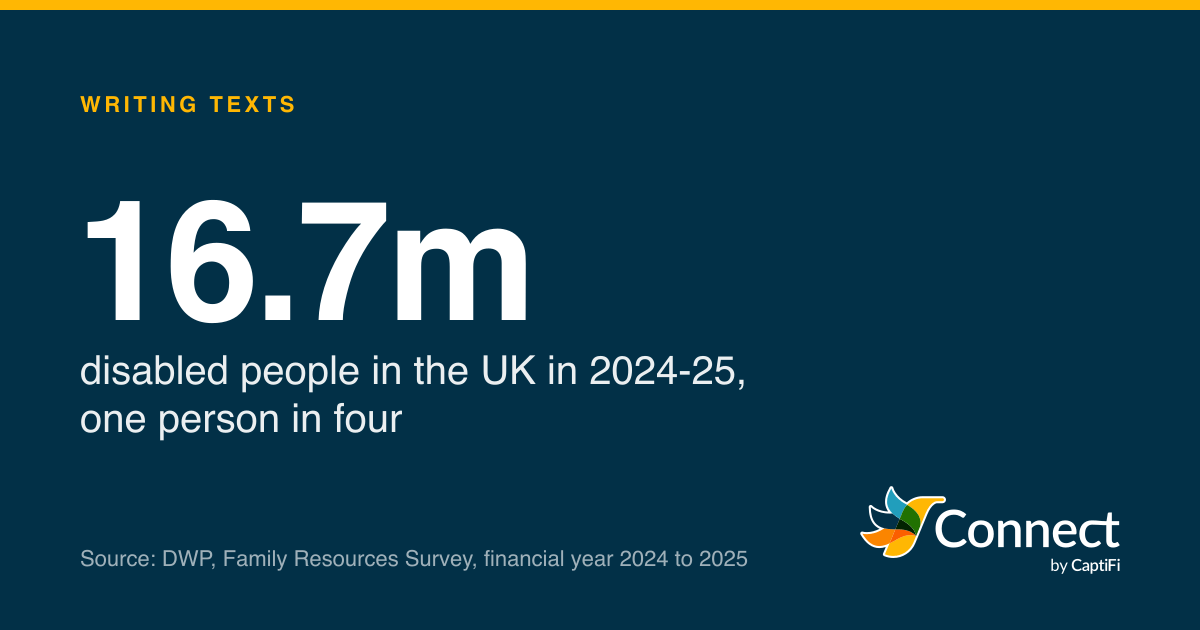
16.7m: disabled people in the UK in 2024-25, one person in four. Source: DWP, Family Resources Survey, financial year 2024 to 2025.
One person in four in the UK is disabled. The Department for Work and Pensions' Family Resources Survey, published on 26 March 2026, counted 16.7 million disabled people in 2024-25, 25% of the population, up from 12.9 million (20%) ten years earlier. Many of them get on well with text messages: NHS England's revised Accessible Information Standard, republished on 30 June 2025, says that "for many people with a disability, impairment or sensory loss, emails and text messages can be a highly effective format." Whether a particular text works for them comes down to how it's written, and to whether they can answer it without picking up the phone.
Who reads your texts?
The survey uses the Equality Act definition of disability: a physical or mental impairment with a "substantial" and "long term" effect on normal daily activities. Ask disabled people what kind of impairment they have and the answers spread widely. Mobility comes top, then stamina, breathing or fatigue, then mental health.
All disabled people in private households, sample of 9,400. People can report more than one impairment, so the shares add up to more than 100%. The 18% reporting another impairment are left off.
Source: DWP, Family Resources Survey 2024 to 2025, disability data tables (table 4.6)
See the figures as a table
| Disabled people (%) | |
|---|---|
| Mobility | 46 |
| Stamina, breathing or fatigue | 35 |
| Mental health | 33 |
| Dexterity | 24 |
| Social or behavioural | 17 |
| Learning | 16 |
| Memory | 15 |
| Hearing | 12 |
| Vision | 12 |
Several of those lines matter directly to a text. Vision, at 12% of disabled people, can mean screen readers and magnified screens. Dexterity (24%) can mean fiddly typing and small buttons. With learning (16%) and memory (15%) impairments, a text that asks for two things, or depends on remembering an earlier message, is easy to lose track of. The shares change with age, too: among disabled pensioners, 68% reported a mobility impairment and 23% a hearing one, while among disabled children 61% reported a social or behavioural impairment.
Reading is the other half of it. The Department for Education's Survey of Adult Skills, published on 10 December 2024, found 18% of adults in England had low literacy proficiency, scoring at Level 1 or below. The report's description of that group is useful to anyone writing a template: they "struggle to complete tasks involving longer texts with distracting information".
- Below Level 1
- Level 1
Adults aged 16 to 65 in private households. Level 1 or below counts as low proficiency. The report rounds the 55 to 65 total to 24%.
Source: DfE, Survey of Adult Skills 2023, national report for England (figure 13)
See the figures as a table
| Below Level 1 (%) | Level 1 (%) | |
|---|---|---|
| 16-19 | 1 | 9 |
| 20-24 | 3 | 10 |
| 25-34 | 4 | 7 |
| 35-44 | 6 | 11 |
| 45-54 | 10 | 13 |
| 55-65 | 8 | 17 |
Low literacy is more common among older working-age adults, 24% at 55 to 65 against 10% at 16 to 19, and the survey links higher literacy with "not having a health problem or disability which limited day-to-day activities". Put the two surveys together and the brief for a business text is short, plain and about one thing.
What does the law ask of a business?
Section 20 of the Equality Act 2010 sets out the duty to make reasonable adjustments in three requirements: changing a provision, criterion or practice that puts disabled people at a substantial disadvantage, dealing with physical features, and providing auxiliary aids. Two details in it bear on texting. Where the requirement "relates to the provision of information", the reasonable steps include "ensuring that in the circumstances concerned the information is provided in an accessible format". And a business can't charge the disabled person for the cost of the adjustment.
For services, schedule 2 of the Act adds a detail. The reference to a disabled person is "to disabled persons generally". The duty is owed in advance, to disabled customers as a group, so a business is expected to plan for them before any particular customer asks. NHS England's page on the standard calls this "an anticipatory legal duty on all service providers". The Act covers England, Wales and Scotland.
In practice that rarely means anything expensive for a texting business. It means a reminder that a screen reader can read, a way to reply that doesn't need a phone call, and noticing when someone has told you that texts don't work for them.
What the NHS standard asks of health and care providers
The Accessible Information Standard has been in force since August 2016, and NHS England says it was "reviewed, updated and re-published in 2025". Under section 250 of the Health and Social Care Act 2012, all organisations that provide NHS care or adult social care are expected to follow it, and the standard names general practice, community pharmacy, dental and optometry services among them. Its six steps are to identify, record, flag, share, meet and review people's information and communication needs, and the 2025 version added the sixth, review.
Three of its requirements are about contact. Organisations "must ensure people are able to access their services by having accessible contact methods in place". The implementation guidance says services must offer "at least 1 communication or contact method that is accessible to and useable by the person", that staff must use it to contact them, and that text messages are one example. And it warns against one channel for everyone: "many service users, including those who are deaf or have some hearing loss, will not be able to use a telephone to book an appointment or receive test results."
The guidance also separates needs from preferences, which is worth borrowing outside the NHS. "If an individual uses a screen reader, a preference for receiving material via email or text message will help meet their needs." So the standard asks for the need to be flagged on the record, where staff and systems will see it, and for "requests to change contact or communication preferences" to be "actioned accurately and promptly". It even gives a sample text for a GP surgery to send: "We want to improve how we communicate with you and anyone who supports you. Please tell us if you need information in a different format or need other communication support."
Writing a text a screen reader can read
NHS England's guidance notes that texts "can often be 'read-aloud' by blind people and people with visual loss". When a message is heard, its start matters even more than usual, and some written shortcuts stop making sense.
Put the sender name first and the one important thing next. The GOV.UK Service Manual says to "get the most important information across in the first sentence" and to "say only one important thing in each message", which suits a listener as well as a reader.
Spell things out. GOV.UK's A to Z style guide notes that "'eg' can sometimes be read aloud as 'egg' by screen reading software" and recommends "for example" instead. Its rule for other abbreviations is to explain them in full the first time, and a 160-character text rarely has room for a second time, so appt, w/c and tmrw are better written out. Write dates as "Monday 9 November", without ordinals, and times as "10:30am".
Don't shout. The style guide puts it in capitals to make the point: "DO NOT USE BLOCK CAPITALS FOR LARGE AMOUNTS OF TEXT AS IT'S QUITE HARD TO READ."
Watch the negatives. GOV.UK advises against negative contractions like "can't" and "don't" because "many users find them harder to read, or misread them as the opposite of what they say". "If you cannot come" survives a quick skim; "can't make it?" sometimes doesn't.
Show where links go. The Service Manual tells government services to "spell out any web addresses (URLs) in full to show the user where links are going" and to avoid redirects. A full address like example.co.uk/book tells the reader where it goes, and a shortened code doesn't. Our guide to links in texts covers the trust side of that.
| Instead of | Write | Why |
|---|---|---|
| Appt w/c 9/11 | Appointment on Monday 9 November | GOV.UK says to explain abbreviations in full |
| Bring ID eg passport | Bring photo ID, for example a passport | Screen readers can say "egg" |
| PLEASE CONFIRM NOW | Please reply YES to confirm | Block capitals are harder to read |
| Can't make it? | If you cannot come, reply NO | Negative contractions get misread |
| Tap bit.ly/3kQz | Book at example.co.uk/book | A full address says where it goes |
Writing for dyslexia, memory and limited reading
Most of the same habits help here, with a few more. Keep sentences short and words everyday. Ask for one action, and make it the last thing in the text so it's fresh when the reader finishes. Don't rely on an earlier message ("as mentioned yesterday"), because someone with a memory impairment may not have it to hand. Repeat the essentials instead: who, when, where, what to do.
Keep it to one SMS part where you can. Partly that's cost (a long message is billed as several), but mostly it's the survey finding: longer texts with distracting information are exactly where low-literacy readers struggle. Our post on writing texts the way GOV.UK writes has the rest of GOV.UK's plain English rules, and writing for older customers covers basic handsets and small screens.
Let people answer without a phone call
"Call us to rearrange" is a common line in reminders, and for a Deaf customer it's a dead end. The NHS standard says as much about booking by telephone. A text that can be answered by text ("Reply YES to confirm or NO to cancel") works for them, provided the reply reaches a person who acts on it.
Then record what people tell you. If a customer says texts don't work for them (because they can't see the screen, or a carer reads their messages), note it where staff will see it and stop texting them. If someone says texts are the only thing that works, note that too, and don't fall back to a phone call when it's convenient.
CaptiFi Connect puts replies in a shared two-way inbox, where replies are free, and handles STOP and other opt-out words automatically. The character counter shows whether a template fits in one part before it goes out.
The sample line in the NHS guidance is a good one to borrow, whatever your business: ask people, once, whether they need information in a different format, note the answer where staff will see it, and write the next text accordingly.
Sources
Read for this post on 22 October 2026.
- DWP: Family Resources Survey, financial year 2024 to 2025
- DWP: Family Resources Survey 2024 to 2025, data tables
- DfE: Survey of Adult Skills 2023, national reports for England
- legislation.gov.uk: Equality Act 2010, section 20
- legislation.gov.uk: Equality Act 2010, schedule 2, paragraph 2
- NHS England: Accessible information standard, about the standard
- NHS England: Accessible information standard, requirements (DAPB1605)
- NHS England: Accessible information standard, implementation guidance
- GOV.UK: A to Z style guide
- GOV.UK Service Manual: Sending emails and text messages
Written by the CaptiFi Connect team. Published 22 October 2026. More in Writing texts
Send your first text this week
Set up your account and contacts now. Until we've approved it, a person reads each text before it goes out.