
Writing texts8 min read
Reply Y to confirm: designing texts people answer
NHS England says reminders work better when patients can reply to cancel. How to write texts that get usable answers: one question, clear options, a deadline.
In short
- NHS England's guidance on reducing missed outpatient appointments, published in February 2023, says providers see better results when patients can reply to a reminder to cancel.
- GOV.UK Notify charges the services that use it nothing to receive text replies, while the people replying pay their standard text message rate.
- A 2020 review of GOV.UK Notify data by the Government Digital Service found that a third of teams that let people text them never received any replies.
- The GOV.UK Design System recommends asking one question per page and letting people answer that they do not know or are not sure, where that is a valid answer.
- In NHS England's autumn and winter 2025 vaccination campaign, 46% of patients sent a text message responded to the request, against 61% for NHS App messages and 42% for letters.
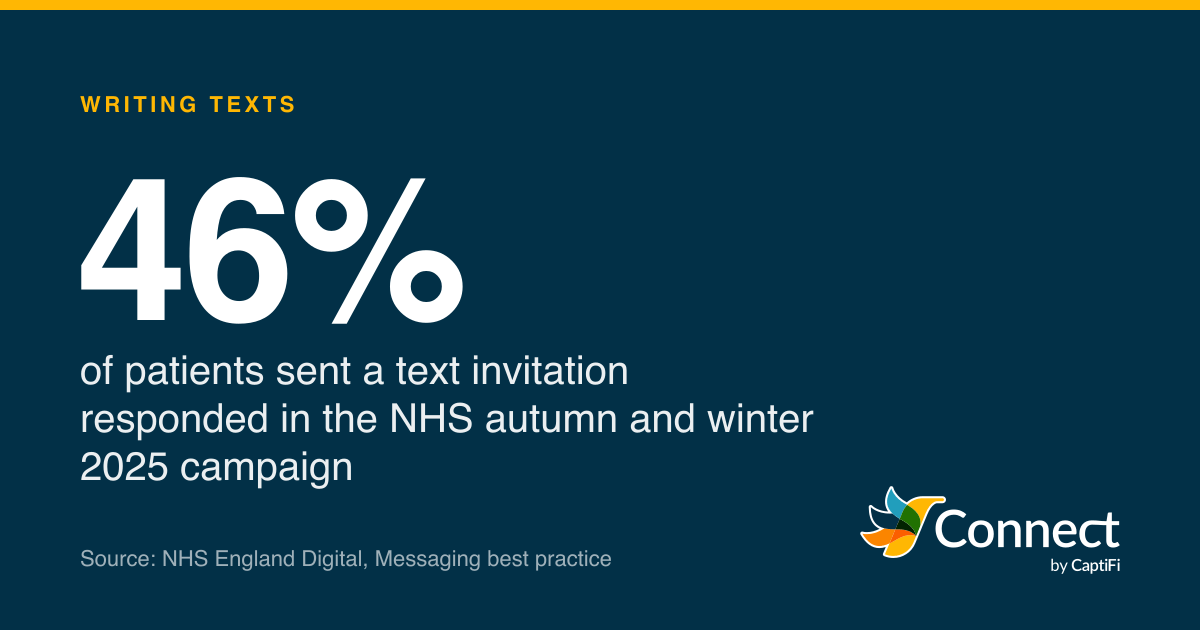
46%: of patients sent a text invitation responded in the NHS autumn and winter 2025 campaign. Source: NHS England Digital, Messaging best practice.
A text gets a usable reply when it asks one question, tells people exactly what to send back (YES or NO, or a number), gives a deadline, and lands somewhere that acts on the answer. NHS England's guidance on reducing missed outpatient appointments, published in February 2023, explains why it's worth the trouble: "Providers have told us that they see better results when communication is 'two way' (i.e. patients can reply to cancel their appointment), and patients also told us that they like this." The same guidance sets a floor for every provider: appointment reminders, and "an easy option to cancel and rearrange appointments".
Most of the effort is in the wording, and most of the mistakes are small ones: two questions in one text, an open-ended "let us know", a reply word that means something else to the system receiving it. The NHS and GOV.UK publish guidance for their own messages that covers nearly all of it.
Why let people reply at all?
A text that can be answered turns a notice into a conversation, and the answer is the useful part. A confirmed appointment is one you don't need to chase. A cancellation that arrives on Monday is a slot you can offer to someone else before Thursday. Our post on appointment reminder wording covers the trials that measured what the words in a reminder do to attendance.
For the person replying, it's the simplest way to answer. GOV.UK Notify, which public services use to send texts, puts the arrangement simply on its page about receiving texts: "It does not cost you anything to receive text messages. Your users will pay their standard text message rate." A reply goes to the same number the text came from, so nobody has to find a phone number or wait in a queue.
Letting people reply doesn't mean they will. In 2020 the Government Digital Service looked at how teams used Notify and found that "a third of teams that let recipients send them text messages never get any replies". The post was careful to add that it couldn't say whether that was good or bad until it knew whether those teams expected replies. One sure way to get a silent inbox is to send texts that never ask a question.
For a benchmark of what a single request by text achieves, NHS England's messaging guidance publishes figures from its national vaccination campaign. During autumn and winter 2025, 46% of patients who were sent a text message responded to the request, against 61% for NHS App messages and 42% for letters. That measures people acting on the invitation, which is a different thing from replying, but it shows a text holding its own against a letter.
NHS England's measure is patients who 'responded to the request' in its national vaccination campaign, autumn and winter 2025.
Source: NHS England Digital, Messaging best practice, performance data
See the figures as a table
| Responded (%) | |
|---|---|
| NHS App message | 61 |
| Text message | 46 |
| Letter | 42 |
One question per text
The GOV.UK Design System, which sets the patterns for government online forms, has a rule for question pages that transfers directly: "Start by asking one question per page." The reasoning applies just as well to a text: "Asking just one question per question page helps users understand what you're asking them to do, and focus on the specific question and its answer." NHS England's messaging guidance says the same about actions, "try to only include one action for the recipient to take", and the NHS service manual asks for texts that "contain a clear action that patients can follow".
Here's a reminder that breaks the rule:
Hi, just a reminder about your appointment on Thursday. Let us know if you can make it, or if not when would suit you better? Thanks, Crown Dental
It asks two things (can you make it, and if not, when), the second one invites any answer at all, and the sender's name comes last. Replies will range from "yes" to "can I do the 26th after school" to "who is this", and each needs a person to read it. Compare:
Crown Dental: your check-up is on Thursday 19 November at 10:30am. Reply YES to confirm or NO if you cannot come.
That's 113 characters, one question, two possible answers. Rebooking is a second conversation, started once you know who said no. The GOV.UK Service Manual's advice on messages backs that split: "Say only one important thing in each message. If you have several important things to say, send more than one message."
Designing the answers: words, letters or numbers
There are three common ways to ask for an answer, and each suits a different question.
| Reply format | Good for | Example |
|---|---|---|
| YES or NO | Confirming something already booked | Reply YES to confirm or NO if you cannot come |
| A number | Choosing between a few fixed options | Reply 1 for Tuesday at 9am or 2 for Wednesday at 3pm |
| A keyword | Joining a list or asking for something | Reply BOOK and we will call you |
Whole words leave less room for doubt than single letters. A single "C" can mean confirm or cancel depending on who wrote the template, which is a good reason to avoid it. Numbers work when the options need words of their own:
Crown Dental: we need to move your check-up on Thursday 19 November. Reply 1 for Tuesday 24 November at 9am or 2 for Wednesday 25 November at 3pm.
That's 146 characters and one part, with the full dates written out. Two or three options is about as many as a text can carry before it runs into a second part or gets hard to read on a lock screen.
Be careful with the words you choose, because some replies carry a meaning of their own. CaptiFi Connect opts a number out automatically when the reply is STOP, STOPALL, STOP ALL, UNSUBSCRIBE, CANCEL, END, QUIT, OPTOUT or OPT OUT. That makes "Reply CANCEL to cancel your appointment" a trap: the person cancels every future text along with the appointment, including the reminder for the rebooked one. Use NO for a cancellation instead. Our guide to STOP replies explains what happens to an opted-out number.
The Design System has one more rule worth borrowing. Every question page should "allow users to answer 'I do not know' or 'I'm not sure' if they are valid responses". A text can't offer a third button, but it can offer an escape route for anyone the options don't fit: a phone number, or a line saying that any other reply goes to a person.
What to do with "yes thanks see you then"
People don't reply like forms. Ask for YES and you'll get "Yes", "yes.", "Y", "yep", "Yes thanks see you then" and a thumbs up, along with "yes but can I come at 11" and "Is this Crown Dental?". A reply system needs a rule for each kind.
- Match the clear answers, and only those. YES, Y, YES PLEASE and YES THANKS are confirmations; NO and N are cancellations. A rule that accepts any reply starting with YES will also catch the next example, so test your rules on the sort of replies above before they go live.
- Send everything else to a person. "Yes but can I come at 11" contains a YES and means something quite different. A rule that confirms it automatically is worse than no rule.
- Answer the answer. A short automatic reply ("Crown Dental: thanks, you are confirmed for Thursday 19 November at 10:30am. See you then.") tells the person their text arrived and saves them sending a second "did you get my message?".
- Read the inbox the same day. A reply asking to move the appointment is a cancellation that hasn't happened yet, and it's only useful while there's time to fill the slot.
NHS England's guidance adds a point about access that's easy to miss: "if patients can only cancel or amend appointments by sending links via text message, this does not take into consideration those without a mobile phone." Keep the phone route open alongside the reply.
Questions a text should never ask
NHS England's checklist for testing messages ends with a short line: "never ask for personal information". The GOV.UK Service Manual says the same thing as part of protecting people from spam and phishing, telling services to "avoid making requests for personal information, like a user's date of birth". A reply flow is the obvious place to break that rule without meaning to ("Reply with your date of birth to confirm it's you"), and it's exactly what a scam text would ask.
The Design System adds a related rule for forms: "Make sure to only ask for a piece of information once within a single journey." In a text conversation you already know which number replied, and that's usually all the identification a confirmation needs. If a reply needs a proper identity check (a change of address, a payment), move it to a phone call or a signed-in website.
Deadlines and timing
The Service Manual asks every message to "make it clear what you need the user to do and include any deadlines", and to "say what will happen if they don't do what you're asking". In a confirmation request that's half a sentence:
Crown Dental: your check-up is on Thursday 19 November at 10:30am. Reply YES to confirm by 6pm on Tuesday 17 November, or NO if you cannot come.
At 144 characters that's still one part, and the deadline leaves a day and a half to offer an unconfirmed slot to someone else. Saying what happens after the deadline (a phone call, or the slot being offered to someone on the waiting list) is fair, provided it's what really happens.
When the text arrives matters too. NHS England's messaging guidance warns that "patients are less likely to respond to a message if they are irritated or annoyed by it", and that "some may become anxious if they are unable to respond immediately". It asks senders to consider "if you are expecting a response from the patient and within what timeframe", and notes that NHS Notify only sends text messages between 8am and 6pm on weekdays. A request for a reply works best when the person can answer it there and then, and when someone at your end is around to read the answer.
CaptiFi Connect is built for this kind of exchange: replies come back to the same number and appear in a two-way inbox, they're free to receive, and keywords can send an automatic reply to a YES or a BOOK while everything else waits for a person. STOP and the other opt-out words are handled automatically, which is why none of them should be the answer to any question except whether someone wants to stop getting your texts.
The best test of a question text is the replies to the first hundred. If more than a handful need a person to work out what they mean, the question had more than one answer in it.
Sources
Read for this post on 22 October 2026.
- NHS England: Reducing did not attends (DNAs) in outpatient services, 2 February 2023, updated 15 August 2023
- NHS England Digital: Messaging best practice
- NHS digital service manual: Writing NHS messages
- GOV.UK Notify: Receive text messages
- GDS blog: Can GOV.UK Notify help the public sector write better emails, text messages and letters?, 18 August 2020
- GOV.UK Design System: Question pages
- GOV.UK Service Manual: Sending emails and text messages
Written by the CaptiFi Connect team. Published 22 October 2026. More in Writing texts
Send your first text this week
Set up your account and contacts now. Until we've approved it, a person reads each text before it goes out.