
By the numbers8 min read
Rural mobile not-spots: will your text get through?
Ofcom's January 2026 data puts 3.8% of UK land out of 4G from every network, and 9.2% of Scotland. Where the gaps are, and why a text often still arrives.
In short
- Ofcom's Connected Nations data for January 2026 shows 3.79% of UK land with no 4G signal from any of the four mobile networks, rising to 9.18% of Scotland.
- In Powys, 4.49% of the land had no 4G from any network in January 2026 and 72.98% had 4G from all four, according to Ofcom's local authority data.
- Ofcom describes 'variable' outdoor coverage as usually enough for voice and texts, and in July 2025 it covered 94% of Powys from at least one network, against 81% at the 'good' level.
- Under the Shared Rural Network each of the four operators must provide good 4G coverage to 89.2% of the UK landmass by 31 January 2027, a target cut from 90% in July 2025.
- Ofcom's July 2025 figures put indoor 4G coverage of rural premises at 78% to 84% depending on the operator, against 97% to 99% in urban areas.
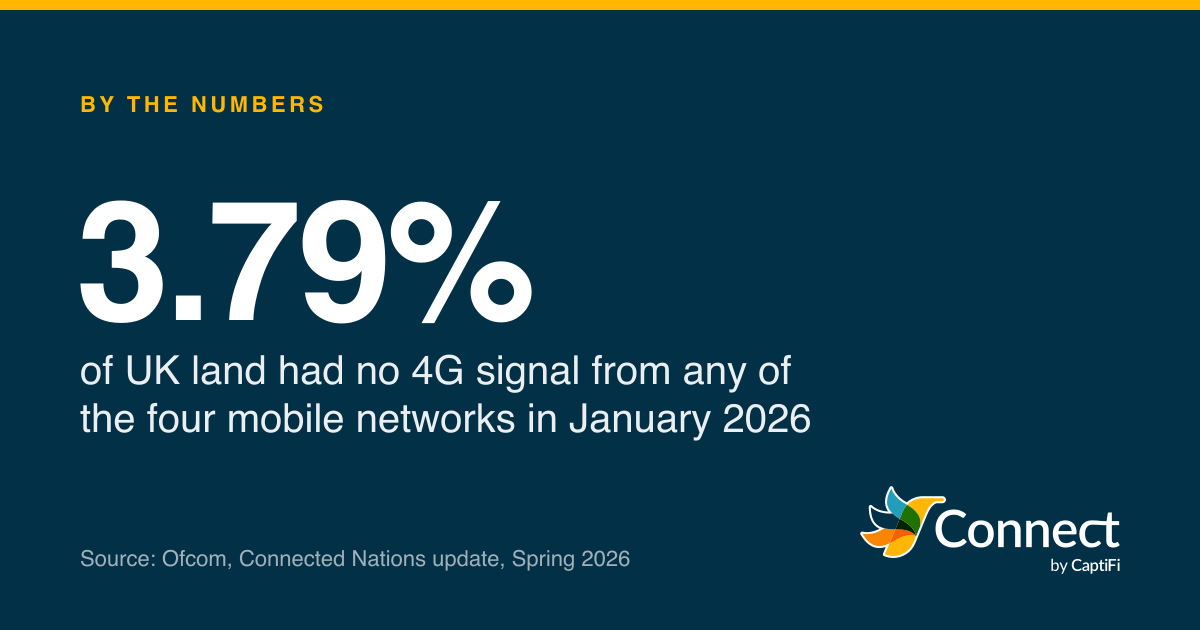
3.79%: of UK land had no 4G signal from any of the four mobile networks in January 2026. Source: Ofcom, Connected Nations update, Spring 2026.
A text will reach a farm in Powys if the farmhouse is in signal from the customer's own network, and on Ofcom's latest figures that's the case for most of the county but not all of it. Ofcom's Connected Nations update, published on 13 May 2026 with operator data for January 2026, shows 4.49% of the land in Powys with no 4G signal from any of the four networks, and only 72.98% with 4G from all four. Across the UK, 3.79% of the land had no 4G from anyone, a little over 9,200 square kilometres, most of it in Scotland.
Coverage figures are built around data speeds. A text needs much less, and Ofcom's own coverage checker says so.
How much of the UK has no mobile signal?
Ofcom measures coverage by dividing the country into 100m squares and asking the four operators (EE, O2, Three and Vodafone) to predict the signal in each. For 4G a square counts as covered outdoors if the predicted signal is at least -105 dBm. Coverage "from at least one" network means any of the four reaches it; coverage "from all four" means every one does, which is what matters if you don't know which network your customer uses.
In January 2026, 96.21% of UK land had 4G from at least one network and 83.58% from all four. Ofcom's Spring 2026 update notes the all-four figure was up three percentage points on July 2025. The squares with no 4G from anyone are far from evenly spread.
Share of 100m by 100m squares with no predicted outdoor 4G signal of at least -105 dBm from EE, O2, Three or Vodafone. Operator data with a reference date of 1 January 2026.
Source: Ofcom, Connected Nations update Spring 2026, mobile coverage data (UK and nations file)
See the figures as a table
| No 4G from any network (%) | |
|---|---|
| Scotland | 9.18 |
| Wales | 2.79 |
| Northern Ireland | 1.19 |
| England | 0.97 |
| UK | 3.79 |
Scotland has 9.18% of its land outside 4G from every network, which by Ofcom's square count is about 7,200 square kilometres. Wales has 2.79%, Northern Ireland 1.19% and England 0.97%. The all-four figures run the other way: 91.37% of England, 86.65% of Northern Ireland, 79.82% of Wales and 71.11% of Scotland. Those are shares of land, though. Ofcom's Connected Nations 2025 report, published on 19 November 2025, found outdoor 4G from every operator at 99% of UK premises, and 94% of rural premises, because people mostly live where the masts are.
Powys, square by square
Powys is a useful test case: the largest county in Wales by Ofcom's count, at 519,504 squares (about 5,200 square kilometres), with 71,508 premises. Ofcom's local authority file breaks its coverage down by how many networks reach each square.
Outdoor 4G at -105 dBm or better, across the 519,504 100m squares Ofcom counts in Powys. Reference date 1 January 2026.
Source: Ofcom, Connected Nations update Spring 2026, mobile coverage data (local authority file)
See the figures as a table
| Share of land (%) | |
|---|---|
| No network | 4.49 |
| One network | 5.9 |
| Two networks | 5.65 |
| Three networks | 10.97 |
| All four networks | 72.98 |
So 4.49% of Powys, about 230 square kilometres, has no 4G from any network. Another 5.9% has it from only one, 5.65% from two and 10.97% from three. Six months earlier, in July 2025, the no-network share was 5.43% and the all-four share 69.65%, so the gaps are closing, if slowly. Put the middle three bands together and more than a fifth of the county has 4G from some networks but not others, which is where "will my text get through?" becomes "which network is the customer on?". The networks aren't level across Wales either. In January 2026 Three's 4G covered 92.86% of Welsh land, EE's 90.47%, Vodafone's 90.32% and O2's 85.19%.
At the front door the picture is better. Only 0.48% of Powys premises had no outdoor 4G from any network in January 2026. Indoors it's 3.18%, which is roughly 2,300 homes and businesses, and only 75.43% of Powys premises had indoor 4G from all four. On A and B roads, 5.45% of the road squares had no in-car 4G from any network. For comparison, Highland, the largest council area in Scotland, had 16.26% of its land outside 4G from every network. Nationally, Ofcom's 2025 report put in-car 4G coverage of B roads at 81% to 83% depending on the operator, and in-car voice coverage at 82% to 95%, which matters if the person you're texting is a driver.
Why a text often gets through where data struggles
Ofcom's coverage figures use a signal level designed around data. Its Connected Nations reports define good 4G coverage as the ability "to sustain a 90 second voice call and access data speeds of at least 2 Mbit/s". Its Map Your Mobile checker, launched on 26 June 2025, goes further and sorts outdoor signal into bands: below -105 dBm is "poor to none", -105 to -95 dBm is "variable", and -95 dBm or better is "good". Ofcom's description of the variable band is the useful line for anyone sending texts: it's "usually enough for voice and texts and lower quality video", while good coverage is where "you can be more confident that the network will support streaming".
Ofcom published Map Your Mobile figures for every local authority with its July 2025 data. Here's how much land had 4G or 5G from at least one network at each level.
| Area, July 2025 | Variable or better (texts usually work) | Good (streaming reliable) |
|---|---|---|
| Powys | 94.41% | 80.64% |
| Wales | 96.55% | 86.75% |
| UK | 95.70% | 88.42% |
About 14% of Powys sits in the gap: signal Ofcom describes as usually enough for a call or a text, short of what it calls good. Ask about all four networks and the gap widens, from 69.85% at the variable level to 40.32% at the good one. A customer standing in that band may find a web page crawling while a text arrives normally.
Voice coverage tells the same story. Ofcom counts voice across 2G, 3G and 4G, and texts travel on the same networks that carry calls (our post on the 3G switch-off explains the 2G route that three of the four networks still keep). In January 2026, 2.89% of Powys land had no voice coverage from any network against 4.49% with no 4G, and indoors the gap was 2.01% of premises against 3.18%.
Two more things help. A text that can't be delivered isn't lost: the network holds it and tries again when the phone comes back into signal, which is the subject of our post on why a text can arrive late. And Wi-Fi calling, which Ofcom defines as "the ability to make and receive a call and text/SMS over a Wi-Fi network", is offered by all four operators. Ofcom's 2025 report says 10% to 18% of voice calls on the networks that could measure it went over Wi-Fi, though "not all mobile phones are configured to support this feature".
What has the Shared Rural Network done?
The Shared Rural Network is the deal the government struck with the four operators in March 2020. A GOV.UK announcement of 19 March 2024 describes it as "a £1 billion plan led by the UK government and telecoms companies", with a combined target of 95% 4G coverage of UK landmass by the end of 2025. Ofcom's 2025 report says the operators met their first obligations, good 4G coverage of 88% of the UK landmass each by 30 June 2024, and delivered the 95% aspiration early. The second obligation, revised in July 2025, is 89.2% each by 31 January 2027, down from 90%.
The hard part is the "Total Not Spots", areas no operator covered in 2020. Part of the fix is upgrading the Home Office's Extended Area Service masts, built for the emergency services network, so that all four operators can use them. The 2024 announcement put that at £184 million of the government's £500 million, with 292 such sites planned across Great Britain, 86 of them in Wales. It also marked the first of 86 government-funded masts in Wales being switched on, with three serving Powys. It forecast 4G from all four operators across 80% of Wales, up from 60% before the programme. January 2026's figure was 79.82%.
Indoors is still the weak spot
Most texts land on a phone inside a building, and that's where rural coverage thins out. Ofcom's July 2025 figures put indoor 4G at 78% to 84% of rural premises depending on the operator, against 97% to 99% in urban areas, and indoor voice at 83% to 98% of rural premises. In Wales, indoor voice coverage from all four networks was 67% of rural premises against 95% in urban areas, though 98% of rural premises had voice from at least one.
Ofcom's report lists the workarounds for poor indoor signal: Wi-Fi calling, messaging and calling apps, mobile repeaters, and femtocells, which it describes as small low-power base stations "connected to the mobile network over the internet". For a customer who never gets your texts at home, Wi-Fi calling is the one to suggest first, since all four networks offer it.
Ofcom is open about the limits of those numbers. Its indoor figures assume an average signal loss of 10 dB through walls, which "provides only a simplified view of indoor coverage and the real experience depends heavily on the types of building material and insulation in a specific building".
What should a business texting rural customers do?
Write every text so it still makes sense if it arrives hours late: the date and time in full, never "today" or "in an hour". Send reminders the afternoon before, so a phone that spends the evening in a signal gap still picks the message up in time.
Put the facts in the text, without needing a link. A link needs data, and data is what the variable band does badly. If you need a reply, ask for a single word, which works at any signal level a text can reach.
Find out which network a regular rural customer uses if it matters, or suggest they switch on Wi-Fi calling at home. Ofcom's Map Your Mobile checker shows predicted coverage for each network at a postcode.
And read your delivery reports. A text to a rural number that sits undelivered for hours may simply be waiting for the phone to come back into signal. CaptiFi Connect records a delivery report for every text with a timeline from accepted to delivered, so you can see when a message reached the phone; the guide to how business texts reach UK phones explains the route.
The Shared Rural Network's next deadline is 31 January 2027, and Ofcom's next Connected Nations figures will show how much of that 4.49% of Powys is left.
Sources
Read for this post on 22 October 2026.
- Ofcom: Connected Nations update, Spring 2026 (data for January 2026), 13 May 2026
- Ofcom: Connected Nations 2025, UK report, 19 November 2025
- Ofcom: Connected Nations 2025, Wales report, 19 November 2025
- Ofcom: Connected Nations 2025 data downloads (mobile coverage, July 2025)
- Ofcom: Map Your Mobile
- Ofcom: Map Your Mobile coverage checker, threshold methodology
- GOV.UK: UK government's 4G rollout signals end of mobile blackspots in rural Wales, 19 March 2024
Written by the CaptiFi Connect team. Published 22 October 2026. More in By the numbers
Send your first text this week
Set up your account and contacts now. Until we've approved it, a person reads each text before it goes out.