
By the numbers9 min read
WhatsApp Business or SMS: which suits a UK firm?
Meta charges 4.58p per WhatsApp marketing message to a UK number from October 2026. How cost, reach and the opt-in rules compare with business texts.
In short
- Meta's sterling rate card from 1 October 2026 charges 4.58p for each WhatsApp marketing message delivered to a UK number, and 1.59p for a utility, authentication or service message.
- From 1 October 2026 Meta charges for WhatsApp service messages beyond the first 1,000 a month on each business phone number, and for utility messages sent inside the 24-hour customer service window.
- Ofcom's Online Nation 2025 found WhatsApp used by 90% of UK online adults in May 2025, with 74% opening it on an average day.
- On our reading of Ofcom's March 2026 Technology Tracker, about 69% of UK adults had a text from an organisation in three months, against about 26% who heard from one on WhatsApp.
- WhatsApp's Business Messaging Policy, updated 23 September 2026, allows messages promoting alcohol only in listed countries, and the United Kingdom is not on the list.
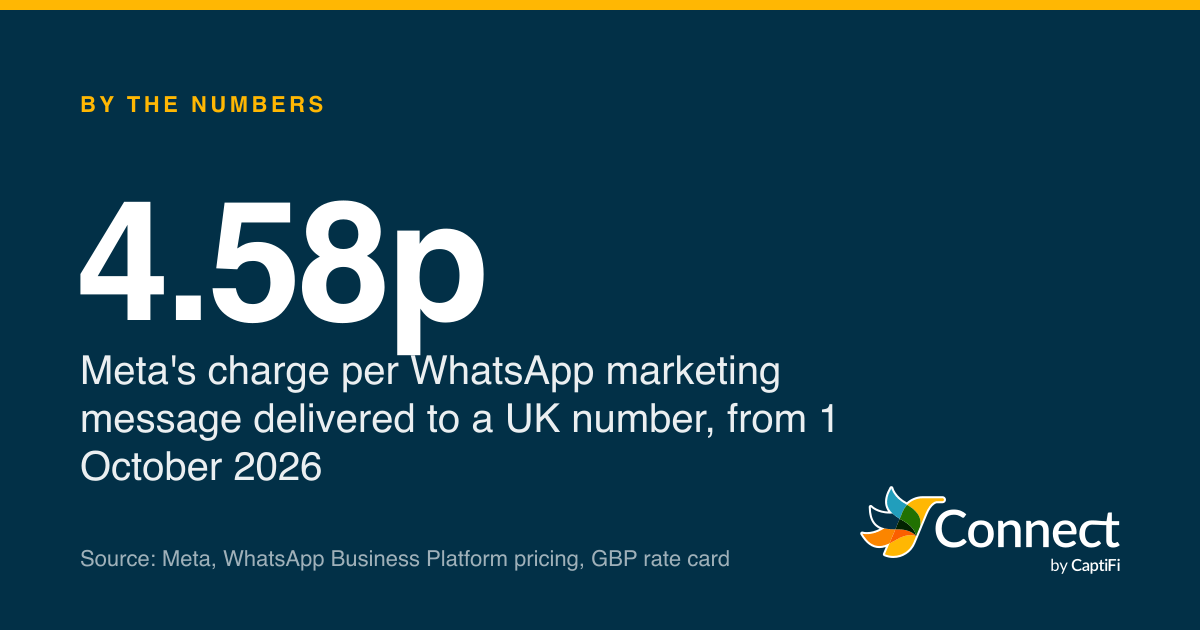
4.58p: Meta's charge per WhatsApp marketing message delivered to a UK number, from 1 October 2026. Source: Meta, WhatsApp Business Platform pricing, GBP rate card.
Meta's sterling rate card for the WhatsApp Business Platform, in force from 1 October 2026, charges 4.58p for each marketing message delivered to a UK number and 1.59p for a utility, authentication or service message. That puts a WhatsApp marketing message in the same price range as a business text. Reach is where the two part company. Ofcom's Online Nation 2025 report found 90% of UK online adults used WhatsApp in May 2025, but on our reading of Ofcom's March 2026 Technology Tracker about 69% of UK adults had received a text from an organisation in the previous three months, against about 26% who had heard from one on WhatsApp.
CaptiFi Connect sends SMS only, so on WhatsApp we're working from the same public pages you can read: Meta's pricing documentation, WhatsApp's Business Messaging Policy and Ofcom's research. Both channels have a place, and the rules for each differ more than the prices do.
How many people use WhatsApp?
Nearly everyone online. Online Nation 2025, published on 10 December 2025, uses Ipsos audience measurement of UK internet users aged 18 and over. WhatsApp reached 90% of them in May 2025, 44.2 million people, up from 87% in 2024 and 86% in 2023. Daily use is high too: on an average day in May 2025, 74% of UK online adults (36.1 million) opened WhatsApp, up from 64% a year earlier, and they spent about 17 minutes a day in it. Facebook Messenger was second among messaging services at 58%, and falling.
The base matters, though. Those are shares of adults who are online, and the Ofcom survey that covers everyone is the Technology Tracker, run by Ipsos with 4,033 adults aged 16 and over in March 2026. It only asked about WhatsApp if a person had used the internet to message or call, so we've divided Ofcom's weighted counts by all adults to get a whole-population figure. On that basis about 69% of UK adults had used WhatsApp in the previous three months. On the same basis, 94% had sent or received a text through their mobile network.
The gap widens with age. Among 16 to 24 year olds it's 96% for texts and about 74% for WhatsApp. Among over-75s it's 77% for texts and about 38% for WhatsApp. Ofcom's Adults' Media Use and Attitudes report, published on 2 April 2026, makes the same point from another angle: WhatsApp "has consistently high use across all ages", with 81% of social media users aged 16 to 24 on it and 78% of those aged 75 and over. But only 68% of internet users aged 75 and over use social media at all, and not every over-75 is online in the first place. So WhatsApp is popular with the older people who use it, and plenty of them don't.
Who hears from businesses on each one?
The Technology Tracker asks a sharper question too. People who'd had a text in the previous three months were asked whether any came from organisations or businesses, and 74% said yes. People who used messaging apps were asked through which app they'd had correspondence from organisations or businesses, and 36% named WhatsApp. Turned into shares of all adults, that's about 69% who'd had a text from an organisation and about 26% who'd heard from one on WhatsApp.
- By text message
- On WhatsApp
Our calculation: Ofcom's weighted counts for each answer divided by all adults in the age group, rounded to whole numbers. Ipsos fieldwork in March 2026, 4,033 UK adults aged 16 and over.
Source: Ofcom, Technology Tracker 2026 core data tables (questions QM15 and QE24)
See the figures as a table
| By text message (%) | On WhatsApp (%) | |
|---|---|---|
| All adults | 69 | 26 |
| 16 to 24 | 59 | 30 |
| 25 to 44 | 70 | 31 |
| 45 to 64 | 78 | 29 |
| 65 to 74 | 67 | 17 |
| 75 and over | 50 | 9 |
The pattern holds in every age group. It's closest among 16 to 24 year olds (about 59% against 30%) and widest at the top, where about half of over-75s had a text from an organisation and fewer than one in ten had a WhatsApp message from one. WhatsApp is where people talk to each other, and texts are still where organisations reach them. That could change, and the youngest group suggests which way it might drift, but it's where things stood in March 2026.
What does Meta charge?
Meta moved the WhatsApp Business Platform from conversation-based pricing to per-message pricing on 1 July 2025. Its pricing page says a business is charged only when a message is delivered, at a rate set by two things: the message category and the country code of the person receiving it. A business starting a conversation has to use an approved template, and every template falls into one of three categories: marketing, utility (an order update, say) or authentication (a sign-in code). Free-form replies are service messages, and they can only be sent inside a 24-hour customer service window that opens each time the customer messages you.
Meta's sterling rate card for the United Kingdom, effective 1 October 2026, charges £0.0458 for a marketing message and £0.0159 for each of the other three categories. Utility and authentication messages get volume discounts in tiers (above 100,000 utility messages a month, in the UK's case). Meta doesn't charge for messages a customer sends to a business.
Meta's list rates in sterling for the United Kingdom market, converted from pounds to pence. Utility and authentication rates fall in volume tiers above 100,000 and 300,000 messages a month respectively.
Source: Meta, Pricing on the WhatsApp Business Platform, GBP list rates effective 1 October 2026
See the figures as a table
| Pence per message (p) | |
|---|---|
| Marketing | 4.58 |
| Utility | 1.59 |
| Authentication | 1.59 |
| Service (after 1,000 a month) | 1.59 |
The same date brought a bigger change for anyone using WhatsApp for customer service. From 1 October 2026 each business phone number gets 1,000 free service messages a month, with no roll-over, and Meta charges from the 1,001st. Utility messages sent inside the customer service window, which had been free since July 2025, are now charged too. Eligible government bodies and non-profits keep free service messages until 31 December 2027. There's one other free route: when someone messages you from a click-to-WhatsApp ad, a "free entry point" window opens for up to seven days, and Meta doesn't charge for marketing, utility, authentication or service messages while it lasts.
Prices move. Meta's own pricing calendar, published in September 2025, says rates can change on the first day of any quarter, with a month's notice for a rate change, and the UK marketing rate went up on 1 July 2026. Those are also only Meta's charges. If you reach the platform through a provider, whatever the provider charges sits on top.
One structural difference from SMS is length. A text is billed in parts of 160 standard characters, or 70 once an emoji or accent forces Unicode (the SMS character limit guide has the arithmetic), so a long text costs more. Meta's rate card has no length bands: one message, one charge.
What does WhatsApp's policy allow?
WhatsApp's Business Messaging Policy, last updated on 23 September 2026, sets out the permission rule in one sentence:
You may only contact people on WhatsApp if: (a) they have given you their mobile phone number or username; and (b) you have received opt-in permission from the recipient confirming that they wish to receive subsequent messages or calls from you.
It adds that you must respect requests to opt out "either on or off WhatsApp", that conversations can only be started with an approved template, and that Meta can "review, approve, pause and reject any Message Template at any time". Automated replies are allowed inside the 24-hour window as long as there's a clear escalation route, such as a transfer to a person, a phone number or an email address. The policy's best practice section goes further and suggests a separate opt-in for each category of message.
UK law sits on top of that. The ICO's guidance on electronic mail marketing under PECR defines electronic mail as "any text, voice, sound or image message sent over a public electronic communications network" and says the same rule covers "direct messages via social media". WhatsApp isn't named, but we'd treat a WhatsApp marketing message exactly as we'd treat a text: it needs specific consent, or the soft opt-in for existing customers, with a simple way to opt out every time. Our guide to SMS marketing rules covers how that works.
Then there's what you're selling. The policy lists alcohol, over-the-counter drugs and online gambling as regulated verticals that can only be promoted on the Business Platform in named countries, and the United Kingdom isn't on any of the three lists. The policy also bars using WhatsApp for Business to promote or facilitate payday loans or debt collection, "irrespective of the global or local licenses" a business holds. So a pub's cocktail offer, a pharmacy's hay fever promotion or a bookmaker's free bet can't go out on WhatsApp to UK customers under Meta's rules. Sent by text to people who've agreed to hear from you, the same offer is governed by PECR and the advertising codes (our post on the CAP code and promotional texts covers those), plus the Gambling Commission's rules for a bookmaker.
Where each one wins
| Question | WhatsApp Business Platform | SMS |
|---|---|---|
| UK adults using it in three months | About 69% (Ofcom data, our calculation) | 94% sent or received a text |
| Heard from an organisation on it | About 26% | About 69% |
| Marketing message to a UK number | 4.58p from Meta, plus any provider charge | Your provider's price per 160-character part |
| Who can start the conversation | The business, with an approved template | Either side, no template |
| Permission | UK law plus WhatsApp's opt-in rule | UK law |
| Alcohol promotions to UK customers | Not allowed under Meta's policy | Allowed with consent, under the CAP code |
WhatsApp is the better tool when the customer starts the conversation. Inside the 24-hour window you can reply as often as you like, the first 1,000 service messages a month on each number are free, and the customer's messages cost you nothing. A long order update costs Meta's 1.59p however long it runs, where a text of the same length would run to several parts, and WhatsApp can carry richer formats than a text, such as the media carousels in Meta's own pricing examples. If your customers already message you on WhatsApp, meet them there.
A text is the better tool for reaching everyone on your list, especially anyone over 65, and for anything you send first without waiting to be asked. It needs no template approval and no platform policy decides which products you can mention. It also arrives on phones that can't run apps: 18% of over-75s with a mobile at home had no smartphone in the house in Ofcom's March 2026 survey.
Running both without doubling up
Most businesses that use WhatsApp will still text, so a few habits help. Collect the mobile number once and record which channels the customer agreed to, with the date and wording, since WhatsApp expects its own opt-in and PECR expects consent you can show. Send the time-critical message (the appointment tomorrow, the table at eight) by text, because that reaches the most people, and offer WhatsApp for the back-and-forth if the customer wants it. Never send the same promotion on both. And treat an opt-out on one channel as covering the other unless the customer tells you otherwise, which is the safer reading of WhatsApp's "on or off WhatsApp" wording.
CaptiFi Connect sends SMS to UK mobiles only (the UK, Guernsey, Jersey and the Isle of Man) and doesn't offer WhatsApp. Packs run from 500 credits for £25 (5p a text) to 20,000 credits for £700 (3.5p a text) with no VAT added, replies cost nothing to receive, and a STOP reply to a text sent from a number opts the customer out automatically; the two-way SMS page shows the inbox.
Meta's next chance to change its UK rates is 1 January 2027, with at least a month's notice under its own calendar. The next Technology Tracker should show whether that 69% to 26% gap is closing.
Sources
Read for this post on 22 October 2026.
- Meta: Pricing on the WhatsApp Business Platform, with GBP rate card and volume tiers effective 1 October 2026
- WhatsApp: Business Messaging Policy, last updated 23 September 2026
- Ofcom: Online Nation 2025, published 10 December 2025
- Ofcom: Technology Tracker 2026, core data tables
- Ofcom: Adults' Media Use and Attitudes report, 2 April 2026
- ICO: Guide to PECR, electronic mail marketing
Written by the CaptiFi Connect team. Published 22 October 2026. More in By the numbers
Send your first text this week
Set up your account and contacts now. Until we've approved it, a person reads each text before it goes out.